


When eCommerce sales slow down, fixed loan payments can create serious cash flow problems. Traditional loans require the same payment every month, even if your revenue drops significantly. This can force tough decisions, like delaying inventory purchases or cutting back on staff.
Variable repayment offers a solution. Instead of fixed payments, you repay a percentage of your sales. If sales dip, your payment goes down too. For example, with a 10% repayment rate, $10,000 in sales means a $1,000 payment. If sales drop to $5,000, your payment adjusts to $500, easing financial strain.
Key Benefits of Variable Repayment:
- Payments adjust to sales, reducing pressure during slow periods.
- No collateral or personal guarantees required.
- Faster access to funds - often within 24 hours.
- Flat fees (e.g., 6–12%) instead of compounding interest.
This model minimizes financial risk, helps maintain operations, and avoids the vicious cycle of cutting back during slow weeks. Tools like Onramp Funds integrate directly with platforms like Shopify and Amazon to automate repayment calculations, making it a practical option for U.S. eCommerce businesses.
The Problem: Fixed Repayments Create Cash Flow Pressure
How Fixed Repayments Affect Cash Flow
Traditional bank loans come with fixed repayment schedules that don’t adjust for fluctuations in sales, whether seasonal or unexpected [6]. This creates a disconnect between revenue and repayment obligations. Take this example: an eCommerce retailer with average monthly sales of $50,000 secures a $100,000 term loan requiring $4,000 in fixed monthly payments. During a post-holiday slump, sales drop to $20,000. Suddenly, that $4,000 payment eats up 20% of the reduced revenue, leaving little room for essential expenses like inventory restocking. This leads to stockouts, further compounding the problem [5].
In fact, during slower weeks, fixed repayments can consume anywhere from 20% to 50% of revenue, leaving businesses with minimal funds to cover operating costs. The rigidity of fixed payments forces businesses to prioritize debt repayment over reinvestment. When revenues drop by 30% to 50%, companies are often left with no choice but to cut back on critical spending like advertising or inventory purchases. This creates a vicious cycle, where reduced investment makes recovery even harder, putting the business at greater risk.
Business Risks from Inflexible Payment Terms
The challenges of fixed repayments don’t stop at cash flow constraints - they can lead to broader operational disruptions. When cash is tied up in loan payments, businesses may struggle to pay suppliers on time. This disrupts the supply chain, delaying the procurement of goods, especially imported ones [4]. The result? Order fulfillment issues, customer cancellations, and negative reviews on platforms like Shopify, which can damage a retailer’s reputation.
Fixed repayment structures also mean missed growth opportunities. For instance, a business might forgo a 20% discount on a $10,000 bulk inventory order because it lacks the liquidity to take advantage of the deal. Similarly, scaling advertising during high-demand periods becomes nearly impossible, further limiting revenue potential. Research shows that eCommerce businesses with fixed loan obligations experience 25% to 40% higher default rates during sales slumps. Worse still, inflexible terms can double or even triple the risk of default during slow periods, leading to penalties or even asset seizures [2].
These risks highlight the importance of repayment structures that adapt to fluctuating sales, allowing businesses to navigate slow weeks without compromising their operations or long-term stability.
sbb-itb-d7b5115
The Solution: Variable Repayment Adjusts to Your Sales
What Variable Repayment Means
Variable repayment swaps out fixed payments for a model that adjusts based on your revenue. Instead of a set amount, you pay a percentage of your sales, which means payments shrink during slower weeks and grow when business picks up. This approach helps smooth out cash flow challenges.
Here’s an example: A Shopify seller takes a $100,000 loan with a 10% repayment rate. If they make $50,000 in sales, they repay $5,000. If sales drop to $20,000, the repayment falls to $2,000. On top of this, there’s a fee of 6–12%, so the total repayment could reach up to $112,000 [3]. This flexibility is designed to align with the ups and downs of eCommerce businesses, offering a financing option that adjusts alongside your sales.
Why Revenue-Based Financing Works for eCommerce
Revenue-based financing is ideal for eCommerce businesses because it minimizes risk during tough times. Unlike fixed-payment loans, this model ties repayments directly to your actual sales, providing relief when sales are slow. It’s a game-changer for businesses that deal with unpredictable factors like algorithm changes, supply chain hiccups, or seasonal demand shifts.
Typically, repayments range from 5% to 25% of your monthly revenue, easing financial strain during slow periods while increasing repayments as sales grow. The process is streamlined, too - repayments are calculated automatically from your sales data. Funding decisions are often made within 24 hours, with amounts ranging from $10,000 to $5,000,000 [3]. Unlike traditional loans with fixed obligations, this model adapts to your revenue, helping you keep operations running smoothly even during uncertain sales cycles.
How To Fund Your Ecommerce Business For Cheap (Or Even Free)
How Onramp Funds Revenue-Based Repayment Works
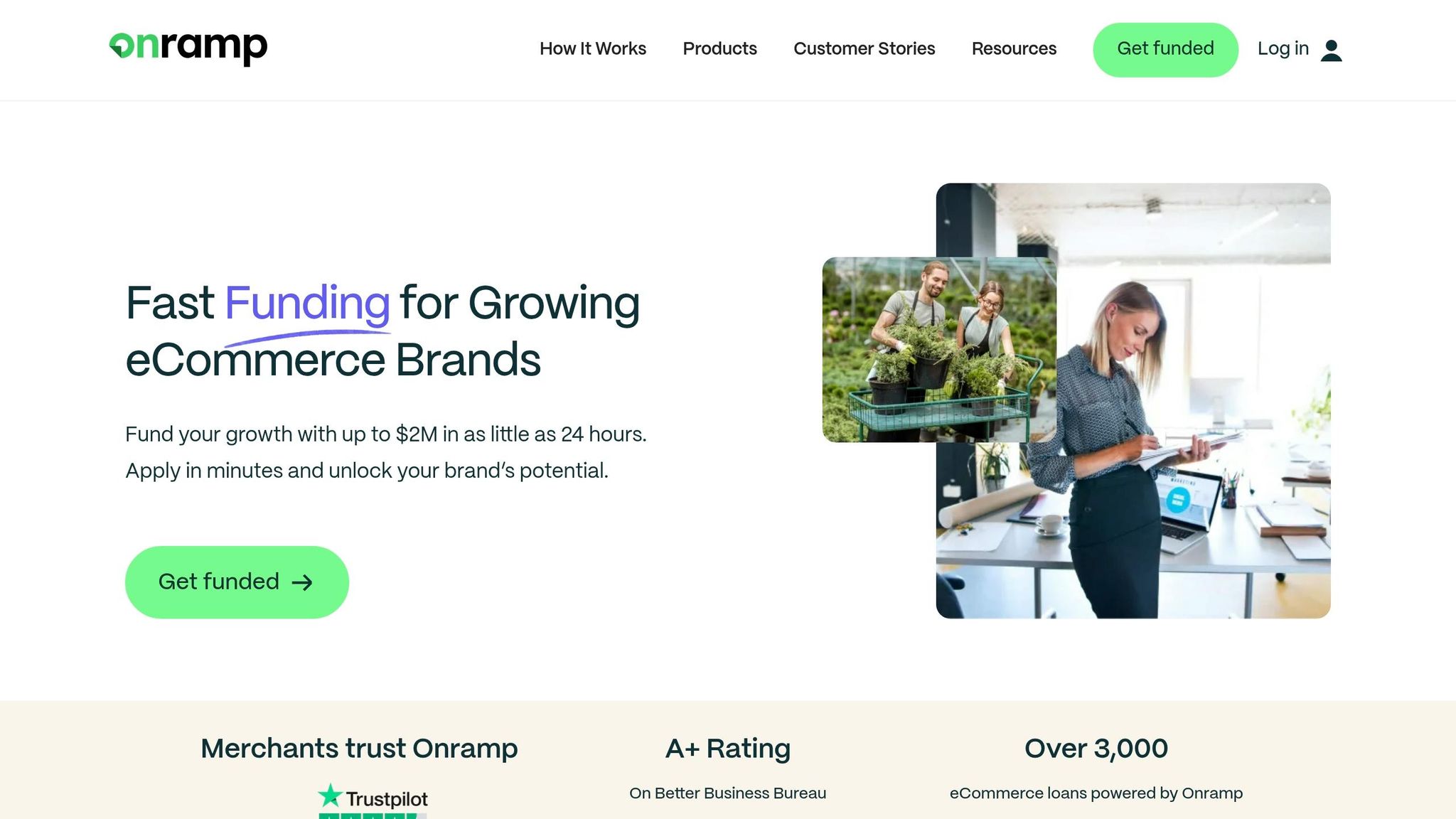

Direct Integration with Your Sales Channels
Onramp Funds connects directly to your eCommerce platforms like Amazon, Shopify, Walmart, BigCommerce, WooCommerce, Squarespace, and TikTok Shop. This connection allows them to pull live sales data, enabling automated repayment adjustments based on your actual sales performance [1][7]. Forget about manually reporting sales - Onramp’s AI-driven tools handle everything, ensuring repayments match your business's current performance.
The process is quick and straightforward. In just about 5 minutes, you can link your store, and Onramp’s AI will analyze your data. Funding offers, ranging from $10,000 to $2,000,000, are often delivered within 24 hours to 7 days. Once you accept an offer, funds can land in your account in under 24 hours. This real-time integration ensures repayment terms are tailored to your sales, giving you flexibility and peace of mind.
Flexible Repayment Terms with No Hidden Fees
Repayments are determined as a percentage of your daily sales, starting as low as 1%. For example, if your sales drop from $5,000 to $1,000, a 1% repayment rate means your payment adjusts from $50 to $10. This ensures repayments align with your cash flow, avoiding financial strain. Plus, there are no monthly minimums or surprise fees.
Onramp uses a flat fee structure, typically between 2% and 8% of the funded amount. For instance, a $100,000 advance would require a total repayment of around $102,000 to $108,000. There are no interest charges, hidden fees, or penalties if sales slow down, and you retain full ownership of your business since the financing is equity-free.
Fixed vs. Variable Repayment: A Side-by-Side Comparison
Let’s say your sales for the week are $3,000. With fixed repayment, a $1,000 payment would consume 33% of your revenue, leaving just $2,000 for essentials like inventory and advertising. On the other hand, a variable repayment at 5% would adjust to $150, leaving $2,850 available for operational needs. This flexibility helps keep your business running smoothly, even during slower sales periods.
Measured Benefits: Lower Risk with Onramp Funds
Reduced Default Risk During Sales Fluctuations
Onramp Funds' revenue-based financing model offers a smarter way to manage repayments, especially during unpredictable sales periods. Instead of sticking to fixed loan payments, repayments adjust automatically based on your revenue. This flexibility can cut default risk by 30–70% for businesses experiencing sales ups and downs[2][8].
Here’s how it works: Imagine your sales drop by 40% in a month. With a traditional loan, you’d still owe a fixed $5,000 repayment, even if your revenue is significantly reduced. But with Onramp Funds, repayments scale with your income. For example, if your revenue falls by $20,000 and you’re on a 10% repayment plan, your payment drops to $2,000 instead. This approach doesn’t just reduce risks on paper - it ensures your business has the cash flow to handle day-to-day operations.
Practical Example: Keeping Your Business Running
Let’s break it down further with a real-world scenario. Picture an apparel eCommerce store that usually pulls in $100,000 a month but sees sales dip to $60,000 after the holidays. The store takes a $20,000 advance from Onramp Funds with a 10% repayment rate. Instead of being locked into a $10,000 repayment, the owner only pays $6,000 based on actual sales, keeping an extra $4,000 available for crucial expenses like stocking inventory or running marketing campaigns.
This adaptable repayment model doesn’t just help businesses survive slow periods - it creates room for growth. Whether it’s preparing for the next big sales season or investing in strategies to bounce back, Onramp Funds’ approach ensures you can keep moving forward without the looming threat of default.
Conclusion
Managing cash flow during slower weeks doesn't have to put your business at risk. With Onramp Funds' variable repayment structures, eCommerce sellers gain the flexibility they need to navigate dips in sales - without being tied to rigid, fixed payments that ignore actual revenue.
The repayment model adjusts automatically based on your sales performance. When revenue slows, payments decrease, leaving more cash available for critical needs like restocking inventory, running ad campaigns, or covering daily expenses.
This approach has earned recognition from industry leaders.
"Repayments adjust automatically with fluctuations in revenue - rising when sales are strong and decreasing during slower periods."
- Eric Youngstrom, Founder and CEO, Onramp Funds
Onramp Funds provides capital advances ranging from $10,000 to $3,000,000, with a clear flat fee structure of 6% to 13%. There are no hidden costs or early repayment penalties.
The result? Better cash flow management, reduced default risk, and uninterrupted business operations. It's financing designed to work the way eCommerce actually functions.
FAQs
How is my repayment percentage set?
In a revenue-based model, your repayment is directly linked to your sales revenue instead of being a fixed amount. You pay back a specific percentage of your monthly sales, which adjusts according to your performance. For example, with a 10% repayment rate and $30,000 in sales, you'd repay $3,000. If sales dip during slower periods, your repayment decreases proportionally, providing flexibility and reducing financial pressure.
What happens if my sales drop to $0?
If your sales hit $0, your revenue-based repayment automatically drops to zero too. Since payments are directly linked to your sales, you won’t owe anything during periods without revenue. This setup eases financial pressure and helps you maintain cash flow until your sales pick up again.
Can I pay off early to reduce the flat fee?
Yes, with revenue-based financing, you have the option to pay off early and reduce the flat fee. Many repayment models, like those offered by Onramp Funds, don’t penalize you for settling your balance ahead of schedule. Since repayments are usually tied to a percentage of your sales, paying off sooner can help lower your total costs without any additional charges.
Related Blog Posts
Onramp Funds
Funding built around your sales
Connect your store and see what you qualify for. Repay as a percentage of sales, with no personal credit check.
Funding in as little as 24 hours.
