

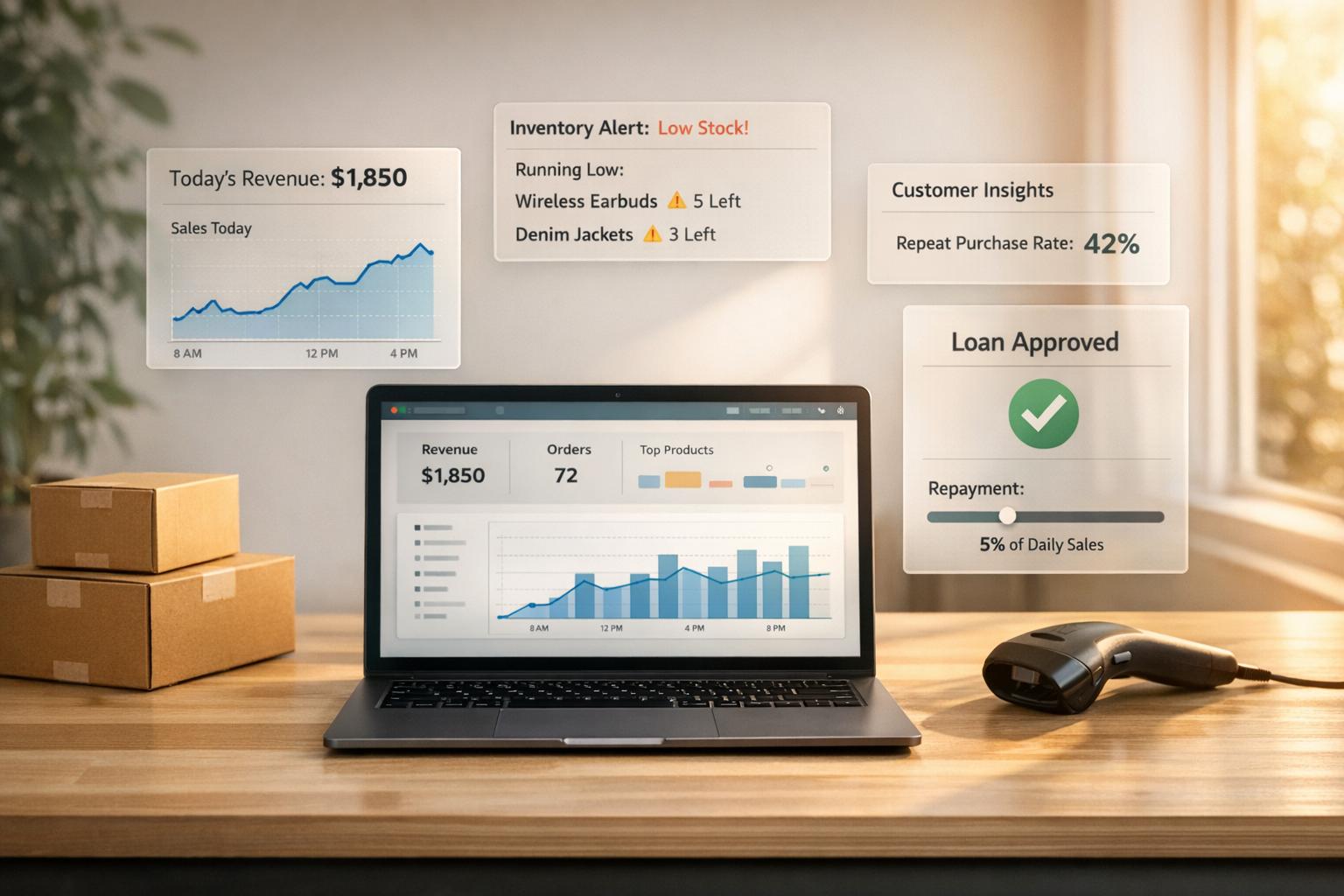
eCommerce sellers face unique challenges when securing funding. Unlike traditional businesses, their success hinges on platform-specific metrics like sales trends, customer reviews, and inventory turnover - not credit scores or tax returns. Lenders now leverage real-time data from platforms like Shopify, Amazon, and TikTok Shop to make faster, more tailored financing decisions.
Key Takeaways:
- Faster Approvals: Real-time data allows lenders to approve loans in under 24 hours.
- Flexible Repayments: Revenue-based financing adjusts payments based on daily sales.
- Metrics That Matter: Monthly sales ($10,000+), order defect rates, inventory turnover, and customer retention rates are critical.
- API Integrations: Direct connections to sales platforms simplify and speed up the process.
- Better Terms: Strong metrics can lead to lower interest rates and higher funding limits.
By understanding and optimizing these metrics, eCommerce sellers can secure funding that aligns with their business needs, ensuring smoother cash flow and growth opportunities.
The Rise of E-Commerce Lending: A Conversation with Eric Youngstrom
How Lenders Evaluate eCommerce Businesses Using Platform Data

When applying for eCommerce financing, lenders take a different approach compared to traditional banks. Instead of focusing on credit scores or requiring collateral, they connect directly to your sales platforms - like Shopify, Amazon Seller Central, or TikTok Shop - to analyze your operational data. This direct connection provides insights into how your business is performing on a day-to-day basis.
Lenders rely on real-time data such as monthly revenue trends (spanning 3–12 months), inventory turnover rates, and product seasonality to gauge operational risk. They also pay close attention to metrics like your Order Defect Rate (ODR), late shipment percentages, and customer feedback scores, as these can highlight potential risks that might affect your ability to repay the loan.
"Unlike traditional lenders who focus on credit scores and collateral, eCommerce-focused funders use real-time performance data to assess risk and approve capital." - Onramp Funds [1]
To qualify for significant capital, most lenders typically require at least $10,000 in monthly sales and a selling history of 6–12 months [1]. They also evaluate your product mix. Businesses that offer a variety of SKUs and generate revenue across multiple platforms - such as Amazon, Walmart, and Shopify - are often seen as lower-risk and may qualify for larger funding amounts. In contrast, single-product businesses may face more scrutiny.
Key Metrics Lenders Review
Here's a breakdown of the primary metrics lenders analyze and why they matter:
| Metric Category | Specific Data Points | Why Lenders Care |
|---|---|---|
| Sales Performance | Monthly volume, growth trends, sales velocity | Confirms consistent revenue generation for repayment |
| Account Health | Order Defect Rate, late shipments, customer reviews | Highlights operational reliability and suspension risks |
| Product Portfolio | SKU concentration, seasonal vs. evergreen mix, fulfillment method | Assesses revenue stability and inventory risk |
| Marketing Efficiency | Customer acquisition cost, marketing ROI | Shows how effectively capital is driving business growth |
These metrics are collected through API integrations, which make the process faster and more accurate.
API Integrations for Real-Time Data Access
Modern eCommerce lenders use API connections to link directly to your sales platforms. Once you grant permission, these integrations pull data from platforms like Shopify, Amazon, or TikTok Shop, giving lenders access to details like transactions, inventory levels, and payout history.
This automated, API-driven system simplifies the approval process by verifying data in real time [1]. Instead of relying on older methods like reviewing tax returns, lenders make decisions based on your current performance metrics.
Another advantage of this approach is that repayments are tied to your daily revenue. Through API integration, lenders can automatically adjust your payments based on how much revenue you generate each day. If sales slow down, your payments decrease proportionally, helping to maintain your cash flow.
"The more transparent and frequent your cash flow, the lower your perceived risk." - Onramp Funds [1]
Platform Metrics That Affect Lending Decisions
Sales Performance and Growth Patterns
When lenders evaluate your business for financing, they take a close look at your sales performance. Consistent monthly revenue and year-over-year growth in the range of 20%–50% can open the door to loans between $50,000 and $500,000.
One key metric that lenders scrutinize is your average order value (AOV). If your AOV is above $50 to $100, it signals that your business is attracting higher-value customers and has the potential to scale. This can boost your chances of securing loans worth 50% to 80% of your monthly revenue. On the flip side, a stagnant or declining AOV might suggest challenges like market saturation or pricing issues, potentially raising red flags for lenders.
Another critical factor is your customer retention rate. A repeat purchase rate of 30%–40% shows stable and predictable revenue, which can reduce your interest rates by 1–2 percentage points. However, if your retention rate dips below 20%, lenders may impose stricter terms or even deny financing altogether. High churn often indicates that your business might struggle to maintain consistent cash flow, making repayment less reliable.
While these sales metrics highlight market demand, lenders also pay attention to how well you manage your inventory, as it reflects your operational efficiency.
Inventory Turnover and Cash Flow Management
Efficient inventory management is a cornerstone of maintaining healthy cash flow, and lenders rely on this data to assess your financial stability. Your inventory turnover ratio - how often you sell and replace stock - plays a significant role. Businesses that turn over inventory 4 to 6 times annually, with a days sales of inventory (DSI) under 60 days, are seen as efficient. Meeting these benchmarks can qualify you for credit lines worth up to 20% of your annual sales. A fast turnover rate shows that your cash isn't tied up in unsold products, which lowers the risk of repayment issues.
Inventory management directly impacts your cash flow. For eCommerce businesses, cash gaps of 15 to 90 days are common because expenses like supplier payments, ad costs, and fulfillment fees often come before marketplace payouts arrive [6]. Lenders look favorably on platforms that show real-time inventory data, maintain stockout rates below 5%, and keep optimal stock levels. If your inventory turnover exceeds 5 times per year, you may qualify for 20% to 30% higher funding limits compared to businesses with slower-moving inventory.
Another critical metric is your cash conversion cycle, which measures how quickly your business turns inventory investments into cash. If your cycle is under 45 days, you're more likely to secure lines of credit at competitive rates, such as prime rate plus 2%. However, businesses with longer or more volatile cycles often face higher interest rates or are directed toward merchant cash advances instead. Faster cash conversion not only improves your financial flexibility but also makes you a more attractive candidate for favorable financing options.
How to Optimize Your Platform Data for Better Financing
Improving Key Metrics Before Applying
When applying for financing, your platform data needs to clearly showcase your business's performance. One key factor is maintaining stable and consistent monthly sales patterns. Lenders tend to favor businesses with steady or upward revenue trends over a 3-to-12-month period rather than those with unpredictable spikes or dips[1]. If your sales are all over the place, it's often better to wait until you can demonstrate a period of stable growth before submitting your application.
Beyond sales, your account health metrics play a critical role. For example, on Amazon, lenders often evaluate your Order Defect Rate (ODR) and late shipment rates to gauge your operational reliability[1]. A low defect rate signals that your business is well-managed and less likely to experience disruptions that could interfere with repayment. To improve these metrics, focus on reducing chargebacks by ensuring accurate product descriptions, clear return policies, and responsive customer service.
Another important factor is inventory diversification. Lenders typically prefer businesses that rely on a variety of products rather than being overly dependent on a single SKU or seasonal items[1]. If most of your revenue comes from one product, think about expanding your catalog to reduce risk. This approach helps protect your overall performance if one product underperforms. Using dynamic inventory tracking tools can also help you maintain real-time stock accuracy, minimizing the chance of sales interruptions[5].
Lastly, ensure your business structure is formalized. Most lenders require you to have a verified entity, such as an LLC or S-corp, along with at least 6 to 12 months of active selling history on your platform[1]. If you sell on multiple channels like Amazon, Shopify, Walmart, or TikTok Shop, linking these accounts can provide lenders with a more comprehensive view of your cash flow.
Strong metrics are essential, but combining them with a solid digital presence can make your business even more appealing to lenders.
Maintaining a Consistent Digital Presence
In addition to optimizing your metrics, having a professional and consistent digital presence can significantly boost your credibility. Customer reviews and ratings act as social proof, showcasing the quality of your products and customer satisfaction. Positive feedback and low return rates indicate that your business has found a good product-market fit, which translates to more reliable revenue streams. If your ratings have dropped, take the time to address customer concerns and improve satisfaction before applying for financing.
Another key aspect is professional branding. Consistency across all your sales channels - whether Amazon, Shopify, or TikTok Shop - reflects business maturity. This includes using high-quality product photos, clear descriptions, and a cohesive brand identity. Lenders are more likely to view businesses with polished storefronts as credible and less risky.
Platform compliance is equally critical. Each marketplace has its own rules and standards. For instance, Amazon's seller requirements differ from Shopify's merchant policies or TikTok Shop's guidelines[3]. Any violations or warnings on your account could raise red flags during the financing process. Regularly check your compliance status and resolve any issues promptly. A clean record shows lenders that you operate responsibly within the rules.
Finally, make sure your financial records are in sync with your platform data. Automated reconciliation tools can help ensure your accounting system aligns with your marketplace reports, covering transactions, refunds, and chargebacks[5]. When lenders see that your financial records match your platform data, it builds trust in your financial management and can speed up the approval process.
How Data-Driven Lending Creates Flexible Financing Options
Revenue-Based Financing and Flexible Repayment
Using your platform data, lenders can offer financing that aligns with your sales cycles. Revenue-based financing (RBF) is one such option, where repayments are tied directly to your revenue - usually between 5% and 20%. This setup means you pay more during high-revenue months and less when sales slow down.
This flexibility is made possible through API integrations with platforms like Shopify, Amazon, and TikTok Shop. These integrations provide real-time sales data, allowing lenders to calculate repayments based on your current cash flow. For example, if you sell seasonal products and experience a slow month followed by a holiday surge, your repayment schedule adjusts accordingly. Instead of being stuck with fixed payments during leaner months, your repayments scale with your actual performance.
Take Amazon's seller financing as an example. It has helped sellers double their GMV by offering capital ahead of key restock periods, such as preparing for Black Friday with a major inventory purchase in September[3]. This repayment model not only protects your cash flow but also enables quicker access to the funds you need to grow.
Faster Approvals Through Real-Time Data
In addition to flexible repayments, real-time data significantly speeds up the approval process. Traditional bank loans often take weeks - sometimes up to six - to process, as they rely on manual reviews, credit checks, and collateral assessments. Data-driven eCommerce lending, on the other hand, uses metrics like sales volume and inventory turnover to streamline the process. By eliminating manual financial reviews, lenders can approve loans in hours or days, giving you the ability to act on opportunities that require quick decisions.
This faster underwriting process evaluates your creditworthiness based on how well your business is performing, rather than focusing solely on your personal credit score[1].
Data Security and Compliance in eCommerce Lending
Protecting Business Data
When it comes to eCommerce lending, safeguarding your business data is non-negotiable. Two key technologies play a major role here: encryption and tokenization. Encryption, often implemented via SSL/TLS certificates, ensures that data traveling between your eCommerce platform and the lender is scrambled and unreadable to unauthorized parties. Tokenization, on the other hand, swaps out sensitive information - like credit card numbers - with meaningless tokens, making it useless to hackers.
"Every e-commerce site should be using SSL, and that means using SSL certificates issued by a trusted certificate authority. Nobody should be sending payment data in plain text across the Internet."
- Phil Brass, Senior Evangelist and Technical Advisor, DirectDefense [7]
API integrations offer another layer of security by eliminating the need for manual file transfers. For example, linking your Shopify or Amazon account directly through an API ensures your data moves through encrypted channels, untouched by human hands. This reduces the risk of accidental leaks. Add multi-factor authentication (MFA) to the mix, and you've got even stronger protection. With cybercrimes involving stolen login credentials up by 71% in 2023 compared to the previous year, MFA is more important than ever [7].
Role-based access control (RBAC) further strengthens your defenses. By restricting data access based on job roles, you ensure employees can only access what they need to perform their tasks. As Simon Wijckmans, Founder and CEO of c/side, points out:
"If someone only needs to update product descriptions on their e-commerce site, they shouldn't be able to modify payment systems. When you combine this careful control over who can do what with active monitoring... you create a much stronger security position." [7]
These technical measures form the backbone of data protection, working hand-in-hand with compliance frameworks to keep your information secure.
Regulatory Compliance Requirements
Handling sensitive business data in eCommerce lending means navigating a maze of regulatory requirements. The Gramm-Leach-Bliley Act (GLBA) mandates that lenders clearly explain how they use your data and implement protective safeguards [8][10]. Meanwhile, the Fair Credit Reporting Act (FCRA) governs how credit information is collected and used in lending decisions. For those processing credit card data, compliance with PCI DSS is a must [7][8].
Before sharing your data with any lender, confirm their compliance with these standards. Certifications like SOC 2 provide assurance that a lender meets strict data security and privacy requirements. Additionally, consumer-permissioned data access ensures that your information is only viewed after you've given explicit consent. Lenders are required to provide clear documentation showing which data points are accessed and for what purpose.
The growing reliance on real-time cash flow data has raised the stakes for compliance. With 45 million Americans lacking traditional credit scores, many lenders now base decisions on platform metrics like sales, inventory, and customer behavior [10]. This approach aligns with data minimization principles, focusing only on the information necessary for the lending process [9]. By adhering to these practices, lenders not only comply with regulations but also build trust with their clients.
Conclusion
Platform data has completely changed how eCommerce sellers access funding. Instead of relying on traditional methods like credit scores or physical collateral, lenders now focus on real-time sales performance, inventory turnover, and customer behavior. This shift allows sellers with limited credit histories but strong platform metrics to secure funding that would typically be out of reach through conventional banks. This data-driven approach has already facilitated billions in financing for eCommerce businesses, proving its effectiveness. By understanding these metrics, sellers can open doors to better financing opportunities.
Lenders tend to prioritize specific metrics, such as monthly sales volume (often $10,000 or more), consistent growth trends, and operational reliability, which is reflected in low order defect rates and positive customer feedback[1][4]. Keeping accurate records and integrating multiple sales channels through APIs - which provide lenders with the real-time data they need - can position your business as a lower-risk borrower. This not only increases your chances of approval but also helps you secure terms where the total repayment cost could be as low as 5% of the borrowed amount[2].
Revenue-based financing is a prime example of how platform data can offer flexibility while protecting your cash flow. With repayments tied to daily sales, you avoid the pressure of fixed monthly payments, especially during slower periods. Plus, the speed of real-time data access means you can often get approval and funding in under 24 hours, allowing you to restock inventory or ramp up ad spending without delay[1][3]. However, this flexibility only works if you treat your data as a tool for strategic decision-making.
To maximize the potential of your platform data, focus on diversifying your product offerings and maintaining strong account health. These efforts not only build stability but also create opportunities for scalable growth. Your platform data isn't just a collection of numbers - it's a powerful foundation for growing your business while staying financially secure. By leveraging it wisely, you can navigate peak periods and sustain long-term success.
FAQs
How does real-time platform data speed up loan approvals for eCommerce businesses?
Real-time platform data gives lenders the ability to evaluate crucial business metrics like sales performance, growth trends, and account health without the hassle of manual paperwork or drawn-out credit checks. This efficient approach can shrink approval times from weeks to mere hours.
By tapping into data directly from platforms such as Shopify, Amazon, or TikTok Shop, lenders get an accurate, up-to-the-minute snapshot of your business. This insight allows them to craft financing options that align with your specific needs, giving you quicker access to the funds required to manage cash flow and drive business growth.
What metrics should eCommerce sellers focus on to get better financing terms?
To secure better financing terms, eCommerce sellers should focus on the key metrics lenders use to assess business health and repayment ability. Here's what to keep in mind:
- Monthly revenue and consistency: Lenders typically look for a minimum of $10,000 in monthly sales. They also value steady or growing sales trends over the past 3–12 months.
- Sales growth and inventory turnover: Month-over-month growth and quick inventory turnover suggest a business that's thriving and scalable.
- Platform-specific performance: Metrics such as customer feedback, order defect rates, and on-time shipping are crucial for marketplace sellers, as they highlight operational reliability.
- Transaction volume: A steady daily order count - 10 or more orders per day - is a strong indicator of consistent buyer demand.
- Cash flow and debt management: A working capital ratio of 1.2 or higher, combined with manageable debt levels, gives lenders confidence in a seller's ability to repay loans.
By closely monitoring these metrics and ensuring accurate data through platform integrations, sellers can strengthen their credit profile. This not only improves their chances of securing financing but also helps them negotiate terms that align with their business goals.
What makes revenue-based financing a flexible option for eCommerce businesses?
Revenue-based financing (RBF) gives eCommerce businesses a repayment model that adapts to their sales performance. Instead of dealing with fixed monthly payments, businesses repay a percentage of their monthly revenue. For instance, if sales hit $50,000 in a month, 5% of that would mean a $2,500 repayment. But if sales drop to $20,000, that same 5% would only be $1,000. This setup eases financial pressure during slower months and helps maintain better cash flow.
Repayments are tied directly to real-time sales data from platforms like Shopify, Amazon, or TikTok Shop. This allows lenders to approve and disburse funds quickly - often within 24 to 72 hours. Businesses can use this funding for essentials like inventory, marketing, or day-to-day operations. Plus, they keep full ownership of their business, as RBF doesn't require giving up equity or signing personal guarantees.
Thanks to its flexible repayment terms and quick access to funds, RBF is an excellent option for eCommerce businesses dealing with seasonal sales swings or experiencing fast growth. It provides the resources to scale effectively without the stress of rigid loan conditions.
Related Blog Posts
Onramp Funds
Funding built around your sales
Connect your store and see what you qualify for. Repay as a percentage of sales, with no personal credit check.
Funding in as little as 24 hours.
