


When seeking financing for your eCommerce business, lenders focus on two main areas: financial performance and business efficiency. They evaluate your cash flow stability, sales trends, and credit health to ensure you can handle repayments. Operational factors like inventory turnover, customer acquisition costs, and platform performance also play a critical role.
Key takeaways:
- Monthly sales benchmarks: Typically $5,000–$15,000, depending on the lender.
- Revenue-based financing: Repayments tied to sales, ideal for businesses with fluctuating revenue.
- Credit scores: A score of 600+ is often required, though strong sales can offset minor credit issues.
- Operational metrics: Efficient inventory management, low return rates, and strong customer retention improve funding chances.
- Preparation tips: Provide 24–36 months of financial records, maintain a cash reserve, and connect eCommerce accounts for real-time data access.
How To Fund Your Ecommerce Business For Cheap (Or Even Free)
Financial Metrics Lenders Evaluate
When lenders assess your eCommerce business for financing, they focus on three main financial areas: cash flow stability, revenue trends, and credit health. These metrics help them determine if your business can manage the loan and repay it consistently. Let’s break down each of these critical factors.
Cash Flow Stability
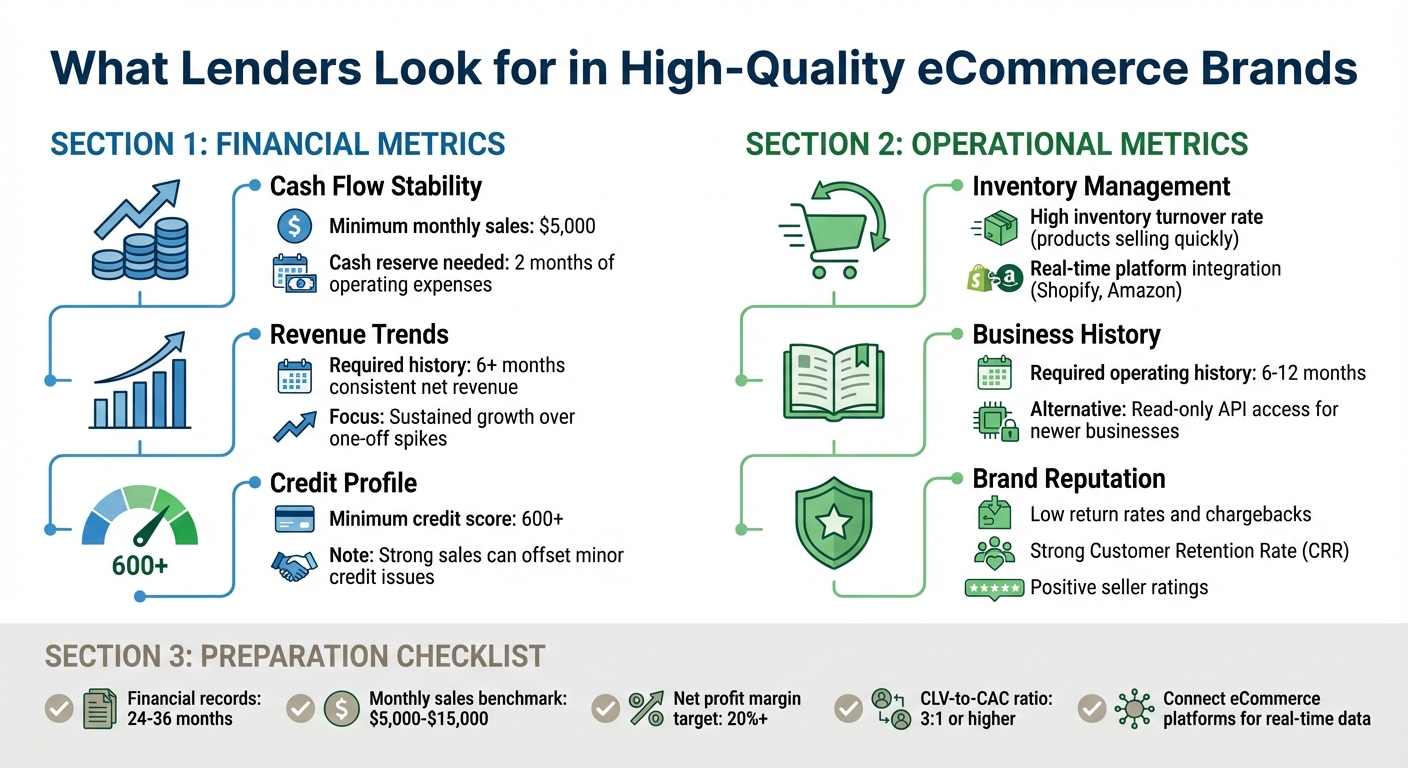
Lenders prioritize steady cash flow over unpredictable earnings. They typically require businesses to meet a minimum monthly sales benchmark, often around $5,000 [4]. This consistent cash flow reassures lenders that your business generates enough revenue to cover loan payments.
To verify this, lenders review your bank statements and eCommerce sales data. These records provide real-time insights into your transaction volume. Financial advisors often suggest keeping a cash reserve equal to at least two months of operating expenses as a safety net. Lenders take note of this buffer, as it signals your ability to weather unexpected financial challenges [1].
Revenue Trends and Growth
Sustained revenue growth carries more weight than one-off spikes. Lenders typically require at least six months of consistent net revenue - after accounting for returns and discounts - to evaluate your business’s growth trajectory and customer acquisition strategy [4].
They’ll also analyze your revenue by traffic source, looking for evidence that your marketing channels are delivering reliable results. This helps them gauge whether your approach to acquiring customers is built for the long haul.
Credit Profile and Financial Health
Even though revenue-based financing places heavy emphasis on sales history, your credit profile is still a key factor. For traditional loans or SBA-backed financing, lenders usually expect a personal and business credit score of 600 or higher [4]. They’ll also review your existing debt and debt-to-income ratio to ensure you’re not overleveraging.
Strong monthly revenue can sometimes balance out minor credit issues, but lenders take a comprehensive approach. They’ll weigh your credit health alongside your sales performance and operational efficiency to determine whether your business is ready for funding. Together, these insights shape their decision-making process.
Operational Metrics Lenders Review
When lenders evaluate your eCommerce business, they don’t just focus on your financial statements. They also dig into how well your business operates day-to-day. They want to see that your processes are efficient, scalable, and reliable. These operational metrics help them determine if your business is ready for growth capital and capable of meeting repayment obligations. Tightening up these areas can boost your chances of securing funding.
Inventory Management Efficiency
One of the first things lenders scrutinize is your inventory turnover rate. A high turnover rate signals that your products are selling quickly and that you're effectively reinvesting capital [12]. They also examine your sales velocity and historical trends to gauge how quickly you can generate revenue to repay financing.
Lenders often connect with platforms like Shopify or Amazon to access real-time data on sales and inventory levels [11][12]. They’ll also assess your logistics setup - this includes your warehousing, fulfillment processes, and the strength of your management team - as key indicators of operational reliability [9].
Another important factor is your relationships with suppliers. If you can pay suppliers upfront to secure discounts or priority production slots, it demonstrates a competitive edge [12]. To improve your standing with lenders, consider linking your platform accounts for full data transparency and using sales forecasting tools to maintain the right stock levels [11][12].
Business Age and Operating History
After reviewing your inventory management, lenders turn their attention to your business’s track record. Most require at least six to 12 months of operating history to confirm your business’s stability [8][10]. They’ll look at tax returns and platform data to ensure consistent sales over time. While traditional banks might prefer longer histories, eCommerce-focused lenders prioritize recent sales and revenue trends.
If your business is relatively new, you can still build trust by providing read-only API access to your store and bank accounts [13]. This allows lenders to view real-time financial data without needing years of documentation. Selling across multiple platforms can also give lenders a more comprehensive picture of your performance.
Brand Reputation and Platform Performance
Your brand’s reputation plays a key role in lender evaluations. They look closely at how customers perceive your business. High return rates and frequent chargebacks are major red flags, suggesting issues with fulfillment or customer satisfaction [14]. When you integrate platforms like Shopify, Amazon, or BigCommerce, lenders can access real-time data on order volume, return rates, and customer behavior to assess your operational stability [14].
Another metric lenders value is your Customer Retention Rate (CRR) [15]. A strong CRR shows that you’re building a loyal customer base rather than relying solely on new buyers. Positive seller ratings and reviews on platforms like Amazon or TikTok Shop further reinforce your credibility.
To improve your brand reputation before seeking funding, focus on reducing chargebacks and returns, engage personally with customer inquiries on social media and platform reviews, and link accounting tools like QuickBooks or Xero to give lenders a full view of your financial and operational health [14].
sbb-itb-d7b5115
How to Prepare Your eCommerce Brand for Funding
Now that you know what lenders look for, it's time to make sure your business is ready to shine. Preparing isn’t just about gathering paperwork - it’s about presenting your business in the best possible light. Taking the right steps before applying can boost your chances of approval and help you secure better terms. These steps also reinforce the operational and financial metrics we discussed earlier.
Review Your Financials and Sales Data
Start by pulling together 24–36 months of financial records, including profit and loss (P&L) statements, tax returns, and bank or payment processor statements [7]. These records allow lenders to evaluate your business's stability and growth over time. Most lenders look for businesses generating at least $5,000 in monthly sales, though some may require $12,000 monthly sales or $100,000 in annual revenue [4][5].
Beyond just revenue, calculate your normalized earnings using SDE (Seller’s Discretionary Earnings) or EBITDA (Earnings Before Interest, Taxes, Depreciation, and Amortization). For SDE, add back expenses like the owner’s salary, benefits, discretionary spending, one-off costs, and depreciation to your net income [7]. This gives lenders a clearer picture of your actual profitability.
You’ll also want to analyze your customer economics, especially your CLV-to-CAC ratio (Customer Lifetime Value to Customer Acquisition Cost). A ratio of 3:1 or higher indicates efficient marketing and a sustainable growth model [7]. For instance, if your CLV is $150 and your CAC is $40, your 3.75:1 ratio shows strong unit economics that lenders appreciate.
Don’t forget to check your credit profile. Most lenders require a credit score of 600 or higher [4]. Review your credit reports from all three major bureaus to ensure they’re accurate [18]. If your score isn’t where it needs to be, work on improving it by making timely payments and lowering your credit utilization before applying.
Improve Metrics That Lenders Value
Once your financials are in order, focus on improving the metrics that matter most to lenders. Address any revenue inconsistencies and work on improving your profit margins. Businesses with unpredictable revenue are less appealing to lenders since fixed loan payments can become a challenge [6]. If your business is seasonal, create a clear strategy to explain your revenue patterns - this can help lenders better understand your operations and increase your chances of approval [4].
Aim for a net profit margin above 20%, as this range tends to justify higher valuations [7]. If your margins are below this, look at cutting unnecessary operational costs or adjusting your pricing strategy. Margins under 5% can make it harder to secure favorable funding terms.
Another key area to focus on is your inventory turnover rate. High turnover shows that you’re efficiently converting inventory into revenue, which directly supports healthy cash flow.
Additionally, maintain a cash reserve that covers at least two months of operating expenses and work on reducing high-interest debt. This financial cushion demonstrates to lenders that you can handle short-term challenges without risking loan default [1].
Connect Your eCommerce Platform Accounts
Finally, ensure that your eCommerce accounts are fully integrated. Linking your platform accounts can streamline the funding process. Many modern lenders use read-only APIs to securely access your store data, allowing them to evaluate your real-time sales performance without requiring piles of paperwork [1][17]. This approach speeds up decisions and often results in more flexible terms based on your actual cash flow [16].
Be sure to connect accounts from all the platforms where you sell - Shopify, Amazon, Walmart, BigCommerce, WooCommerce, Squarespace, and TikTok Shop - so lenders can get a complete picture of your revenue streams [3]. Also, link your primary business bank account to enable smooth fund disbursement and automated repayments [1]. Automating these processes reduces errors and ensures lenders have an accurate view of your financial health [16].
Keeping these connections active ensures lenders can access live metrics like transaction volume, average order value, and customer lifetime value. This real-time transparency helps them better understand your growth patterns and seasonal trends, which can lead to more favorable funding offers tailored to your business's current performance rather than relying on outdated financial statements.
Conclusion
Securing funding for your business hinges on demonstrating solid financial health and operational efficiency. Lenders want to see consistent cash flow, accurate and up-to-date financial records, and inventory management that swiftly turns stock into revenue. Metrics like gross margins above 60% and a CLV-to-CAC ratio of 3:1 can showcase your brand as a low-risk, high-reward investment. These figures form the foundation for securing flexible, revenue-based financing.
Revenue-based financing options, such as those offered by Onramp Funds, provide an attractive alternative to traditional bank loans, especially for businesses with steady sales. With this model, repayment adjusts to your revenue - meaning you only pay when you make a sale. This flexibility is a game-changer for seasonal businesses or those experimenting with new marketing strategies. Approvals can happen in as little as two hours, and there’s no need to give up equity or provide collateral. It’s a financing solution designed to keep pace with the dynamic world of eCommerce [2].
To streamline the process, connect your eCommerce accounts and allow lenders secure, real-time access to your sales data. This transparency not only accelerates approvals but often leads to better terms based on your current performance rather than outdated financial reports. As Stephen Brown from LedgerGurus points out, maintaining clean financial records and healthy margins is key to securing the best funding terms [19].
FAQs
What financial factors do lenders consider when funding eCommerce businesses?
Lenders look at a few critical financial metrics when deciding if an eCommerce business qualifies for funding. These typically include consistent monthly revenue (usually a minimum of $10,000 per month), stable cash flow, sales history, and growth trends. They’ll also review any existing debt to get a clear picture of your business's financial health.
If you want to boost your chances of getting approved, focus on keeping your revenue steady, managing your inventory smartly, and practicing sound financial management. Lenders are more inclined to fund businesses that demonstrate reliability and a pattern of sustainable growth.
What steps can I take to improve my eCommerce brand's chances of getting funding?
To boost your eCommerce brand's chances of securing funding, start by presenting a clear and stable financial picture. Most lenders want to see at least 6–12 months of operating history, along with consistent monthly revenue of $10,000 or more. Keeping track of your sales trends, seasonal fluctuations, and cash flow is key to showing stability and minimizing perceived risk.
Make sure your financial documentation is thorough and well-organized. This should include tax returns, profit-and-loss statements, bank statements, and inventory reports. If you're selling on platforms like Amazon, Shopify, or Walmart, think about integrating their APIs. This allows lenders to access sales data directly, showcasing transparency and speeding up the approval process.
Operational efficiency is another important factor. Keep your inventory turnover lean to avoid unnecessary costs and aim for a working capital ratio of 1.2 or higher to prove you can manage short-term financial obligations. Highlight any recent growth milestones and be prepared to explain how the funding will help you scale. By combining sound financial practices, detailed documentation, and efficient operations, you can greatly enhance your chances of securing the funding you need.
How does revenue-based financing benefit eCommerce businesses?
Revenue-based financing is a fast way for eCommerce businesses to access capital while keeping repayment terms flexible. Unlike traditional loans with fixed monthly payments, this approach ties repayments to your sales. That means during slower months, you pay less, giving you breathing room to manage your cash flow more effectively.
With this financing option, you maintain 100% ownership of your business - there’s no need to give up equity or provide personal guarantees. By syncing repayments with your revenue, it reduces financial pressure and supports your business’s growth at a pace that works for you.
Related Blog Posts
Onramp Funds
Funding built around your sales
Connect your store and see what you qualify for. Repay as a percentage of sales, with no personal credit check.
Funding in as little as 24 hours.
