

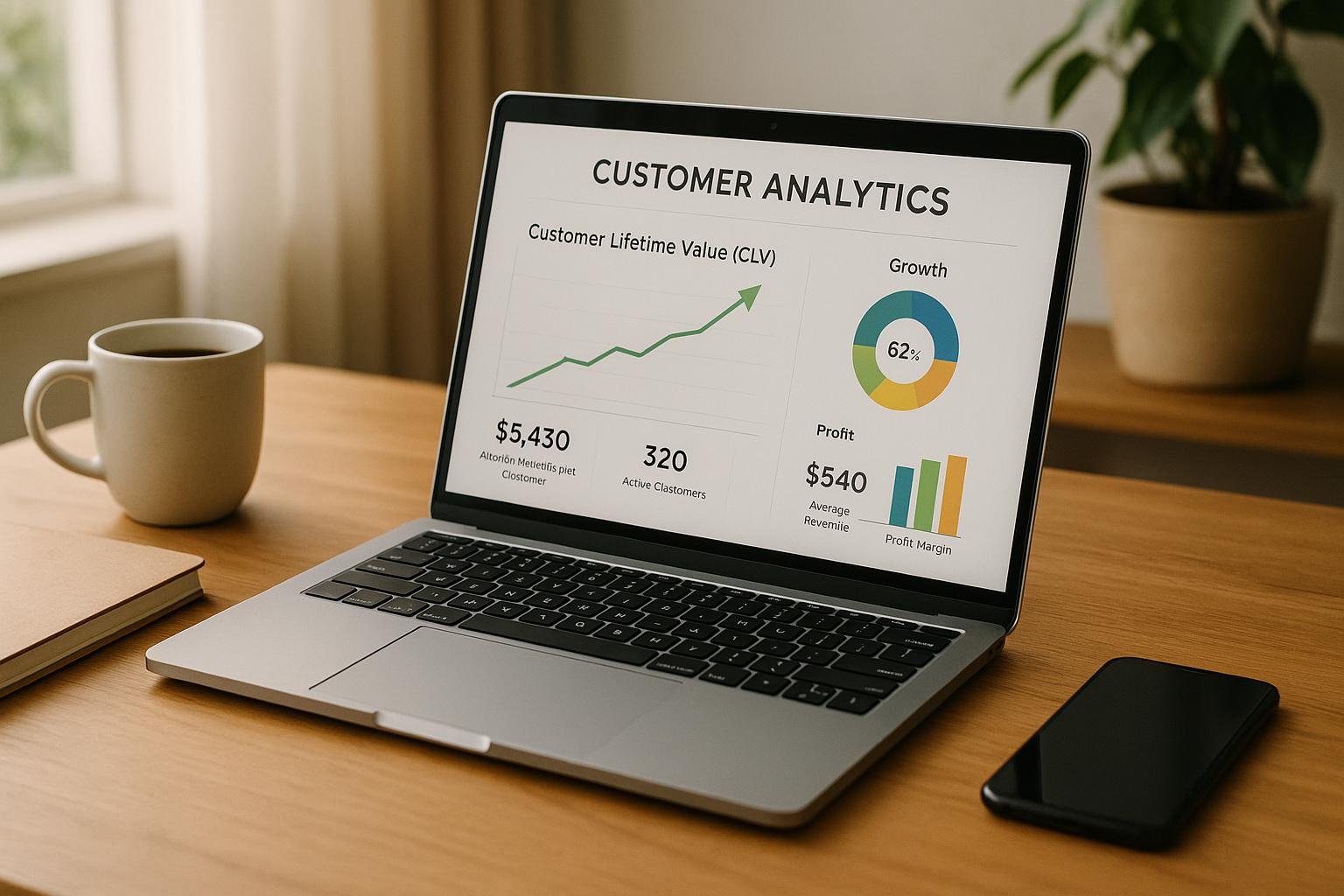
Customer Lifetime Value (CLV) is the key to growing your eCommerce business. It’s not just about one-time sales - it’s about understanding how much revenue a single customer can bring over time. By focusing on CLV, you can increase profits, improve cash flow, and reduce marketing costs.
Key Takeaways:
- What is CLV? It’s the total revenue you can expect from a customer during their relationship with your business. Example: If a customer spends $50 per order, buys 3 times a year, and stays for 2 years, their CLV is $300.
- Why does CLV matter? Retaining customers is 5x cheaper than acquiring new ones. Even a 5% boost in retention can increase profits by 25% to 95%.
- Low CLV hurts: It leads to higher acquisition costs, high churn rates, and unstable revenue.
- How to improve CLV? Personalize experiences, use loyalty programs, and engage customers after purchases.
- Cash flow challenges? Revenue-based financing, like Onramp Funds, can help maintain investments in CLV-focused strategies.
Focusing on CLV builds long-term stability and positions your business for growth. Ready to learn how? Let’s dive in.
Why Customer Lifetime Value Is the Metric That Matters MOST
How to Measure and Track CLV
Measuring Customer Lifetime Value (CLV) requires a blend of accurate calculations, tracking key metrics, and leveraging historical data to refine predictions over time.
How to Calculate CLV
The formula for CLV might seem straightforward, but understanding its components is crucial. Here's the basic equation:
CLV = (Customer Value × Average Customer Lifespan)
To break it down:
- Calculate Average Order Value (AOV): Divide total revenue by the number of orders.
- Determine Average Purchase Frequency Rate (APFR): Divide the total number of orders by the number of unique customers.
- Find Customer Value: Multiply AOV by APFR.
- Factor in Customer Lifespan: Use the inverse of your churn rate to estimate how long customers typically stay.
For example, if your AOV is $50, customers purchase 2.5 times per quarter, and their average lifespan is 4 years, the calculation looks like this:
CLV = ($50 × 2.5) × 16 quarters = $2,000 per customer.
To get a clearer picture of profitability, include your gross margin and subtract customer acquisition costs (CAC) to calculate the net CLV.
Key Metrics to Track for Accurate CLV
Once you’ve calculated CLV, tracking specific metrics can help you refine its accuracy and uncover opportunities for improvement. Here are some key metrics to monitor:
- Churn Rate: The percentage of customers who stop purchasing within a set timeframe. A high churn rate shortens customer lifespan.
- Retention Rate: Tracks how many customers continue to buy over time, providing insights into loyalty trends.
- Customer Acquisition Cost (CAC): Measures how much you spend to acquire a customer. Aim for a healthy ratio where CLV is about three times higher than CAC.
- Website Traffic and Add-to-Cart Rate: Early indicators of customer engagement that can predict future purchases and highlight potential obstacles in the buying process.
- Refund Rate: Refunds directly impact CLV, so keeping this rate low is essential.
Interestingly, studies show that only 34% of business owners fully grasp CLV, and just 24% actively track it. Businesses that monitor these metrics consistently can gain a significant edge over competitors.
Using Historical Data to Improve CLV Accuracy
Historical data is a goldmine for refining CLV calculations, as it reveals patterns in customer behavior.
Start by segmenting your customers using RFM analysis - which stands for Recency, Frequency, and Monetary value. This method helps you identify your most valuable customer groups, focusing on those who buy often, spend more, and have made recent purchases.
Dive deeper into your data by analyzing CLV across various dimensions like demographics, product categories, and acquisition channels. For instance, you might find that customers acquired through certain marketing channels are more loyal or that buyers of specific product bundles have a longer customer lifespan.
Here’s a real-world example: 123BabyBox improved their CLV by 40% after analyzing historical subscription data. By shifting from $59.99 monthly subscriptions to $39.99 annual plans, they extended the average subscription length from five to eight months. This adjustment added nearly $150 in CLV per customer, reduced churn by 18%, and significantly increased referrals.
For future-focused insights, predictive CLV models use statistical tools and machine learning to anticipate customer behavior. These are especially helpful for adapting to market changes. On the other hand, historical CLV models rely on past spending patterns, making them ideal for established businesses but less suitable for startups.
"Keep it simple. Track how long customers stay and what they spend, then find one friction point and fix it. The easiest wins often come from improving what's already working." - Zarina Bahadur
Problems Caused by Low CLV
A low Customer Lifetime Value (CLV) doesn’t just strain your marketing budget - it also weakens the foundation of long-term customer relationships. When CLV is low, it triggers a chain reaction of challenges that can stall growth, reduce competitiveness, and disrupt operational stability.
How Low CLV Drives Up Acquisition Costs
Low CLV forces businesses to spend heavily on constantly acquiring new customers. When customers either disengage quickly or spend less than expected, companies are left in a cycle of endlessly replacing them.
Over the past eight years, customer acquisition costs have skyrocketed by 222%. This means finding new customers is becoming increasingly expensive, while low CLV makes it harder to justify marketing expenses due to limited revenue per customer.
Here’s the thing: repeat customers are significantly more cost-effective. They are 6 to 7 times cheaper to sell to and spend up to 67% more per purchase. With low CLV, you miss out on these benefits, relying instead on costly new customer acquisition. This creates a vicious cycle of high expenses and limited returns.
"A higher CLV means you can spend more to acquire each customer, allowing your investments in customer acquisition to spread further and become more effective."
Boosting customer retention by just 5% has the potential to increase profitability by 75%. Without a focus on retention, however, businesses face rising acquisition costs and diminishing returns when customers churn quickly.
The Link Between Low CLV and High Churn Rates
Low CLV doesn’t just mean higher acquisition costs - it’s also a red flag for retention problems. High churn rates and low CLV often go hand in hand, making sustainable growth nearly impossible. When customers leave quickly, they never reach their full potential value, keeping CLV stuck at a low level.
Improving retention rates can increase CLV by 25% to 95%, demonstrating just how impactful customer loyalty can be. Unfortunately, many eCommerce companies prioritize acquisition over retaining their current customers, leaving money on the table.
High churn also leads to constant onboarding efforts and increased support costs. Meanwhile, returning customers generate three times more revenue than first-time buyers. On top of that, 61% of customers stop doing business with a company due to poor customer service. This highlights the importance of investing in customer experience and retention strategies.
"Churn is the rate at which customers stop doing business with an entity. It's a key indicator of customer dissatisfaction, market competition, or failure in business processes." - Daniel Fishel, Investopedia
Comparing High CLV and Low CLV Businesses
The gap between high CLV and low CLV businesses goes beyond revenue - it impacts nearly every aspect of operations, from marketing efficiency to growth potential.
| Metric | High CLV Business | Low CLV Business |
|---|---|---|
| Revenue Predictability | Steady income from loyal customers | Uncertain revenue due to frequent turnover |
| Marketing ROI | High – Focus on premium channels and precise strategies | Low – Limited to less effective methods |
| Customer Loyalty | Strong repeat purchases and referrals | Mostly one-time buyers |
| Cash Flow Stability | Reliable recurring revenue | Volatile – Dependent on constant new customer acquisition |
| Competitive Edge | Strong – Can outbid competitors with higher budgets | Weak – Struggles with high acquisition costs |
| Growth Potential | Sustainable – Retention-driven growth | Unsustainable – High costs and unpredictable revenue |
Returning customers are a powerhouse for revenue, contributing up to 65% of a company’s income. In contrast, new customers typically convert at much lower rates, often between just 1–3% on their first visit. A healthy CLV-to-CAC (Customer Acquisition Cost) ratio typically falls between 3:1 and 5:1. Low CLV businesses, however, face higher acquisition costs and shaky revenue streams, making long-term growth an uphill battle.
Strategies to Increase CLV and Drive Growth
To boost Customer Lifetime Value (CLV) and fuel business growth, the focus must shift from one-off transactions to fostering long-term customer relationships. Companies that succeed at this create predictable revenue streams and build loyalty, setting the stage for steady growth.
Personalization and Tailored Customer Experiences
Personalization transforms occasional shoppers into devoted customers by making every interaction feel meaningful. When customers sense that a brand understands their needs, they’re more likely to return and spend more.
One of the most effective ways to personalize is by leveraging customer data for precise product recommendations. By analyzing past purchases and browsing habits, you can suggest items that align with each customer’s interests. This goes beyond generic suggestions like "others also bought" - it creates a curated experience that resonates on a personal level.
Personalized emails are another powerful tool. Instead of sending the same newsletter to everyone, segment your audience based on their buying history, demographics, or engagement trends. For instance, send birthday discounts, early sale access, or seasonal product recommendations tailored to their preferences. These targeted emails consistently outperform generic campaigns.
On your website, dynamic content can elevate personalization further. For returning visitors, show products related to their past purchases, highlight items they left in their cart, or offer exclusive discounts based on their shopping behavior. This seamless, tailored experience encourages customers to engage more deeply with your brand.
The key is to use personalization to address real customer needs, not just to push products. When customers feel understood, trust and loyalty naturally follow, translating into higher CLV.
Implementing Loyalty Programs
Loyalty programs are a proven way to encourage repeat purchases and drive higher spending. The best programs reward engagement while offering meaningful incentives.
Points-based systems are particularly effective for eCommerce. Customers earn points for every dollar spent, which they can redeem for discounts, freebies, or perks. The trick is to strike a balance - make the rewards appealing enough to drive purchases but still maintain profitability.
Sephora’s Beauty Insider program is a great example. With its tiered system, customers earn points, gain access to exclusive products, and enjoy personalized experiences based on their spending. This approach has significantly boosted customer retention and increased average spending, showcasing the direct impact of a well-designed loyalty program.
Tiered rewards programs add another layer of motivation. For example, bronze members might get free shipping, silver members could enjoy early sale access, and gold members might unlock exclusive products or personal shopping services. Customers are naturally incentivized to spend more to reach higher tiers.
For a loyalty program to succeed, it must be simple to understand and offer meaningful rewards. Overly complex systems or insignificant perks can frustrate customers. Instead, focus on benefits that genuinely enhance their experience, like free shipping thresholds, exclusive discounts, or access to limited-edition items.
Adding referral incentives to loyalty programs can further amplify growth. By rewarding customers for bringing in new buyers - through points or discounts - you turn loyal shoppers into enthusiastic brand advocates.
Optimizing Post-Purchase Engagement
The post-purchase phase is often overlooked, yet it’s a critical opportunity to deepen relationships and encourage repeat business. Effective engagement after a sale builds trust and keeps your brand top-of-mind.
Follow-up email sequences are a great starting point. Begin with order confirmations and shipping updates, then follow up with product care tips, usage suggestions, or recommendations for complementary items. For instance, if a customer buys a coffee maker, you could send tips on brewing techniques or recommend premium coffee beans.
Customer feedback surveys show that you value their opinions while offering insights to improve your products and services. Keep surveys short and focused, and consider offering a small reward, like a discount or loyalty points, as a thank-you. Acting on this feedback demonstrates that their input matters, which strengthens trust.
Providing responsive customer support can turn problems into opportunities. Customers often become more loyal when they see a company go above and beyond to resolve an issue.
Automated communication ensures consistent engagement without overwhelming your team. Set up email sequences for order updates, usage tips, and review requests, all timed to keep the interaction relevant and personal.
Finally, offering exclusive deals to existing customers reinforces their value to your business. Send personalized discount codes, grant early access to new products, or host member-only sales. These gestures not only show appreciation but also encourage repeat purchases.
sbb-itb-d7b5115
Solving Cash Flow Problems with eCommerce Financing
Cash flow issues can throw a wrench into even the best customer lifetime value (CLV) strategies. When cash is tight, businesses often end up making short-term decisions that can damage long-term customer relationships. The key to avoiding this? Accessing financing options that align with your business's growth patterns and goals.
Why Cash Flow Is Critical for CLV Optimization
Steady cash flow is the backbone of any successful CLV strategy. Without it, essential investments in marketing, inventory, and customer service can take a hit. Here’s the challenge: eCommerce businesses often have to pay upfront for inventory, marketing campaigns, and operational costs, but customer payments might not roll in for weeks - or even months. This mismatch can be especially challenging when you're investing in loyalty programs, personalized marketing, or improved customer support, all of which require upfront spending before delivering returns.
Seasonal revenue spikes, like those during the holidays, can make cash flow management even trickier. During slower months, it becomes harder to maintain those CLV-focused investments without external support. Tight cash flow often forces businesses to cut back on critical areas - reducing customer service teams, delaying product launches, or scaling back marketing efforts. These cuts can hurt customer relationships, ultimately impacting your CLV. That’s where flexible financing can make all the difference, helping businesses maintain consistent investments and avoid these pitfalls.
How Onramp Funds Supports eCommerce Growth
Onramp Funds provides eCommerce businesses with fast, equity-free financing specifically designed to address cash flow challenges. What sets them apart? They evaluate your business based on actual sales across major eCommerce platforms, ensuring their funding solutions are tailored to your needs.
The application process is quick and straightforward, with funding available within 24 hours of approval. This rapid access to capital can be a game-changer, allowing you to sustain CLV-focused efforts like restocking inventory for a campaign, investing in customer retention tools, or expanding loyalty programs. By ensuring you have the funds when you need them, Onramp helps keep your growth on track.
Onramp’s team, based in Austin, provides personalized support throughout the process. They understand the unique challenges eCommerce businesses face and tailor funding solutions to match your goals. Funding amounts and terms are customized based on your sales history and growth trajectory, while their integration with major eCommerce systems simplifies the process. By eliminating much of the paperwork and offering a clear view of your business’s financial health, Onramp provides a smoother, more transparent funding experience. Their solutions also include adaptive repayment structures that align with your business's performance.
Why Revenue-Based Financing Works for CLV Strategies
Revenue-based financing (RBF) offers a flexible approach to funding that fits perfectly with CLV optimization strategies. Instead of fixed monthly payments, RBF allows you to repay a percentage of your sales. This means payments automatically adjust based on your business’s performance - a critical feature for eCommerce businesses with fluctuating revenue.
The RBF model is gaining traction fast. It’s projected to grow from $6.4 billion in 2023 to $178.3 billion by 2033, highlighting its effectiveness for businesses needing adaptable financing. With RBF, you preserve cash flow during slower months while scaling payments during growth periods. Unlike equity financing, which requires giving up ownership, RBF lets you retain full control over your business decisions. And compared to traditional loans with rigid monthly payments, RBF offers the flexibility to manage financial ups and downs more effectively.
Onramp offers transparent terms, charging between 2–8%, making it easier to predict costs. For businesses generating at least $10,000 in monthly sales, this model provides a reliable way to access capital while maintaining the flexibility needed to execute CLV strategies effectively.
Conclusion: Building a CLV-Focused Strategy for Growth
Customer Lifetime Value (CLV) is more than just a number - it's the backbone of sustainable growth in eCommerce. Focusing on CLV means shifting away from quick-win sales tactics and instead fostering long-term customer relationships that fuel steady revenue over time. Businesses that excel in this approach don't just weather market changes - they thrive through them.
Optimizing CLV involves investing consistently in areas like personalization, loyalty programs, and post-purchase engagement. However, these strategies often require upfront funding before they start delivering results. For many businesses, cash flow limitations can become a significant obstacle, even for the most well-thought-out CLV initiatives. This is where a financing solution tailored to dynamic revenue cycles becomes essential.
Revenue-based financing provides that flexibility. By aligning payments with your sales performance, it helps maintain cash flow during slower periods and scales as your business grows. The potential of this model is clear: the global revenue-based financing market is expected to hit $42.3 billion by 2027, with a compound annual growth rate of 61.8%.
Onramp Funds takes this approach further by offering revenue-based financing tailored to address these challenges. Their customers have reported real results, with an average revenue increase of 7% just 180 days after receiving funding. The process is quick and straightforward, with funds available within 24 hours of approval.
"Got our offer, and had cash in our bank account within 24 hours. Their Austin, TX-based team was very professional and helped me deploy the cash to effectively grow our business." - Nick James, CEO, Rockless Table
To make CLV a cornerstone of your strategy, start by calculating your current value using historical data and pinpointing areas for improvement. Whether it’s refining personalization efforts, launching a loyalty program, or enhancing customer service, financial flexibility is key to executing these plans consistently. By pairing your customer relationship strategies with adaptive financing solutions, you can build a business that’s both resilient and ready to scale.
FAQs
How can eCommerce businesses calculate Customer Lifetime Value (CLV) and which metrics should they focus on to improve it?
How to Calculate Customer Lifetime Value (CLV)
Customer Lifetime Value (CLV) is a crucial metric for eCommerce businesses, as it helps estimate how much revenue a single customer will bring over the course of their relationship with your brand. The calculation is straightforward: multiply the average order value by the purchase frequency and the customer lifespan.
Here’s an example: If a customer spends $60 per order, makes 20 purchases annually, and stays with your business for 5 years, their CLV would amount to $6,000.
Boosting Your CLV
To increase CLV, focus on improving these key areas:
- Purchase frequency: Motivate customers to buy more often with loyalty programs or personalized discounts.
- Average order value: Suggest complementary products through upselling or cross-selling strategies.
- Customer retention rate: Build lasting relationships by offering exceptional customer service and tailored marketing efforts.
By keeping an eye on these metrics and working to improve them, you can drive higher revenue while ensuring steady growth for your eCommerce business.
How can eCommerce businesses increase Customer Lifetime Value (CLV) to drive growth?
To increase Customer Lifetime Value (CLV) and drive sustainable growth, eCommerce businesses should focus on delivering standout customer experiences. This means offering personalized product recommendations, running targeted marketing campaigns, and ensuring the shopping journey is smooth and enjoyable - encouraging customers to return time and time again.
Equally important are post-purchase strategies. You can inspire repeat purchases by leveraging upselling, cross-selling, and bundling products tailored to customers' past orders. Combine this with top-notch product quality, responsive customer support, and consistent, reliable delivery to build trust and loyalty. These steps will help strengthen customer relationships and maximize their long-term value.
How can revenue-based financing help eCommerce businesses manage cash flow and boost Customer Lifetime Value (CLV)?
Revenue-based financing provides eCommerce businesses with a flexible way to secure funding without the pressure of fixed monthly payments. Instead of a set repayment schedule, payments are linked to your sales performance. This means during slower months or seasonal dips, your payments adjust accordingly, easing financial strain.
This model empowers businesses to channel funds into crucial areas like inventory, marketing, and strategies to boost Customer Lifetime Value (CLV). By syncing repayments with revenue, businesses can prioritize steady growth and maintain a stable cash flow - setting the stage for long-term success.
Related posts
Onramp Funds
Funding built around your sales
Connect your store and see what you qualify for. Repay as a percentage of sales, with no personal credit check.
Funding in as little as 24 hours.
