

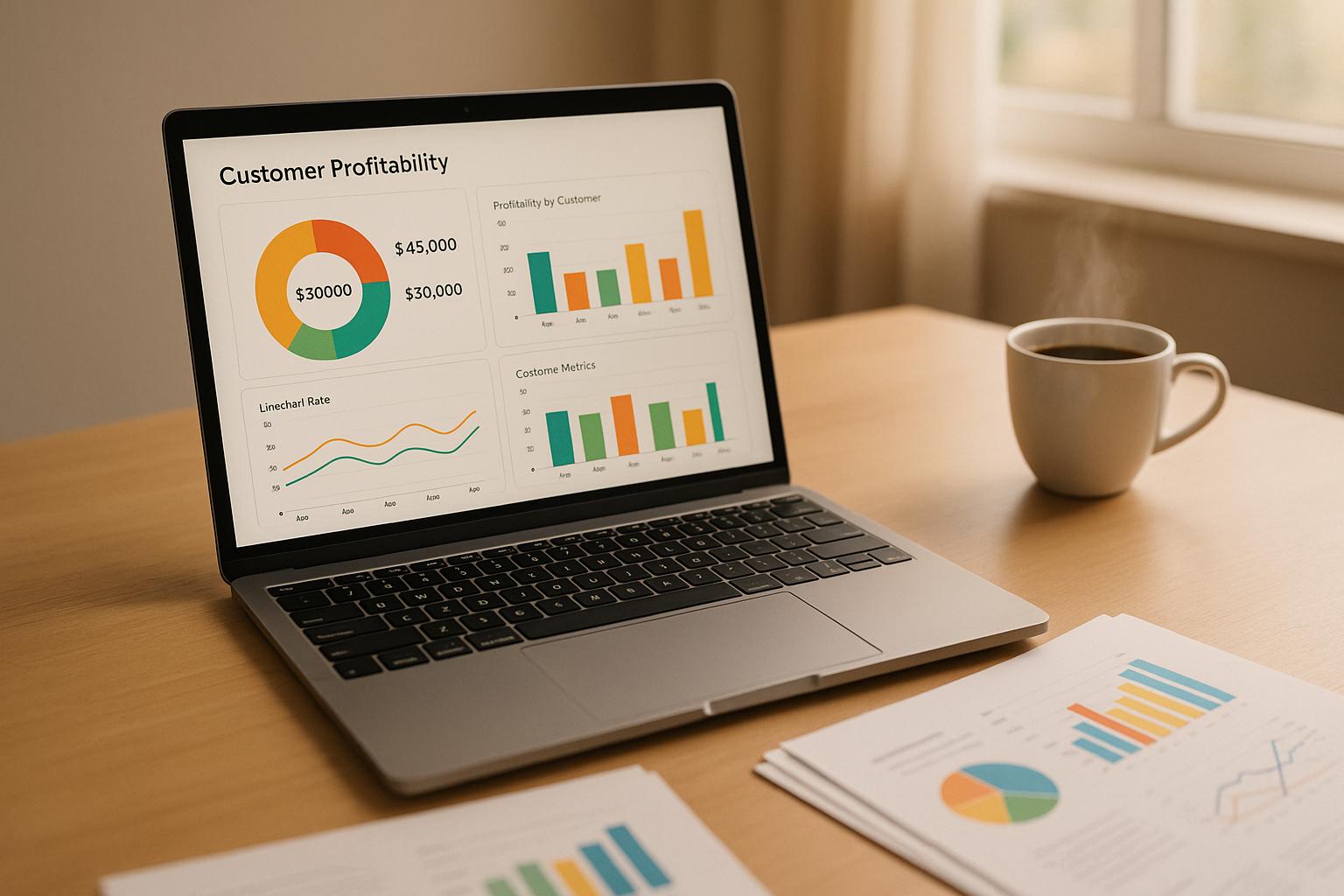
Customer Profitability Analysis (CPA) helps businesses understand how much profit each customer generates by analyzing costs like marketing, service, and delivery. This insight allows eCommerce businesses to make smarter decisions, such as optimizing marketing budgets, refining pricing strategies, and improving customer retention. Key metrics include:
- Customer Lifetime Value (CLTV): Total revenue expected from a customer over time.
- Customer Acquisition Cost (CAC): Cost of acquiring a new customer.
- Retention Costs: Expenses to keep existing customers loyal.
- Revenue per Customer: Net income generated per customer.
Steps to Analyze Customer Profitability:
- Gather Data: Collect customer data from various sources (e.g., CRM, sales history).
- Calculate Metrics: Measure CLTV, CAC, and retention/service costs.
- Segment Customers: Group customers by profitability and behavior.
- Analyze Results: Identify trends and refine strategies.
Strategies to Improve Profitability:
- Targeted marketing for high-value customers.
- Pricing adjustments like dynamic or value-based pricing.
- Cost reduction in areas like shipping or support.
- Retention programs like loyalty rewards or personalized campaigns.
Analyzing Customer Profitability
Key Metrics for Customer Profitability
To truly understand customer profitability, businesses must focus on specific metrics that highlight the financial impact of each customer relationship. These metrics provide the foundation for informed decision-making and refined strategies.
Customer Lifetime Value (CLTV)
Customer Lifetime Value (CLTV) estimates the total revenue a business can expect from a customer over the course of their relationship [7]. It's influenced by factors like average order value, purchase frequency, gross margin, and churn rate. Companies can calculate CLTV using historical data or predictive models [3] [4].
The numbers speak for themselves: while only 42% of companies can accurately measure CLTV, a staggering 89% agree that it plays a key role in driving brand loyalty alongside a strong customer experience [3]. For eCommerce brands, the average CLTV is $168 [5].
"Using CLV, you can better understand the different personas among your customers - the first step to effective targeting or personalization."
- Daniar Rusnak, Bloomreach Academy, Senior Trainer [3]
A great example comes from 123BabyBox, which revamped its subscription tiers and increased CLTV by nearly $150 per customer, while also cutting churn by 18% [6]. This kind of insight is crucial for optimizing marketing strategies, as we’ll explore further.
Customer Acquisition Cost (CAC)
Customer Acquisition Cost (CAC) measures the total investment in sales and marketing to bring in a new customer over a specific time frame [11]. For a business to be profitable, CAC should always be lower than the customer's lifetime value [11]. Successful eCommerce businesses often aim for a spending-to-revenue ratio of around 1:3 [12].
When calculating CAC, include all relevant costs: marketing software, salaries, advertising expenses, and promotional offers [9]. For smaller online stores, the average CAC is about $20 per customer [12]. However, it’s worth noting that customer acquisition costs have risen by 60% over the past five years [8].
"Customer acquisition cost (CAC) measures how much you spend, on average, to bring in a new customer."
- Georgie Walsh, Content Marketing Manager at LoyaltyLion [8]
It’s also helpful to distinguish between New CAC, which focuses solely on acquiring new customers, and Blended CAC, which includes revenue from existing customers [10]. Don’t confuse CAC with Cost Per Acquisition (CPA); while CAC tracks the cost of acquiring paying customers, CPA measures the cost of acquiring leads [11].
Retention and Service Costs
Retention and service costs are ongoing expenses that play a major role in determining customer profitability. Retention costs focus on keeping existing customers engaged and loyal, while service costs cover areas like support, fulfillment, and assistance [13] [14].
Positive customer experiences can have a huge impact. For example, satisfied customers are likely to spend 140% more, and loyalty programs - used by 80% of Americans - can increase repeat purchases by 60% [13].
"Retaining existing customers is often more cost-effective than it is to acquire customers for a simple reason: the customers you already have know your brand, trust your products, and are much easier to convince to purchase again." [13]
Retention costs (CRC) differ from acquisition costs (CAC) in both timing and purpose. CAC covers the cost of gaining a new customer, while CRC accounts for the expenses involved in keeping that customer engaged [14]. CAC tells you when you’ll break even on acquisition, while CRC helps determine the long-term profitability of retention efforts [14].
Service costs - like customer support salaries, return processing, and technical support systems - also directly affect your bottom line. Including these costs in your profitability analysis is essential.
Revenue per Customer
Revenue per customer measures the actual income each customer generates, factoring in returns, refunds, and discounts. Unlike gross sales, this metric gives a clear picture of the net revenue flowing into your business from each customer relationship. To calculate it, subtract returns, promotional discounts, and chargebacks from the total revenue a customer generates over a set period.
This metric can vary widely depending on the type of business. For instance, subscription businesses often focus on monthly recurring revenue, while seasonal retailers may look at yearly revenue per customer. Comparing your figures to industry benchmarks can help identify areas for improvement [3].
"The advantage of determining customer lifetime value is not just the final number itself, but also the thinking and calculation behind the metric."
- Lukas Sitar, Inbound Marketing Specialist [3]
Tracking revenue per customer alongside metrics like purchase frequency and average order value provides a deeper understanding of customer behavior. This information is vital for tailoring strategies to different customer segments and preparing for further analysis.
Step-by-Step Process for Customer Profitability Analysis
After reviewing key metrics, follow these steps to break down and understand customer profitability.
Gathering Data
The first step in analyzing customer profitability is collecting data from various touchpoints. Businesses that base decisions on data often see a return on investment that's five to eight times higher than those that don't [16].
Start by identifying your data sources. These might include your online store, CRM system, ad platforms, email campaigns, and affiliate networks. Don’t overlook customer service records, as they provide insight into support costs and customer satisfaction.
"Customer profitability analysis (CPA) compares the profitability of individual customers or clients within a business. This is done by evaluating the average revenue a customer generates vs the amount a company spends to provide a service or product." - Saras Analytics [15]
To make the analysis meaningful, integrate all data into a centralized system [2]. Focus on gathering these five key data types:
- Identity data: Basic details like names, email addresses, and customer IDs.
- Behavioral data: Information about website navigation, product views, and search queries.
- Descriptive data: Demographics, such as age, location, and income levels.
- Attitudinal data: Customer opinions collected through reviews and surveys.
- Transactional data: Purchase history, returns, and customer service interactions.
It’s critical to comply with data governance rules, such as GDPR and CCPA, to ensure proper handling and storage of customer information [2].
With all your data consolidated, you can move on to calculating profitability.
Calculating Profitability
Start by determining your Customer Acquisition Cost (CAC). This is calculated by dividing your total marketing spend by the number of new customers acquired. Be sure to include all relevant expenses, such as software subscriptions, staff salaries, advertising costs, and content creation fees [9].
For example, if you spent $10,000 on marketing in January and gained 500 new customers, your CAC would be $20 per customer.
Next, calculate the Customer Lifetime Value (CLTV) using cohort analysis and gross margin to find out how much profit each customer generates [17]. For instance, one fashion brand discovered that customers acquired during Black Friday sales had a lower CLTV compared to those who shopped during full-price periods [17].
To gauge the efficiency of your customer acquisition efforts, calculate the CLTV:CAC ratio by dividing CLTV by CAC [17]. A healthy ratio is around 3:1, meaning a customer’s lifetime value should be three times the cost of acquiring them [18].
Don’t forget to include ongoing service costs, such as customer support, return processing, and retention programs, to get a true picture of profitability.
Once you’ve completed these calculations, you’re ready to segment your customers.
Segmenting Customers
After calculating individual customer profitability, group your customers into segments to uncover patterns and customize your approach. Research shows that 80% of companies using segmentation report higher sales [19].
One effective method is RFM analysis (Recency, Frequency, Monetary). This technique evaluates when customers last made a purchase (Recency), how often they buy (Frequency), and how much they spend (Monetary value).
For example, an RFM analysis might reveal that a small group of elite customers generates a large portion of revenue while having the lowest return rates, making them highly profitable [20]. Including return data in your monetary calculations can make your analysis even more precise.
You can also create segments based on profitability levels:
- High-value customers: Strong CLTV:CAC ratios.
- Medium-value customers: Moderate ratios.
- Low-value or unprofitable customers: Weak ratios.
Other segmentation options include behavior patterns, demographics, or purchase timing. These insights help you tailor strategies to each group.
With segmented data in hand, you’re ready to dive into deeper analysis.
Analyzing Results
Use your analysis to spot trends and opportunities. Look for patterns in your customer segments to understand why some groups are more profitable than others. Seasonal variations in acquisition and profitability can also provide valuable insights.
Pay close attention to how acquisition channels impact profitability. For instance, customers acquired through organic search might have a higher CLTV than those from paid social media campaigns. This information can guide you on where to allocate your marketing budget.
Based on segmentation insights, develop targeted strategies. High-value customers might appreciate exclusive offers or premium services, while medium-value groups could respond well to cross-selling or bundled promotions.
Monitor behavioral signals that predict shifts in profitability. Customers exploring multiple product categories, reading detailed product descriptions, or engaging in loyalty programs often indicate higher long-term value. Real-time data can help you adapt your strategies to changing customer behavior and market trends [19].
These insights will help you refine your approach to boost profitability effectively.
Strategies to Improve Customer Profitability
Once you’ve completed your customer profitability analysis, the next step is implementing strategies to maximize value across your customer base. The goal? Focus on efforts that deliver the most impact while cutting costs that don’t contribute to value.
Targeted Marketing
Leverage customer profitability data to fine-tune your marketing strategies. High-value customers deserve premium, personalized approaches, while cost-sensitive groups benefit from tailored, budget-conscious tactics. Considering that US$37 billion is wasted annually on ads that miss their target audience [21], precision targeting is more important than ever.
Start by using CRM data to create detailed buyer personas. These personas can guide your messaging and help you pick the right channels. For instance, segmented email campaigns significantly outperform generic ones - personalized emails see 6.2% higher open rates and a 91% increase in purchase likelihood [21]. A great example is Casper, which segments emails based on sleep habits to boost engagement.
SMS marketing is another powerful tool. With open rates as high as 98% compared to email’s 20% [27], this channel is ideal for engaging your most profitable customers. Bushbalm, for example, runs an automated SMS welcome series that consistently achieves click-through rates above 50% [22].
When it comes to customer acquisition, focus ad spend on channels that attract high-lifetime-value customers. Google’s pay-per-click advertising delivers an impressive ROI of US$8 for every US$1 spent [22]. Influencer marketing is also highly effective - take ramen brand immi, which used Shopify Collabs to recruit over 400 ambassadors and generate more than US$200,000 in sales [22].
With your marketing strategies in place, pricing becomes the next area to refine for profitability.
Pricing Optimization
Adjusting prices strategically can increase profits by an average of 5% without the need for additional customer acquisition [24]. Profitability data can help you identify the best pricing strategies for your audience.
A/B testing is a great way to find the sweet spot for pricing. Since over 70% of consumers compare prices online before making a purchase [26], it’s important to strike a balance between competitive pricing and profitability.
Here are a few pricing strategies to consider:
- Raise prices for premium customer segments.
- Offer bundled discounts to reward loyal customers.
- Provide attractive deals for price-sensitive buyers.
Dynamic pricing, which adapts to real-time market conditions and customer behavior, can also be effective. However, transparency is key - customers may lose trust if pricing feels arbitrary. Bundle pricing is another useful approach, encouraging customers to spend more by offering perceived discounts on packaged deals.
"Having more margin is a gigantic ecommerce cheat code."
– Andrew Faris, ecommerce expert [25]
Value-based pricing, which focuses on what customers are willing to pay rather than simply covering costs, can deliver higher margins. While this requires deep insights into customer behavior, the payoff can be substantial.
Cost Reduction
Cutting inefficient costs is a straightforward way to improve profitability without increasing sales. Start by analyzing support tickets for recurring issues - this can help you improve product descriptions, FAQs, or instructional content. Interestingly, 96% of customers are willing to stick with a company that acknowledges and fixes its mistakes [30].
Other cost-saving measures include:
- Negotiating better shipping rates with carriers.
- Streamlining inventory to reduce storage costs.
- Shifting marketing budgets from underperforming channels to high-ROI activities.
Automation tools like email sequences, chatbots, and inventory management systems can also help reduce labor costs while maintaining consistency.
Once you’ve optimized costs, the next step is to focus on retaining your most profitable customers.
Retention Programs
Improving customer retention by just 5% can lead to a profit boost of 25% to 95% [28]. Retention programs are a smart investment, as they focus on customers who already bring value to your business.
Loyalty programs with gamification elements are particularly effective. For example, The Turmeric Co doubled its customer lifetime value and increased retention by 60% within a year of launching a gamified loyalty program [30]. Subscription programs can also drive retention, but the key is offering real value that makes the subscription worthwhile.
Personalized retention campaigns are another powerful tool. Shapeways, for instance, increased click-through rates by 525% by tailoring email campaigns to each customer’s purchase cycle [30].
Strong customer support also plays a critical role in retention. Proactive and prompt responses build loyalty and encourage referrals. Building a community around your brand can create emotional connections that set you apart - Glossier, for example, achieved this by fostering a community through user-generated content [23].
Win-back campaigns can re-engage lapsed customers at a much lower cost than acquiring new ones. Alex Mill successfully reduced cart abandonment by sending follow-up emails offering a 15% discount to encourage purchases [22].
"The most impactful retention strategies are built on shared data between a brand's tech stack, so your brand has a 360-degree view of every single customer - what they like, what they don't, when and what they purchase, who they are, and more."
– Moran Khoubian, Senior Director, Ecosystem & Community at Yotpo [29]
Email marketing remains a standout tool for retention, offering an ROI of over 4,000% [30]. Techniques like welcome sequences, post-purchase follow-ups, and abandoned cart recovery campaigns help keep your brand top-of-mind throughout the customer journey.
The key to successful retention programs is measuring their impact on customer lifetime value and continuously refining your approach based on what works best for your audience segments.
sbb-itb-d7b5115
Using Funding Solutions to Scale Profitability
Scaling profitability in eCommerce often requires capital - whether it’s for stocking up on inventory, launching marketing campaigns, or improving operations. Unfortunately, traditional financing options can be a poor fit for many eCommerce businesses. Rigid repayment schedules and lengthy approval processes often clash with the fast-paced, cash flow-driven nature of online retail. That’s where revenue-based financing (RBF) steps in as a flexible alternative.
With RBF, eCommerce businesses can secure funding in exchange for a percentage of future revenue, avoiding the need to give up equity or provide personal guarantees [32]. What makes this approach particularly appealing is its adaptability - repayments adjust based on sales. During high-revenue months, payments increase, while slower months mean smaller repayments, reducing financial strain [35].
Onramp Funds is a platform designed specifically to meet the needs of eCommerce businesses. It offers quick funding - often within 24 hours - and integrates seamlessly with major platforms like Amazon, Shopify, BigCommerce, WooCommerce, Squarespace, Walmart Marketplace, and TikTok Shop [31]. Onramp’s customers have reported an average revenue growth of over 60%, with 75% choosing to borrow again [34].
"Onramp offered the perfect solution with revenue-based financing to secure the capital we needed to invest in inventory and pay it back at a reasonable time frame once we made sales. The process was quick, easy, and the support was great." – Jeremy, Founder and Owner of Kindfolk Yoga [31]
This testimonial highlights how flexible funding can empower businesses to grow. One of the practical benefits of RBF is the ability to align repayment rates with the cost of what you’re financing. For instance, if inventory accounts for 15% of your retail price, you can set your repayment rate at 15% of daily sales [32]. This ensures financing costs stay proportional to the revenue generated by your investment.
RBF can support a wide range of profitability strategies. Whether you’re funding a targeted marketing campaign or expanding inventory to serve high-value customer segments, this type of financing offers the working capital needed - without the inflexibility of traditional loans [32].
The global RBF market is expanding rapidly, projected to grow from $901.41 million in 2019 to $42.3 billion by 2027, with a compound annual growth rate of 61.8% [36]. Unlike conventional bank loans that demand fixed monthly payments regardless of sales, RBF adapts to your business’s sales performance, making it a practical choice when profitability strategies take time to deliver results [35].
Another key advantage of RBF is the alignment of interests between the lender and the business. As your business grows, so do the returns for RBF investors, creating a mutually beneficial relationship [33].
When considering RBF, take the time to model how the revenue share will impact your monthly cash flow. Make sure to account for revenue stability, growth projections, and capital requirements to ensure this funding solution aligns with your long-term goals [37][38].
"Revenue-based financing is reshaping how e-commerce businesses access capital. By offering a flexible, performance-based repayment structure, it provides an attractive alternative to traditional debt and equity financing." – martini.ai blog [35]
For eCommerce businesses aiming to scale profitability, RBF offers the capital and adaptability needed to execute growth initiatives effectively. By integrating this funding approach into your strategy, you can maintain financial stability while enhancing customer value at every stage.
Conclusion and Key Takeaways
Understanding customer profitability is a game-changer for growing your eCommerce business. By identifying which customers bring in the most profit and which ones drain resources, you can make smarter decisions about where to focus your efforts and budget.
Key metrics like Customer Lifetime Value (CLTV), Customer Acquisition Cost (CAC), retention costs, and revenue per customer provide a clear snapshot of your business's performance. Together, these numbers help you see where you stand today and what you can achieve with well-planned strategies.
To make the most of this analysis, follow a simple plan: gather your data, calculate profitability, segment your customers, and dive into the results. This approach allows you to take targeted actions - whether it's refining your audience, improving retention, adjusting pricing, or cutting unnecessary costs [40].
"By better understanding customer behavior and the actual cost of doing business with individual customers, companies can make more informed decisions about their marketing costs, customer service strategies, and overall approach to business." – Illia Lahunou [1]
Profitability data drives smarter decisions across the board. From launching targeted marketing campaigns to tweaking pricing strategies, reducing costs, or building retention programs, the insights you gain allow you to focus on what works. For example, you might concentrate on retaining high-value customers, boosting average order value with bundles or recommendations, and lowering acquisition costs by zeroing in on the most effective channels [15].
Of course, executing these strategies often requires upfront investment. Whether it’s stocking inventory for high-value segments or funding a marketing push, access to capital is critical. Flexible funding options, like revenue-based financing, can bridge this gap. As Eric Youngstrom, CEO of Onramp Funds, points out, some merchants have grown their customer base by up to 75% in just 180 days. Others have tripled their sales within two years [41].
This type of financing aligns perfectly with profitability goals, letting you invest in proven strategies and repay based on actual results. Plus, with refined insights, you can confidently explore international markets. Sellers operating in multiple regions, for instance, see an average growth rate 35.7% higher than those sticking to a single market [39]. With the right funding and data, expanding into new territories becomes a calculated step, not a risky leap.
Customer profitability analysis transforms guesswork into actionable strategies. Paired with flexible funding, it gives eCommerce businesses the tools and resources they need to achieve sustainable growth and long-term profitability.
FAQs
What is Customer Lifetime Value (CLTV), and how can eCommerce businesses measure it effectively?
Customer Lifetime Value (CLTV)
Customer Lifetime Value (CLTV) represents the total revenue a business can anticipate from a customer over the course of their relationship. To calculate it, eCommerce businesses often rely on a formula that incorporates three key metrics: average purchase value, purchase frequency, and customer lifespan.
Why does CLTV matter? Because it sheds light on who your most profitable customers are. This insight allows businesses to fine-tune marketing budgets, focus on retention strategies, and make informed decisions that drive long-term growth. When you understand CLTV, you’re better equipped to maximize profitability and build a loyal customer base.
How can I lower Customer Acquisition Cost (CAC) while increasing customer profitability?
To cut down on Customer Acquisition Cost (CAC) while enhancing customer profitability, concentrate on strategies that bring more value from both existing and new customers. Start by strengthening customer retention through loyalty programs, tailored experiences, and top-notch service. Keeping current customers is often less expensive than attracting new ones.
You can also implement referral programs to drive word-of-mouth marketing, a cost-effective way to bring in new customers. Invest in targeted marketing methods such as retargeting ads or segmented campaigns to focus your budget on audiences that are most likely to convert. Simplifying your sales funnel and refining the customer journey can further lower acquisition costs while boosting conversion rates.
Finally, aim to grow customer lifetime value (CLV). Building long-term relationships with your customers ensures profitability continues to rise, even with reduced acquisition expenses.
How can revenue-based financing help eCommerce businesses grow profitably, and what makes it different from traditional loans?
Revenue-based financing (RBF) offers eCommerce businesses a practical way to secure funding that grows with their sales. Instead of dealing with fixed monthly payments, businesses repay a percentage of their revenue, making it easier to handle cash flow during periods of growth or fluctuation.
What sets RBF apart from traditional loans is its non-dilutive nature - business owners don’t have to give up equity or control over their company. The approval process is usually quicker, and there’s no burden of rigid repayment terms. This flexibility lets businesses focus on scaling, whether that means stocking up on inventory, boosting marketing efforts, or tackling other growth-related initiatives. With RBF, businesses can expand at their own pace without the added pressure of fixed repayment schedules.
Related Blog Posts
Onramp Funds
Funding built around your sales
Connect your store and see what you qualify for. Repay as a percentage of sales, with no personal credit check.
Funding in as little as 24 hours.
