


Predictable payments can simplify financial management for eCommerce businesses by offering fixed, scheduled installments. Unlike flexible repayment plans tied to sales, predictable payments provide stability, making it easier to manage cash flow, cover fixed costs, and plan for growth. Flexible repayment may adjust to slower sales, but it often leads to budgeting challenges, higher costs as revenue grows, and financial uncertainty during seasonal changes. Onramp Funds addresses these issues with a fixed repayment model, upfront pricing, and no hidden fees, helping businesses maintain steady operations and scale confidently.
Key Takeaways:
- Predictable Payments: Fixed amounts, easier budgeting, consistent costs.
- Flexible Repayment: Adjusts with sales, but unpredictable and costly during growth.
- Onramp Funds: Offers fixed repayment plans with transparent fees and fast funding.
For eCommerce sellers, predictable payments provide the financial clarity needed for long-term growth.
Problems with Flexible Repayment for eCommerce Businesses
Cash Flow Uncertainty During Seasonal Changes
Flexible repayment structures can create a tricky situation when cash flow fluctuates with seasonal changes. For example, businesses that rely on percentage-based repayments might see their repayment amounts drop during slower seasons. However, fixed expenses like payroll, rent, subscriptions, and insurance don’t go away[3]. Imagine a seasonal business facing a 40% revenue decline in one quarter - while repayment obligations may decrease, those fixed costs remain steady. This mismatch often forces businesses to either stockpile cash during better months or seek additional financing when cash flow is tight.
Challenges with Financial Planning and Budgeting
Variable repayments make it harder to plan finances effectively. Unlike fixed payment schedules, which allow for clear forecasting, repayments tied to sales performance bring month-to-month unpredictability. This lack of consistency can throw off critical decisions like inventory purchases, as businesses won’t know their repayment amounts until after sales are finalized. Studies show that fixed repayment schedules provide the predictability businesses need to manage costs and allocate resources effectively[3]. Without that stability, companies risk overestimating their budgets and holding excess reserves or underestimating and running into cash shortfalls - both of which can stifle growth opportunities.
Increased Costs with Revenue Growth
As sales grow, percentage-based repayments can feel like a "growth tax." For example, if a business owes 10% of its revenue, an increase in sales from $100,000 to $500,000 means repayments jump from $10,000 to $50,000. This escalating repayment burden can strain resources at a time when businesses need capital to scale, hire staff, or boost marketing efforts[2][3]. Unlike fixed repayment plans that remain steady regardless of revenue, flexible repayment structures can ramp up faster than a business’s ability to reinvest in itself. This highlights why predictable payment schedules are often a better fit for long-term stability.
sbb-itb-d7b5115
How To Fund Your Ecommerce Business For Cheap (Or Even Free)
Benefits of Predictable Payments with Onramp Funds
Predictable payments can make financial management far less stressful for eCommerce businesses, especially when paired with the right funding approach.
Stable Cash Flow
Onramp Funds offers a fixed repayment structure where sellers pay equal, scheduled installments, rather than a fluctuating percentage of daily sales[5]. This setup directly addresses seasonal cash flow challenges. Even during slower months, your payment amount remains steady - no surprises or unexpected adjustments. You’ll know exactly how much is leaving your account and when, allowing you to cover fixed costs without disruption. Plus, the locked-in APR ensures your cost of capital stays consistent, making long-term financial planning much simpler[5].
Easier Financial Planning
Fixed repayment amounts take the guesswork out of budgeting. Unlike repayment plans that vary with sales performance, Onramp Funds’ approach lets you plan with certainty. Whether you're gearing up for a $50,000 inventory order or a $10,000 marketing push, you’ll know precisely how much capital you’ll have on hand each month. This model functions as a short-term, fixed-fee loan, freeing you from the unpredictability of daily remittances tied to sales[5]. With this clarity, you can better align your outflows with supplier deadlines and inventory needs, all without keeping excessive cash on hand or risking a shortfall. The transparency extends across all financial commitments, including pricing.
Clear Pricing with No Hidden Fees
Transparency is a cornerstone of Onramp Funds’ approach. The total repayment amount - your advance plus a flat fee - is disclosed upfront[5]. Flat fees range between 2% and 8% of the funded amount and remain unchanged once agreed upon[5]. There’s no compounding interest to eat into your profits and no surprise fees popping up later. For Amazon sellers, the estimated APR typically falls between 11.9% and 19.9%[5]. This straightforward pricing structure allows you to calculate your cost of capital from the start, helping you decide if the funding option is the right fit for your business.
Predictable Payments vs Flexible Repayment: A Comparison
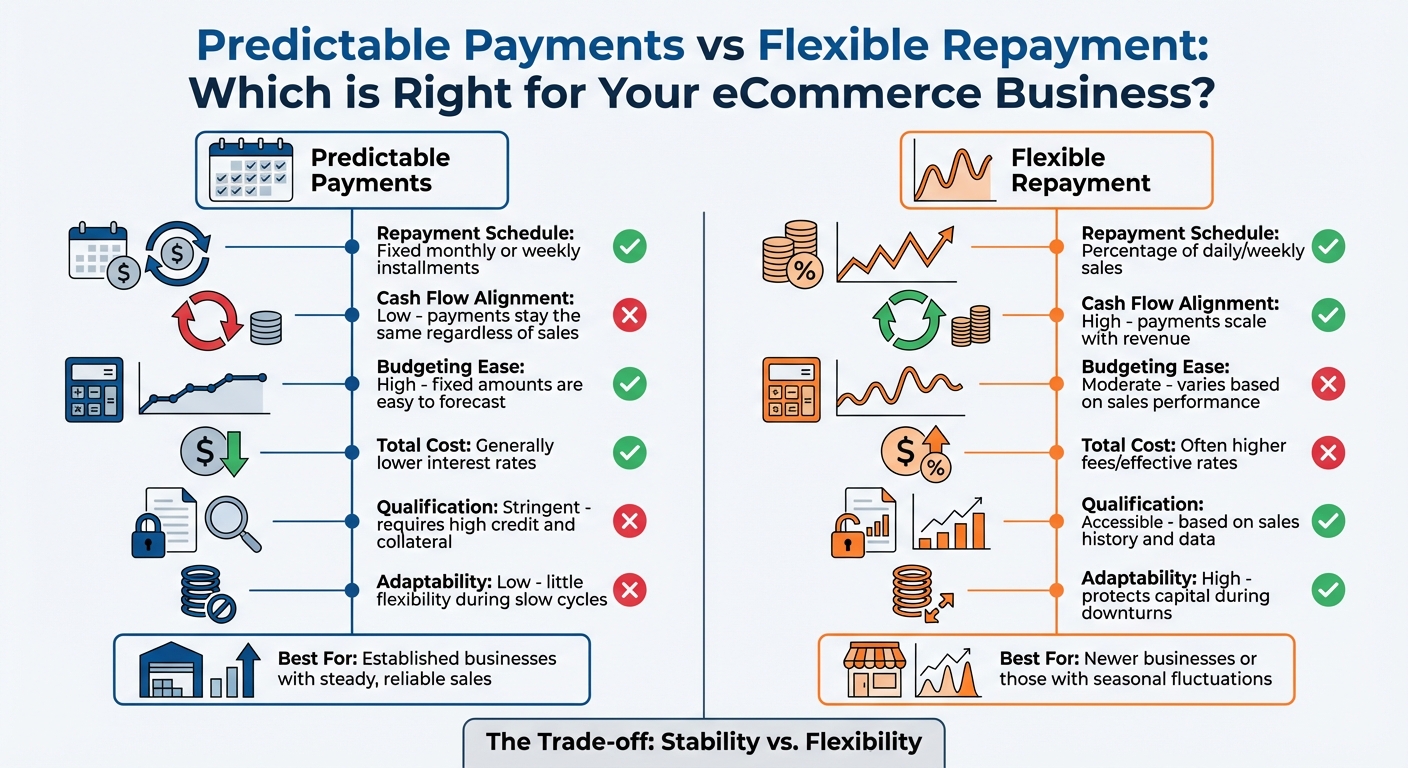
Choosing between predictable payments and flexible repayment boils down to balancing stability with adaptability. Each model impacts cash flow, budgeting, and planning in unique ways.
Key Differences Table
At the heart of this comparison is the trade-off between stability and flexibility. Predictable payments offer consistency, making it easier to plan ahead without worrying about fluctuating repayment amounts. In contrast, flexible repayment adjusts in line with your earnings, which can be a relief during slower periods but comes with higher costs.
Businesses with steady, reliable sales often lean toward predictable payment plans due to their lower costs and straightforward budgeting. On the other hand, businesses experiencing seasonal highs and lows may prefer the flexibility of payments tied to revenue, even if it means paying more in the long run.
The qualification process also highlights a key difference. Fixed payment plans typically require strong credit scores and collateral [1], making them more suitable for established businesses. Flexible repayment options, however, rely on sales performance and data [1], offering a lifeline to newer businesses or those with limited credit history - albeit at a higher price.
How Onramp Funds Supports eCommerce Growth
Onramp Funds makes funding for eCommerce businesses straightforward by integrating directly with popular eCommerce platforms. These integrations allow sellers to access funding without tedious spreadsheets or personal credit checks. Supported platforms include Amazon, Shopify, Walmart, BigCommerce, WooCommerce, Squarespace, TikTok Shop, Shopline, and Stripe. By analyzing real-time sales data, Onramp Funds qualifies businesses with at least $10,000 in average monthly sales[8].
Platform Integrations
The integration process is designed to eliminate the usual application headaches. Once connected, Onramp's system reviews sales history and cash flow to create a funding plan that aligns with your business needs[8]. Payments are automatically synced with sales deposits, offering what Torrie V., Founder and Owner of Torrie's Natural, calls a "set it and forget it" experience:
"Onramp has simplified cash flow by automating everything: easy to request, set it and forget it payments – quick and fast!"[8]
Merchants can receive funding in less than 24 hours[8], with no upfront or recurring fees[9]. To date, the platform has facilitated over 3,000 eCommerce loans, helping sellers save an average of 50% compared to traditional loans or costly cash advances[9]. This seamless integration ensures funding is both accessible and practical.
Example: Funding Inventory and Marketing
These integrations are particularly useful for preparing for high-demand periods. For example, an eCommerce seller with a Shopify store generating $50,000 in monthly revenue might use Onramp's funding to gear up for the Q4 shopping season. By opting for Onramp's fixed repayment model, they secure capital for inventory with predictable weekly payments over six months. This setup allows them to launch aggressive marketing campaigns while maintaining steady cash flow, regardless of daily fluctuations in sales.
Nick James, CEO of Rockless Table, shared his experience:
"We applied, received our offer, and had cash in our bank within 24 hours. The Austin-based team helped us deploy the funds to grow our business."[8]
With payments starting as low as 1% of sales[9] and a flat fee structure that avoids compounding interest[8][10], Onramp Funds provides sellers with a transparent and manageable way to plan their budgets without worrying about hidden charges.
Conclusion: Choosing Stability for Long-Term Growth
Predictable payments help smooth out cash flow and make it easier to plan for steady eCommerce growth. While flexible repayment options might work for short-term needs, they can make budgeting tricky, especially during seasonal fluctuations.
Onramp Funds offers a fixed fee model - between 2% and 8% - that ensures clear, upfront pricing with no hidden surprises. For example, securing $10,000 in funding with a 5% fee means a $500 charge[4]. This makes it easier to budget for key expenses like inventory, marketing, and operations.
Their repayment structure provides consistency, even during slower periods, so sellers can reinvest wisely without worrying about complicated administrative tasks. Plus, with funding available in less than 24 hours, sellers can keep their operations running smoothly. And as revenue grows, financing costs stay the same.
Opting for predictable payments creates the financial foundation needed to support scalable, long-term growth in eCommerce.
FAQs
How do I know if predictable payments fit my store’s cash flow?
Take a close look at your revenue patterns and cash flow to determine what kind of repayment structure works best for your business. If your sales are steady and consistent, opting for predictable payments can make budgeting easier and give you a clearer picture of your finances.
On the other hand, if your revenue tends to fluctuate or follows seasonal trends, a more flexible repayment plan might be a better fit. To figure this out, analyze your sales data from the past 12–24 months. Pay attention to your expenses, accounts receivable, and any seasonal shifts in revenue. This will help you decide if a fixed payment schedule aligns with your cash flow or if flexibility is the smarter choice.
What happens if my sales drop during a slow season?
If your sales take a hit during a slow season, offering flexible financing options like revenue-based financing can make a big difference. With this approach, repayments adjust in line with your reduced revenue, helping to ease financial strain and keep your cash flow steady during tough times.
How can I estimate my total cost before accepting funding?
You can figure out your total cost by using tools like an eCommerce lending cost calculator. These tools break down funding options into a single, easy-to-understand metric like APR. This helps you see the actual repayment cost clearly, so you can make a well-informed decision before committing to any funding.
Related Blog Posts
Onramp Funds
Funding built around your sales
Connect your store and see what you qualify for. Repay as a percentage of sales, with no personal credit check.
Funding in as little as 24 hours.
