


Running an eCommerce business is tough, but smart capital management can make it easier. Here’s how you can tackle common challenges like cash flow gaps, supply chain delays, and rising costs:
- Calculate your capital needs: Track cash flow patterns, seasonal trends, and inventory expenses.
- Secure flexible financing: Use options like revenue-based funding that adjust with your sales.
- Optimize inventory and supply chains: Diversify suppliers, maintain buffer stock, and use inventory management tools.
- Diversify income streams: Sell on multiple platforms like Amazon, Shopify, and TikTok Shop.
- Reinvest for growth: Focus on automation, data-driven decisions, and customer retention.
Key takeaway: Managing capital effectively helps you overcome disruptions, maintain steady cash flow, and position your business for long-term growth.
Take Control of your eCommerce Cash Flow For Business Success!
sbb-itb-d7b5115
Determine How Much Capital Your Business Needs
Before you start allocating funds, it’s critical to understand exactly how much capital your business requires. By analyzing cash flow, inventory needs, and growth opportunities, you can pinpoint your financial requirements. Without this clarity, you risk either running out of resources at critical moments or locking up money that could be better utilized elsewhere.
Getting a clear picture of your capital needs helps safeguard your business against unexpected market shifts. To do this, focus on three key areas: cash flow patterns, inventory expenses, and funding tools.
Track Cash Flow Patterns and Seasonal Changes
Start by examining your past sales, seasonal trends, and operational costs to anticipate potential cash flow gaps during slower periods [2]. Key metrics to review include total sales volume, product performance, return rates, and restocking expenses. These figures will help you align your funding with inventory demands [2].
Seasonal fluctuations can put a strain on cash flow if you’re unprepared [2]. Compare your cash flow statements with both actual and projected operating costs to identify short-term funding needs [2]. For example, cash shortages often arise during high-cost advertising campaigns, when hiring additional staff, or while scaling operations to meet sudden demand [2]. Reviewing past HR data can also reveal which months typically require more labor hours, allowing you to plan for seasonal staffing needs [2].
Once you understand your cash flow dynamics, you can move on to calculating supply and inventory costs.
Calculate Inventory and Supply Chain Expenses
Inventory management plays a huge role in determining your working capital (Current Assets – Current Liabilities) [4][5]. To get a clear picture, estimate all fulfillment costs, including the price of goods, warehousing, shipping, and related fees. Additionally, factor in your cash conversion cycle - the time it takes to turn inventory into cash - to optimize inventory levels [1][4][5].
Use historical sales data to refine demand forecasting. This helps you maintain enough inventory to meet customer needs without overstocking, which can tie up cash unnecessarily [4]. Be sure to account for supply chain disruptions like rising manufacturing costs, shipping delays, or unexpected stockouts [1].
A solid working capital ratio (Current Assets ÷ Current Liabilities) typically falls between 1.50 and 2.00 [5]. In fact, a 2024 survey found that 62% of corporate CFOs and treasurers rely on external working capital solutions to improve efficiency and support growth [5].
Use Funding Calculators to Estimate Capital Requirements
Digital tools can simplify the process of estimating your capital needs for specific goals, such as purchasing inventory or launching marketing campaigns. Cash flow and working capital calculators can help you assess your net liquid assets (Current Assets - Current Liabilities) and identify potential cash shortfalls [3][5].
Get Fast, Flexible Financing with Onramp Funds

When you know exactly how much capital your business needs, finding the right financing solution becomes the next step. Traditional loans can be a challenge for eCommerce sellers, especially during market ups and downs. Fixed monthly payments don’t adjust for slower sales periods or unexpected surges, often putting unnecessary pressure on cash flow.
Onramp Funds offers a solution tailored for eCommerce businesses on platforms like Amazon, Shopify, Walmart, and TikTok Shop. Their financing is equity-free, meaning you keep full ownership of your business while accessing funds in as little as 24 hours. What makes it stand out is its repayment model - it adjusts based on your sales. When sales are strong, payments increase. When sales slow down, payments decrease accordingly [8]. This approach can help you maintain steady cash flow through seasonal shifts or supply chain hiccups.
How Onramp Funds Financing Works
Onramp Funds integrates directly with your eCommerce platform to analyze real-time data, including sales, inventory, and customer behavior [7]. This streamlined, data-driven process eliminates the need for collateral or extensive paperwork, making approvals faster and easier. Plus, their transparent fee structure ensures no hidden costs. You can even select repayment frequencies - daily, weekly, or bi-weekly - to match your business’s cash flow [6].
The revenue-based repayment model means you’re not locked into fixed obligations. Whether you’re stocking up for peak seasons or seizing new supplier opportunities, you can access capital without the stress of rigid payment terms.
Onramp Funds Pricing Plans Compared
| Plan Name | Price | Description | Features | Limitations |
|---|---|---|---|---|
| Custom Funding Offers | Variable | Tailored funding for your business | Fast funding, equity-free, flexible repayment | Requires integration with supported platforms |
| Fixed Fee Structure | 2-8% fee | Predictable repayments with fixed fees | Transparent costs, no hidden fees | Minimum $10,000 monthly sales required |
| Revenue-Based Financing | Based on sales | Repayments adjust with sales | Flexible remittance, no fixed payments | Requires sales history and store connection |
These options are designed to fit your business’s unique needs and operational cycle.
Requirements to Qualify for Onramp Funds
To qualify, your business must generate at least $10,000 in monthly sales and be connected to a supported eCommerce platform like Amazon, Shopify, Walmart, or TikTok Shop [7]. By integrating with your platform, Onramp Funds can review your sales history and performance in real time, simplifying the approval process [6]. Since the financing is unsecured, there’s no need for collateral or giving up equity in your business.
Improve Inventory and Supply Chain Management with Capital
Using capital wisely can strengthen your inventory and supply chain, ensuring your business is better prepared for disruptions. Supply chain challenges have the potential to cut up to 45% of annual profits over a decade [11]. Even a single prolonged production issue can reduce earnings before interest, taxes, and depreciation by 30% to 50% [9].
One effective approach is to build relationships with multiple suppliers across different regions. This diversification provides alternative sources when disruptions occur. While managing multiple suppliers may increase administrative costs, it serves as a safeguard against total supply chain breakdowns [10]. Many companies are adopting this strategy to reduce risks [11].
Nearshoring - a practice of moving production closer to home - is another way businesses are cutting shipping risks and reducing lead times [9]. Additionally, treating suppliers as long-term partners, rather than one-off transactions, can help secure priority during shortages [11].
"The mantra we use at Jabil is to treat supplier partners like a customer." - Frank McKay, Senior Vice President, Chief Supply Chain Officer, Jabil [11]
This approach complements earlier cash flow and inventory strategies.
Keep Extra Inventory for Peak Seasons
Diversifying suppliers is just one piece of the puzzle. Keeping additional inventory on hand can shield your business from unexpected demand spikes. While just-in-time models are efficient, they often fail during peak periods. Maintaining safety stock ensures you can consistently meet customer needs.
Take Toyota Motor Corp. as an example. After semiconductor shortages, the company instructed suppliers to increase inventory levels from three to five months. While this reduced traditional inventory efficiency metrics, it led to record-breaking profits and production levels [9].
For seasonal peaks, consider placing large orders ahead of time. This not only secures stock but also allows for negotiating better payment terms with suppliers [2]. Be sure to account for the costs of storage, labor, and marketing to move this inventory effectively.
Use Inventory Management Software
Relying on manual spreadsheets can lead to costly mistakes. Inventory management software offers real-time tracking, demand forecasting, and tools to prevent stockouts or overselling [12][13][14].
These systems can automate tasks like purchase orders and reorder notifications, while AI-based forecasting analyzes historical data to predict future demand. This is especially useful for handling seasonal peaks or managing longer lead times [13][14].
For example, some companies have cut warehousing costs by switching to flexible fulfillment solutions [9]. During the 2020 COVID-19 shutdowns, O2, an athletic recovery drink brand, used Ware2Go’s flexible fulfillment service. They fulfilled 98% of new direct-to-consumer orders on time, fueling a fivefold increase in business during the pandemic [9].
When choosing inventory management software, pick a solution that fits your business size and needs. Small-to-mid-sized retailers might find Zoho Inventory or Shopify’s built-in tools sufficient - Zoho even offers a free tier for businesses processing fewer than 50 orders per month. Larger operations, on the other hand, may require enterprise-grade solutions like NetSuite, which supports global compliance and full supply chain automation [14][15].
Add Revenue Channels and Control Cash Flow
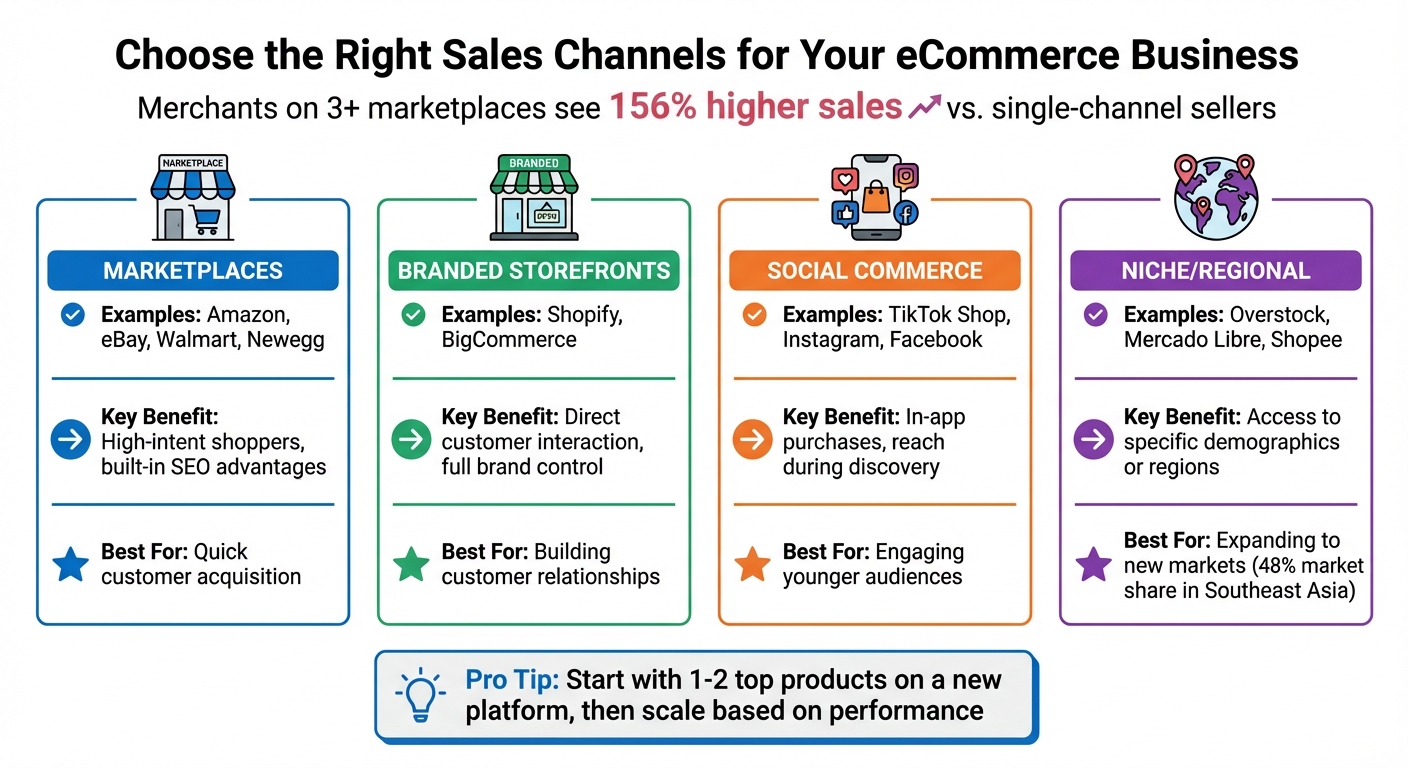
Diversifying your revenue streams is a smart move to protect your business from sudden market changes. Relying on just one sales channel can be risky - if that platform changes its algorithm, suspends your account, or faces a downturn, your entire income could vanish. By spreading your business across multiple platforms, you create a financial safety net that keeps cash flowing even if one channel underperforms [18].
Here's a compelling stat: merchants active on three or more marketplaces see 156% higher sales compared to those using just one channel [16]. Use your capital to establish a presence on platforms like Amazon, Walmart Marketplace, TikTok Shop, or Instagram. Each of these platforms brings its own audience and shopping habits [16].
"Even if most of your eggs are in one basket, if that gets tipped over, you still have revenue [from alternate sales channels]."
- Minna Khounlo-Sithep, Co-founder, The Product Boss [18]
Start small by launching one or two of your top products on a new platform. Monitor customer feedback and sales performance before scaling up [18]. Investing in tools like multichannel listing software and automated repricing systems can help you manage inventory and pricing across platforms seamlessly. A centralized system ensures you have real-time visibility and avoids overselling [16][17].
Sell on Multiple Platforms for Steady Revenue
Different platforms offer distinct opportunities to diversify your revenue. For example, marketplaces like Amazon and eBay attract shoppers ready to buy, while branded storefronts like Shopify let you build direct relationships with customers. Social commerce platforms like TikTok Shop and Instagram enable quick, in-app purchases during moments of discovery [16][1].
Here’s a quick breakdown of platform types:
| Platform Type | Examples | Key Benefit |
|---|---|---|
| Marketplaces | Amazon, eBay, Walmart, Newegg | High-intent shoppers, built-in SEO advantages |
| Branded Storefronts | Shopify, BigCommerce | Direct customer interaction, full brand control |
| Social Commerce | TikTok Shop, Instagram, Facebook | In-app purchases, reach during discovery |
| Niche/Regional | Overstock, Mercado Libre, Shopee | Access to specific demographics or regions |
Consider testing international markets, where competition might be lower, and profit margins higher. For instance, a leading Southeast Asian marketplace holds a 48% market share in its region, offering a great opportunity for U.S. sellers [19]. However, always factor in total landed costs, including platform fees, shipping, and local taxes, to ensure profitability [19].
While third-party platforms are great for customer acquisition, focus on building an email list. This gives you direct access to your customers, reducing reliance on platforms and their risks [18].
"Being on more sales channels allows you to get on other people's platforms and audiences."
- Jacqueline Snyder, Co-founder, The Product Boss [18]
Use Cash Flow Management Tools
Keeping a close eye on cash flow is essential. Tools that integrate with your bank accounts, ERP systems, and CRMs can provide real-time insights into your financial health [20][4].
Forecast your cash inflows and outflows for the next four to six weeks to identify potential gaps early [20]. A healthy current ratio - calculated by dividing current assets by current liabilities - should fall between 1.5 and 2 [4].
Automating invoice reminders and vendor payments can improve your cash conversion cycle. Use full payment terms unless early-pay discounts offer a better deal [20][4]. Businesses have reported a 30% increase in operating cash flow by renegotiating supplier terms and diversifying revenue streams [20].
Keep an emergency fund that covers three to six months of operating expenses. This buffer provides a safety net for unexpected disruptions [20]. Shortening your cash conversion cycle - how quickly you turn inventory into cash - reduces financial risk and frees up funds for other investments [4].
Budget for Marketing and Promotions
Marketing is crucial for maintaining steady revenue, especially during slower periods. For instance, August often sees reduced activity due to vacations, while February can be sluggish after the holiday season [2]. Use your budget to maintain brand visibility through email campaigns and content sharing during these times.
Plan aggressively for Q4, when holiday shopping peaks. While advertising costs rise due to increased competition, the potential return from high-intent buyers is worth the investment [2]. Allocate funds for retargeting campaigns in January and February to turn holiday shoppers into repeat customers. This shift from one-time sales to building customer lifetime value (LTV) makes the high acquisition costs of Q4 more worthwhile [2].
When offering discounts, aim for 50% off - research shows this is the sweet spot for consumer interest. Discounts higher than 70% or lower than 25% don’t have the same impact [2].
Flexible funding options can also help. Look for repayment plans that adjust to your sales volume, so you’re not pressured by fixed payments during slow periods. This allows you to invest in marketing campaigns while maintaining operational stability. Reinvesting in targeted promotions ensures your business stays resilient and competitive.
Reinvest Capital for Long-Term Growth
When a business has steady cash flow and diverse revenue streams, reinvesting wisely can transform that capital into sustainable growth. But here's the thing: there's a difference between simply growing and scaling. Growth often means an equal increase in both revenue and costs, while scaling focuses on boosting revenue without a matching rise in expenses [21]. The secret lies in channeling your capital into tools and systems that amplify results without adding unnecessary overhead.
With 28% of the global population shopping online [21] and 64% of commerce professionals noting higher customer expectations [22], reinvesting strategically is more important than ever. Smart investments in automation, data systems, and customer retention can turn your capital into a long-term advantage that builds momentum over time.
Add Platform Integrations and Automation
Automation is a game-changer for eCommerce businesses, no matter their size [22]. Start by automating your most time-consuming processes. For example, the "order-to-cash" cycle - from the moment a customer places an order to when the payment is received - is a prime area for improvement [22].
Centralized systems like ERP platforms (think Acumatica or NetSuite) can unify inventory, order management, and financial data across all sales channels [21][25]. These systems reduce manual data entry, cut down on errors, and free up time for more strategic initiatives.
In fact, research shows that 66% of business leaders experimented with workflow automation in at least one area in 2020 [23]. Take Helthjem, a delivery service that introduced an AI chatbot during the COVID-19 pandemic to manage a surge in customer inquiries. The result? A 25% increase in average order values [21].
Focus on automating first-level customer service tasks, such as order status updates, return requests, and basic product information. With 90% of customers expecting responses in under 10 minutes [21][23], AI chatbots can provide instant support around the clock, allowing your team to focus on more complex issues.
Platforms like Shopify Plus or BigCommerce, which support API integrations, make it easy to expand across multiple channels [21]. Don't overlook automated tax and compliance tools like Avalara, which handle regional tax rates and help you avoid costly errors [21].
| Strategy | Complexity | Outcome |
|---|---|---|
| Process Automation | Medium-High | 20–50% cost reduction; faster workflows [24] |
| Strategic Sourcing | Medium | 5–25% savings on procurement costs [24] |
| Shared Services | High | 15–40% reduction in functional costs [24] |
| Value Engineering | Medium | 10–30% savings on product costs [24] |
| Workforce Optimization | Medium | 10–30% reduction in labor costs [24] |
Grow Your Business Using Performance Data
Using data to guide decisions ensures your capital goes where it delivers the best results. Start by keeping an eye on your Current Ratio (Current Assets ÷ Current Liabilities). A healthy ratio between 1.5 and 2.0 signals you have enough liquidity to grow without risking your operations [26].
Your Cash Conversion Cycle (CCC) measures how quickly you turn inventory spending into cash from sales. A shorter cycle frees up more capital for reinvestment [26]. Similarly, tracking Days Sales Outstanding (DSO) - how long it takes to collect payments - can help improve cash flow and direct funds more effectively [26].
Real-time dashboards that integrate bank accounts, CRM, and ERP systems can flag cash flow gaps before they become problems [20][26]. Businesses using data-driven inventory systems and exploring alternative revenue streams have seen operating cash flow increase by up to 30% in just three months [20].
Tools like ABC inventory analysis can help you identify your best-selling products ("fast-movers") and allocate more resources to them, while liquidating slow-moving inventory to free up cash [20]. Rolling cash flow forecasts based on historical data can show how much capital you can safely reinvest over the next 4–6 weeks [20].
Auditing recurring expenses often reveals underused software or ineffective marketing channels where money is being wasted [26]. Redirecting these funds to high-performing areas, while benchmarking DSO and inventory turnover against industry standards, can uncover more opportunities for efficiency [26].
Modern tools powered by AI and open banking now make it easier to categorize transactions and improve growth forecasts without needing a dedicated analytics team [20]. These insights can guide smarter reinvestment decisions.
Invest in Customer Retention for Consistent Revenue
Retaining customers is one of the most cost-effective ways to grow. Since 2013, customer acquisition costs have risen by 222% [27], making it far more expensive to win new customers than to keep existing ones. High retention rates also increase customer lifetime value (LTV), creating a more predictable revenue stream [27][29]. Investors closely monitor retention metrics because they reflect brand loyalty and long-term stability [28][29].
Reinvest in advanced CRM systems that track customer interactions and enable personalized experiences [30]. Go beyond basic loyalty programs by offering VIP tiers, unexpected rewards, or engaging content like quizzes and polls [27]. With 75% of commerce brands already automating order support and self-service options, staying competitive means meeting or exceeding these standards [22].
Improving shipping and warehousing processes can also encourage repeat business [31][32]. On the digital side, optimizing your website for mobile users with features like one-click checkouts and faster load times is essential. By 2025, mobile commerce is expected to account for 59% of all retail e-commerce sales, totaling around $4.01 trillion [29].
Consider building community hubs - like online forums or hosting exclusive events - to foster a sense of belonging among your customers [27]. This is especially important for younger generations, with 80% of Gen Z and millennials more likely to support brands that align with their values [27]. Transparent business practices and sustainability initiatives are increasingly important for retaining these customers.
AI tools can take personalization to the next level, offering tailored product recommendations and enhancing engagement with chatbots [29]. Some brands are even leveraging augmented reality (AR) and virtual reality (VR) to let customers "try" products virtually, reducing returns and boosting confidence in their purchases [27]. Investing in customer retention not only strengthens revenue but also sets the foundation for scalable growth by increasing LTV and lowering acquisition costs over time.
Conclusion
Running a resilient eCommerce business hinges on smart financial management. Start by closely monitoring your cash flow and pinpointing exactly how much funding you need to cover inventory, supplier costs, and seasonal spikes. Once you’ve got a clear picture of your numbers, look for flexible financing options that align with your sales cycles rather than working against them. For example, Onramp Funds provides quick, equity-free capital with repayments that adjust based on your revenue - helping you maintain cash flow while seizing growth opportunities.
To safeguard your operations, diversify your suppliers to minimize risks, build buffer inventory for busy seasons, and explore platforms like Shopify and TikTok Shop to create steady revenue streams. Considering that 82% of small businesses fail due to cash flow issues [33], having reliable tools to track expenses and forecast your financial needs is not just helpful - it’s critical.
When reinvesting, focus on strategies that yield the greatest impact. Automate repetitive processes, let performance data inform your decisions, and prioritize customer retention to boost lifetime value. These steps won’t just help you weather market shifts - they’ll also enable you to grow efficiently without inflating costs.
FAQs
How can I determine how much capital my eCommerce business needs?
To determine how much capital your eCommerce business needs, start by examining your working capital - the difference between your current assets and liabilities. This calculation gives you a snapshot of the funds available for daily operations. Next, build a cash flow forecast to predict future income and expenses. This step helps you spot potential funding gaps or surpluses while factoring in seasonal trends, unexpected costs, and sales across all your channels.
It’s also essential to review metrics like inventory turnover, marketing expenses, and payment terms. These figures provide insight into the capital required to maintain or grow your business. Using tools like accounting software or cash flow management platforms can make these calculations easier and ensure your funding strategy aligns with your business objectives. Combining financial analysis with careful planning will help you estimate your capital needs and make informed decisions to support your business’s growth.
What are the advantages of revenue-based financing for eCommerce businesses?
Revenue-based financing offers eCommerce businesses a way to manage cash flow with repayment terms that scale with your sales. This means during slower seasons, you pay less, and during busier times, you pay more - making it a flexible option compared to traditional loans. Plus, there’s no need to put up collateral or give away any ownership in your business.
This approach lets you channel resources into growth areas like inventory, marketing, or upgrading technology - all without the pressure of fixed monthly payments. It’s a smart option for businesses navigating the ups and downs of a fast-changing market.
How does diversifying revenue streams make my business more resilient?
Diversifying how your business earns money can safeguard it from being overly dependent on just one income source. By spreading your earnings across various channels, you’re better equipped to handle challenges like market shifts, supply chain disruptions, or seasonal dips in demand.
It’s not just about stability, though - it’s also about growth. Branching out allows you to reach new customer groups and explore untapped markets. For instance, you might consider selling on additional platforms, introducing complementary products, or even offering subscription services. These strategies can help maintain consistent cash flow and build a more resilient business over time.
Related Blog Posts
Onramp Funds
Funding built around your sales
Connect your store and see what you qualify for. Repay as a percentage of sales, with no personal credit check.
Funding in as little as 24 hours.
