


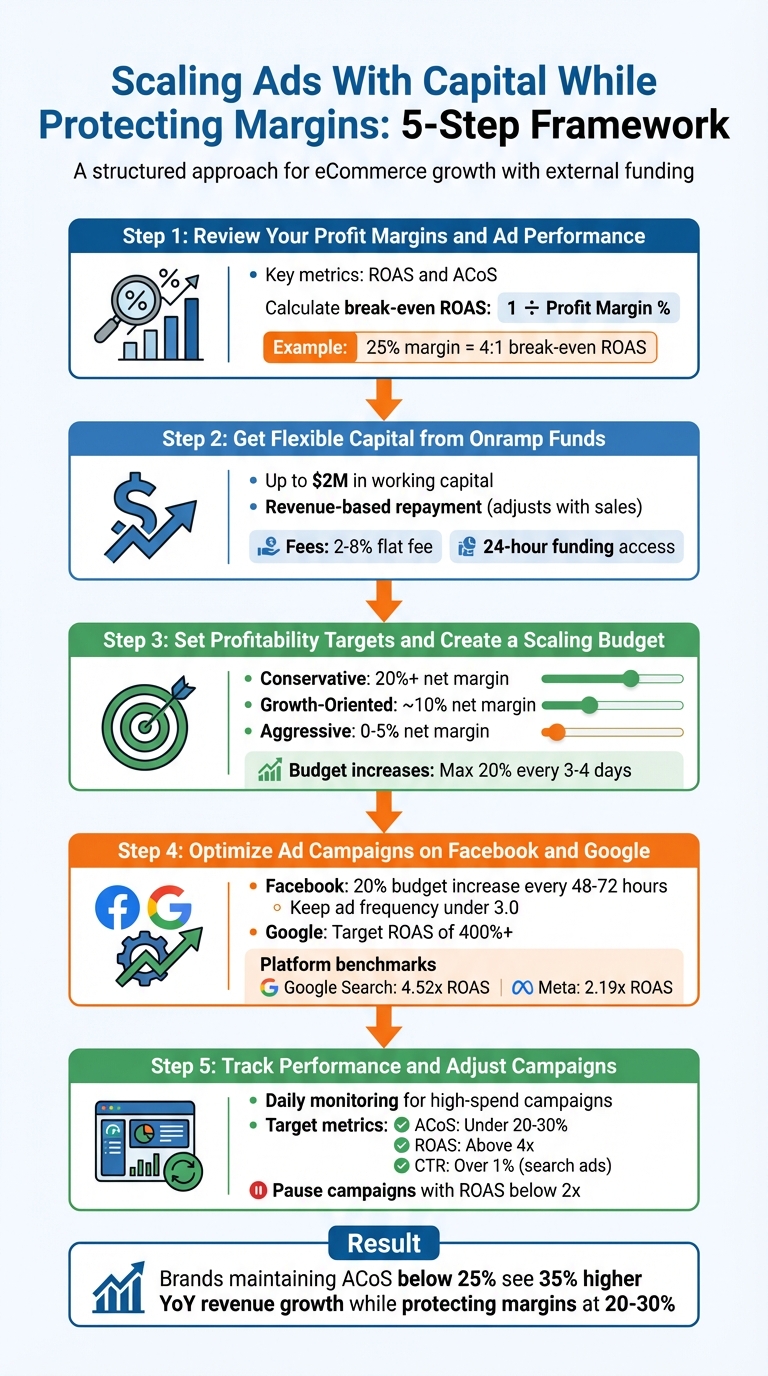
Scaling ads without sacrificing profit margins can be challenging for eCommerce businesses. Increasing ad spend too quickly risks cash flow and profitability, especially when most working capital is tied up in inventory and operations. The solution? Use external financing to grow ad budgets while maintaining financial stability. Here's how:
- Focus on Metrics: Understand key performance indicators like ROAS (Return on Ad Spend) and ACoS (Advertising Cost of Sale) to identify profitable campaigns.
- Secure Flexible Funding: Revenue-based financing, like Onramp Funds, ties repayments to sales performance, offering a cash flow-friendly way to scale ads.
- Set Profitability Goals: Calculate your break-even ROAS and contribution margins to guide ad spend decisions.
- Optimize Campaigns: Gradually scale ads on platforms like Facebook and Google while monitoring performance. Avoid overspending by using automated rules and refreshing creatives.
- Track Results: Regularly review metrics like ACoS, ROAS, and CTR to ensure campaigns remain profitable.
How to Scale Ecom Ads to $10K/Day (The System)
sbb-itb-d7b5115
Step 1: Review Your Profit Margins and Ad Performance
Before diving into ad spending with external capital, take a hard look at your financials. A common mistake sellers make is oversimplifying their profit margin as "selling price minus product cost." This misses crucial factors like fulfillment, payment processing fees, platform commissions, and returns, all of which eat into your bottom line [4]. Once you've got a clear picture of your margins, move on to evaluating your ad performance to zero in on campaigns that are actually driving profits.
"Understanding your break-even ROAS is the difference between profitable growth and cash flow destruction. Most ecommerce businesses that fail do so because they prioritized growth over profitability." - Oliver, Digital Ads Calculator [4]
Review Ad Performance Metrics
Getting a handle on your ad performance starts with knowing your numbers. Two key metrics to focus on are Return on Ad Spend (ROAS) and Advertising Cost of Sale (ACoS).
- ROAS tells you how much revenue you're making for every dollar spent on ads. It's calculated by dividing total revenue by ad spend.
- ACoS, on the other hand, shows the percentage of your revenue that goes toward advertising. You calculate it by dividing ad spend by total revenue, then multiplying by 100.
Beyond these, keep an eye on conversion rates and keyword performance to make smarter budget decisions [5]. A/B testing can also reveal which images, audience segments, or ad variations are pulling their weight [5].
Calculate Breakeven Points
Your break-even ROAS is a critical number to know - it’s calculated as 1 ÷ Profit Margin Percentage. For instance, if your profit margin after all costs is 25%, your break-even ROAS is 4:1. This means you need to generate at least $4 in revenue for every $1 spent on ads to avoid losing money [4].
Use this break-even ROAS as your baseline. Campaigns that fall below this level should either be paused or optimized. But remember, your break-even ROAS isn't the goal - it’s the bare minimum. To grow sustainably, focus on scaling campaigns that consistently exceed this threshold. That way, you'll keep your margins intact while expanding your reach.
Step 2: Get Flexible Capital from Onramp Funds
Once you've pinpointed profitable campaigns, the next step is securing flexible funding to scale effectively. Traditional financing often comes with rigid repayment terms that can squeeze your cash flow. That’s where revenue-based financing stands out - it adjusts repayments based on your actual sales, offering more breathing room during slower periods. Here’s how Onramp Funds uses this model to help you scale your advertising efforts.
How Onramp Funds Financing Works
Onramp Funds offers up to $2 million in working capital specifically for eCommerce sellers on platforms like Amazon, Shopify, Walmart Marketplace, and TikTok Shop [7]. The process is simple: connect your store or payment processor, let Onramp review your sales data, and get access to funds within 24 hours [7].
Instead of fixed monthly payments, this financing model ties repayments to a percentage of your daily or weekly sales. There’s no need for a personal credit check or collateral, and you maintain full ownership of your business [7].
"Our customers have been asking us for even more flexibility with respect to how they can draw capital as needs arise. We're thrilled to offer this new product to better serve them as they reach new stages of growth."
– Eric S. Youngstrom, CEO and Founder, Onramp Funds [6]
Onramp’s fee structure is straightforward, ranging from 2% to 8% of the funded amount with no hidden charges or compounding interest [7]. For Amazon sellers, fees typically fall between 0.5% and 4% of sales, with an estimated APR of 11.9% to 19.9% [7]. To qualify, businesses must be based in the U.S. and generate at least $10,000 in monthly sales [7].
Financing Options Comparison Table
Here’s a breakdown of three financing plans designed to match different scaling strategies:
| Financing Plan | Key Features | Pricing/Fees | Best For |
|---|---|---|---|
| Rolling Cash Line | Revolving credit that grows with sales; pay fees only on the capital used | One transparent fee | Ongoing ad campaigns and maintaining a consistent advertising presence |
| Variable Funding | Quick access to capital with sales-based repayment; remittance as low as 1% of daily sales | 2% to 8% flat fee | Short-term marketing pushes, seasonal ad scaling, or capturing immediate demand |
| Fixed Funding | Predictable equal installments with a "frozen" effective APR | 2% to 8% flat fee | Strategic scaling projects that require simplified cash flow planning |
"Having the flexibility to draw funds as we need them has been a game changer for our growth. Onramp's customer service is always excellent, and I know I have a true partner in them."
– Chad Tovey, Owner of Curriculum [6]
Step 3: Set Profitability Targets and Create a Scaling Budget
Once you've secured the necessary capital, it's time to pinpoint your contribution margin before ramping up ad spend. Even impressive ROAS numbers, like 4.5x, might only translate to slim margins - around 7.8% - after factoring in COGS, shipping, and other variable expenses [9]. To build a sustainable budget, focus on your contribution margin, which is the amount left after deducting COGS, shipping, and marketing costs from your revenue. Use this as the foundation for setting ad spend limits that align with your profitability goals.
Set Tiered ACoS Targets
A tiered approach to ACoS (Advertising Cost of Sales) can help you adapt based on your business's growth stage:
- Conservative Strategy: Aim for a net profit margin of 20% or more by keeping ACoS low. This approach prioritizes retargeting high-intent customers and maintaining steady profits [8].
- Growth-Oriented Strategy: Align with industry norms of around a 10% net margin. This allows for a moderate ACoS, enabling you to steadily scale successful campaigns [8].
- Aggressive Strategy: Push ACoS close to breakeven (0–5% net margin) to quickly gain market share or attract new customers [11].
Your gross margin plays a key role in determining how much you can spend. For instance, beauty brands with gross margins of 50–70% can afford higher ACoS, while electronics sellers with tighter margins of 15–25% need to be more cautious [8]. To calculate your maximum ad spend, use the breakeven ACoS formula:
(Net Sales – COGS – Shipping Expense) / Net Sales [12].
Campaign Scaling Decision Framework Table
Before scaling any campaign, use the following framework to validate its readiness:
| Step | Action | Criteria for Scaling |
|---|---|---|
| 1. Review ROAS/ACoS | Compare current performance against your tiered targets. | If your marginal ROAS is above breakeven (with a safety buffer), move forward. |
| 2. Check Conversion Rate | Assess the landing page and offer's performance. | If conversion rates are stable or improving, proceed. |
| 3. Evaluate Profit | Look at the contribution margin after ad spend and COGS. | If net profit per order is still positive, you're good to go. |
| 4. Adjust Budget | Gradually increase the budget. | Limit increases to 20% every 3–4 days [10]. |
| 5. Monitor Frequency | Watch for signs of creative fatigue. | If ad frequency stays under 3.0, continue; if it exceeds 3.0, refresh your creative [10]. |
Finally, consider your CAC (Customer Acquisition Cost) payback period:
- If it's under three months, scale aggressively.
- If it's between three and six months, scale cautiously.
- If it's over six months, focus on improving retention or cutting acquisition costs [9].
Step 4: Improve Ad Campaigns on Facebook and Google
With your budgets and goals in place, it's time to focus on optimizing ad performance on two of the most impactful platforms: Facebook and Google. While each platform demands its own strategy, the ultimate aim is the same - make every dollar work harder while keeping your margins intact.
Facebook Ads Optimization Methods
Before scaling your Facebook campaigns, ensure they’re stable. A stable campaign typically shows 7–14 days of consistent performance, a positive ROAS (Return on Ad Spend), and generates at least 25–50 conversions weekly. Meta’s algorithm usually needs around 50 optimization events per week per ad set to exit the learning phase and deliver steady results [13][15][16][17].
When scaling vertically, increase your budget by no more than 20% every 48–72 hours. This avoids resetting the learning phase and keeps performance steady.
"The golden rule for vertical scaling is the 20% rule. To keep things stable, you should only increase the budget on a proven ad set by a maximum of 20% every 48-72 hours." – AdStellar [13]
If your audience starts to saturate, shift to horizontal scaling. This involves duplicating successful ad sets and testing new variables like broader Lookalike Audiences (3%–5%), different interest groups, or expanding into new geographic regions [13][16]. Since Apple’s iOS 14.5 update, broad targeting has often outperformed narrow segments. For example, advertisers have reported a 49% higher ROAS and a 45% lower CPM by eliminating interest and demographic filters and letting Meta's AI identify potential converters [13].
Creative fatigue is another challenge when scaling. For ad spends over $50,000 per month, aim to introduce 15–25 new creatives weekly [16]. Keep an eye on your ad frequency - if it exceeds 3.0 in prospecting campaigns, it’s time to refresh your creatives or broaden your audience [13][14]. To retain engagement metrics like likes, comments, and shares, use the "Post ID" method when moving winning ads into new campaigns [15].
| Monthly Ad Spend | New Creatives Needed Per Week | Active Creatives to Maintain |
|---|---|---|
| $5,000 - $20,000 | 5 - 8 | 10 - 15 |
| $20,000 - $50,000 | 10 - 15 | 20 - 30 |
| $50,000+ | 15 - 25 | 30 - 50 |
To protect your margins, set up automated rules. For example, a "Stop-Loss" rule can pause ad sets if the CPA (Cost Per Acquisition) exceeds your target by 30% after a certain spend. Similarly, a "Winner’s Boost" rule can increase budgets by 20% for ad sets that exceed your ROAS targets [13][15]. Campaign Budget Optimization (CBO) is another effective tool, allowing Meta’s algorithm to reallocate budget dynamically to the best-performing ad sets [13][15].
Google Ads Optimization Methods
Google Ads require a different approach, focusing on capturing high-intent traffic. Start by separating "Brand" keywords from "Non-Brand" terms. For products, allocate higher budgets to bestsellers while lowering bids for items with lower impressions [18]. Every bid strategy should align with your profitability targets.
Use Custom Labels in Google Merchant Center to tag products by their margin levels, such as "High Margin" or "Low Margin." This helps you bid more aggressively on profitable products while being cautious with lower-margin items [18]. When scaling, monitor Marginal ROAS - the return on each additional dollar spent. If it dips below your break-even point, any extra spending becomes unprofitable, even if your average ROAS looks good.
"If your marginal ROAS drops below your break-even point, every new dollar you spend is losing money - even if your average ROAS still looks healthy." – InsightIQ [10]
For Performance Max (PMax) campaigns, avoid micromanaging. Instead, feed the AI high-quality creative assets and robust Audience Signals, such as customer lists and past purchaser data. Once a campaign achieves 30–50 conversions, switch to a Target ROAS (tROAS) strategy to set a profitability floor (e.g., 400%). This ensures additional spending only happens when margins are met [18].
Here’s a real-world example: In March 2026, a mid-size eCommerce brand in Northeast Ohio partnered with Good Smart Idea to implement an AI-powered campaign management system. By integrating Shopify inventory and margin data, the brand slashed its monthly ad spend from $15,000 to $6,000 - a 60% reduction - while maintaining $31,800 in monthly revenue. Over 90 days, their ROAS jumped from 2.1x to 5.3x by using AI to optimize for profit margin per order instead of clicks. The system monitored performance signals every 15 minutes [19].
Group similar campaigns with Portfolio Bid Strategies to speed up algorithm learning. Also, use account-level negative keywords in PMax campaigns to avoid wasting budget on irrelevant searches. During high-conversion periods like flash sales or Q4, take advantage of Seasonality Adjustment tools to encourage more aggressive bidding [18].
Step 5: Track Performance and Adjust Campaigns
Scaling with capital only works if you keep a close eye on performance. For high-spend campaigns, daily monitoring is a must, while smaller budgets can get by with weekly check-ins. The key here is catching inefficiencies early - especially when you're using external funding to drive growth. If you let problems linger, they can eat into your margins fast.
Monitor Key Metrics
Pay attention to metrics like ACoS (Advertising Cost of Sales), ROAS (Return on Ad Spend), CTR (Click-Through Rate), conversion rate, and CPA (Cost Per Acquisition). These numbers reveal whether your ads are profitable or just burning through cash. For instance, if your ACoS creeps above 25% on a product with 40% gross margins, you’re on a slippery slope to losing profitability.
To avoid constant dashboard monitoring, set up automated alerts in tools like Facebook Ads Manager or Google Ads. For example, you can use rules to pause campaigns when ROAS falls below 3x.
While benchmarks depend on your product, here are some general targets to aim for:
- ACoS: Keep it under 20–30%.
- ROAS: Aim for above 4x.
- CTR: Shoot for over 1% for search ads and 0.5–1% for display ads.
If your ACoS goes past your breakeven point (where ad spend eats up all your profit), stop scaling immediately. Campaigns with a ROAS above 3x can usually sustain growth while keeping margins in the 20–30% range [1][2][21].
Make Ongoing Ad Adjustments
When performance starts to slip, you need to act fast. For example, if your ACoS jumps from 20% to 35% due to audience fatigue, here are some steps you can take:
- Pause ad sets with ROAS below 2x.
- Test new creatives that can boost CTR by 10–20%.
- Reduce bids by 15–20%.
Here’s an example: reallocating 30% of the budget from low-CTR video ads to high-performing carousel ads helped one campaign drop its ACoS by 12% while scaling spending by 50% [1][2].
Automated rules can also help protect your margins. For instance:
- Increase bids by 10–20% on keywords or ad sets with ROAS above 4x and CTR over 1%.
- Cut bids by 20–50% on those with ROAS below 2.5x.
- Reallocate budgets weekly, shifting funds from underperforming ads to those hitting your targets.
Refresh your creatives weekly, retiring any ads with a CTR below 0.5%. Duplicate your best-performing ads for A/B testing to see what resonates most with your audience. Following this data-driven approach ensures that scaling doesn’t push you past your breakeven point, so you can grow while keeping your margins intact [1][20][21].
Conclusion
Scaling your ad campaigns with outside funding doesn’t have to come at the expense of your profit margins. The secret lies in taking a data-driven approach - beginning with a solid understanding of your performance metrics like ROAS, CTR, and breakeven points. Pair this with flexible financing options that support growth while keeping your cash flow intact. Onramp Funds provides equity-free financing with repayments tied to your sales, allowing you to scale ad spend from $10,000 to $100,000 per month, all while maintaining healthy margins of 20–30%.
To summarize, here’s the framework: audit your ad performance, secure flexible funding, set tiered ACoS targets, optimize campaigns, and keep a close eye on key performance indicators (KPIs). Brands that stick to this approach and manage to keep ACoS below 25% often experience 35% higher year-over-year revenue growth, all while protecting their profit margins [3][21].
Staying on track requires disciplined monitoring of your metrics. Conduct weekly reviews of ROAS (aiming for 4x or higher) and margins (targeting 20% or more). Use this data to shift budgets from underperforming campaigns to those delivering strong results. With Onramp Funds’ quick, 24-hour access to capital, you can act on opportunities immediately - no need to wait for traditional loan approvals.
Start by running a profitability audit of your current campaigns. From there, secure financing to channel growth capital into the areas where it will make the biggest impact. By scaling only when returns are measurable, this strategy ensures you can boost ad performance while keeping your financial health intact.
FAQs
How do I calculate my break-even ROAS?
To figure out your break-even ROAS, take 1 and divide it by your profit margin percentage. For instance, if your profit margin is 25%, the calculation would look like this: 1 / 0.25 = 4:1. This means you need to generate $4 in revenue for every $1 spent on ads to break even.
Make sure to account for all costs - this includes product costs, advertising expenses, and operational overhead - when determining your profit margin. Getting an accurate profit margin is key before calculating your break-even ROAS.
How much should I increase my ad budget at a time?
Increasing your ad budget requires a careful, step-by-step approach to safeguard your profit margins. A good rule of thumb is to raise your budget by about 10–20% at a time. This strategy gives you the chance to monitor performance closely and make adjustments as needed.
Keep a close eye on key metrics like ROAS (Return on Ad Spend) and profit margins to ensure your growth remains sustainable. For instance, aiming to keep your ad spend under 33% of your revenue and maintaining a ROAS of at least 2.8:1 can help you scale up without compromising profitability.
When does using financing to scale ads make sense?
Financing can be a smart move when growth opportunities demand additional funds - like ramping up ad campaigns or replenishing inventory. It’s particularly useful during times of tight cash flow, enabling you to invest in high-return strategies without interrupting daily operations. To make it worthwhile, ensure your return on ad spend (ROAS) is higher than the cost of borrowing. Also, align funding with specific goals, such as preparing for peak seasons or expanding into new markets, to support growth while safeguarding your profit margins.
Related Blog Posts
Onramp Funds
Funding built around your sales
Connect your store and see what you qualify for. Repay as a percentage of sales, with no personal credit check.
Funding in as little as 24 hours.
