

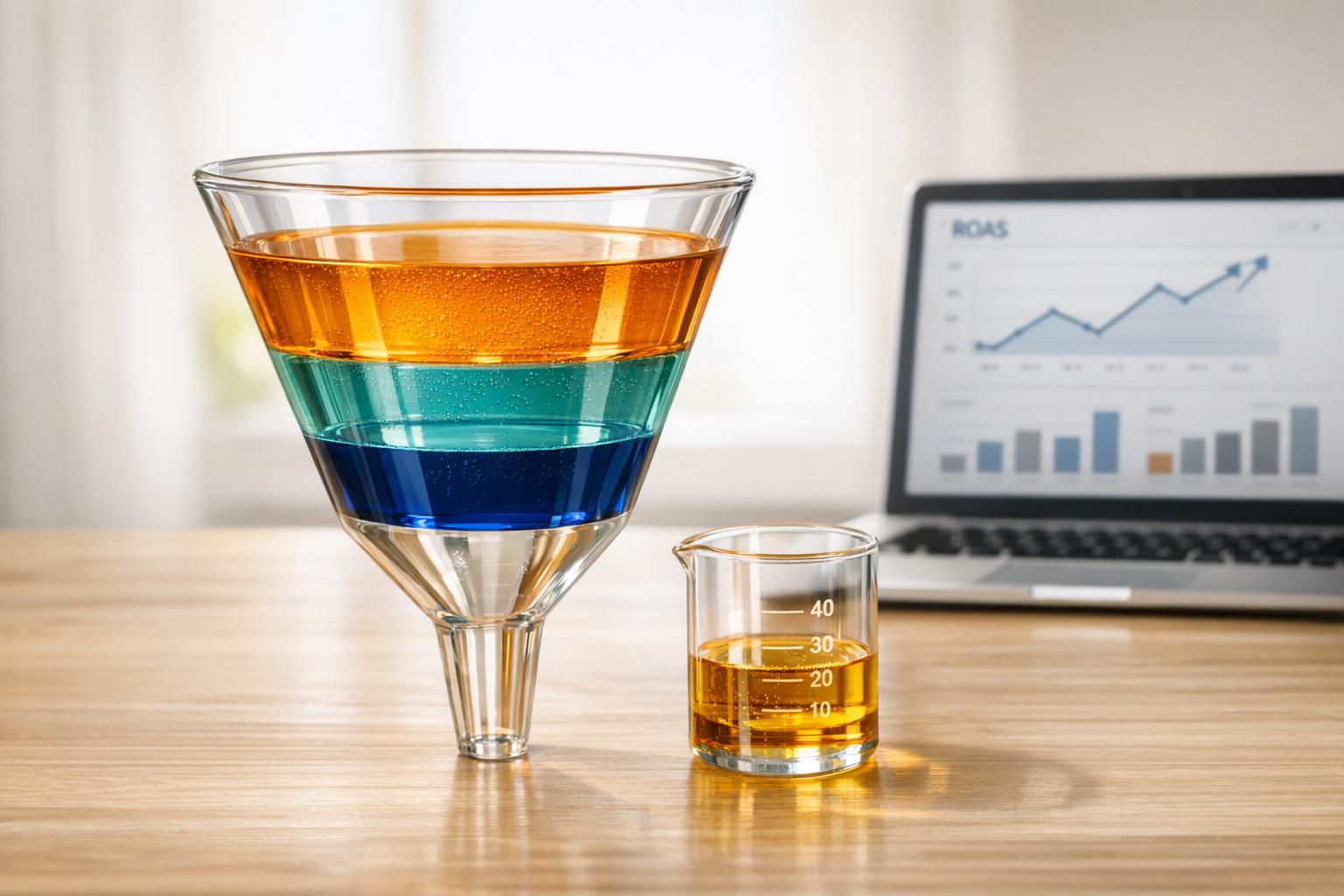
When running Shopify ads, most businesses fail to maximize their budget by not aligning it with the customer journey. Here's the key: allocate your ad spend across the awareness, consideration, and conversion stages to guide potential customers from discovery to purchase. This approach can lower acquisition costs, increase lifetime value, and improve your return on ad spend (ROAS).
Key Takeaways:
- Awareness (50-70% budget): Target new audiences with broad campaigns on platforms like TikTok, YouTube, and Meta. Focus on impressions, reach, and click-through rates (CTR).
- Consideration (20-30% budget): Use retargeting ads, testimonials, and tutorials to engage users already familiar with your brand. Monitor add-to-cart rates and time on site.
- Conversion (10-20% budget): Focus on closing sales with discounts, abandoned cart emails, and free shipping offers. Track conversion rates and ROAS.
For new businesses, prioritize awareness campaigns to build brand visibility, while established stores can shift more budget toward consideration and conversion. Testing is also critical - allocate 30% of your total ad spend to experiment with creatives, audiences, and platforms.
Pro Tip: Use tools like Shopify Analytics and ad dashboards to monitor performance metrics at each funnel stage. Aiming for a 4:1 ROAS is a common benchmark, but adjust based on your industry.

The 3 Stages of a Shopify Ad Funnel
Running a successful Shopify ad campaign means guiding customers through three key stages: awareness, consideration, and conversion. Each stage reflects a phase in the customer journey and requires tailored strategies, content, and performance metrics.
By understanding these stages, you can deliver the right message at the right time. For example, someone unfamiliar with your brand will need a different approach than someone who has visited your product pages multiple times. Aligning your ad spend with the customer’s mindset at each stage is the secret to effective campaigns.
Awareness Stage
At the awareness stage (commonly called Top of Funnel or ToFu), your focus is on introducing your brand to a broad audience. This is the discovery phase, where your goal is to grab attention and spark curiosity. Think of it as planting the seed for future engagement.
Strategies here include social media ads, Google ads targeting generic search terms, and influencer collaborations. The content should be designed to stop the scroll - whether through viral videos, striking visuals, or bold, attention-grabbing messages.
The metrics to watch at this stage are impressions, reach, and new users, as they show how many people are becoming aware of your brand.
Consideration Stage
The consideration stage (Middle of Funnel or MoFu) focuses on those who are actively researching and evaluating your products. These potential customers are comparing options, reading reviews, and deciding whether your product fits their needs.
To engage this audience, use tactics like retargeting ads for people who’ve visited your site, customer testimonials, tutorials, or articles that address common questions or concerns. This is your chance to highlight what makes your product stand out.
Key metrics here include click-through rate (CTR), add-to-cart rate, and time spent on site. These numbers help you gauge how well your content resonates with and engages your audience.
Conversion Stage
The conversion stage (Bottom of Funnel or BoFu) is where you seal the deal. At this point, your goal is to address any lingering doubts and make the purchase process as smooth as possible. This is where your efforts translate directly into sales.
Effective strategies include sending abandoned cart emails, offering time-sensitive discounts, providing free shipping, or using live chat to answer last-minute questions.
Track metrics like conversion rate, completed sales, and ROAS (Return on Ad Spend) to measure how effectively your campaign is driving revenue.
Up next, we’ll dive into how to allocate your ad budget effectively across these stages to maximize your campaign’s success.
How to Allocate Your Ad Budget Across Funnel Stages
When it comes to ad budgets, relying on data beats guesswork every time. The framework below offers a structured approach, but it's important to tweak it based on your store's specific performance metrics.
A tried-and-true starting point is the 70/30 rule: allocate 70% of your budget to reliable, high-performing campaigns and reserve 30% for testing new ideas and audiences [2]. Here's how to break it down for each stage of the funnel.
Step 1: Review Current Performance and Set Goals
Start by diving into your data. Use tools like Shopify Analytics and ad platform dashboards to evaluate your ROAS (Return on Ad Spend), CPA (Cost Per Acquisition), and pinpoint where potential customers are dropping off in the funnel.
Set clear, measurable goals. For example, a common ROAS benchmark is 4:1 - earning $4.00 for every $1.00 spent - though this varies by industry. Brands in sports and outdoor gear often hit around $4.98, while beauty brands might average closer to $3.01 [3][4]. Knowing your numbers ensures you're making informed decisions before spending a dime.
Step 2: Allocate 50-70% of Your Budget to Awareness
If your brand is relatively new, the awareness stage should take the lion's share of your budget. For instance, Nathan James, a home and garden brand, used Shopify Audiences in 2025 to refine targeting, achieving a 5.6x ROAS and slashing acquisition costs by 52% [4].
"If you're a start-up, nobody knows who you are yet. You need to generate awareness for your brand through upper funnel campaigns."
- Josh Brisco, Senior Manager, Retail Search Operations at CPC Strategy [6]
Focus on broad targeting across platforms like Meta, TikTok, YouTube, and Google Display Network. Use video ads designed to grab attention in the first 3 seconds, and make sure to exclude existing customers to avoid wasting your budget [1]. Start with a wide net, analyze metrics like CPM and CTR, and refine based on performance.
Step 3: Allocate 20-30% of Your Budget to Consideration
This stage targets people who are already intrigued by your brand. Apparel brand Mac Duggal expanded its retargeting audience by 2.3 times using customer journey data, earning a 2:1 ROAS [4].
Invest in campaigns like retargeting site visitors, lookalike audiences, and ads focused on specific products. This is where you nurture the 96-98% of first-time visitors who don't convert right away [1]. Use content like testimonials, tutorials, and product comparisons to build trust and guide them closer to making a purchase.
Step 4: Allocate 10-20% of Your Budget to Conversion
At the bottom of the funnel, the focus shifts to sealing the deal. This budget targets cart abandoners with dynamic ads, limited-time discounts, and free shipping offers. For example, Firebelly Tea leveraged Shop Campaigns to cut customer acquisition costs by over 50% and doubled their ROAS [4].
Keep this portion of your budget lean but effective. Monitor key metrics like conversion rates and ROAS daily to ensure every dollar is driving results.
Step 5: Reserve 30% of Your Budget for Testing
Set aside 30% of your total budget for experimentation. This allows you to explore new creative approaches, audiences, and platforms before committing significant resources.
"If you start with organic and validate what works, you've already got proof that there's a good chance that'll work when it comes to paid."
- Nik Sharma, CEO, Sharma Brands [2]
Refresh 20% of your creative assets every 2–4 weeks to avoid ad fatigue [1]. When scaling successful campaigns, increase budgets gradually - no more than 20% every three days - to maintain platform algorithm stability [7]. If your ad frequency exceeds 3 views over 7 days without conversions, it’s time to either refresh or pull back [7].
Tracking Performance Metrics for Each Funnel Stage
Once you've allocated your budget, the next step is keeping a close eye on performance metrics. These metrics help you gauge how well each stage of your funnel is working.
Awareness Stage Metrics
At the top of the funnel, your main goal is visibility. Metrics like impressions and reach tell you how many people are encountering your brand for the first time. Shopify reports offer a "Visibility" metric to show the percentage of first-page auctions your ad participated in [11]. A high CTR (click-through rate) indicates that your creative is resonating with your audience. Additionally, a low CPM (cost per thousand impressions) suggests that platforms find your content relevant and are rewarding it accordingly [2]. To track performance more precisely, use UTM parameters (like utm_source, utm_medium, and utm_campaign) in your ad links. These allow you to group data effectively in Shopify and Google Analytics [13]. With visibility established, the next stage focuses on deeper engagement.
Consideration Stage Metrics
In the consideration phase, engagement becomes the priority. Tools like the Meta pixel or conversion tags can help you monitor key actions such as "Add to Cart" or "View Content" [12]. Other important metrics include time on site and bounce rate, both available in Google Analytics. A high bounce rate often signals a mismatch between your ad and the landing page [5]. Tracking email opt-ins and micro-conversions also provides insights into user intent [8]. Shopify's "Web Engagement Rate" is another useful tool, highlighting visitors who spend more than 10 seconds on your site or view multiple pages - both signs of genuine interest [9].
Conversion Stage Metrics
At the bottom of the funnel, the focus shifts to profitability. Shopify Analytics gives real-time insights into completed sales, conversion rate (CVR), and average order value (AOV) [9]. To measure the efficiency of your spending, calculate ROAS (return on ad spend) at the channel, campaign, and creative levels. A 4:1 ROAS - earning $4.00 for every $1.00 spent - is a solid benchmark, though this varies by industry [3][4]. Keep an eye on your shopping cart abandonment rate, as it can reveal issues in the checkout process [9]. For a broader view of ad performance, track aMER (acquisition Marketing Efficiency Ratio), which divides total revenue by total ad spend. Unlike ROAS, aMER accounts for imperfect attribution, giving you a clearer sense of your overall advertising impact [10].
sbb-itb-d7b5115
Funding Your Ad Spend with Revenue-Based Financing
After planning your budget allocation, the next step is securing the capital needed to scale your ad campaigns effectively. Revenue-based financing is a practical way to fund both tried-and-true campaigns and experimental ones without putting undue pressure on your cash flow.
Scaling ad budgets for your Shopify store can be tricky. Traditional loans often come with rigid repayment schedules that can strain your finances, especially during campaign testing or when conversions take longer than expected. With digital advertising costs constantly fluctuating, you need a funding solution that grows with your revenue. That’s where revenue-based financing comes in - it’s a flexible option tailored to eCommerce sellers.
How Onramp Funds Helps Grow Your Ad Budget

Onramp Funds (https://onrampfunds.com) offers fast, equity-free financing specifically designed for Shopify sellers. This service allows you to scale your advertising efforts without the cash flow stress that typically comes with traditional loans. With funding available in as little as 24 hours, Onramp integrates directly with your Shopify store to assess your eligibility based on actual sales data.
For instance, if you need to meet the 50-unit weekly sales threshold required for ad platforms to optimize your campaigns effectively [2], Onramp Funds can provide the capital to hit that target. No need to wait for organic revenue to trickle in - just connect your store, receive a custom funding offer, and access the funds you need to invest in awareness campaigns, retargeting strategies, or testing new audiences.
Flexible Repayment Tied to Sales Performance
Unlike traditional loans with fixed monthly payments, Onramp Funds uses a revenue-based repayment model. This means repayments are calculated as a percentage of your sales, making it a perfect fit for the unpredictable nature of ad testing. For example, when about 30% of your budget is allocated to testing new ads or audiences [2], this flexible structure ensures you’re not stuck with rigid debt obligations if those tests don’t immediately convert. If your conversions temporarily drop or acquisition costs increase, your repayments automatically adjust downward [2][4].
This setup also allows you to scale more confidently. Strong performance metrics, like a 4:1 ROAS, mean you can increase your ad spend without worrying about fixed payment burdens holding you back.
Conclusion
Effectively dividing your Shopify ad spend across the awareness, consideration, and conversion stages creates a steady path for growth. Keeping an eye on key metrics helps you identify what’s working and what’s not. For example, a high click-through rate paired with low add-to-cart rates often points to issues with your landing page design or messaging [2].
The results speak for themselves. Businesses like Nathan James saw their acquisition costs drop by 52% and achieved a 5.6x ROAS by fine-tuning their targeting. Similarly, Firebelly Tea doubled their ROAS while slashing acquisition costs by over 50% through testing and optimizing their ad channels [4]. These achievements highlight the importance of smart budget planning, ongoing performance analysis, and reallocating funds to campaigns that deliver results.
Scaling, however, requires sufficient resources. Ad platforms generally need around 50 conversions per week to gather enough data for meaningful optimization [2]. Without adequate funding, it’s tough to test new audiences or maintain the ideal 70/30 balance between proven campaigns and experimental ones [2]. This is where revenue-based financing comes into play. Services like Onramp Funds provide the cash flow needed to scale without waiting for revenue cycles to align.
FAQs
How should I allocate my Shopify ad budget across different funnel stages?
To make the most of your Shopify ad budget, start by diving into your business goals and performance data. Pay close attention to metrics like Customer Acquisition Cost (CAC), Return on Ad Spend (ROAS), and conversion rates. These numbers will give you a clear picture of how each stage of your funnel - awareness, consideration, and conversion - is performing. This insight is key to knowing where your resources will have the biggest impact.
When allocating your budget, think about the goals you're aiming to achieve. If you're focused on building brand recognition, channel more funds toward awareness campaigns. On the other hand, if your priority is driving sales, prioritize the conversion stage. Keep a close eye on your key performance indicators (KPIs), and be ready to adjust your spending as needed to optimize your ROI and stay aligned with your objectives.
Leverage tools to track your ad performance and make data-driven changes over time. This approach ensures your budget is working hard at the stages that bring the best results for your Shopify store.
What key metrics should I monitor to measure the success of my Shopify ad spend?
To gauge how well your Shopify ad budget is performing, pay attention to three key metrics: Return on Ad Spend (ROAS), Customer Acquisition Cost (CAC), and conversion rates. These numbers give you a clear picture of how efficiently your ads are turning into sales and bringing in new customers.
It’s also important to keep an eye on real-time performance data. This allows you to spot trends early and make adjustments to your campaigns as needed. By staying on top of these metrics, you can ensure your ad spending is working as hard as possible to drive results.
How can revenue-based financing help me scale my Shopify ad campaigns?
Revenue-based financing offers a smart way to scale your Shopify ad campaigns by giving you access to funding that adapts to your sales performance. This means you can put money into ads that are driving results without stressing over upfront costs or cash flow issues.
The repayment model is simple: you pay back a percentage of your revenue. When your sales go up, so do your repayments - but if sales slow down, your payments decrease too. This flexibility allows you to allocate your ad budget more effectively across different stages like awareness, consideration, and conversion, helping your business grow at a manageable pace.
Related Blog Posts
Onramp Funds
Funding built around your sales
Connect your store and see what you qualify for. Repay as a percentage of sales, with no personal credit check.
Funding in as little as 24 hours.
