


Sudden demand spikes on Shopify can overwhelm your inventory if you're not prepared. Viral trends, influencer shoutouts, or flash sales can lead to stockouts or overstocking - both of which hurt profits and customer satisfaction. To avoid this, focus on:
- Accurate demand forecasting: Combine historical Shopify data with real-time insights like social media trends to predict surges.
- Safety stock planning: Keep extra inventory as a buffer, but calculate it precisely to avoid tying up cash.
- Automation tools: Use Shopify apps like Stocky and Flow for real-time alerts, demand forecasting, and automated reordering.
- Flexible financing: Services like Onramp Funds provide fast cash to replenish inventory during spikes.
How to Fix Stockouts and Overselling with Safety Stock #ecommerce #shopify #business

Forecasting Demand to Prevent Stockouts and Overstocking
Getting demand forecasts right can save you from two major headaches: running out of stock or sitting on piles of unsold inventory. The key? Predicting demand accurately by blending historical Shopify data with real-time insights.
By Q1 2025, a staggering 98% of companies reported using AI in their supply chains to fine-tune inventory and forecasting processes [2]. These AI-driven systems can cut inventory levels by 20% to 30% while still meeting customer demand [5]. How? They pull together data from various sources - Shopify sales records, current warehouse inventory, and even external cues like weather or social media trends. This lets you spot patterns early and make quick inventory tweaks when demand spikes.
Using Real-Time Analytics to Track Sales Trends
Real-time analytics give you a live feed of your sales activity. Instead of waiting for weekly or monthly reports, you can monitor how quickly products are flying off your virtual shelves and adjust your inventory strategy immediately. This speed is a game-changer because viral trends don’t wait for your next planning session.
The savviest Shopify sellers combine their internal sales data with external signals. While your order history shows past performance, tracking social media chatter or other external cues reveals what’s happening right now. This strategy, called demand sensing, helps you prepare for sudden surges in traffic or sales [5][4].
Ann McFerran, CEO of Glametic, highlights the importance of this approach: "Demand planning goes further by considering other factors that could impact demand, such as seasonality and consumer taste trends. This information is essential for meeting your customer demand while minimizing excess inventory" [4].
By merging historical data with real-time market trends, you can catch emerging spikes before they disrupt your inventory flow.
Setting Safety Stock Levels and Minimum Stock Thresholds
Safety stock is like a safety net - it’s the extra inventory you keep to handle unexpected demand spikes or delays from suppliers. Without it, a sudden surge could wipe out your inventory in hours; but too much safety stock ties up cash that could be better spent elsewhere.
Here’s the basic formula for calculating safety stock:
(Maximum Daily Sales × Maximum Lead Time in Days) – Lead Time Demand = Safety Stock [1].
Let’s put this into perspective. Say your top-selling item usually moves 50 units a day but can spike to 150 units during peak times. If your supplier takes 10 days to deliver, you’d calculate: (150 × 10) – (50 × 10) = 1,000 units of safety stock.
Your reorder point, the level at which you place a new order, combines your safety stock with your lead time demand [1].
Sylvia Fountaine, owner of Feasting at Home, learned this firsthand while managing artisan goods with long international lead times: "Product lead time accuracy was crucial for keeping our shelves well stocked" [4].
She used tools like Stocky to identify fast-moving items and slow sellers, allowing her to place orders early and give artisans enough production time. This approach helped her avoid stockouts during busy seasons.
| Metric | Formula | Purpose |
|---|---|---|
| Lead Time Demand | Average lead time (days) × Average daily sales | Ensures stock covers the wait for new shipments |
| Safety Stock | (Max daily sales × Max lead time) – Lead time demand | Acts as a buffer during unexpected demand spikes |
| Reorder Point | Lead time demand + Safety stock | Triggers a new order before stock runs out |
Adjust these numbers based on your seasonal trends. For instance, if you sell swimwear, your safety stock in May should be much higher than in November. Use tools like Shopify Flow to set up automated alerts when inventory hits these critical levels [3]. This way, you’re always prepared for the next big sales moment.
Using Shopify Inventory Tools for Better Control
Shopify's built-in inventory system and specialized apps are designed to help businesses manage sudden spikes in demand with ease. By leveraging these tools, you can keep a tight grip on your inventory, even during periods of unexpected sales activity.
Shopify automatically syncs stock quantities across your online store, marketplaces, and physical retail locations whenever products are received, sold, or returned [7]. This real-time synchronization eliminates the need for manual data entry, saving businesses over 10 hours each month by reducing the time spent on physical counts and reconciliations [7].
Take the example of Australian brand Bared Footwear. They once faced challenges with separate online and POS systems that failed to sync quickly enough. To avoid overselling during promotions, they had to close their retail stores. But after switching to Shopify Plus and Shopify POS in 2025, they unified their commerce data, allowing them to run online and in-store promotions simultaneously with accurate, real-time stock updates across all five locations [7].
"Having all our tooling and commerce data unified in a single platform was a real driving factor. All our sales channels display the same stock availability, and we can run a promotion online and in-store concurrently without worrying about overselling", explains Alexandra McNab, COO of Bared Footwear [7].
This streamlined system provides a solid foundation for advanced tools like Stocky and automated workflows.
Managing Inventory with Stocky and Real-Time Alerts
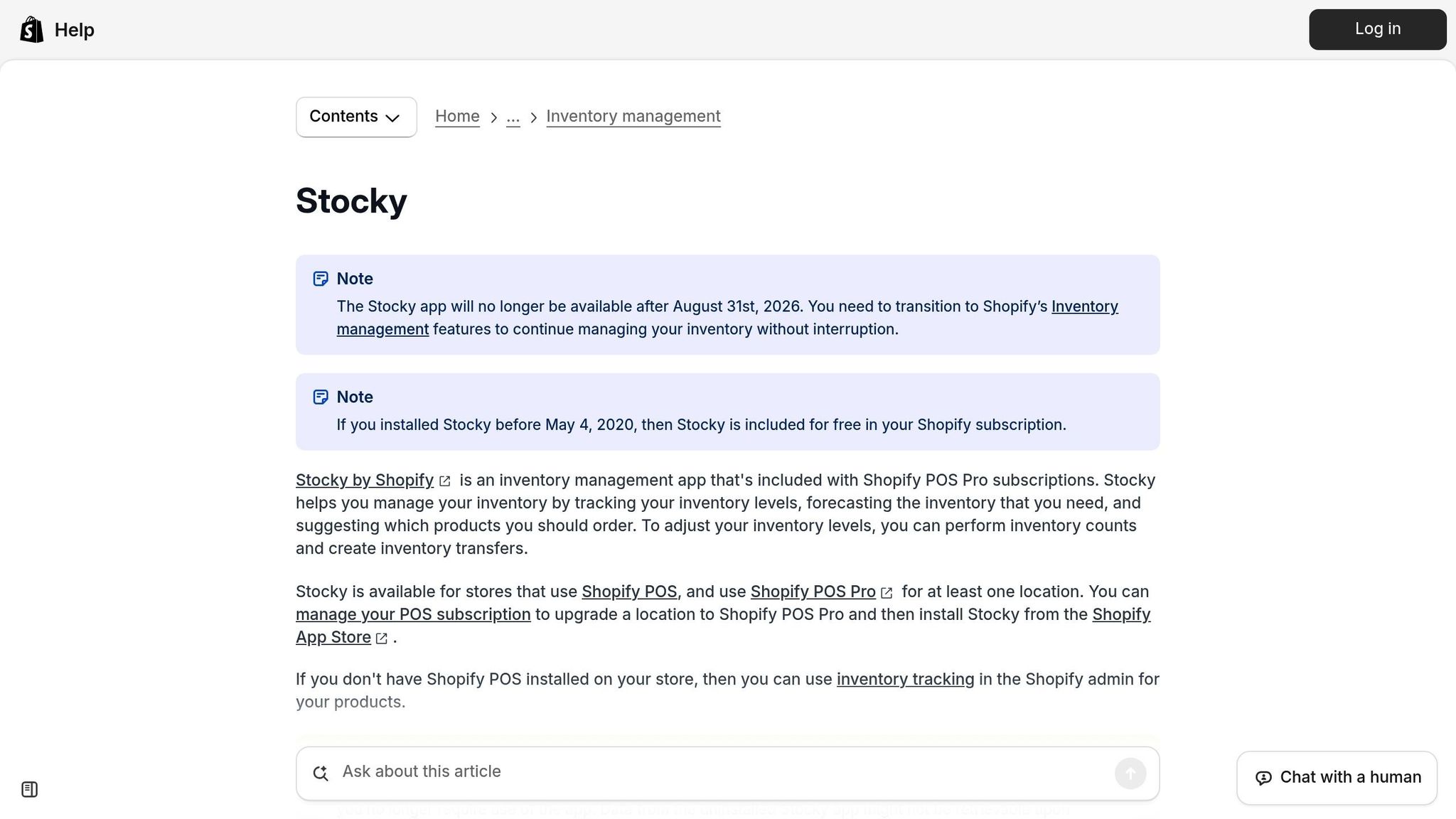
For businesses using Shopify POS Pro, the Stocky app offers advanced inventory management features like demand forecasting and automated purchasing recommendations. These suggestions are based on historical sales data and seasonal trends [7]. Stocky also generates ABC analysis reports, which help identify your most profitable products, ensuring you prioritize restocking items that drive the most revenue.
Shopify Flow takes automation a step further. With this tool, you can create custom workflows to trigger real-time notifications. For example, if a bestselling product falls below a set threshold - say, 20 units - the system can automatically generate a draft purchase order and notify your purchasing team [7]. This eliminates the need for constant manual checks and reduces the risk of running out of stock.
French footwear brand Odaje is a great example of this system in action. By connecting inventory data across 16 physical stores and their online shop in 2025, they boosted conversion rates by 6% and increased international sales by 25% [7].
| Feature | Tool | Benefit During Demand Spikes |
|---|---|---|
| Low Stock Alerts | Shopify Flow | Sends instant Slack/Email alerts to avoid stockouts |
| Demand Forecasting | Stocky | Predicts future needs based on past sales trends |
| Purchase Orders | Shopify Admin | Simplifies restocking and tracks incoming supply |
| Inventory Transfers | Shopify Admin | Shifts stock between locations to meet demand |
| ABC Analysis | Shopify Reports | Highlights top-performing items for prioritization |
Automating Reordering and Supplier Sync
Handling reorders manually can create bottlenecks, especially during demand surges. Shopify's automation tools help solve this by syncing supplier orders with inventory levels, ensuring smooth operations.
The Purchase Order tool in Shopify allows you to update on-hand quantities and transfer inventory across as many as 1,000 locations. This ensures new stock arrives before your current inventory runs out [7][8]. By aligning reorder points with supplier lead times, you can avoid stockouts altogether [8].
Danish tea retailer TeSelskabet is a great case study. They used Shopify POS and certified apps to manage complex tea blends and bundles. Automatic inventory updates between their POS and ecommerce platform prevented overselling and led to a 25% increase in sales [7]. Similarly, lifestyle brand Oak + Fort unified their retail operations in 2025, cutting staff labor by 50 hours per week and reducing operating costs by 47% [9]. These efficiencies free up time and resources, allowing you to focus on scaling your business instead of wrestling with inventory spreadsheets.
sbb-itb-d7b5115
Securing Flexible Financing with Onramp Funds


Managing inventory during sudden demand spikes isn’t just about having the right tools - it’s also about securing fast, adaptable financing to avoid cash flow issues.
Even the best inventory solutions can’t stop cash from running dry when demand surges unexpectedly. If your working capital is tied up in marketing or operations, waiting weeks for a traditional bank loan isn’t practical. That’s where revenue-based financing steps in.
Onramp Funds connects directly to your Shopify store, analyzes your real-time sales data, and provides funding without requiring equity. The process is quick, with minimal paperwork, and repayment adjusts based on your sales: higher revenue means larger payments, while slower sales reduce them [12].
Fast and Flexible Funding for Shopify Sellers
Onramp Funds ensures you get capital within 24 hours of approval, so you can replenish your inventory before running out of stock [12]. Applying is simple - connect your Shopify store, review a pre-qualified, no-obligation offer, and choose a funding plan that works with your cash flow. The entire process takes just about five minutes.
To qualify, your store must have generated at least $10,000 in monthly sales over the past 30 days [10]. Once approved, the funds can be used for inventory, shipping, or even marketing. For example, one Shopify apparel seller secured a $50,000 advance in just 18 hours during a 300% demand spike and repaid 5% of daily sales over 12 months [14][15].
"Onramp offered the perfect solution with revenue‑based financing to secure the capital we needed to invest in inventory and pay it back at a reasonable time frame once we made sales", says Jeremy, Founder and Owner of Kindfolk Yoga [12].
On average, merchants using Onramp Funds have seen a 73% revenue increase within 180 days of their first advance, with 75% returning for additional funding [12].
Transparent Fee Structures and Benefits
Unlike traditional loans or high-interest credit cards, Onramp Funds offers a fixed fee of 2–8%, with no hidden costs, interest, or penalties for early repayment [13][11]. For instance, on a $50,000 advance with a 5% fee, you’ll pay exactly $2,500 - making it easy to plan your cash flow.
| Feature | Onramp Funds | Traditional Bank Loan | Credit Card |
|---|---|---|---|
| Funding Speed | Within 24 hours | 2–4 weeks | Instant (but limited) |
| Repayment | Sales‑linked percentage | Fixed monthly payments | Minimum + interest |
| Cost | 2–8% fixed fee | 7–15% APR | 20%+ APR |
| Equity Required | None | Often requires collateral | None |
| Application | 5 minutes via Shopify | Extensive paperwork | Credit check required |
Onramp Funds also provides automated payment adjustments, ensuring repayments are handled seamlessly as sales deposits hit your account [12]. With an A+ Better Business Bureau rating and a “Great” Trustpilot score from 221 reviews, Onramp Funds has already supported over 3,000 eCommerce loans.
"Onramp has simplified cash flow by automating everything: easy to request, set it and forget it payments - quick and fast!" shares Torrie V., Founder and Owner of Torrie's Natural [12].
This streamlined financing option works hand-in-hand with your inventory management strategy, helping you stay ahead during demand surges.
Building Long-Term Inventory Resilience
Handling a one-time demand surge is challenging, but creating a system that consistently manages recurring spikes is an entirely different ballgame. The secret lies in moving from reactive fixes to proactive inventory planning - a strategy that identifies potential issues before they occur. At the core of this approach? Solid supplier relationships.
Vendor Management and Backorder Prevention
Strong supplier relationships are essential for avoiding backorders. For instance, in 2024, fitness brand Bala leveraged Shopify Collective to onboard eight partner brands as suppliers in under 24 hours. This integration allowed them to sync SKUs without holding inventory upfront, leading to 45% of their sales coming from new customers [17].
Personal connections with suppliers can make a world of difference. Take Nicholas Fiorentino from The Meatery as an example. During a national beef shortage, his focus on building strong relationships ensured access to rare products when others struggled.
"Maintaining an excellent relationship with our suppliers is critical to our business. I'm sure you've read there are beef shortages. We've never felt a moment of that, and I cannot help but credit it to the relationships we've built." – Nicholas Fiorentino [17]
To minimize backorders, consider these practical steps:
- Share demand forecasts with your suppliers well in advance, especially before peak seasons.
- Establish safety buffers based on supplier lead times.
- Pay invoices on time to build "relationship currency", increasing the likelihood of priority treatment during supply crunches [17][18].
- For key suppliers, negotiate flexible Minimum Order Quantities (MOQs) to avoid tying up cash in slow-moving inventory [17].
Improving Inventory Turnover with Data-Driven Decisions
Strong supplier relationships are only part of the equation. Pairing them with data-driven strategies can take your inventory management to the next level, ensuring you’re prepared for fluctuating demand.
One effective tool is ABC Analysis, which categorizes inventory into three groups:
- "A" items: High-priority products generating 80% of revenue.
- "B" items: Moderate performers.
- "C" items: Low-value products.
This method helps you focus your forecasting and safety stock efforts on the items that matter most [16].
Monitoring your inventory turnover rate is another key tactic. Calculate it by dividing your Cost of Goods Sold (COGS) by the average inventory for a given period [16]. A high turnover rate indicates strong demand and efficient stock management, while a low rate may signal deadstock issues. Additionally, the "Fast, Slow, and Non-moving" method can pinpoint slow sellers that might be better off cleared out [16].
"The more you know about your demand, the less uncertain you are about demand. That means you can manage your inventory better and reduce inventory levels in your warehouses." – Javad Nasiry, Management Professor at McGill University [16]
To avoid overselling during demand spikes, consider using Available-to-Promise (ATP) calculations. The push-based ATP formula - (On-hand inventory + Incoming supply) – (Sales orders + Forecasted demand) - helps ensure you only promise what you can deliver [6]. This is especially critical when you consider that stockouts and overstocks led to nearly $350 billion in lost sales across the US and Canada in 2022 [4]. Data-driven planning can help you steer clear of those costly pitfalls.
Conclusion: Key Takeaways for Managing Inventory Risk
When demand on Shopify spikes overnight, the ability to capitalize on those surges while avoiding lost sales often comes down to being prepared. The strategies we've discussed - ranging from precise forecasting to automation and smart financing - create a solid framework for managing inventory risk effectively.
Start by refining your demand forecasting. Rely on proven methods and real-time analytics to determine the right safety stock levels. This helps you avoid the pitfalls of both stockouts and overstocking, which can lead to unnecessary financial strain.
Incorporate automated inventory management tools to simplify stock tracking and reduce the chance of human error. Combine these tools with flexible financing options, like those offered by Onramp Funds, to ensure you have the capital needed to scale up inventory quickly when demand surges.
Lastly, focus on building long-term resilience. Strengthen relationships with suppliers and make data-driven decisions to stay agile. By combining accurate forecasting, automation, and accessible financing, you can transform sudden Shopify demand spikes into ongoing growth opportunities.
FAQs
How does real-time analytics help manage sudden spikes in Shopify demand?
Real-time analytics can completely transform how you handle unexpected demand surges on Shopify. It gives you instant access to critical insights like inventory levels, sales trends, and customer behavior. This means you can make quick, informed decisions when it matters most - whether that’s restocking popular items, identifying trends as they emerge, or preventing problems like running out of stock or over-ordering.
By leveraging real-time data, you can align your inventory planning with shifting sales patterns, keeping your business agile and ready to tackle sudden changes in demand.
How does safety stock help prevent inventory problems during sudden demand spikes?
Safety stock acts as a buffer to protect against inventory shortages when demand unexpectedly spikes. Keeping extra inventory on hand allows you to handle sudden sales surges or supply chain hiccups without running out of stock.
This approach helps you meet customer needs, avoid losing sales, and keep operations running smoothly - even when demand is unpredictable.
How does Onramp Funds help Shopify sellers handle sudden sales spikes?
Onramp Funds supports Shopify sellers in handling unexpected spikes in sales through revenue-based financing. This gives you fast access to the money you need to restock inventory and keep your operations running smoothly, all without straining your cash flow.
What sets this apart is that repayments adjust based on your sales. You pay more only when your business earns more. This flexibility helps you stay stocked and ready to meet demand, avoiding the pitfalls of running out of stock or overloading on inventory.
Related Blog Posts
Onramp Funds
Funding built around your sales
Connect your store and see what you qualify for. Repay as a percentage of sales, with no personal credit check.
Funding in as little as 24 hours.
