

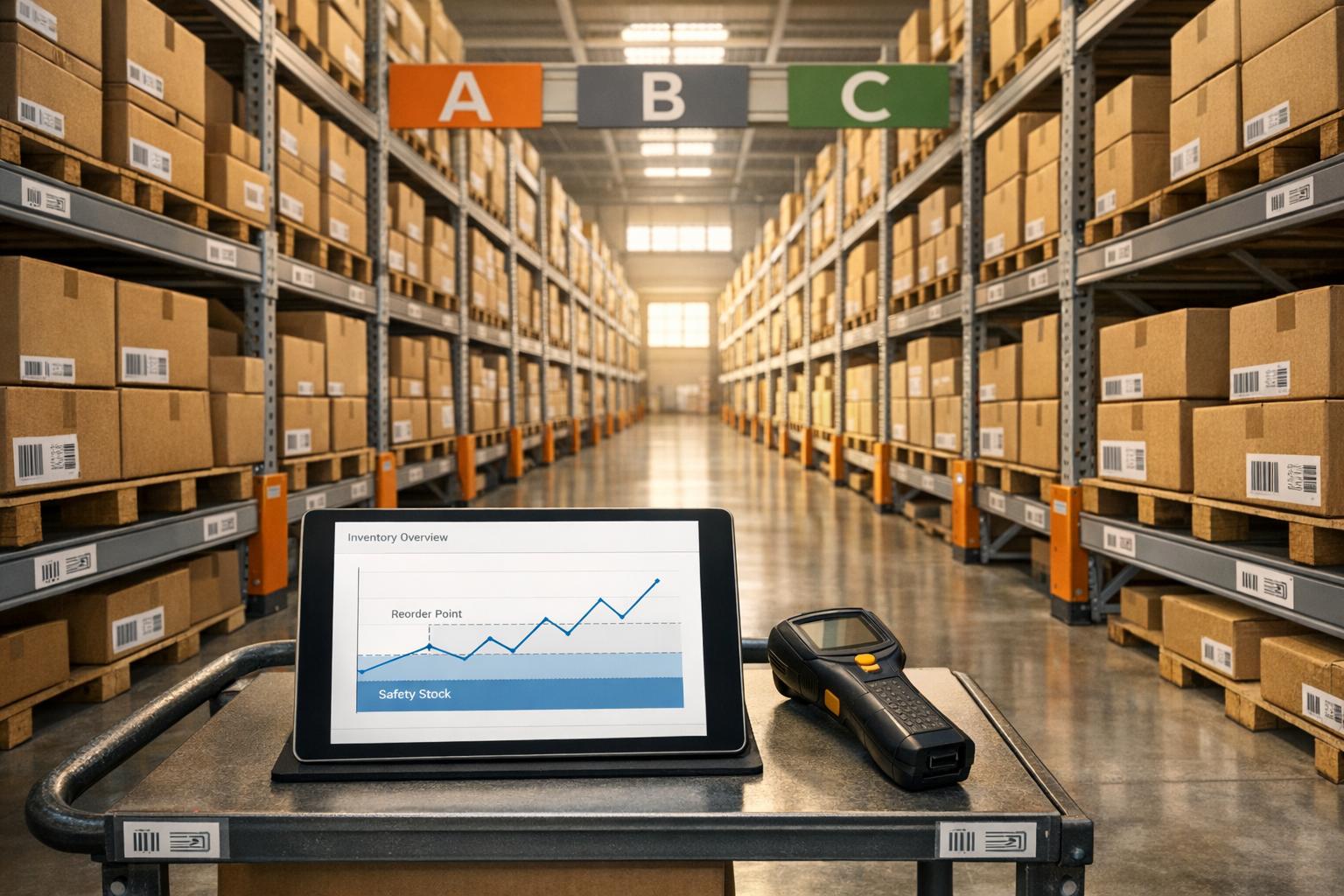
Scaling your Shopify store requires mastering inventory management. Without proper planning, stockouts and overstocking can cost you money and customers. Here’s a quick summary of how to avoid these pitfalls:
- The Problem: Retailers lose $1 trillion annually from stockouts and overstock issues. Only 70% have accurate inventory visibility.
- The Solution: Use AI-driven demand forecasting to reduce inventory by 20%-30%, cut stockouts by 15%-30%, and free up cash.
- Key Strategies:
- Analyze sales patterns and seasonal trends to predict demand.
- Calculate reorder points and safety stock for each product.
- Use tools like Shopify’s Stocky or Inventory Planner for automation.
- Sync inventory across all sales channels to prevent overselling.
- Regularly audit stock to maintain accuracy and reduce errors.
- Actionable Tips:
- Focus on top-performing products (20% of SKUs drive 80% of revenue).
- Clear slow-moving stock with discounts or bundles.
- Adopt barcode or RFID systems for real-time tracking.
Shopify Inventory Management Made Simple - Tips That Actually Work in 2025

The Shopify Inventory Lifecycle

Managing inventory effectively starts with understanding its flow. The process begins with planning and forecasting, where historical sales data, market trends, and seasonal patterns are examined to predict future needs. Next comes procurement, where these forecasts guide reorder points and purchase orders.
Once inventory arrives, the focus shifts to receiving and storage. This involves checking shipments, verifying quantities, labeling items with SKUs or barcodes, and organizing them for easy access. The goal is to move items from "ordered" to "available for sale" as quickly and accurately as possible.
Tracking and monitoring is essential for maintaining real-time visibility. A perpetual inventory system updates stock levels with every transaction - whether it's an online sale, an in-store purchase, or a return - giving you precise stock counts across all channels. Following this, allocation and sales ensure inventory is distributed strategically across warehouses or retail locations based on regional demand.
The fulfillment stage involves picking, packing, and shipping orders. This can be done in-house or through a third-party logistics provider (3PL). Finally, returns and reverse logistics complete the cycle. Returned items are inspected to determine whether they can be restocked, discounted, or written off. With nearly 25% of online apparel orders in the U.S. being returned [6], this stage is crucial for maintaining accurate inventory levels. Each step, from procurement to returns, plays a vital role in cash flow and operational efficiency, setting the foundation for better sales analysis and inventory management.
Analyzing Sales Patterns and Seasonal Trends
Your Shopify sales data is a goldmine for smarter inventory planning. By identifying which products sell steadily and which experience seasonal spikes, you can avoid overstocking slow-moving items or running out of bestsellers. Dive into monthly and weekly SKU sales reports to spot trends - do certain products surge during holidays? Do sales drop in specific months?
Seasonal trends are especially critical for scaling businesses. For instance, a retailer selling outdoor furniture should stock up in spring and early summer, then reduce orders as demand declines. External factors like weather, local events, or viral social media trends can also shift demand unexpectedly.
"Demand planning goes further by considering other factors that could impact demand, such as seasonality and consumer taste trends. This information is essential for meeting your customer demand while minimizing excess inventory." - Ann McFerran, CEO, Glametic
Focus on your top-performing products - the top 20% of SKUs that typically drive 80% of revenue. These "A" items need closer monitoring and higher safety stock levels to avoid stockouts. On the other hand, lower-priority items can be reordered less frequently. These insights provide a roadmap for improving inventory turnover.
Improving Inventory Turnover
Inventory turnover shows how often your stock is sold and replaced within a specific timeframe. A higher turnover rate means you're moving products quickly, freeing up cash and cutting holding costs like warehousing and insurance. To calculate turnover, divide your cost of goods sold (COGS) by your average inventory value. For example, if your annual COGS is $500,000 and your average inventory value is $100,000, your turnover rate is 5 - indicating you've cycled through your inventory five times in a year. Higher turnover not only improves cash flow but also supports growth.
To increase turnover, position fast-moving "A" items near packing stations for quicker fulfillment. Use the FIFO (First In, First Out) method to prioritize selling older inventory first - this is especially vital for perishable goods or items with a short shelf life. To clear slow-moving stock, run promotions like bundling these items with popular products or offering time-sensitive discounts. In 2023, fashion retailers faced an estimated 2.5 to 5 billion excess items, translating to $70 to $140 billion in lost sales [4]. Clearing out stagnant inventory is key to avoiding such losses and keeping your business agile.
Demand Forecasting for Shopify Stores
Getting inventory right is a balancing act, and accurate forecasting helps you stay on that tightrope. By blending historical sales patterns with external market insights, you can predict what customers want and when they'll want it. The payoff? You avoid costly stockouts and don’t tie up cash in excess inventory. Let’s dive into how to use your Shopify data and external factors to fine-tune your forecasts.
Using Past Sales Data for Forecasting
Your Shopify sales history is a goldmine for demand forecasting. Start by consolidating and cleaning your sales data from all channels - online and in-store - to ensure accuracy [1]. Once the data is ready, calculate average daily sales by dividing your total sales from the past year by 365. This gives you a baseline to work with [5].
Next, look at sales trends over different time frames, like 30, 90, or 365 days, to spot patterns of growth or decline [5]. For seasonal forecasting, compare sales from the same quarter in previous years. For instance, use Q4 2025 as a reference when planning for Q4 2026 [5].
To determine how much stock you need, calculate lead time demand by multiplying your average daily sales by your supplier’s lead time. For example, if you sell 20 units daily and your supplier takes 15 days to deliver, you’ll need 300 units to cover that period [5]. Add a safety stock buffer to account for unexpected delays or demand spikes. This can be calculated as: (Maximum daily sales × Maximum lead time) – Lead time demand [5].
While numbers are critical, they don’t tell the whole story. Combine trend analysis with insights from your sales, marketing, and finance teams. For example, if last year’s sales surge was tied to a one-time promotion, adjust your forecast accordingly to avoid overstocking [5].
Adding External Market Data
While internal data shows your store’s history, external factors can help you anticipate broader trends. For instance, macro-level forecasting looks at economic indicators like inflation, GDP growth, and unemployment to predict supply chain changes [7]. Tools like the barometric technique use leading indicators - such as new loyalty program sign-ups - to signal potential demand shifts, while lagging indicators like product returns highlight what didn’t work [7].
Seasonal patterns, holidays, and even weather play a role in shaping demand [7][8]. Short-term forecasts often focus on the next six months, while long-term projections can span up to four years [5][7].
Social media has also become a powerful forecasting tool. Platforms like TikTok and Instagram can signal whether a product trend is gaining traction or fading out [8]. This real-time "demand sensing" captures shifts in consumer behavior that historical data might miss [1]. Tools like Google Trends and social listening platforms (e.g., Brandwatch, Sprout Social) can help you gauge market sentiment and current conditions [9].
"With Shopify Plus, we have our point-of-sale and ecommerce systems under one umbrella, which serves our ultimate purpose of being an omnichannel retailer and viewing the customer as one customer - no matter where they shop with us." - Travis Boyce, Head of Global Retail Operations, Allbirds [10]
By combining internal sales data with external signals, you set the stage for smarter forecasting.
Using Shopify-Integrated Forecasting Tools
As your catalog grows, manual forecasting becomes impractical. Shopify’s integrated tools simplify the process by analyzing massive amounts of data in seconds. For instance, Shopify Sidekick, an AI-powered assistant, can answer questions like “Which SKUs will run out next week?” by analyzing real-time sales, weather, and promotional data to suggest reorder quantities [11]. In early 2025, 98% of companies reported using AI for supply chain forecasting and inventory management [11].
Stocky, included with Shopify POS Pro, automates inventory tracking and uses your sales data to recommend reorder points. It also streamlines stock transfers and barcode audits [2].
"Shopify POS gives us real-time visibility into stock and operations. Our team can see exactly where a product is and manage transfers easily, which has been essential for running four service centers smoothly." - Pierre Asteix, Operations Director, Weebot [2]
For larger product catalogs, Inventory Planner leverages machine learning to forecast demand for thousands of SKUs. AI tools like this can cut inventory levels by 20% to 30%, reduce stockouts by 15% to 30%, and lower overstock rates by up to 25% [2][12]. On average, retailers save about 10 hours per month on inventory management tasks by using Shopify’s unified data model [2].
Modern forecasting goes beyond historical data. It now includes real-time signals like social media trends, weather APIs, and competitor pricing [11][12]. While AI works well for steady-demand products, human judgment is still essential for new launches or unexpected market shifts [11]. Start small by automating forecasts for one product category before scaling across your entire catalog [12].
sbb-itb-d7b5115
Inventory Management Techniques That Work
Effective inventory management is all about using accurate demand forecasts to maintain a balance: keeping your best sellers in stock while avoiding tying up cash in slow-moving products. The following techniques can help Shopify store owners manage inventory with precision and reduce guesswork.
Setting Reorder Points and Low Stock Alerts
A reorder point (ROP) tells you when it’s time to restock. The formula is straightforward: (Daily Average Demand × Lead Time) + Safety Stock [13][5]. For example, if you sell 20 units per day and your supplier takes 15 days to deliver, your lead time demand is 300 units. Add a safety stock buffer to determine your ROP.
Shopify itself doesn’t offer customizable low-stock alerts, but third-party apps like Stockie, LSA, and Prediko can step in. These apps, with pricing starting as low as $5.99/month, allow you to automate notifications. Create tiered alerts - one for "Low Stock" to trigger reorders and another for "Out of Stock" to prevent overselling [14][15][16].
These strategies have proven effective. For instance, We Are Jolies reduced stockouts by 60% in December 2025 using Prediko's AI-powered alerts, while Kate Hewko improved operational efficiency by 40% with automated purchase orders [16]. Globally, stockouts cost retailers a staggering $1.235 trillion annually [15].
It’s essential to calculate ROP individually for each SKU, as sales velocity and lead time vary by product. Adjust these thresholds seasonally, increasing ROPs 30 to 60 days before high-demand periods like Black Friday [13][5].
Calculating Safety Stock Levels
Safety stock acts as a buffer against unexpected demand surges or supplier delays. Use this formula to calculate it: (Maximum Daily Sales × Maximum Lead Time in Days) – (Average Daily Sales × Average Lead Time in Days) [5]. For example, if your peak daily sales hit 30 units and your supplier’s longest lead time is 20 days, you’d need 600 units to cover worst-case demand. Subtract the average lead time demand of 300 units to arrive at 300 units of safety stock [5].
Real-world applications highlight the benefits. Oak + Fort streamlined inventory management, saving 50 staff hours per week and cutting operating costs by 47% [17]. Allbirds optimized stock levels using Shopify POS, enabling them to operate in smaller spaces more efficiently [17]. Meanwhile, Rebecca Minkoff achieved 99% inventory accuracy through RFID tags [17].
"With Shopify Plus, we have our point-of-sale and ecommerce systems under one umbrella, which serves our ultimate purpose of being an omnichannel retailer and viewing the customer as one customer - no matter where they shop with us."
– Travis Boyce, Head of Global Retail Operations, Allbirds [17]
Once reorder points and safety stock are in place, segmenting inventory by revenue impact can further refine your strategy.
Using ABC Inventory Analysis
ABC analysis divides inventory into three categories based on revenue contribution. Typically, A items (top 20% of products) generate about 80% of revenue, B items (next 30%) contribute around 15%, and C items (remaining 50%) account for roughly 5% [18][20]. This prioritization helps allocate resources effectively.
For A items, establish clear reorder points, build relationships with backup suppliers, and store them in easily accessible locations to speed up fulfillment [18][20]. Weekly inventory counts and tight controls are crucial for these top performers [4][3]. Retailers who correct inventory discrepancies through audits have seen an 11% increase in sales [4].
For C items, strategies like bundling them with A products, offering steep discounts, or donating excess stock can help free up cash [18][20]. U.S. retailers currently hold $1.39 in inventory for every dollar of sales, making this analysis a key tool to reduce that ratio [18].
"By categorizing products based on their value and usage, you have greater insight into what slow-moving products you're losing money from, so you can discount them and make room for more profitable products."
– Jara Moser, Digital Marketing Manager, Shopventory [18]
Revisit ABC classifications quarterly - or even monthly during rapid growth - to stay aligned with seasonal shifts and market trends [19]. Shopify merchants can simplify this process by pulling an "ABC analysis by product" report directly from their dashboard [18].
Using Technology for Better Inventory Management
Once you’ve set your reorder points and categorized your inventory, technology becomes a key player in keeping everything accurate and scalable. Relying on manual spreadsheets only gets you 70%–80% accuracy, but barcode systems can push that to 95%–99%, and RFID technology can hit 98%–99.9% accuracy [4]. Considering retailers lose $82 billion each year from out-of-stock items [23], investing in tracking tools is a smart move. These tools bridge the gap between manual efforts and automated precision, ensuring every sale and stock adjustment is recorded in real time.
Tracking Inventory with SKUs and Barcodes
There’s no shortage of tools to help you manage inventory effectively. Platforms like Stocky, Fabrikatör, StockSavvy, iPacky, inFlow Inventory, Katana MRP, Finale Inventory, 506 EasyScan, Sortly, and Zoho Inventory each bring something unique to the table. For example:
- Stocky, Shopify's built-in app, tracks inventory in real time and automatically generates purchase orders when stock levels dip below your preset thresholds [4][22].
- Fabrikatör uses AI for barcode scanning, supplier SKU tracking, and automated replenishment [21].
- StockSavvy focuses on cycle counts and label printing, allowing you to batch-update Shopify quantities [21].
- iPacky reduces packing errors by supporting multiple barcodes per product - ideal for businesses sourcing from different suppliers [21].
For more specialized needs, inFlow Inventory offers a durable Android scanner for warehouse use and handles barcode creation and printing [21]. Manufacturing-focused businesses might prefer Katana MRP, which tracks raw materials and finished goods across locations using mobile scanning [21]. Other options like Finale Inventory excel at high-speed barcode scanning for tasks like receiving and stock transfers, while Sortly provides a mobile-first solution that uses smartphone cameras and QR codes - even offline [21].
Hardware costs for barcode scanners typically range from $100–$500, label printers from $200–$1,000, and inventory management software subscriptions from $50–$300 per month [4]. These tools significantly reduce manual entry errors and let employees handle tasks like cycle counts and stock transfers directly on the sales floor using handheld scanners or smartphones [4][23]. Plus, syncing data across sales channels ensures everything stays up-to-date.
Syncing Inventory Across Multiple Sales Channels
Keeping inventory synced across all your sales channels - whether online, in-store, or marketplaces - ensures stock levels update automatically with every transaction [22][24]. This prevents overselling and creates a unified view of inventory, allowing staff to check availability at other locations and offer services like "buy online, pick up in-store" [4][24].
Take Bared Footwear, for example. They switched to a unified data model on Shopify, syncing their ecommerce and POS systems to avoid sellouts during busy sales events. They even added an "endless aisle" feature, which now accounts for 4% of their in-store orders [24]. COO Alexandra McNab shared:
"We had no way of making sure that we didn't oversell without shutting down a sales channel or reducing the amount of stock available to the online customer, which was really frustrating operationally" [24].
Businesses with integrated systems see 20% faster order fulfillment and a 10%–15% boost in sales efficiency [25]. Without this integration, teams can waste up to 16 hours per week manually syncing inventory data - costing over $21,000 annually per entry-level employee [25]. Integration also helps reduce excess stock by 15%–20% and improves customer satisfaction by 30% with real-time inventory visibility [25].
Running Regular Inventory Audits
Regular audits are crucial for keeping your inventory accurate. Schedule these during off-hours or when your business is closed. To make the process smoother, organize items logically, group similar products together, and face labels outward for easy scanning. Count every unit, noting defective or unsellable items, and log everything directly into your inventory system.
After each audit, review discrepancies and investigate their root causes. On average, retailers only have accurate inventory visibility 70% of the time [4], which means 3 out of 10 products thought to be in stock might actually be missing. Regular cycle counts using mobile scanning tools can maintain over 95% accuracy [4][24], helping to avoid the global $1.6 trillion cost of inventory distortion [25].
Building a Scalable Inventory System
If you're aiming to grow your Shopify store, it's time to ditch manual tracking methods and embrace automated, real-time inventory systems. Why? Because limited visibility can cost businesses millions every year [2][4]. Scaling successfully depends on three key elements: real-time data, automation, and integrated systems.
The first step is upgrading your inventory management process. Switch to a perpetual inventory system, which updates automatically with each transaction, eliminating the need for periodic manual counts. This approach gives you the real-time insights necessary to manage multiple locations and sales channels without constant reconciliation headaches. Pair this with AI-driven demand forecasting, which can cut inventory levels by 20% to 30% [2][1] while maintaining service standards. Businesses that adopt unified commerce platforms like Shopify report a 22% improvement in total cost of ownership and a 20% faster implementation time [1], making the investment a smart move for growing brands.
Once you’ve established real-time visibility and automation, take it a step further with ABC analysis. Focus your efforts on the 20% of SKUs that generate 80% of your revenue, while automating replenishment for lower-priority items. Don’t forget to revisit your safety stock calculations [2]. A well-calculated buffer can protect your business from supply chain disruptions - a challenge that impacted nearly 90% of companies in 2024 [1].
Technology like barcodes and automation can also help you scale effectively. Investing in scanning tools and software can boost inventory accuracy from 70%–80% to an impressive 95%–99% [4]. For example, when Weebot implemented Shopify POS across four service centers, Operations Director Pierre Asteix highlighted the immediate benefits:
"Shopify POS gives us real-time visibility into stock and operations. Our team can see exactly where a product is and manage transfers easily" [2].
This kind of insight becomes crucial as you expand to new locations or sales channels.
To further strengthen your inventory system, combine cycle counting with automated alerts, diversify your supplier network to reduce risks, and explore partnerships with third-party logistics (3PL) providers. These steps allow you to scale distribution without the need for costly infrastructure investments. Ultimately, scalability comes down to two things: accuracy and responsiveness - not stockpiling unnecessary inventory.
FAQs
How does AI-powered demand forecasting help Shopify stores save on inventory costs?
AI-powered demand forecasting helps Shopify store owners cut down on inventory costs by predicting future product demand with precision. By analyzing historical sales data, seasonal patterns, and market trends, these tools help you stock just the right amount of inventory. This means you’re less likely to overstock (which ties up cash and increases storage costs) or understock (which can lead to lost sales and dissatisfied customers).
With AI-driven tools, you can plan purchase orders more effectively, ensuring products are restocked just in time to meet expected demand. This approach reduces excess inventory, avoids waste, and keeps your cash flow steady. Plus, these tools adjust to shifts in consumer behavior or supply chain disruptions, helping you maintain balanced stock levels and keep your business running smoothly.
What are the main advantages of using forecasting tools integrated with Shopify for inventory management?
Using forecasting tools that integrate with Shopify can make a big difference in how you manage inventory. These tools are designed to predict demand with precision, helping you keep just the right amount of stock. By avoiding both stockouts and overstocking, you can improve cash flow, keep operations running smoothly, and deliver a better experience for your customers.
On top of that, these tools take the guesswork out of purchasing decisions. They use data to highlight sales trends, so you can adjust inventory levels as needed. This means you can allocate resources more effectively, setting your Shopify store up for steady and efficient growth.
How can ABC inventory analysis help Shopify store owners boost revenue?
ABC inventory analysis is a powerful tool for Shopify store owners looking to boost revenue. It works by dividing products into three categories based on their value and impact:
- A items: High-value, high-priority products that drive most of the revenue.
- B items: Mid-range products with moderate value.
- C items: Lower-value items with less impact on overall sales.
This categorization helps store owners focus their resources on the products that matter most. For example, prioritizing A items ensures these top-performing products are always available, reducing the chances of stockouts and keeping customers happy.
Meanwhile, better handling of B and C items can free up cash flow, lower storage costs, and prevent overstocking. The result? Improved demand forecasting, balanced inventory levels, and a stronger bottom line. By aligning inventory with business priorities, ABC analysis helps streamline operations and set the stage for consistent growth.
Related Blog Posts
Onramp Funds
Funding built around your sales
Connect your store and see what you qualify for. Repay as a percentage of sales, with no personal credit check.
Funding in as little as 24 hours.
