

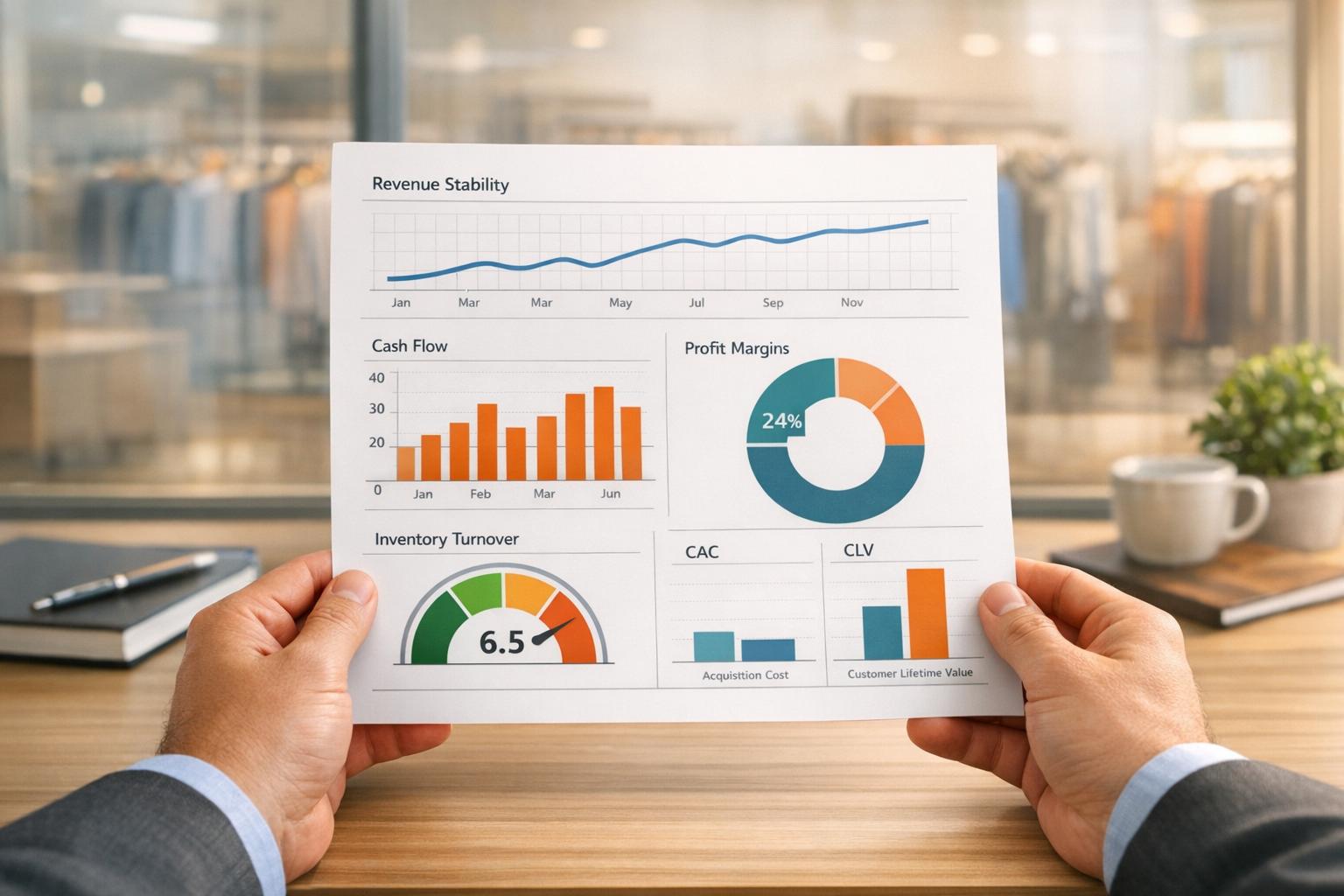
When applying for financing, lenders analyze your store's performance, not just your credit score. They focus on financial and operational metrics to assess your business's stability and ability to repay loans. Here's what you need to know:
- Financial Health: Lenders review income statements, balance sheets, and cash flow. Key metrics include profit margins, debt-to-equity ratios, and revenue consistency.
- Sales Trends: Steady revenue growth and manageable cash flow gaps are crucial. Lenders prefer businesses with predictable income patterns.
- Operational Metrics: Inventory turnover, customer acquisition costs (CAC), and customer lifetime value (CLV) highlight your business's efficiency and growth potential.
- Data Accuracy: Clean, integrated data from platforms like Shopify or Amazon builds trust and speeds up loan approval.
- Creditworthiness: Personal and business credit scores, along with well-maintained records, strengthen your application.
- Presentation: Clear financial reports, detailed growth plans, and organized documentation are vital for securing funding.
Takeaway: Lenders prioritize measurable performance metrics and reliable data. By understanding what they evaluate, you can prepare effectively and improve your chances of approval.

Ecommerce Business Plan: 5 Crucial Factors for Funding Approval (+Free Template)
Financial Metrics Lenders Review
When lenders evaluate your financial health, they dive deep into your financial statements to ensure your business is profitable. They closely examine your income statements to confirm you're generating a net profit after covering all expenses. They also review your balance sheets to compare your assets against liabilities. These documents provide insights into important metrics like your debt-to-equity ratio and whether you have sufficient working capital to handle daily operations and loan repayments [4][5]. Let’s take a closer look at how revenue patterns and other financial indicators influence lender decisions.
Accurate data is non-negotiable. Lenders rely on precise financial records to make informed credit decisions [6]. Automated accounting tools like Xero and NetSuite simplify this process by offering real-time bank reconciliations [5]. This level of transparency not only builds trust but also signals that you’re managing your finances with the diligence lenders expect.
Revenue Consistency and Growth Patterns
Lenders value steady revenue growth as a sign of stability. They want assurance that your revenue isn’t prone to erratic fluctuations and that your business can weather seasonal changes or market shifts. For eCommerce businesses, revenue and sales volume are key indicators of overall business health. Lenders often assess performance across multiple platforms - such as Amazon, Shopify, and Walmart - to get a comprehensive view of your operations rather than relying on data from a single marketplace.
Growth trends also play a major role. Month-over-month increases in revenue show that your business is expanding rather than stagnating [8]. This upward trajectory gives lenders more confidence to provide capital, knowing your business is on a path to scale.
Cash Flow Management
Positive cash flow is a must. Lenders scrutinize your cash flow to ensure money is consistently moving through your business. One critical metric they assess is the Cash Gap - the time between paying your suppliers and receiving payments from customers. This helps them determine whether your business might face cash shortages, even if it’s profitable on paper [7]. For eCommerce businesses, which often operate on 60- to 180-day cycles [3], lenders need to see that you can manage operational costs and loan repayments during slower periods.
"Reliable online business funding ensures you can navigate seasonal fluctuations, supplier disruptions, and shifts in consumer behavior without cash flow constraints." - Onramp Funds [9]
To address cash flow challenges, many eCommerce lenders now offer flexible repayment options. These models, where payments are tied to a percentage of incoming sales revenue, help businesses stay afloat during turbulent times. This approach aligns repayments with actual performance, reducing financial strain during slower seasons.
Profit Margins and Debt-to-Equity Ratios
Profit margins are another critical factor. They reveal whether your business model is sustainable and can support loan repayments without jeopardizing operations. For eCommerce businesses, the average gross margin is about 45.25% [5]. Lenders use this benchmark to assess whether your margins can handle loan costs, including interest, while still leaving room to absorb supplier price increases, manufacturing expenses, or shipping delays [9].
Debt-to-equity ratios, on the other hand, show how much debt your business has compared to its equity. Lenders calculate this by dividing your total liabilities by your equity [4][5]. Ideally, financing should cost no more than 5% over the loan term [3]. Before committing to a loan, it’s crucial to calculate the total cost. For instance, a 1.1 factor rate on a $100,000 loan results in $10,000 in fees. Make sure this fits within your profit margins to avoid financial strain [3].
Operational Metrics That Affect Lending Decisions
When lenders assess your business, they dive deep into its operational efficiency. For eCommerce businesses, which often lack traditional collateral like real estate or machinery, metrics such as sales performance and operational efficiency become critical indicators of stability and growth potential [3]. Lenders today evaluate your performance across platforms like Amazon, Shopify, and Walmart to get a full picture of your business’s operations [3]. These operational metrics complement financial indicators, offering a well-rounded view of your store’s overall health.
Inventory Turnover and Product Performance
Inventory turnover is a key metric that reveals how quickly you sell and restock products. For eCommerce businesses, where inventory often represents the largest asset, this metric is vital. The formula is simple: divide Cost of Goods Sold (COGS) by Average Inventory [10]. Generally, a healthy inventory turnover ratio for online sellers falls between 4 and 6 [10].
A high turnover ratio signals efficient inventory management, freeing up cash, reducing storage costs, and improving cash flow. These are all positive signs for lenders, as they reflect your ability to repay loans.
"The higher your inventory turnover ratio, the better you're doing at managing and moving this asset." – Kelley Birrell, Marketing Manager, LedgerGurus [10]
On the flip side, a low turnover ratio may indicate “dead” stock that ties up capital - money that could be better used for growth or loan repayments. To improve inventory turnover, consider ordering smaller quantities more frequently and eliminating underperforming SKUs. Redirecting resources toward high-turnover products can demonstrate growth potential, especially if you’re seeking funding to stock up before high-demand periods like the holiday season [3].
Customer Acquisition Costs and Lifetime Value
Lenders carefully examine two critical metrics: customer acquisition cost (CAC) and customer lifetime value (CLV). These numbers reveal whether your growth strategy is sustainable or if you're overspending to acquire customers [11]. Modern eCommerce lenders also factor in your profit margins after advertising costs, ensuring that your growth is not only fast but also profitable. Additionally, indicators of customer retention - like email lists and subscription models - are highly attractive to lenders, as they represent predictable, recurring revenue without requiring physical assets [3].
"Your value is best measured by your revenue, sales volume, and contact lists or subscription customers." – Onramp Funds [3]
When showcasing your data, highlight your performance across all platforms to demonstrate efficiency in acquiring and retaining customers. Subscription models or robust customer lists can be particularly compelling, signaling strong business fundamentals. Lenders also evaluate sales effectiveness through metrics like order values and conversion rates.
Average Order Value and Conversion Rates
Metrics like average order value (AOV) and conversion rates reflect how well your store attracts and converts customers. These figures are especially important to eCommerce lenders who often structure repayments as a percentage of daily sales [3]. A strong AOV and high conversion rates suggest consistent cash flow - an essential factor for securing financing.
Lenders typically analyze these metrics alongside trailing 12-month revenue, order volume, and return rates to assess your risk profile [11]. Consolidated sales data from multiple platforms can further strengthen your case, showing lenders that your operations are efficient and scalable. Keeping detailed records of sales performance across all channels can help you secure the maximum financing possible from growth capital providers [3].
sbb-itb-d7b5115
Credit and Business Credibility in Lending
When it comes to securing a loan, lenders don’t just look at your operational performance - they also assess your creditworthiness and how credible your business appears. These factors help them gauge the risk of lending to you and whether you’re likely to repay the loan. For eCommerce businesses, this means lenders will review both your personal financial history and your business’s track record. Knowing how credit is evaluated can help you prepare a stronger application and possibly secure better loan terms. This credit evaluation complements the operational and financial metrics discussed earlier, giving lenders a full picture of your financial standing.
Personal and Business Credit Scores
If you’re asked to sign a personal guarantee for a loan, your personal credit score becomes a critical factor.
"You're almost always going to have to sign a personal guarantee on a small business loan." – Roderick Wilson, Small Business Lending Product executive, Bank of America [12]
Personal credit scores range from 300 to 850, while business credit scores typically fall between 0 and 100 [14]. The higher your score, the better your chances of securing lower interest rates, higher borrowing limits, and more favorable repayment terms. Lenders often look for a Debt Service Coverage Ratio (DSCR) of at least 1.25, which indicates that your income comfortably exceeds your debt obligations [12][13].
Before applying for a loan, it’s a good idea to review your credit reports. For personal credit, check reports from Experian, Equifax, and TransUnion, and for business credit, focus on Dun & Bradstreet, Experian, and Equifax [12][15]. Correct any errors or disputes on your reports, and work on reducing existing debt to improve your debt-to-income ratio. If your credit report contains negative items, be prepared to explain them clearly to potential lenders.
"Something like a dip in revenue isn't necessarily a deal-breaker, but the lender will want to understand your business's story." – Rob Snead, Small Business Credit executive, Bank of America [12]
Some eCommerce lenders now use sales-based underwriting, relying on real-time revenue data from platforms like Shopify or Amazon instead of traditional credit scores [13]. This can be a game-changer for businesses with strong sales but limited credit history.
Maintaining Accurate Business Records
Lenders also evaluate your business using the "Six C's of Credit": Capacity, Capital, Collateral, Conditions, Character, and Communication [12][13]. To showcase these qualities, you’ll need accurate and up-to-date financial records.
Make sure you have at least two years of tax returns, along with current profit-and-loss statements, balance sheets, and cash flow reports [12][13]. These documents help lenders verify your ability to repay the loan and assess your business’s financial health. Additionally, obtaining a "Certificate of Good Standing" can confirm your legal compliance and tax status [13].
Modern lenders may also ask for read-only access to your eCommerce platforms and bank accounts through tools like Plaid. This allows them to verify real-time sales and performance data [16]. Being transparent and organized with your documentation not only builds trust but also makes it easier to secure the funding you need. A clear credit profile and well-maintained records strengthen your business’s credibility and improve your chances of approval, setting the stage for the next steps in presenting your store’s data effectively.
How to Present Your Store's Data to Lenders
When presenting your store's data to lenders, the aim is to showcase your financial stability and potential for growth. This isn't just about handing over numbers - it's about proving you understand your business thoroughly and can handle borrowed funds responsibly. To help you make a strong case, here's how to present your data effectively.
Creating Complete Financial Reports
Accurate records are essential, but how you present them matters just as much. Lenders typically focus on the "big three" financial statements: the Income Statement (Profit and Loss), the Balance Sheet, and the Cash Flow Statement [19][22]. These documents are the foundation for demonstrating your profitability, liquidity, and ability to manage cash flow.
"The income statement is the most important financial statement to provide when applying for funding because it reveals whether your business can generate profits." – CFO Selections Team [21]
For eCommerce businesses, it's crucial to report gross revenue instead of just bank deposits. Break out merchant fees, channel fees, and shipping costs to provide a clear picture of your operational health [18]. Use accrual accounting to record COGS at the time of sale [18][20].
Most lenders will ask for 3 to 5 years of financial data [21]. If your business is new, provide monthly or quarterly projections for the next 12 months [21]. Projections should include income forecasts, balance sheets, and cash flow estimates. Adding ratio analyses like debt-to-equity or current ratio can make your proposal more compelling [21].
Don’t overlook the Management's Discussion and Analysis (MD&A) section. This narrative allows you to explain your financial results, market trends, and growth plans [20][22]. For instance, if you’re in eCommerce, you could highlight how the average cart size reached $150 in 2025, supporting your revenue projections [17].
"Collecting sales tax does not qualify as income and remitting it to the government doesn't qualify as an expense." – Kelley Birrell, Marketing Manager, LedgerGurus [18]
Ensure sales tax is recorded as a liability on your balance sheet, and verify that your sales data aligns with reports from platforms like Shopify or Amazon to demonstrate accuracy [18].
Using Tools to Track Key Metrics
Many lenders now use automated tools to connect directly to eCommerce platforms like Shopify, Amazon, or TikTok Shop, allowing them to review sales history and cash flow in real time [16]. This automation speeds up the underwriting process, with some tech-based lenders approving funding in less than 24 hours after final approval [16].
By integrating your sales data with a lender’s platform, they can evaluate metrics such as average monthly revenue, debt levels, and cash flow needs. For example, Onramp Funds has issued over 3,000 eCommerce loans using real-time performance metrics [16]. Most automated tools require a minimum of $3,000 in average monthly sales to qualify [16].
"Onramp's process is very straightforward and easy to navigate. I had funds in my account within a day of final approval." – Adam B., The Full Spectrum Company [16]
Maximize your chances by consolidating data from all sales channels - whether it’s eBay, Stripe, or Squarespace - into a single dashboard. Also, ensure your business is registered as a legal entity (LLC, C-Corp, or S-Corp), as this is often a requirement for automated lending tools [16]. With these systems in place, focus on maintaining consistent performance above the minimum thresholds and prepare a clear growth plan.
Writing a Clear Business Growth Plan
When writing a business plan for lenders, remember this key difference: investors focus on your future, while lenders assess your current financial health [24]. Your plan should clearly demonstrate your ability to manage debt and generate cash flow.
"A business plan for a loan is not the same as a business plan for investors. Investors buy into your future. Lenders assess your present." – Upmetrics Team [24]
Be specific about how you’ll use the funds. Avoid vague descriptions and instead detail precise objectives, such as "investing in a new packaging line to increase output by 20%" [24]. For example, a small food manufacturer in 2025 secured a $120,000 loan by breaking down the request into three clear categories: $60,000 for machinery, $30,000 for raw materials, and $30,000 for seasonal cash flow needs [24].
Your financial forecasts should match the loan's term. If you’re applying for a five-year loan, provide a five-year forecast that shows how you’ll repay the debt within that timeframe [24]. Include your Debt Service Coverage Ratio (DSCR) - lenders typically look for a minimum of 1.25x, meaning your earnings exceed debt obligations by 25% [24].
Highlight your management team’s experience in reducing risk and ground your market research in credible sources like the U.S. Census Bureau or IBISWorld. This demonstrates that your industry is steady enough to support consistent revenue [24].
Finally, organize your appendix with essential documents: tax returns (2–3 years), business licenses, contracts, and collateral appraisals. Label everything clearly to streamline the underwriting process [24]. Conclude your business plan with a concise executive summary that outlines your business’s financial health, the loan amount, how you’ll use the funds, and your repayment strategy [23][24]. Remember, only about one-third of small business applicants receive the full financing they request, often due to incomplete or misaligned documentation [24].
Conclusion
Lenders evaluate your store's financial health by examining clear, measurable analytics. Metrics like revenue consistency, cash flow management, inventory turnover, and customer lifetime value offer a concrete picture of your business's stability and growth potential [26][27].
"Running your business without analyzing the numbers is similar to driving without checking the key information on your dashboard - it is dangerous to say the least." – Finance Insight Matters [25]
This analogy highlights just how crucial accurate data is for securing funding. Lenders need to see that you're making decisions based on actual performance metrics rather than instinct alone [26]. For instance, maintaining a solid Current Ratio and ensuring your cash flow can comfortably handle new debt are key factors [26].
Modern eCommerce lenders have also embraced technology to assess business performance. By integrating with platforms like Shopify and Amazon, they can track real-time metrics such as Order Defect Rate, shipping reliability, and sales velocity [1][2]. These operational benchmarks now carry as much weight as traditional financial statements. Without a track record of steady and reliable sales, securing funding becomes a challenge [1].
FAQs
What do lenders look at to evaluate the financial health of my eCommerce store?
Lenders pay close attention to a few critical financial metrics when evaluating your store's performance and deciding if it's creditworthy. These metrics include:
- Revenue trends: A steady or growing revenue stream signals stability and resilience over time.
- Profit margins: These show how efficiently your store operates and how well you're converting sales into profit.
- Customer acquisition costs (CAC): This reflects how much you're spending to bring in new customers, offering insights into your marketing efficiency.
- Inventory turnover: A measure of how quickly you sell and restock inventory, indicating demand and operational effectiveness.
Providing lenders with clear, accurate data on these metrics can showcase your store's financial health and dependability. Keeping your records well-organized and leveraging tools to monitor these indicators can make your business stand out as a reliable candidate for financing.
How can I improve my store’s performance to increase my chances of getting a loan?
To enhance your store’s performance and boost your chances of securing financing, focus on the metrics that matter most to lenders. Start by ensuring consistent revenue - aim for at least $10,000 per month - and maintain a steady sales history for six months or more. This kind of stability shows lenders that your business is reliable and has growth potential.
It’s also important to fine-tune your inventory turnover and sales velocity. These metrics reflect how efficiently your store operates. On top of that, keep your account in good standing by managing customer feedback, reducing order defects, and ensuring timely shipments. These details give lenders confidence in your operational stability.
Lastly, prioritize cash flow management. Speed up receivables, negotiate better payment terms with suppliers, and keep inventory costs in check. Detailed financial records and consistent tracking of revenue trends can further underscore your store’s financial health and preparedness for funding.
Why is accurate data important to lenders, and how can I ensure mine is up to standard?
Accurate data plays a critical role in helping lenders evaluate the financial health and creditworthiness of your eCommerce business. Metrics like steady monthly sales (e.g., $3,000 or more), revenue patterns, and operational performance give lenders a clear picture of the risks involved and guide their funding decisions. On the flip side, outdated or incorrect data can result in missed opportunities or less favorable loan terms.
To align with lenders' expectations, it's essential to keep your records well-organized, current, and accurate. Leverage reliable tools such as accounting software or integrate platforms like Shopify, Amazon, or Walmart to streamline and validate your data collection process. Make it a habit to regularly review and verify your sales, inventory, and financial reports. Ensuring these reflect your business's actual performance strengthens your position when applying for funding.
Related Blog Posts
Onramp Funds
Funding built around your sales
Connect your store and see what you qualify for. Repay as a percentage of sales, with no personal credit check.
Funding in as little as 24 hours.
