

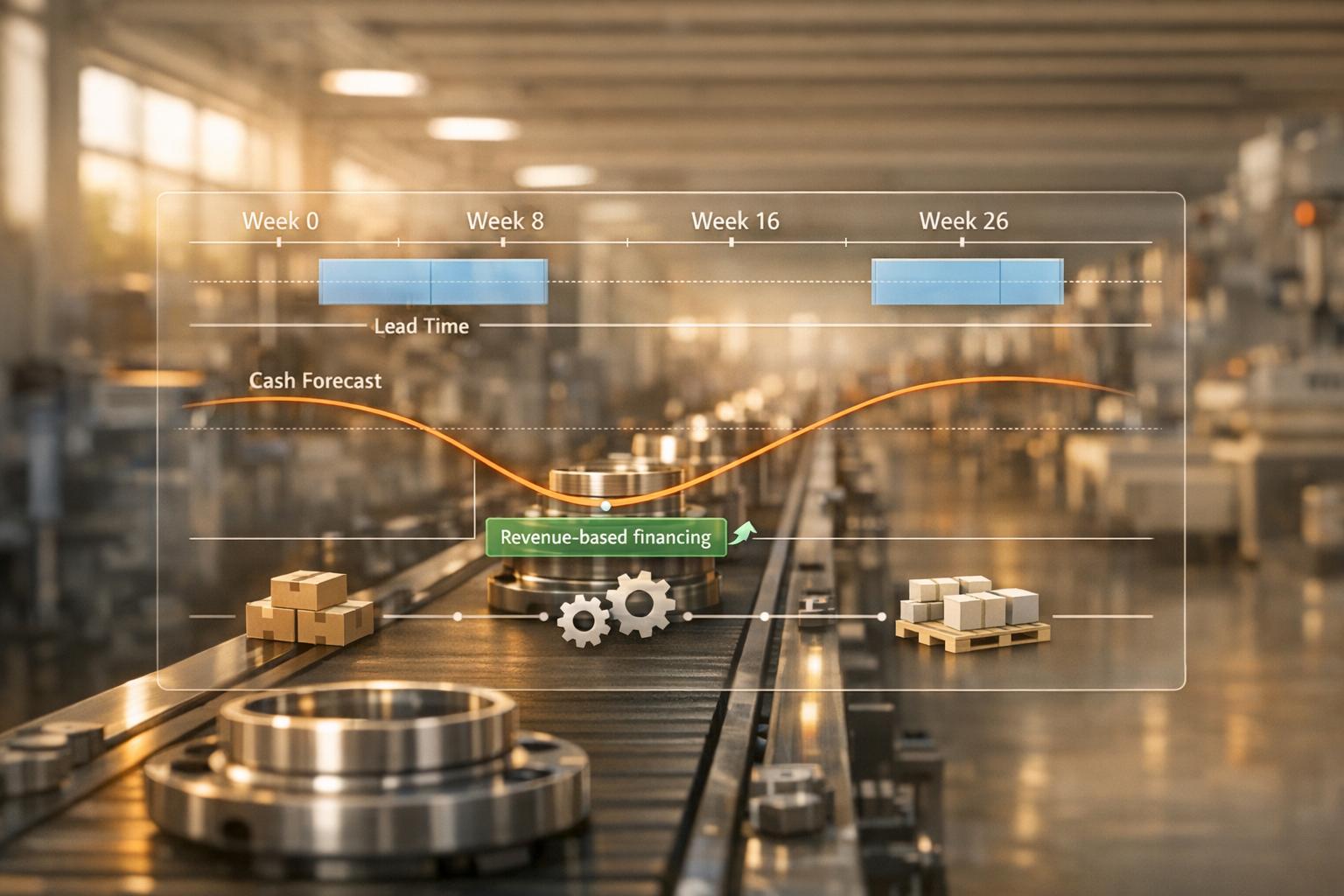
In eCommerce, long manufacturing lead times can strain cash flow and disrupt operations. Businesses face challenges like paying suppliers upfront, managing delayed revenue, and balancing inventory levels. Key strategies to address these issues include:
- Accurate Cash Flow Forecasting: Use tools like 13-week rolling forecasts to anticipate cash needs and identify cash crunch periods.
- Demand Forecasting: Leverage historical sales data and adjust for stockouts to align production with actual demand.
- Planning for Delays: Build buffers for lead time variability, seasonal disruptions (e.g., Lunar New Year), and supplier reliability.
- Financing Options: Explore revenue-based financing, inventory loans, or supplier credit to bridge cash flow gaps.
- Technology Use: Adopt Material Requirements Planning (MRP) software for precise inventory and production scheduling.
Cash flow management best practices for ecommerce entrepreneurs
sbb-itb-d7b5115
How to Forecast Cash Flow for Long Production Cycles
Getting cash flow forecasting right starts with understanding when money leaves and enters your business. In industries with long production cycles - where manufacturing lead times stretch 60 to 90 days or more - the time lag between paying suppliers and receiving customer payments can quickly drain working capital. To avoid this, you need a detailed forecast that captures every dollar tied up in production, shipping, and storage. This clarity helps you better analyze demand and manage potential delays.
One of the most reliable methods is a 13-week rolling forecast. According to Sam Hill, Ecom CFO, "13 weeks is long enough to be useful" [3], aligning well with 90-day manufacturing cycles. Breaking forecasts down by week (rather than month) reveals specific cash crunch periods, giving you more control over timing.
82% of small businesses fail because of cash flow issues [4]. The ability to anticipate and plan ahead often makes the difference between surviving and thriving. To build a strong forecast, track SKU-level sales velocity, average order value, conversion rates, and seasonal trends. Adjust for stockouts - if a product showed "zero sales" during a period when it was out of stock, your forecast risks underestimating actual demand unless you account for those missed opportunities.
When creating your cash flow model, take a cautious approach: assume expenses will hit your account as early as possible and revenue will arrive as late as possible [3]. Include future obligations that haven't cleared yet, such as purchase orders, upcoming tariff payments, planned marketing budgets, and potential expedited shipping costs if delays arise. As Hill explains:
Your bank account doesn't know you just placed a purchase order with your supplier. It doesn't know you're planning to hire someone next month... The forecast has to capture what your statements can't see yet [3].
73% of business leaders believe data-driven decisions help reduce uncertainty [5]. Use tools like time series analysis to identify seasonal patterns, moving averages to smooth out fluctuations, and regression models to predict how factors like pricing changes or ad spend affect demand. The goal isn't to create a perfect forecast but to gain enough visibility to make smarter financial decisions before cash flow becomes an issue.
Using Historical Sales Data to Predict Demand
After establishing a cash flow forecast, the next step is to predict demand accurately using historical data. This is essential for aligning production cycles with capital planning.
Historical sales data is a great starting point, but it's only effective if used correctly. A common mistake is treating all products as if they follow the same patterns. Forecasting needs to happen at the SKU and warehouse level - grouping products into broad categories won't cut it. Each SKU has its own replenishment needs, reorder triggers, and buffer requirements. A consistent bestseller requires a very different strategy than a seasonal item that spikes once a year.
It's also important to distinguish between demand forecasting and sales forecasting. Demand forecasting estimates what customers want to buy, based on historical volume and search interest. Sales forecasting, on the other hand, reflects expected revenue based on inventory, pricing, and marketing efforts. Both are critical but serve distinct purposes when planning capital needs.
For each SKU, track key inputs like sales velocity over the past year, promotional spikes, sell-through rates, average order value, and conversion trends. Pay close attention to seasonality - don't let Q4 holiday performance skew your January forecast. Normalize data to reflect typical buying cycles, payday schedules, and weather-related trends. If a discount campaign temporarily boosted sales, make a note to avoid overestimating organic demand.
One essential adjustment: account for "phantom" data. If a product was out of stock, your sales history might show zero, but demand likely still existed. Customers didn't stop wanting the product - they just couldn't buy it. Adjust your forecast to reflect the demand that would have occurred during those periods.
Don't forget to integrate your marketing plans. Historical data alone won't predict future performance if you're launching a new ad campaign or adjusting pricing. Overlay planned promotions, discounts, and ad spend on your historical baseline to create a more realistic outlook.
Planning for Manufacturing Delays
Even with an accurate demand forecast, manufacturing delays can disrupt cash flow. To safeguard your operations, plan for these delays before they happen.
Delays are inevitable. A single issue with raw materials can ripple through production, warehousing, and shipping, tying up your capital for longer than expected. To protect your cash flow, include buffers in your forecast to account for these disruptions.
Start by calculating lead time variability. Don't just rely on averages - measure how consistent your suppliers are. For example, if a supplier delivers in 45 days 90% of the time but occasionally takes 75 days, you need to plan for the longer timeline.
Safety stock acts as a buffer, but it comes at a cost. Your cash flow model should account for the capital tied up in inventory sitting in your warehouse, waiting to cover demand spikes or supplier delays. As RELEX Solutions points out:
Retailers and wholesalers plagued with forecasting errors often struggle to place orders optimally, forcing them to rely on suppliers with longer lead times [2].
The less reliable your suppliers, the more safety stock you'll need - and the more cash you'll have tied up.
Seasonal shutdowns are another major consideration. For instance, many factories in Asia close during Lunar New Year in January and February, leading to weeks of zero production. Planning for this disruption should start as early as June, as some suppliers begin limiting purchase orders by October. Waiting too long can leave you scrambling to pay for expedited shipping at premium rates.
Internal delays can also extend your cash conversion cycle. Manual data entry, slow order processing, and poor communication between teams and suppliers add hidden days to lead times. 31% of retailers plan to invest in inventory management technologies by 2025 [2] to address these inefficiencies.
Using Material Requirements Planning (MRP) Software
Material Requirements Planning (MRP) software can streamline these processes, helping you manage inventory and cash flow more effectively.
MRP software automates inventory planning by calculating precise order quantities and timing. For businesses with long lead times, these systems can be a game-changer - if used correctly. MRP tools rely on your sales forecast, current inventory levels, and supplier lead times to create a production schedule and purchasing plan. They break down finished goods into components, determine how much raw material you need, and schedule orders so everything arrives just in time for production. This minimizes both overstocking (which ties up cash) and understocking (which causes delays).
These systems also flag potential bottlenecks. For example, if a critical component has a 90-day lead time but you need it in 60 days, the software will alert you to act immediately or find an alternative supplier.
However, MRP is only as effective as the data you provide. Consistent SKU mapping across platforms is crucial for maintaining forecast accuracy. As Saras Analytics notes:
Forecasting accuracy depends more on clean, unified data than complex mathematical models [5].
One practical tip: use MRP to run "what-if" scenarios. What happens if lead times stretch from 60 to 75 days? How much extra capital will you need if demand spikes by 20%? These analyses help you anticipate financing needs, giving you time to explore options like revenue-based financing or inventory loans instead of scrambling at the last minute.
Financing Options for eCommerce Inventory
Once you've forecasted demand and accounted for potential delays, the next step is securing the funds to manage those lengthy lead times. Without sufficient financing, you could face stockouts or miss sales opportunities, both of which can disrupt cash flow. A solid financing approach helps bridge the gap between paying suppliers upfront and receiving revenue from customers, which is especially important for businesses dealing with extended production timelines.
For eCommerce sellers, the challenge lies in maintaining enough inventory to meet demand without tying up too much money in stock. Excessive inventory can lead to higher holding costs and limit your financial flexibility [1]. Timing is also critical. Research shows that 63% of online shoppers prioritize delivery speed when making purchasing decisions [1]. Waiting weeks for funding approval while competitors restock could put you at a disadvantage.
Here are some financing options tailored for eCommerce businesses managing extended production cycles.
Revenue-Based Financing with Onramp Funds
Revenue-based financing offers a flexible solution for eCommerce businesses, especially those with fluctuating sales. Unlike traditional loans with fixed monthly payments, this option lets you repay a percentage of your actual sales. When sales are strong, you pay more; during slower periods, you pay less.
Onramp Funds specializes in this type of financing for eCommerce sellers. They provide funding in as little as 24 hours, integrating directly with platforms like Amazon, Shopify, and Walmart Marketplace. By analyzing your sales data, they create personalized offers, and repayments are automatically deducted as a percentage of your sales. Fees typically range from 2% to 8%, ensuring you won't face rigid payment obligations during slow months.
This option is ideal when you need upfront capital - say $50,000 in April - but won't see revenue until July. The repayment structure adjusts to your sales performance, safeguarding your cash flow during production and shipping.
To qualify, you need at least $10,000 in monthly sales and an established track record on a supported platform. The application process is straightforward: connect your store, review your offer, and receive funding. Since this financing is equity-free, you retain full ownership of your business, and there are no hidden fees.
Inventory Loans and Supplier Credit
In addition to revenue-based financing, inventory loans and supplier credit are two other common options, each with its own advantages.
- Inventory Loans: These loans are designed to cover upfront manufacturing costs, often using the inventory itself as collateral. They come with fixed repayment schedules - monthly or quarterly - over a set term. While the predictability aids in budgeting, the fixed payments remain constant even if sales fall short or delays occur.
- Supplier Credit: This option lets you defer payments to your manufacturer, typically for 30 to 90 days, often without interest. However, supplier credit is usually reserved for businesses with strong, established relationships and a proven payment history. Terms can vary, so clear communication with your suppliers is crucial.
Comparing Financing Options
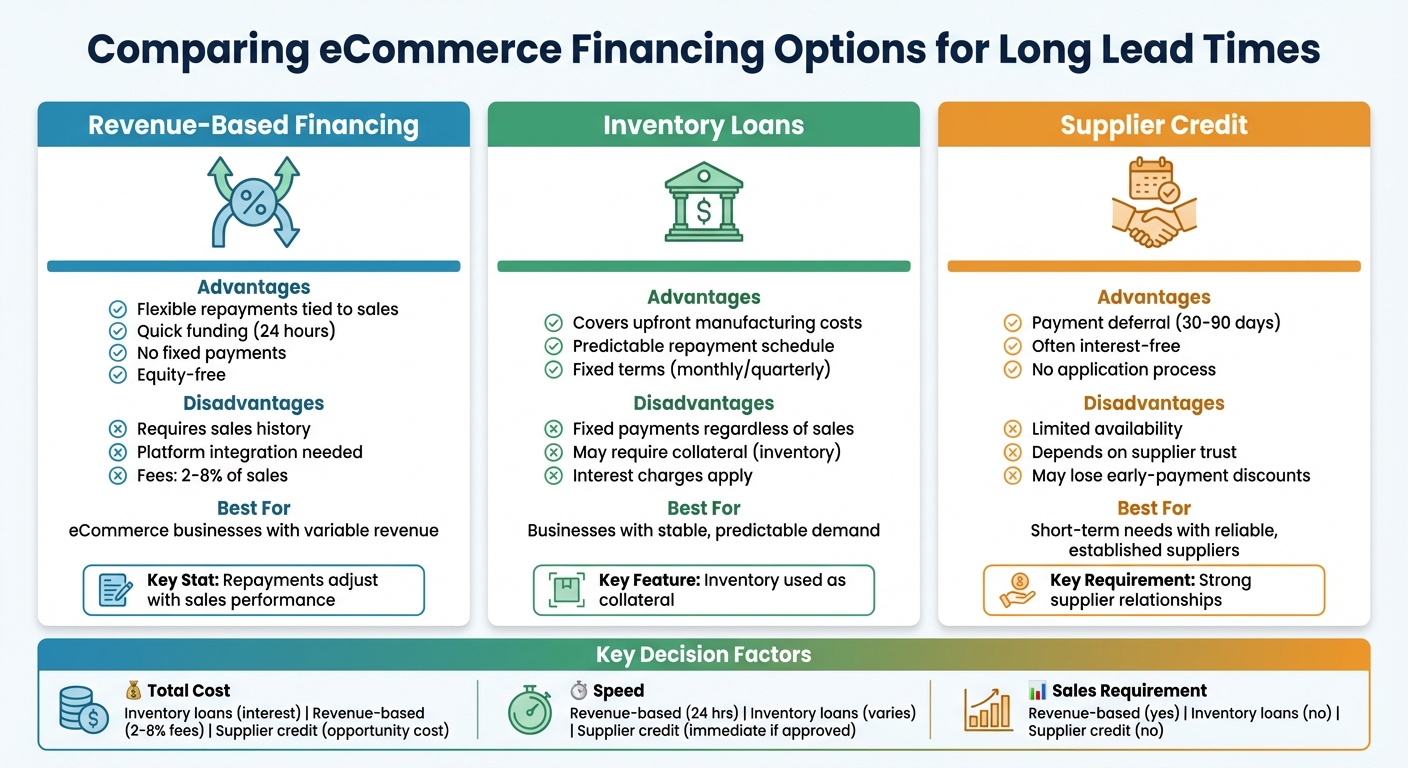
The best financing choice depends on your cash flow, sales patterns, and supplier relationships. Here's a quick comparison of the three main options:
| Financing Option | Advantages | Disadvantages | Best For |
|---|---|---|---|
| Revenue-Based Financing | Flexible repayments; quick funding; no fixed payments | Requires sales history and platform integration | eCommerce businesses with variable revenue |
| Inventory Loans | Covers upfront costs; predictable repayment schedule | Fixed payments regardless of sales; may need collateral | Businesses with stable demand |
| Supplier Credit | Payment deferral; often interest-free | Limited availability; depends on supplier trust | Short-term needs with reliable suppliers |
It's also important to consider the total cost of capital. Inventory loans come with interest, while revenue-based financing involves fees tied to sales performance (usually 2% to 8%). Supplier credit might seem cost-free, but you could lose out on early-payment discounts that reduce overall expenses.
How to Reduce Risks from Production Delays
Production delays can seriously disrupt your capital planning. The longer your manufacturing lead times, the more exposed your operations are to unexpected issues - whether it's supplier problems, factory closures, or sudden demand surges. To navigate these challenges, it's crucial to adopt strategies that minimize both the likelihood and impact of delays. These methods, combined with strong forecasting and financial planning, can help keep your production cycles running smoothly.
Using Just-in-Time (JIT) Inventory Methods
The Just-in-Time (JIT) inventory approach focuses on receiving materials only when they're needed for production, avoiding the need to stockpile large amounts. This method cuts down on holding costs and frees up cash for other business priorities. However, success with JIT hinges on precise coordination with suppliers to ensure production doesn't grind to a halt.
For eCommerce businesses with extended lead times, consider a modified JIT approach. This involves maintaining a minimal safety stock based on how much actual lead times fluctuate. By analyzing these variations, you can calculate the smallest inventory buffer necessary to guard against delays without tying up too much capital. This approach also aligns well with proactive cash flow management by reducing unnecessary inventory costs.
Building Supplier Relationships and Early Procurement
In addition to inventory strategies, strong supplier relationships can be a lifeline during unexpected disruptions. Relying on purely transactional supplier arrangements can leave you exposed during peak seasons or global supply chain challenges. On the other hand, building strategic partnerships with key suppliers often grants you priority access to materials and better terms. Sharing your demand forecasts and production schedules with suppliers helps them plan more effectively, reducing the chances of misunderstandings.
Timing is also critical, especially around predictable disruptions like seasonal factory closures. For example, many manufacturers in China shut down for Lunar New Year, with some halting new orders as early as October [2]. To avoid scrambling for holiday inventory, start procurement discussions as early as June. Strong supplier relationships can also lead to more favorable credit terms, further easing cash flow pressures.
Applying Lean Manufacturing to Reduce Lead Time Variation
Lean manufacturing principles can help you streamline production and reduce variability in lead times. By eliminating inefficiencies and simplifying processes, you can make your operations more predictable. Tools like value stream mapping are particularly useful for identifying bottlenecks, while pull systems ensure production aligns closely with actual customer demand.
The benefits of lean practices extend to your entire supply chain. Tracking supplier performance metrics, such as on-time delivery rates and lead time consistency, can reveal weak links that may be causing delays. If a supplier repeatedly fails to meet deadlines, it might be time to diversify your supplier base. Having alternative suppliers - both domestic and international - provides a backup during regional disruptions, weather-related emergencies, or factory closures. This flexibility reduces your reliance on any single source and helps you adapt more effectively when delays occur.
5-Step Capital Planning Process for eCommerce Sellers
Managing long manufacturing lead times might sound daunting, but breaking it into five simple steps can make the process far more approachable. These steps help align your financing with production cycles, ensuring steady cash flow while building on your existing forecasting and financing strategies.
Step 1: Review Monthly Sales and Lead Times
Start by calculating your total lead time, which includes everything from sourcing raw materials to delivering products to customers. The formula is straightforward: Lead Time = Delivery Date – Order Request Date [6]. This calculation helps pinpoint when you'll need capital to place new orders.
Next, dive into your sales data. Look at historical trends, seasonal shifts, and promotional activities to identify demand patterns. Knowing when sales are likely to peak allows you to schedule orders early, avoiding costly rush fees [2]. For instance, if you source from China, remember that many factories close for Lunar New Year in January and February [2].
"A shorter lead time translates to happier customers, increased profitability, and reduced obsolescence." - Amasty [6]
Tracking these metrics monthly ensures you're prepared to secure the financing needed to keep operations running smoothly.
Step 2: Build Cash Flow Models with Lead Time Buffers
Once you've nailed down your lead times, the next step is creating cash flow models that include delay buffers. These buffers account for variations between supplier estimates and actual lead times. Align your cash flow schedule to cover the gap between upfront expenses and incoming revenue.
Plan out when supplier payments are due versus when you expect customer payments. Long lead times often mean a significant gap, so include all associated costs - storage, inspections, shipping, and more. This will help determine whether external financing is required and how much you might need.
Consider maintaining a safety stock to handle unexpected demand or delays, but balance this against the cost of tying up capital [6]. Tools like automated replenishment software can simplify this process by generating purchase orders based on real-time inventory and demand data, reducing manual errors [2].
Step 3: Apply for Funding Through Onramp Funds
If your cash flow model highlights a funding gap, Onramp Funds provides a tailored solution for eCommerce businesses. Their revenue-based financing integrates seamlessly with major eCommerce platforms, making the application process quick and hassle-free.
The process is simple: connect your eCommerce platform so Onramp Funds can assess your sales history and performance. Based on this data, you'll receive a customized funding offer. Unlike traditional loans, there are no hidden fees or equity requirements, so you retain full ownership of your business.
With revenue-based financing, repayments are tied to your actual sales. Instead of fixed monthly payments, which can strain cash flow during slower periods, you repay as a percentage of sales. This ensures your financing remains aligned with your production cycle and cash flow needs.
Step 4: Track Performance with Real-Time Dashboards
After securing funding and placing inventory orders, keeping a close eye on performance is crucial. Integrate your sales platforms with logistics systems for real-time tracking of order processing and inventory [7]. This setup gives you a clear view of inventory movement and helps verify the accuracy of your cash flow projections.
Real-time dashboards can alert you to potential issues. If sales are slower than expected, you can adjust future order quantities. If demand spikes, you'll know whether you have enough capital to ramp up production or if additional financing is necessary. For example, Amazon uses predictive analytics and historical data to forecast demand, reducing stockouts and managing lead times efficiently [6].
Focus on key metrics like inventory turnover, days on hand, and cash conversion cycles to ensure efficient use of capital and refine your strategy as needed.
Step 5: Adjust Repayments Based on Sales
Revenue-based financing offers flexibility by aligning repayments with your sales performance. During slower months, your repayment amount decreases since it's calculated as a percentage of sales. This eliminates the cash flow strain that often comes with fixed monthly loan payments.
As sales fluctuate - whether due to seasonal trends or promotional efforts - your repayment adjusts accordingly. This flexibility is especially helpful when managing long manufacturing lead times, where capital may be tied up in inventory for extended periods before sales occur.
Use real-time performance data to guide future capital planning. If you notice recurring periods where additional working capital is necessary, plan ahead and apply for funding early. On the flip side, if sales exceed expectations, you can accelerate repayments or reinvest excess cash into inventory without needing external financing.
Conclusion
Managing long manufacturing cycles requires a mix of precise forecasting, smart financing, and thoughtful risk management. These strategies not only help keep cash flow steady but also support business growth.
Start by pulling your last 12 months of sales data from platforms like Shopify or Amazon. Use this data to calculate your average lead times and add a 20% buffer to your cash flow model. This buffer can help you account for production delays and payment gaps. For instance, a U.S. furniture seller with four-month lead times secured $300,000 through Onramp Funds, boosting revenue by 40% year-over-year while avoiding $150,000 in potential shortfalls [11].
Revenue-based financing offers a practical way to navigate extended production cycles. Repayments are tied to your sales - typically 5-10% of monthly revenue - which can ease cash flow pressures during slower sales periods. This is especially helpful when inventory capital remains tied up for three to six months before sales materialize [9].
To reduce risks, consider just-in-time inventory methods, which can lower holding costs by 20-30%, and strengthen supplier relationships to secure early procurement opportunities [10]. A supply chain expert from HBS Online notes:
eCommerce firms with long lead times that adopt buffered cash models and revenue-based financing experience 2x lower default rates and 30% higher margins [11][13].
To put these strategies into action, begin by exporting your sales data into a spreadsheet. Calculate your average lead times and apply a 20% buffer using simple formulas. This step alone can improve forecast accuracy by 25% and create a solid foundation for sustainable growth [8][12]. These methods ensure your business stays on track, even when capital is tied up for months at a time.
FAQs
How big should my lead-time cash buffer be?
Your lead-time cash buffer should account for the cash locked up during your inventory lead times, which often range from 45 to 90 days for longer manufacturing cycles. It's wise to maintain a buffer that can sustain at least one complete lead-time cycle. For instance, if your lead time is 60 days, your buffer should be sufficient to handle inventory payments, operational expenses, and any unforeseen delays, ensuring your operations remain uninterrupted.
How do I forecast demand when I had stockouts?
Forecasting demand after stockouts is no easy task - it essentially means re-evaluating your earlier demand estimates that missed the mark. To improve accuracy, start by diving into historical sales data. Look for patterns or trends that might shed light on what went wrong. Adjust for recent shifts in demand and factor in lead times and current inventory levels to fine-tune your predictions.
It's also critical to think about how stockouts impact customer behavior. Did customers wait for the product to be restocked, or did they turn to competitors? Understanding these reactions can help you anticipate future demand more effectively and prevent the same issue from happening again. By continuously reviewing past data and updating your forecasts, you can plan more precisely and minimize the risk of running out of stock in the future.
When should I use revenue-based financing vs an inventory loan?
Revenue-based financing works well if you're looking for funding that adapts to your sales performance. With no need for collateral, the repayment amounts fluctuate based on your revenue, making it a smart choice for businesses with seasonal or unpredictable sales patterns.
On the other hand, inventory loans are designed for covering upfront inventory costs. They're especially useful when dealing with long lead times, helping you maintain stock levels and avoid delays in fulfilling customer orders. The right option depends on your business's specific cash flow requirements.
Related Blog Posts
Onramp Funds
Funding built around your sales
Connect your store and see what you qualify for. Repay as a percentage of sales, with no personal credit check.
Funding in as little as 24 hours.
