


Lead times, not revenue, determine how much cash your eCommerce business needs. Why? Because lead times create delays between spending on inventory and receiving sales revenue. This gap can strain cash flow, especially for small-to-medium sellers.
Here’s why lead times matter:
- Cash Conversion Cycle (CCC): Measures the time between paying suppliers and receiving customer payments. A longer CCC means more capital is tied up.
- Payout Delays: Platforms like Amazon or TikTok Shop hold payments for days or weeks, creating cash flow gaps.
- Upfront Costs: Sellers often pay suppliers before receiving revenue, leaving little room for marketing or restocking.
Even if sales are high, long lead times can cause cash shortages, making it hard to scale. To manage this, businesses need tools like inventory planning software and flexible financing options that align with their sales cycles. These solutions help bridge cash flow gaps and keep operations running smoothly.
How Long Lead Times Strain eCommerce Businesses
Cash Flow Gaps Created by Lead Times
Long lead times can create serious cash flow challenges for small-to-medium eCommerce businesses. Sellers often have to pay their suppliers upfront - sometimes weeks or even months before the inventory arrives. Then, they face additional delays waiting for platform payouts, which can range from 5 to 31 days. For instance, TikTok Shop has different payout schedules based on seller status: new sellers in the Introductory tier wait 31 days after delivery, while Standard tier sellers receive funds after 8 days. Sellers with a Seller Performance Score of 3.5 or higher can qualify for the Accelerated tier, which shortens the payout window to 5 days [4].
During these waiting periods, sellers still need cash to cover critical expenses like marketing, shipping, and - most importantly - the next inventory order. The situation becomes even trickier when sales spike unexpectedly. A viral product, for example, might require immediate restocking, but funds from previous sales could still be tied up. Meanwhile, suppliers continue to demand upfront payments, creating a capital shortage that stifles growth. These gaps in cash flow also increase the overall cost of funding inventory.
The Cost of Funding Inventory in Advance
Small-to-medium eCommerce sellers often lack the leverage to negotiate better payment terms with suppliers. As a result, they frequently have to pay the full cost of inventory upfront, which ties up their capital throughout the production and shipping process [1].
Take this scenario: a seller holding six months of stock for a product that sells 1,000 units monthly at $3 each would need $18,000 to finance the inventory [2]. For context, TikTok Shop financing requires a monthly operating turnover of $10,000 [3], meaning this inventory investment is nearly two months' worth of revenue. For sellers dealing with longer lead times or higher-priced goods, the financial strain is even greater.
This locked-up capital limits what sellers can spend on other areas like marketing, launching new products, or seizing growth opportunities. While larger businesses can often negotiate extended payment terms with suppliers, smaller sellers are stuck paying upfront while waiting on marketplace payouts. This mismatch in timing drains working capital quickly, leaving little room for flexibility or expansion.
sbb-itb-d7b5115
Ecom Finance Experts Podcast: Gabe Andres on Cash Flow Management and Smart Financing
Lead Time Differences Across eCommerce Platforms
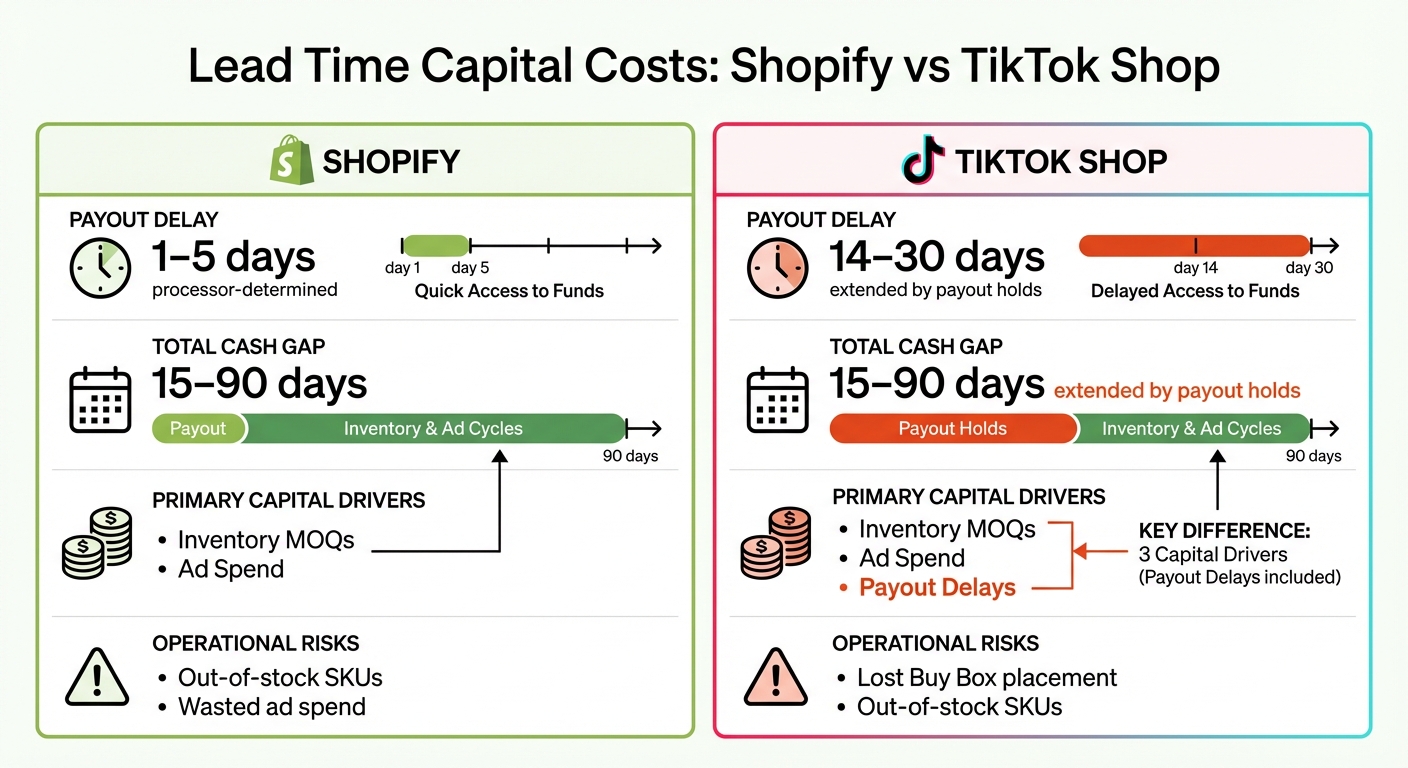
Lead Time Challenges on Shopify vs. TikTok Shop

Lead times play a critical role in determining how much capital sellers need to keep their businesses running smoothly. Different eCommerce platforms handle payouts and other financial processes in ways that either ease or add to these challenges.
For Shopify sellers, payout delays are relatively short, typically ranging from 1 to 5 business days, depending on the payment processor[5]. However, these sellers still face the challenge of covering upfront costs for inventory minimum order quantities (MOQs) and funding advertising campaigns before they see any revenue[5]. This creates a cash flow gap of 15 to 90 days, largely driven by supplier lead times and production schedules[5].
TikTok Shop sellers, on the other hand, face even greater challenges. In addition to similar inventory and advertising expenses, they deal with payout delays of 14 to 30 days[5]. These extended delays put extra pressure on cash flow, often requiring sellers to secure additional working capital. This delay can hinder their ability to restock inventory quickly or sustain advertising efforts, which are vital for maintaining sales momentum.
The risks differ slightly between the two platforms. Shopify sellers often grapple with stockouts and wasted ad spend, while TikTok Shop sellers face the added risk of losing Buy Box placement. Losing the Buy Box can severely impact their visibility and competitiveness in the marketplace[5].
Table: Lead Time-Driven Capital Costs by Platform
Here’s a comparison of how lead times affect capital needs across Shopify and TikTok Shop:
| Platform | Payout Delay | Total Cash Gap | Primary Capital Drivers | Operational Risks |
|---|---|---|---|---|
| Shopify | 1–5 days (processor-determined)[5] | 15–90 days[5] | Inventory MOQs, Ad Spend[5] | Out-of-stock SKUs, wasted ad spend[5] |
| TikTok Shop | 14–30 days[5] | 15–90 days (extended by payout holds)[5] | Inventory MOQs, Ad Spend, Payout Delays[5] | Lost Buy Box placement, out-of-stock SKUs[5] |
How Onramp Funds Solves Lead Time Problems

Fast Revenue-Based Financing
Lead time issues can cripple operations without quick access to cash. Onramp Funds tackles this by offering funding within 24 hours, allowing businesses to schedule production and restock inventory without delays.
What makes this solution stand out is its flexibility. Instead of rigid monthly payments, repayments adjust based on your sales performance. When sales are slower, repayments decrease; during busy periods, they increase. This ensures your cash flow stays in sync with your Cash Conversion Cycle. As Simon Davis from SBO Financial emphasizes:
Cash is the oxygen. You can have great sales, but if you're out of cash, the business will suffocate. [7]
This model is especially helpful during high-demand seasons. For instance, many eCommerce brands see up to 50% of their annual sales during the winter holidays [8]. However, inventory orders and marketing costs often spike months earlier - sometimes as early as August - while the revenue doesn’t roll in until November or December.
Onramp’s financing approach adapts to these seasonal pressures, making it easier to manage cash flow when you need it most.
Funding Solutions for Shopify and TikTok Shop Sellers
For sellers on platforms like Shopify and TikTok Shop, Onramp Funds offers tailored solutions. By directly integrating with these platforms, Onramp analyzes metrics such as Average Order Value and Gross Margin to create funding plans suited to your business needs [6]. This helps bridge cash flow gaps caused by long lead times, addressing platform-specific challenges.
If your business generates at least $10,000 in monthly sales, you can access funding with a transparent fee structure ranging from 2% to 8%, with no hidden costs. Plus, you retain full ownership of your business while getting the capital needed for inventory and marketing. To top it off, their Austin-based team provides personalized support, ensuring you fully understand how the financing works for your situation.
How to Manage Lead Times Effectively
Using Inventory Planning Software
Spreadsheets just don’t cut it anymore for managing today’s intricate eCommerce operations. Inventory planning software takes the guesswork out of the equation by relying on your actual sales data, seasonal trends, and accurate "days of stock" calculations. It determines exactly when you need to place orders, factoring in the entire lead time - from your supplier to your warehouse.
One of the biggest benefits? It compares actual arrival dates against supplier commitments. With around 88% of businesses still experiencing longer-than-usual lead times [9], building accurate safety buffers based on real-world data is essential. The software automates the calculation of your reorder point using this formula: (Average Daily Sales × Lead Time) + Safety Stock. This way, you’re not left scrambling if a supplier runs behind schedule.
Take Inside U, a wellness retailer that adopted Inventory Planner in 2024 to address their supply chain struggles. Founder and COO Steve Velthove shared how the software saved them about 80 hours per month by automating purchase orders. Plus, its notifications helped avoid costly mistakes, such as ordering items already stocked in other warehouse locations [9]. Velthove explained:
Each PO probably takes us 10 fewer minutes than before, which really adds up. I love that it stops us forgetting to complete orders and that it pops up with intuitive notifications that prevent us from making mistakes. [9]
Brands that can forecast demand with ±5% accuracy often free up 20% or more of their working capital by avoiding overstock and stockouts [10]. For products that sell quickly, it’s smart to keep safety stock at 10–20% of expected demand to cushion against any lead time hiccups [10].
But knowing the perfect time to order is just one piece of the puzzle - having the funds ready to act on those insights is just as critical.
Combining Financing with Inventory Management
While inventory software tells you when to place an order, you still need the cash to make it happen. Timing your financing draw is as important as your inventory forecast. For instance, drawing funds 60 days before big sales events like Black Friday or Prime Day ensures your inventory is ordered, manufactured, and delivered well ahead of the demand surge [10].
Onramp Funds offers revenue-based financing that works hand-in-hand with inventory management tools. Repayments adjust to your sales velocity, which keeps your cash flow flexible. Using the EOQ formula - EOQ = √[(2 × Demand × Order Cost) ÷ Holding Cost] - you can calculate the ideal order size and withdraw only the funds you actually need [10]. This approach helps you avoid both under- and over-ordering.
Aligning repayment schedules with inventory turnover is key. Onramp’s dynamic remittance system adjusts based on your daily sales, so you’re not stuck with rigid monthly payments while inventory sits idle in your warehouse. This synchronization helps maintain healthy cash flow throughout the lead time cycle, from placing your order to turning that inventory into revenue. By bridging cash flow gaps, you can keep your operations running smoothly, even when lead times stretch longer than expected.
Conclusion
Key Takeaways for eCommerce Sellers
Lead times - not revenue - ultimately shape your capital needs. Whether you're navigating overseas manufacturing delays or waiting for platform payouts, these time lags lock up cash well before sales roll in. This underscores the critical connection between lead times and cash flow challenges.
To tackle these challenges, pairing accurate inventory planning with revenue-based financing is crucial. Inventory planning tools help you calculate reorder points and avoid costly errors, but having the funds ready when purchase orders are due is just as important. That’s where revenue-based financing steps in - it provides quick access to funds (often within 24 hours) and aligns repayments with your actual sales performance, not rigid monthly deadlines.
Whether you're selling on Shopify or TikTok Shop, aligning your funding strategy with lead times ensures you can restock inventory on time and avoid repayment stress. Drawing funds ahead of peak seasons allows inventory to arrive just as demand starts to climb.
In short, managing lead times effectively means syncing your order placements, inventory arrivals, and revenue cycles. As we've seen, controlling lead times gives you greater control over your capital requirements.
FAQs
How do I calculate my cash conversion cycle (CCC)?
To figure out your cash conversion cycle (CCC), apply this formula: Days of Inventory Outstanding (DIO) + Days Sales Outstanding (DSO) - Days Payables Outstanding (DPO).
- DIO: The average number of days you hold inventory before it’s sold.
- DSO: The average number of days it takes to collect payment after making a sale.
- DPO: The average number of days you take to pay your suppliers.
Make sure to monitor these metrics on a monthly or quarterly basis for accurate insights.
How much cash should I keep for long lead times?
When managing long lead times, the amount of cash you'll need depends on your business size and the typical delays in your supply chain. For instance, if your annual cost of goods sold (COGS) is $1 million and you face a 60-day lead time, you could have approximately $164,384 tied up in inventory that can’t be sold yet. To navigate these challenges, experts suggest maintaining 2-3 months' worth of operating expenses, including inventory costs, as a buffer. Careful planning and accurate forecasting are key to keeping your cash flow steady during these periods.
When should I draw financing before a big sales season?
If you’re gearing up for a busy sales season and foresee cash flow issues due to inventory costs, long lead times, or delayed payments, it’s wise to secure financing several weeks in advance. Doing so ensures you’ll have the funds needed to handle upfront inventory purchases, bridge cash flow gaps, and keep your shelves stocked during periods of high demand. By planning ahead, you can confidently tackle the financial pressures that come with peak sales seasons.
Related Blog Posts
Onramp Funds
Funding built around your sales
Connect your store and see what you qualify for. Repay as a percentage of sales, with no personal credit check.
Funding in as little as 24 hours.
