


Long inventory lead times can strain your business cash flow. Here's how:
- What It Means: Lead time is the duration between ordering inventory and having it ready to sell. Longer lead times mean cash is tied up for extended periods.
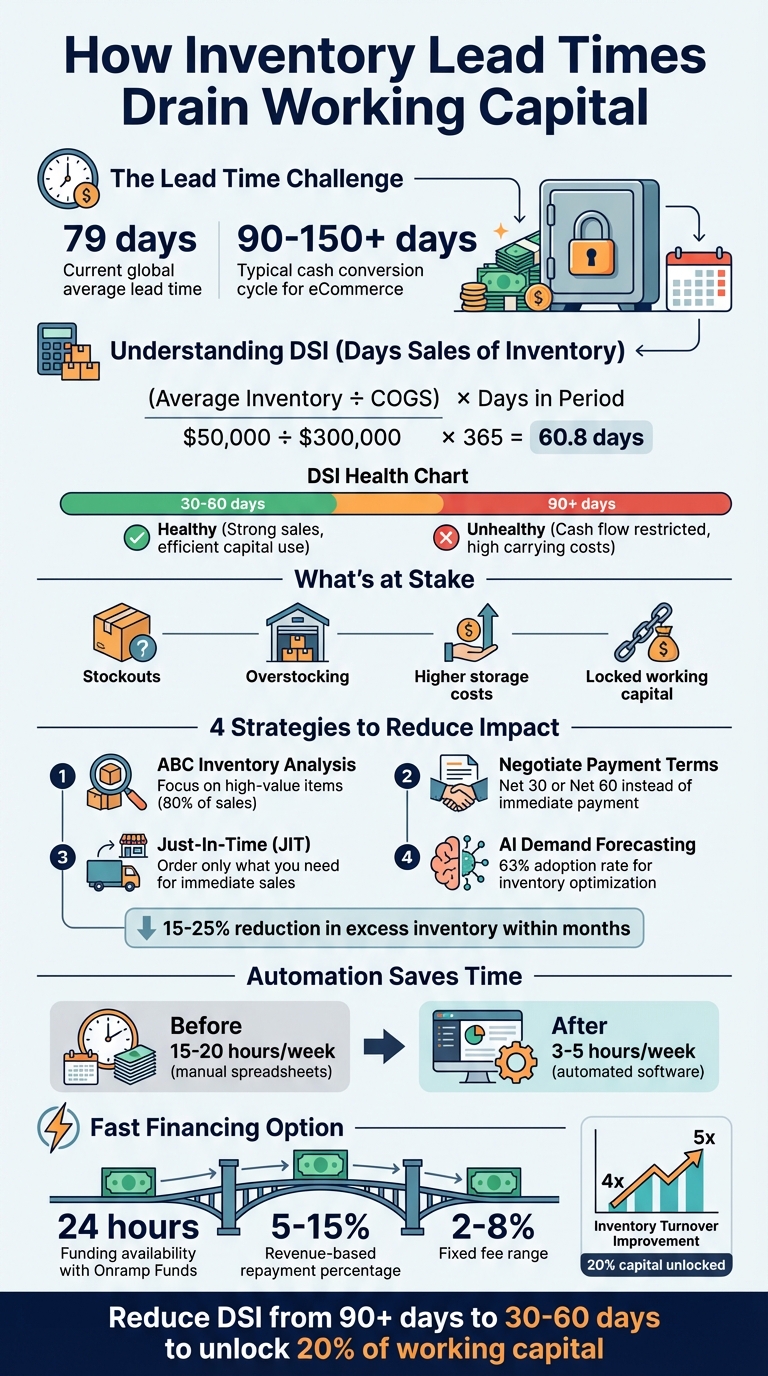
- The Impact: Businesses face challenges like stockouts, overstocking, and higher storage costs. Global lead times currently average 79 days, forcing eCommerce sellers to hold more safety stock, which locks up working capital.
- Key Metric: Days Sales of Inventory (DSI) measures how long inventory stays before generating revenue. A DSI over 90 days indicates cash flow issues.
- Solutions: Strategies like ABC inventory analysis, negotiating better supplier terms, Just-In-Time (JIT) ordering, and AI-powered demand forecasting can reduce lead time effects.
- Financing Option: Revenue-based financing, such as Onramp Funds, provides quick access to cash to cover inventory costs, ensuring smooth operations despite long lead times.
Takeaway: Managing lead times effectively and using financing options can protect your cash flow, improve inventory turnover, and fuel growth.
How Does Lead Time Affect Inventory Management Optimization? - How It Comes Together
sbb-itb-d7b5115
Calculating How Lead Times Affect Cash Flow
Understanding how lead times impact cash flow is essential for eCommerce sellers. One key metric to measure this is Days Sales of Inventory (DSI), which helps determine how long cash remains tied up in inventory before generating revenue. By accurately calculating DSI, businesses can identify ways to free up working capital and fuel growth - an ongoing challenge in the eCommerce world.
What Is Days Sales of Inventory (DSI)?
DSI calculates the average number of days it takes to turn inventory into revenue. The formula is straightforward:
(Average Inventory ÷ Cost of Goods Sold) × Number of Days in the Period
Here’s an example: if your average inventory is $50,000 and your annual Cost of Goods Sold (COGS) is $300,000, your DSI would be about 60.8 days. It’s important to use COGS instead of sales revenue in this formula because including profit margins would skew the results. To account for fluctuations, calculate average inventory as:
(Beginning Inventory + Ending Inventory) ÷ 2
A higher DSI indicates that cash is tied up in inventory for longer periods, while a lower DSI suggests quicker turnover, allowing for faster reinvestment. This metric also helps you spot "dead stock" - inventory that isn’t moving - before it becomes a financial burden [3].
Healthy vs. Unhealthy DSI Numbers
| DSI Range | Status | Financial & Operational Impact |
|---|---|---|
| 30–60 Days | Healthy | Reflects strong sales, efficient capital use, and streamlined operations |
| 90+ Days | Unhealthy | Points to overordering, weak demand, or poor forecasting; leads to increased carrying costs and restricted cash flow |
If your DSI exceeds 90 days, it means your cash is essentially locked in inventory for three months before generating returns. This delay can restrict your ability to invest in other critical areas like marketing or hiring. Regular DSI monitoring - whether monthly or quarterly - can help you catch seasonal spikes or vendor-related delays early on [3].
Software for Monitoring Inventory and Cash Flow
Once you’ve calculated DSI, the next step is streamlining how you monitor it. For mid-sized businesses, manually tracking inventory with spreadsheets can take 15–20 hours per week. In contrast, automated inventory planning software can cut that time down to just 3–5 hours [4]. These tools integrate seamlessly with platforms like Shopify, Amazon, Walmart, and QuickBooks, offering real-time insights into cash flow and inventory value [3][4].
Take Tightly as an example. This software provides live inventory valuation, demand-based reordering triggers, and automated DSI calculations - all accessible through a real-time dashboard [3]. Another option, Finale Inventory, offers velocity-based forecasting and dynamic safety stock calculations, particularly useful for multichannel sellers [4]. Stephanie Parks, CEO of DermWarehouse, highlighted the benefits of Finale Inventory:
"Finale inventory has been a complete game-changer for our business... This software has allowed us to stay organized with our inventory, know exactly when orders need to be placed for each of our brands, keep track of out-of-stock or back-ordered products." [4]
Most inventory management tools are priced between $50 and $500 per month for small to mid-sized businesses. Companies adopting these tools often report a 15% to 25% reduction in excess inventory within months. For example, reducing $500,000 worth of inventory by just 20% could free up $100,000 in working capital [4].
How to Reduce Lead Time Impact on Working Capital
Freeing up working capital while keeping inventory levels and customer satisfaction intact requires smart strategies. From better inventory categorization to renegotiating supplier terms and using advanced forecasting tools, these approaches can make a significant difference.
Using ABC Inventory Analysis
ABC inventory analysis helps you focus on the items that matter most. It divides inventory into three categories:
- A-class items: High-value, fast-moving products that drive 80% of sales. These need daily monitoring and tight reorder schedules.
- B-class items: Moderate-value products that move at a medium pace. Weekly reviews are sufficient here.
- C-class items: Low-value, slow-moving products that only need monthly attention [5].
This method ensures your cash is allocated wisely. For example, you can keep minimal stock of A-class items to free up capital while maintaining higher safety stock for C-class items to avoid unnecessary reorders. A-class products might also benefit from being stored regionally for faster delivery, whereas C-class items can be centralized to cut storage costs [1].
Negotiating Better Payment Terms with Suppliers
One quick way to ease cash flow is by negotiating extended payment terms with suppliers. Instead of paying immediately upon delivery, aim for Net 30 or Net 60 terms. This gives you more time to sell inventory before paying the bill, effectively increasing your Days Payable Outstanding (DPO) and improving liquidity [2].
Here’s a simple formula to keep in mind:
Cash Conversion Cycle = Days Inventory Outstanding + Days Sales Outstanding – Days Payable Outstanding
For instance, if you currently pay suppliers within 15 days but negotiate Net 45 terms, that’s an extra 30 days to use your cash elsewhere. Tracking supplier performance can also help you balance extended payment terms with reduced lead times [5].
Applying Just-In-Time (JIT) Inventory Methods
The Just-In-Time (JIT) inventory approach focuses on ordering only what you need for immediate sales or production, avoiding excess stock. This reduces the working capital tied up in inventory and cuts storage costs.
However, JIT depends on reliable suppliers and strong contingency plans. If a supplier fails to deliver on time, you risk stockouts, which can harm customer trust and sales. That’s why JIT works best when paired with real-time inventory tracking and solid supplier relationships [2]. It’s also smart to keep a reserve of working capital for unexpected disruptions, like shipping delays or demand spikes.
For eCommerce businesses with steady demand and dependable suppliers, JIT can be a game-changer. But for companies dealing with high lead time variability - a challenge cited by 68% of businesses in 2025 - it might be better to apply JIT selectively [5]. Pairing JIT with accurate demand forecasting can further optimize inventory levels.
Leveraging Demand Forecasting Software
Modern eCommerce operations are too complex for manual spreadsheets. AI-powered demand forecasting tools can analyze real-time sales data, seasonal trends, and external factors to predict inventory needs with precision. By 2025, AI adoption for inventory management had doubled, with forecasting (63%) and inventory optimization (58%) being the top applications [5].
These tools integrate with eCommerce platforms and marketing calendars, ensuring inventory targets are based on current data rather than outdated assumptions [1]. For example, if you’re running a promotion, the software can adjust reorder points automatically to prevent stockouts. This eliminates the need for speculative inventory - a problem that affected 63% of businesses during tariff changes in 2025 [5].
Dynamic reorder points replace static ones by factoring in sales velocity, supplier reliability, and seasonality [1]. As the COO of Best Vinyl shared:
"With the Netstock dashboard, I can quickly see stockouts and potential stockouts, which allows me to have a focused conversation with my sales team to determine what's coming up and what else I need to consider when placing orders" [5].
Even for new products, advanced tools can link forecasts to the items they’re replacing, avoiding the overstocking that often happens with new launches. The Operations Manager at Keir Surgical explained how this improved their process:
"Supplier lead times were always a guess and based on a supplier's full line as opposed to individual items. It took tedious amounts of time to work out our orders each month..." [5].
Onramp Funds: Financing for Inventory Needs

Even with the best inventory strategies, long lead times can tie up cash, making it tough to maintain smooth operations. Revenue-based financing provides a way to cover inventory costs without draining your working capital or sacrificing equity. This option works hand-in-hand with the inventory management tips mentioned earlier.
How Onramp Funds Supports Inventory Financing
Onramp Funds offers a lifeline for eCommerce sellers facing cash flow challenges. When long lead times force you to pay suppliers upfront and wait up to 150 days for sales revenue, traditional financing often isn't enough. Onramp Funds steps in with fast funding - available within 24 hours of approval [8]. This allows you to stock up for busy seasons or product launches without the delays that come with bank loans.
The platform connects directly with major eCommerce platforms like Shopify, Amazon, BigCommerce, WooCommerce, Walmart Marketplace, and TikTok Shop. By analyzing your actual sales data, it determines the funding amount you qualify for. With this system, you can purchase inventory in bulk to take advantage of supplier discounts, all while keeping cash free for marketing, fulfillment, and daily expenses [7].
Flexible Repayment Tied to Your Sales
Instead of fixed monthly payments, Onramp Funds uses a revenue-based repayment model. You pay a set percentage - typically between 5% and 15% - of your daily or weekly sales. This approach adjusts automatically based on your revenue. If sales slow down, your repayment amount decreases, which can be especially helpful for businesses with Days Sales of Inventory exceeding 90 days. During busy periods, as your sales grow, repayments scale up in line with your cash flow [8].
What Sets Onramp Funds Apart
Onramp Funds stands out with its straightforward terms: fixed fees ranging from 2% to 8%, no hidden charges, no need for personal guarantees or collateral, and a dedicated support team based in Austin that understands the unique challenges of eCommerce [8]. To qualify, your business needs at least $10,000 in monthly sales. Plus, a funding calculator is available to help you explore your options before applying.
Example: How Long It Takes to Recover Capital
Example: Handling a 90-Day Lead Time
Imagine an eCommerce seller who places a $50,000 inventory order on January 1, 2026. With a 90-day lead time, the inventory won’t arrive until April 1, 2026. That means the seller’s funds are tied up for three months, leaving less money for launching new products, increasing marketing efforts, or restocking popular items [9]. This delay can significantly limit growth opportunities.
Now, picture the same seller using Onramp Funds. Instead of waiting three months, they receive 80–90% of the payment (about $40,000–$45,000) within 24 hours. This quick cash access breaks the connection between long lead times and cash flow limitations [9]. With funds available almost immediately, the seller can confidently place larger orders or respond to unexpected demand surges.
This scenario highlights how fast financing can eliminate the cash flow challenges caused by extended lead times.
Lessons from This Timeline
This timeline sheds light on the financial challenges eCommerce sellers often face and the advantages of having immediate access to cash. A 90-day gap in cash flow can lead to difficult decisions [9]. Without quick financing, sellers might miss out on bulk discounts, promotional opportunities, or the ability to scale quickly. Fast financing solves this problem by providing the flexibility to invest in growth, manage expenses, and stay competitive. The big takeaway? Long lead times don’t have to mean locked-up cash when you have the right financing partner to support your inventory needs.
Conclusion: Managing Lead Times and Protecting Cash Flow
Extended lead times don't have to drain your cash or slow your growth. The strategies discussed - ABC analysis, Just-In-Time ordering, demand forecasting software, and supplier negotiations - are effective ways to bring your Days Sales of Inventory (DSI) down from unhealthy levels (over 90 days) to the ideal range of 30-60 days for eCommerce businesses [6]. Even modest changes, like improving inventory turnover from 4x to 5x, can unlock 20% of your working capital [6]. Lowering your DSI opens the door for smarter financial decisions.
However, when your cash conversion cycle stretches between 90 and 150+ days, operational strategies alone might not be enough. That’s where financing through Onramp Funds comes into play. Their fast access to working capital, with repayments tied to your sales, ensures you can keep shelves stocked, take advantage of bulk discounts, and scale your business without waiting months to recover your cash.
Start by auditing your current DSI and cash conversion cycle to pinpoint where your capital is tied up. Use demand-driven reorder points, negotiate Net 30 payment terms with suppliers, and explore financing options that align with your inventory needs, particularly during peak seasons or product launches. This way, lead times become a manageable part of your growth strategy rather than a financial strain.
FAQs
How do I calculate DSI for my store?
To calculate Days Sales Inventory (DSI), follow this formula:
DSI = (Inventory ÷ Cost of Sales) × Number of Days in the Period
Here’s how you can break it down:
- Step 1: Identify the total inventory value at the end of the period.
- Step 2: Determine your Cost of Goods Sold (COGS).
- Step 3: Divide the inventory value by COGS, and then multiply the result by the number of days in the period (e.g., 365 for a full year).
This calculation helps you understand how long it takes to convert inventory into sales.
What’s the best way to set safety stock for long lead times?
To manage safety stock during long lead times, start by examining how much your demand fluctuates and the length of your lead times. This helps you calculate a buffer that can protect against unexpected changes. Leverage demand forecasting tools and effective inventory planning to strike a balance - avoiding the risk of overstocking.
Prioritize high-margin products and work on improving sell-through rates. This approach helps streamline inventory, cut down on surplus stock, and free up working capital. By doing so, you maintain flexibility in cash flow while ensuring you have enough stock to meet customer needs.
When does revenue-based financing make sense for inventory?
Revenue-based financing can be a great fit for managing inventory, especially when businesses face long lead times of 45–90 days. This type of funding offers flexibility by tying repayments to revenue rather than sticking to fixed payment schedules. It’s particularly useful for growing businesses with steady and predictable sales, as it allows them to handle stock purchases, cover operating expenses, and invest in growth - all without the added pressure of fixed debt payments disrupting their cash flow.
Related Blog Posts
Onramp Funds
Funding built around your sales
Connect your store and see what you qualify for. Repay as a percentage of sales, with no personal credit check.
Funding in as little as 24 hours.
