


A rolling cash line is a flexible financing option designed for eCommerce businesses dealing with unpredictable cash flow. Unlike fixed loans, it allows you to draw funds as needed and repay based on a percentage of daily sales. This ensures repayments align with your revenue, offering a practical way to manage inventory, fund marketing, or address unexpected expenses.
Key takeaways:
- Flexible access: Borrow, repay, and reborrow without reapplying.
- Sales-based repayments: Payments adjust automatically to your revenue.
- Rapid funding: Approvals often take less than 24 hours.
- No personal guarantees: Reduced financial risks compared to traditional loans.
For eCommerce sellers, a rolling cash line helps bridge cash flow gaps, especially during peak seasons or product launches. It's a smarter alternative to rigid loan structures, ensuring you have the capital to seize growth opportunities without unnecessary financial strain.
How To Fund Your Ecommerce Business For Cheap (Or Even Free)
What Is a Rolling Cash Line and How Does It Work?
A rolling cash line is a flexible financing option that lets businesses access funds whenever needed - whether to replenish inventory, kick off a marketing campaign, or address unexpected expenses. What sets it apart is how repayments work: instead of fixed amounts, a portion of your daily sales automatically goes toward repaying the balance. This repayment model keeps your available credit refreshed, so you don't have to reapply every time you need cash.
Unlike traditional loans with set monthly payments, rolling cash lines adjust repayments based on your revenue. When sales are strong, you repay more; when they slow down, your repayments decrease. This dynamic approach ensures your financing aligns with your business's actual cash flow.
Here's how it often works: the provider takes a percentage of your daily credit card sales until the borrowed amount, plus fees, is fully repaid. As payments are made, the credit becomes available again - hence the "rolling" feature, which eliminates the hassle of repeated applications or waiting for approvals.
"When an ecommerce business borrows money to finance operations or growth, it needs positive operating cash flow to repay debt and maintain financial stability." - EcomBalance [1]
Key Features of a Rolling Cash Line
The standout feature is its sales-based repayment structure. For example, if you owe 8% of daily sales and bring in $10,000 in a day, $800 goes toward repayment. On slower days, the repayment amount decreases proportionally.
Another advantage is the automatic renewal of credit. As repayments are made, your credit replenishes, giving you continuous access to funds without the need to reapply.
This setup is particularly useful for businesses with fluctuating financial needs. For instance, eCommerce companies often need extra cash to stock up before peak seasons, like the holidays, and can cut back during slower months. A rolling cash line adapts to these cycles, offering flexibility that rigid payment schedules simply can't match.
Why Rolling Cash Lines Work Well for eCommerce
Rolling cash lines are especially suited to the unpredictable cash flow of eCommerce businesses. Consider this: around 70% of eCommerce shoppers abandon their carts without completing a purchase [2]. This highlights the need for quick access to marketing funds to re-engage these potential customers and seize new opportunities.
Traditional loans often involve lengthy approval processes, which can cause businesses to miss out on time-sensitive growth opportunities. In contrast, rolling cash lines provide immediate access to capital, ensuring you're ready to act when the moment strikes.
Another major advantage is how repayments flex with your revenue. If your costs increase or sales dip, your repayments automatically adjust, easing the financial strain during tough times. This adaptability is a big reason why revenue-based financing is becoming a go-to choice for many eCommerce sellers.
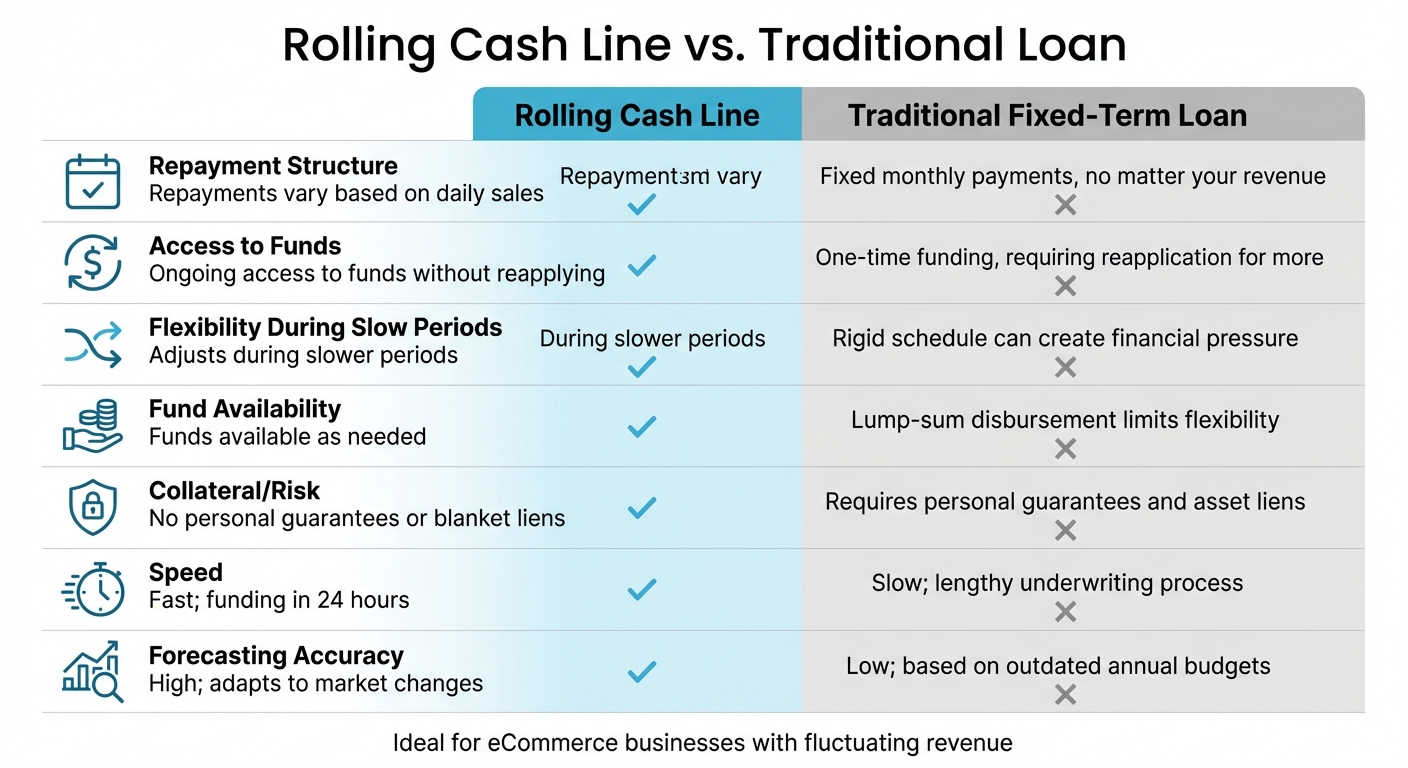
| Rolling Cash Line | Traditional Fixed-Term Loan |
|---|---|
| Repayments vary based on daily sales | Fixed monthly payments, no matter your revenue |
| Ongoing access to funds without reapplying | One-time funding, requiring reapplication for more |
| Adjusts during slower periods | Rigid schedule can create financial pressure |
| Funds available as needed | Lump-sum disbursement limits flexibility |
Benefits of Using a Rolling Cash Line for eCommerce Businesses
Better Cash Flow Management
Rolling cash lines can be a game-changer for managing cash flow, especially during unpredictable sales cycles. Whether you're restocking inventory for a busy season or funding a new product launch, these lines let you access funds exactly when you need them. On the flip side, during slower months, automated lower repayments help conserve your cash reserves.
This is particularly helpful for handling inventory challenges. Many eCommerce businesses have to pay suppliers upfront for large orders but wait weeks - or even months - for revenue from sales. A rolling cash line bridges this gap, ensuring you have the working capital to keep operations running smoothly.
The same goes for marketing. Let's say you spot a golden opportunity to ramp up ad spending during a high-converting period. Instead of waiting for a loan approval or draining your cash reserves, you have immediate access to funds. As sales roll in, a portion of that revenue goes toward repaying the line, creating a sustainable cycle.
Flexibility and Risk Reduction
Rolling cash lines don't just smooth out cash flow - they also give businesses the flexibility to adapt quickly. These tools integrate with your sales data to forecast potential cash shortfalls months in advance, giving you time to adjust. For example, businesses using automated rolling forecast platforms saw their EBITDA margins grow by an average of 6.7 points within the first year [3].
Nick Dupont, CFO of SIMO, highlighted how this flexibility helped his company maintain momentum:
"Without Rolling Funding, we would have been more conservative, and for us that would have meant missing revenue opportunities" [6].
This kind of agility is crucial when unexpected challenges or opportunities arise. Whether it's a sudden spike in freight costs or a viral product moment, rolling cash lines let you respond without being tied down by rigid budgets or fixed repayment schedules.
Another big plus? Many rolling cash line providers don't require personal guarantees or blanket liens on your assets. Instead, they secure their interest in future receivables [6]. This setup helps protect your personal finances and reduces overall business risk.
Rolling Cash Lines vs. Traditional Loans
Here's how rolling cash lines stack up against traditional loans or credit lines:
| Feature | Rolling Cash Line | Traditional Loan / Credit Line |
|---|---|---|
| Access to Funds | Continuous; replenishes automatically as you repay [6] | One-time disbursement or fixed credit limit |
| Repayment Structure | Based on current revenue [6] | Fixed monthly payments regardless of revenue |
| Reapplication | No reapplication needed; one-time approval [6] | Reapplication required for new loans or increases |
| Collateral/Risk | No personal guarantees or blanket liens [6] | Requires personal guarantees and asset liens |
| Forecasting Accuracy | High; adapts to market changes [3] | Low; based on outdated annual budgets [4] |
| Speed | Fast; funding in 24 hours [6] | Slow; lengthy underwriting process [3] |
This comparison highlights why many eCommerce businesses are turning to rolling cash lines. Traditional loans often come with rigid repayment schedules that don't account for seasonal dips or market shifts. If sales slow down, fixed payments can strain your cash flow. Rolling cash lines, on the other hand, adjust to your revenue, giving you the flexibility to navigate tough periods while still having capital available for growth opportunities.
sbb-itb-d7b5115
How to Build a Long-Term Capital Strategy Around a Rolling Cash Line
Step 1: Understand Monthly Sales and Cash Flow Needs
Start by calculating your Cash Conversion Cycle (CCC). To do this, add your Days Inventory Outstanding (DIO) to Days Sales Outstanding (DSO), then subtract Days Payables Outstanding (DPO)[5]. This is especially important for eCommerce businesses, which often face delays between paying suppliers and receiving payouts from marketplaces. For example, Walmart seller disbursements can take up to 14 days[5].
Once you've got your CCC figured out, review your historical sales data, seasonal trends, and promotional results. Use this information to set realistic goals and prepare for different scenarios - best-case, worst-case, and most-likely[7]. Also, keep a close eye on inventory turnover. A high DIO might mean you're holding onto stock for too long, while a low DIO could signal potential stockouts[5].
Step 2: Link Your eCommerce Platforms
Connecting your eCommerce platforms is crucial for aligning financing with your business operations. By integrating platforms like Amazon, Shopify, or Walmart with your financing provider, your repayment schedule can sync directly with your payout cycles. Real-time sales data enables faster funding - sometimes with same-day deposits - and ensures repayments adjust automatically. This setup helps bridge the gap between paying suppliers and receiving marketplace funds. Integration ensures financing through Onramp Funds aligns perfectly with your sales cycles[8].
Step 3: Create a 12-Month Rolling Cash Flow Forecast
With your platforms connected, you now have access to real-time data, which is essential for accurate forecasting. Build a rolling cash flow forecast that updates monthly, providing an evolving view of your financial health. Include projected revenue, cost of goods sold, operating costs, and planned investments for each month. Don't forget to factor in seasonal fluctuations, promotional events, and payout schedules. As each month ends, replace outdated data with fresh insights to stay ahead of potential cash flow challenges.
Step 4: Select a Revenue-Based Financing Provider
Revenue-based financing can be a game-changer for eCommerce businesses. Onramp Funds offers this type of financing, designed for businesses generating at least $10,000 in monthly sales. They provide fast funding - often within 24 hours - without requiring equity or personal collateral. Repayments are flexible and tied to a percentage of daily sales, making them adaptable to your business performance[8].
Onramp Funds integrates with major eCommerce platforms, ensuring financing scales with your operations. Here's a quick breakdown of financing options:
| Plan Type | Fee Range | Key Features | Ideal For |
|---|---|---|---|
| Fixed Fee Structure | 2-8% fee | Predictable costs and repayment schedules | Businesses seeking stable payments |
| Revenue-Based Financing | Based on sales % | Flexible repayments tied to sales performance | Businesses with fluctuating sales cycles |
| Custom Funding Offers | Variable | Personalized funding and support | Scaling businesses with unique needs |
Step 5: Monitor and Adjust Repayments
Once your financing is in place, use your rolling forecast to monitor sales and adjust repayments as needed. Regularly track your sales data to ensure your repayment schedule aligns with your cash flow[8]. Plan ahead for times when you might need extra funds, like before a major product launch or during busy seasons.
During high-revenue periods, higher repayments can help pay down your balance faster, freeing up credit for future use. On the flip side, repayments automatically adjust to be smaller during slower periods, helping you maintain cash reserves while keeping your funding accessible. This flexible cycle of borrowing, repaying, and redrawing funds through Onramp Funds allows you to build a sustainable capital strategy that grows with your business - without the rigidity of traditional loans.
Practical Examples: Using Rolling Cash Lines in eCommerce
Restocking Inventory During Peak Seasons
The holiday season often creates a financial balancing act for eCommerce businesses. Inventory orders need to be placed months in advance, but revenue from sales comes later, creating a cash flow gap. A rolling cash line can help bridge this gap by providing the capital exactly when it's needed, with repayments that adjust to your sales cycle.
Take Black Friday, for example. If you need $75,000 in September to stock up on inventory, you can access that amount immediately through a rolling cash line like Onramp Funds. As sales ramp up in November, you can start paying down the balance at a faster rate. Then, when January arrives and sales slow, your repayments automatically decrease, helping you maintain cash flow during the post-holiday dip.
This same flexibility can also support marketing efforts during critical times.
Funding Marketing Campaigns After Product Launches
Launching a new product often means spending heavily on marketing before you see any returns. Compounding this challenge, payouts from sales can be delayed by 14 to 30 days[9]. Meanwhile, ad costs on platforms like Meta and Google have risen by over 20% in recent years[9], making it even more important to maximize every dollar spent.
A great example of this is Hedoine, a fashion brand that secured $50,000 in 2019 to fund targeted Instagram and Facebook campaigns. By the first quarter of 2020, their strategic ad spend led to an impressive 1,106% increase in sales[10]. They were able to maintain consistent ad activity without interruptions, avoiding the costly loss of algorithm momentum that can occur when campaigns are paused[9].
With a rolling cash line, you can fund initial ad testing, scale successful campaigns, and only repay based on what you've used. As revenue from the campaigns comes in, repayments adjust automatically, allowing you to reinvest profits into top-performing channels while keeping your cash flow steady.
This adaptable funding strategy is also ideal for businesses looking to grow into new markets.
Expanding into New Markets
Rolling cash lines aren't just for short-term needs - they're also a smart way to fund long-term growth. Expanding into new markets, whether it's through new sales channels or geographic regions, requires upfront investments in inventory, marketing, and operational infrastructure.
Consider Purdy & Figg, which grew from £452,000 to £50 million in annual revenue between 2023 and January 2026 by using scalable systems and precise financial planning[11]. Similarly, Wildbird achieved a 10x revenue increase over two years ending in 2025, all while maintaining a 17.5% net profit margin through careful financial management[11].
A rolling cash line allows you to approach market expansion incrementally. For instance, you could draw $20,000 to test demand in a new region through pre-order campaigns. If the results are promising, you can access more funds to stock inventory. If the market doesn't respond as expected, you've only paid for the capital you used, avoiding the burden of a large, fixed loan. This approach minimizes financial risk while enabling data-driven, sustainable growth.
Conclusion
A rolling cash line offers eCommerce businesses a flexible and performance-driven funding solution tailored to the demands of a fast-paced market. Whether you're preparing for a high-sales season, launching a marketing campaign, or exploring a new market, this approach provides the adaptability to navigate challenges while maintaining steady growth. With repayments tied to sales performance, it helps safeguard cash flow during slower periods.
This funding model minimizes risk and supports growth by allowing repeated access to funds without rigid deadlines or the need to reapply. Pairing it with a 12-month rolling cash flow forecast gives you the foresight to identify potential gaps and adjust strategies as market conditions shift.
For eCommerce sellers aiming to scale without compromising equity or cash flow, Onramp Funds delivers tailored revenue-based financing solutions. Their integration with platforms like Shopify, Amazon, and TikTok Shop, combined with automated repayments based on daily sales and funding availability within 24 hours, ensures you have the tools to grow efficiently. With transparent fees ranging from 2% to 8%, there are no hidden costs, making it easier to plan ahead.
Whether you're addressing seasonal changes, launching new products, or expanding into new markets, a rolling cash line turns opportunities into tangible growth. By choosing a provider like Onramp Funds - one that understands the unique needs of eCommerce - you can align your funding with your business's rhythm and goals.
Take the next step with Onramp Funds today and secure the flexible funding your eCommerce business needs to thrive.
FAQs
How do I choose the right sales percentage for repayments?
Choosing the right sales percentage requires a close look at your business's revenue patterns and cash flow requirements. Opting for a repayment model that adjusts based on a percentage of your revenue can provide some breathing room, especially during slower sales periods. To make an informed decision, review your sales data from the past 12–24 months. This will help you identify seasonal trends and choose a percentage that keeps repayments manageable while still leaving room for your business to grow.
What sales data should I track before using a rolling cash line?
To make the most of a rolling cash line, it's crucial to monitor key financial metrics. Pay close attention to factors like sales volume, revenue trends, seasonal fluctuations, and cash inflows and outflows. This information plays a critical role in maintaining accurate cash flow forecasts, which are the backbone of managing your finances effectively.
How much credit should I keep available for emergencies?
It's a good idea to have enough credit available to cover 3 to 6 months of operating expenses. This safety net helps you handle unexpected situations, ensuring your business can keep running smoothly and manage emergencies without major disruptions.
Related Blog Posts
Onramp Funds
Funding built around your sales
Connect your store and see what you qualify for. Repay as a percentage of sales, with no personal credit check.
Funding in as little as 24 hours.
