


A rolling cash line is a flexible financing option designed for eCommerce businesses. Unlike loans that require fixed payments on a lump sum, this tool lets you borrow only what you need and repay based on daily sales. It’s equity-free, charges a flat fee (2–8%), and adjusts repayments automatically to match your revenue cycles. With funds available in less than 24 hours, it’s ideal for managing inventory, boosting marketing, or bridging cash flow gaps during seasonal peaks.
Key Benefits:
- Flexible Borrowing: Access up to $500,000 and only pay for what you use.
- Revenue-Based Repayments: Payments scale with sales, reducing financial strain in slow months.
- Fast Approval: Get funds in under 24 hours by linking your sales data.
- Transparent Costs: No hidden fees, just a clear upfront fee.
This approach ensures you have the capital to grow your business without overextending financially. Whether preparing for a busy season or seizing a trending opportunity, a rolling cash line keeps your cash flow steady and your business ready for growth.
eCommerce Financing Options to Scale Your Business - eCom Week LA 2021
sbb-itb-d7b5115
What Is a Rolling Cash Line?
A rolling cash line is a flexible financing option tailored for eCommerce businesses, offering continuous access to growth capital without the constraints of traditional loans. Instead of receiving a lump sum with fixed monthly repayments, you draw funds as needed and repay through a percentage of your daily sales. This approach ensures you retain 100% ownership of your business, as it’s entirely equity-free, and simplifies cash flow management through automation.
Torrie V., Founder and Owner of Torrie's Natural, shared: "Onramp has simplified cash flow by automating everything: easy to request, set it and forget it payments!"
Unlike the cumbersome process of traditional bank loans, which often require extensive paperwork and personal credit checks, rolling cash lines rely on your business's performance data to determine eligibility. To qualify, your business must generate at least $10,000 in average monthly sales. Once approved, funds can be available in your bank account in less than 24 hours. This model is designed to align seamlessly with the natural ups and downs of eCommerce sales cycles, making it an ideal solution for businesses with fluctuating revenue streams. [1]
How Rolling Cash Lines Match eCommerce Sales Cycles
The nature of eCommerce involves constant change - seasonal demand spikes, inventory management, and varying marketing results. A rolling cash line adjusts to these changes because repayments are tied to your revenue. During busy periods, repayments increase, while slower sales periods automatically reduce them, helping you maintain steady cash flow. This flexibility is especially useful for managing inventory. For instance, you can draw funds to stock up before a high-demand season and repay as sales come in.
Jeremy, Founder and Owner of Kindfolk Yoga, noted: "Onramp offered the perfect solution with revenue-based financing to secure the capital we needed to invest in inventory and pay it back at a reasonable time frame once we made sales."
This system also allows businesses to act quickly on opportunities, such as capitalizing on a product trending on TikTok Shop. By aligning repayment schedules with revenue cycles, rolling cash lines make it easier to seize these moments without disrupting cash flow. This adaptability is just one part of the overall structure - let’s explore its standout features next. [1]
Main Features of Rolling Cash Lines
One of the standout benefits of a rolling cash line is its flexibility. Instead of locking into a fixed loan amount, you gain access to a revolving credit line - often up to $500,000. Fees are only applied to the funds you actually use, so unused credit doesn’t cost you anything. This pay-as-you-go model allows you to fund growth strategically, using capital only when necessary. Repayments are automated and can be set daily, weekly, or bi-weekly, with terms ranging from 1 to 6 months. Plus, there’s just one clear fee - no hidden charges.
Nick James, CEO of Rockless Table, described his experience: "Applied, got our offer, and had cash in our bank account within 24 hours."
The qualification process is also streamlined. By connecting directly to your sales platforms - such as Amazon, Shopify, TikTok Shop, and Walmart - the system evaluates your business performance quickly, providing tailored funding offers in record time. [1][4]
Benefits of Funding Growth Only When Needed

For eCommerce sellers, matching funding to sales cycles can be a game-changer. It keeps cash flow steady while supporting growth that aligns with actual demand. By tying funding to sales, you avoid paying for unused capital during slower periods. A rolling cash line charges fees only on the amount you use, with repayments adjusting to your daily sales. This approach ensures you're not stuck with payments that stretch your budget during leaner times. It all boils down to flexible repayments, upfront pricing, and a structure that fits the rhythm of eCommerce.
Flexible Repayments Based on Sales
Repayments are directly tied to your daily sales deposits. For example, if your revenue soars from $5,000 to $50,000 during Black Friday, your repayment automatically scales (usually 5–10% of daily sales), helping you pay down the balance faster. On the flip side, during post-holiday slowdowns, repayments shrink - or even pause - when sales dip. This eliminates the stress of fixed monthly payments that demand the same amount, whether you bring in $1,000 or $100,000 in a month. According to McKinsey, businesses using flexible funding to adapt quickly to market changes see 20-30% stronger financial outcomes compared to those locked into rigid payment plans [5].
Clear Costs and No Hidden Fees
Another advantage is the transparent cost structure. Onramp Funds charges a fixed fee of 2-8% on the amount you draw, applied upfront based on the advance size and repayment terms. That’s it - no hidden fees, no origination charges, no prepayment penalties, and no fluctuating interest rates. For instance, if you borrow $50,000 at a 5% fee, you’ll repay $52,500. Compare that to traditional loans, which often come with variable interest rates (typically 10-20% APR), making it harder to predict costs. This clarity helps you budget more effectively, whether you're planning for inventory or marketing.
Rolling Cash Line vs. Traditional Loans
Here’s how a rolling cash line stacks up against traditional loans in addressing the needs of eCommerce:
| Feature | Rolling Cash Line | Traditional Loan |
|---|---|---|
| Repayment | Percentage of daily sales, adjusts with revenue | Fixed monthly payments |
| Flexibility | Draw and repay as needed; credit replenishes | Lump sum, no redraw until fully repaid |
| Cost Structure | Fixed fee (2-8%) on the amount used | Variable interest (10-20% APR) on the full loan |
| Seasonal Fit | Adapts to sales cycles | Fixed payments can disrupt cash flow in slow seasons |
This kind of flexibility is a lifeline for seasonal businesses. With a rolling cash line, you’re not forced to choose between making a loan payment and restocking inventory during slower months. Instead, you can draw funds when opportunities arise - like stocking up before a TikTok trend explodes - and repay using the revenue those sales generate. It’s a system built for the unpredictable pace of eCommerce.
How Onramp Funds Supports eCommerce Growth
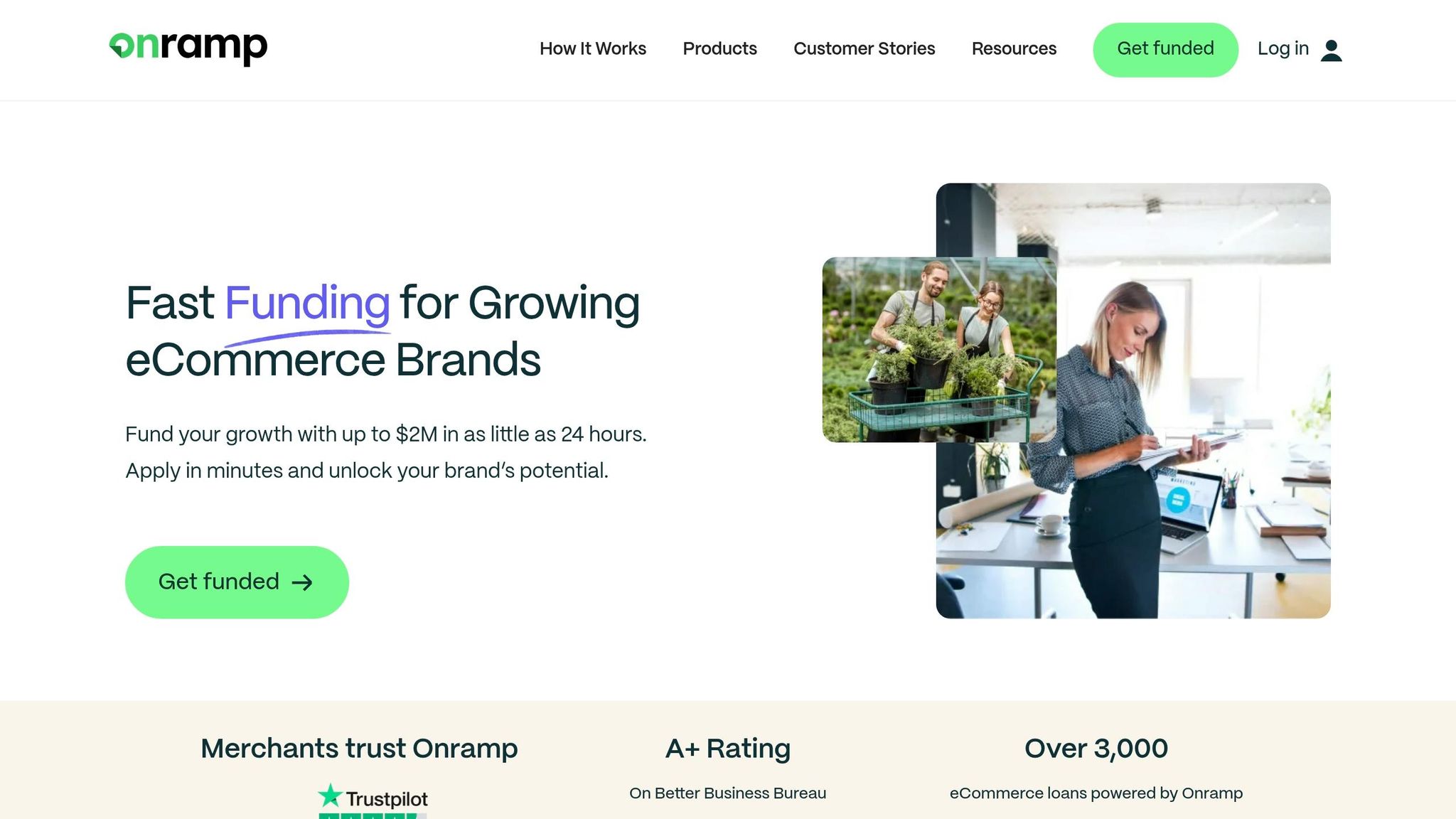
Onramp Funds provides a rolling cash line tailored for sellers operating on platforms like Amazon, Shopify, Walmart, and more. With compatibility across platforms such as TikTok Shop, WooCommerce, BigCommerce, Squarespace, Shopline, and Stripe, it offers flexibility no matter where you sell. The process is simple: integrate your sales channels directly with Onramp to skip the hassle of paperwork and delays. Once connected, you could have funds in your bank account in less than 24 hours - a game-changer when you need to restock quickly or jump on a trending product. Here's a closer look at how this works.
Fast and Flexible Funding
Getting started with Onramp Funds is quick and straightforward. Begin by completing a short questionnaire to receive an initial funding estimate. Then, securely connect your store in about five minutes. This integration automatically pulls your sales data, so there's no need to submit tax returns or undergo personal credit checks. Once approved, funds are deposited into your account within 24 hours. The rolling cash line allows you to draw funds again as soon as you've repaid, eliminating the need to reapply - an essential feature for businesses juggling rapid growth or multiple product launches.
Support Team and Tools
Onramp's Austin-based support team is there to guide you every step of the way, from setting up your account to making the most of your funding. They don’t just process applications - they help you strategize how to use the funds effectively to fuel growth. The platform also features a funding calculator that uses your actual sales data to generate personalized estimates. This tool shows how much funding you can access and provides a clear picture of repayment amounts tied to your revenue. Whether you're planning a $20,000 inventory purchase or a $50,000 marketing campaign for Q4, the combination of transparent tools and expert support makes the process seamless.
Eligibility Requirements
Onramp Funds keeps its eligibility criteria simple, making it accessible to a wide range of eCommerce businesses. To qualify, you need at least $10,000 in monthly sales and a registered business entity in the U.S. (LLC, C-Corp, or S-Corp). Additionally, you must integrate with at least one supported sales platform - such as Amazon, Shopify, or Walmart - so Onramp can verify your transaction history and cash flow. Unlike traditional lenders, there's no requirement for a minimum time in business. Instead, the focus is on your sales performance and transaction data, making it a practical solution for newer sellers who have consistent revenue but lack access to conventional financing options.
Step-by-Step Guide to Using a Rolling Cash Line
Setting up a rolling cash line is straightforward and fast, often giving you access to funds in under 24 hours. Here's a detailed breakdown of how to assess your cash flow, link your accounts, and make the most of your funding.
Step 1: Calculate Your Cash Flow Needs
Before requesting funds, take a close look at your cash flow. Start by figuring out your net cash flow: subtract all expenses - like inventory, shipping, advertising, payroll, and overhead - from your sales revenue. This will show whether you're running a surplus or facing a shortfall.
Next, map out a 13-week rolling forecast. Lay out your expected revenue and expenses week by week for the next three months. For instance, if you plan to spend $25,000 on inventory in Week 4 but won't see sales revenue until Week 8, you'll know exactly when you'll need funding to bridge the gap. Use at least 12 months of reliable historical data to make these projections as accurate as possible [7].
Once you've nailed down your cash flow needs, you're ready to connect your accounts.
Step 2: Connect Your Sales Platforms and Accounts
After identifying your funding requirements, connect your business to Onramp Funds. Start by entering basic business details to get a quick pre-qualification estimate - this usually takes about a minute. Make sure your business operates on one of the supported platforms, including Amazon, Shopify, TikTok Shop, WooCommerce, BigCommerce, Squarespace, Walmart, Shopline, or Stripe.
Next, securely link your eCommerce store. This step takes about five minutes and uses read-only access to review your sales history. You'll also need to link your business bank account to verify cash flow and check for any existing debts. Keep in mind that your business must be a legally registered entity in the U.S. (LLC, C-Corp, or S-Corp) to proceed.
Step 3: Use the Funding Calculator
Once your accounts are connected, the funding calculator steps in. It automatically pulls your sales data and generates a personalized funding estimate. The offer amount is based on your revenue, cash flow needs, and any existing debt.
The calculator is designed to prevent over-borrowing by adjusting estimates according to your business's financial health. Make sure automated data updates from platforms like Shopify or Amazon Seller Central are enabled to keep your funding projections current.
With a clear estimate in hand, you can plan how to use the funds effectively.
Step 4: Deploy Funds for Growth
Once approved, funds typically arrive in your account within 24 hours. Use this capital where it will have the most impact. For example:
- Restock trending products or seasonal bestsellers.
- Ramp up marketing efforts during high-traffic periods, like the holiday season.
- Improve operations by investing in faster shipping or better packaging to enhance customer satisfaction.
Work backward from your sales targets. If you need $50,000 in extra revenue next quarter, figure out the inventory or ad spend required to hit that goal and only draw the amount you need. Keep repayments manageable by ensuring the revenue generated from these investments can cover your repayment obligations.
Step 5: Monitor and Adjust Your Usage
After deploying funds, keep a close eye on your cash conversion cycle - how long it takes to turn inventory into sales revenue. Track how quickly your products sell and ensure repayments align with your incoming sales deposits. Repayments are flexible, often decreasing during slower months and increasing during busier periods.
Regularly review your debt and cash flow, and update your funding estimates as your business grows. If sales exceed expectations, consider drawing more funds to seize new opportunities. On the flip side, if growth slows, pause additional draws until your revenue picks back up. Since repayments adjust based on sales, this system supports smart cash flow management while helping you balance growth with manageable risk levels.
Common Mistakes and Best Practices
Avoid Drawing Funds Without Sales Projections
One of the biggest missteps eCommerce sellers make is withdrawing funds without having a clear sales forecast in place. Picture this: you pull $50,000 to stock up for the holidays, anticipating a surge in sales, but then shipping delays or other hiccups derail your plans. Now you're stuck paying fees on capital that isn’t bringing in any revenue yet. With rolling cash lines, you’re charged only on the amount you withdraw, so every dollar taken without a solid plan adds to your costs [2][3].
Another common trap is ignoring seasonal sales cycles. If you overdraw during slower months and fail to account for how peak-season sales will cover repayments, you could end up maxing out your credit line just when you need it most [2]. The solution? Use rolling cash flow forecasts that update monthly with real sales data. Studies show that businesses using this method achieve 14% more accurate revenue predictions compared to static forecasts. This gives you the flexibility to adjust your funding decisions based on actual market conditions [5].
With a reliable forecast in hand, you can take smarter steps to manage your cash flow effectively.
Best Practices for Managing Cash Flow
Once your sales projections are on point, managing cash flow becomes much easier. Start by conducting weekly bookkeeping reviews. These regular check-ins help you spot sales slowdowns early, giving you time to pause new withdrawals and avoid unnecessary fees. Plus, it allows you to repay outstanding draws promptly from incoming receivables, keeping your costs in check [6][5].
Aim to keep inventory turns within 45 days. Why? This aligns with typical customer payment cycles, ensuring that funds you borrow are quickly recovered. Faster inventory turnover not only stabilizes your cash flow but also ensures the revenue generated from your investments can cover repayments without added stress [2].
Businesses that adapt quickly to market shifts by following these practices tend to see 20-30% stronger financial performance compared to those relying on outdated methods [5]. The takeaway? Treat your rolling cash line like a precision tool. Only draw what you need, when you need it, and base your decisions on accurate, up-to-date projections - not guesses. This disciplined approach ensures your funding supports growth without adding unnecessary financial strain.
Conclusion
A rolling cash line gives you the flexibility to fund growth exactly when you need it. Unlike traditional loans with fixed payments that don’t account for fluctuations in sales, this financing option adapts to your revenue cycles. You can draw funds for inventory or marketing during high-demand periods, repay using sales revenue, and reuse the line without the hassle of reapplying. This revolving system ensures you always have access to capital for opportunities like restocking popular products or ramping up ad campaigns during peak seasons.
Financial tools like this have been shown to boost performance by 20–30% and improve revenue forecasting accuracy by 14% [5]. By aligning funding with actual sales projections, you create a cycle where borrowed funds generate revenue quickly enough to cover repayments. This approach not only supports growth but also ensures that funding remains efficient and manageable.
Onramp Funds simplifies the entire process with instant funding and automated, sales-linked repayments that protect your cash flow. With funds available in less than 24 hours and integration with platforms like Amazon, Shopify, Walmart, and TikTok Shop, you can deploy capital immediately. Repayments adjust automatically - lower during slow months and higher when sales increase - ensuring your cash flow stays balanced throughout your growth journey.
"Applied, got our offer, and had cash in our bank account within 24 hours. Their Austin, TX based team was very professional and helped me deploy the cash to effectively grow our business." - Nick James, CEO of Rockless Table
This feedback and real-world success highlight the value of a rolling cash line. Take control of your eCommerce growth with funding that adapts to your needs. Connect with Onramp Funds today to access your rolling cash line, integrate your sales platforms, and deploy capital precisely when your business demands it - fueling sustainable growth without the limitations of traditional financing.
FAQs
Will this impact my personal credit?
This financing option steers clear of impacting your personal credit. It’s a non-dilutive solution that doesn’t rely on personal loans or credit checks. Instead, it works by automatically deducting about 1% of your gross merchandise volume (GMV) as sales come in, keeping the process straightforward and focused solely on your business.
How much can I safely draw without hurting cash flow?
When deciding how much to withdraw, align the amount with your sales performance and cash flow requirements. A good rule of thumb is to take out a percentage you’re confident you can repay without straining your liquidity. Flexible repayment methods, such as revenue-based financing or dynamic credit lines, adapt to your sales and cash flow patterns. This approach ensures you can access the funds you need while keeping your financial stability intact.
What happens to repayments if my sales drop?
If your sales drop, your repayments automatically adjust because they’re tied to a percentage of your revenue. This means during slower times, you’ll have less financial strain, making it easier to manage your cash flow.
Related Blog Posts
Onramp Funds
Funding built around your sales
Connect your store and see what you qualify for. Repay as a percentage of sales, with no personal credit check.
Funding in as little as 24 hours.
