


Managing cash flow is one of the toughest challenges for eCommerce businesses. Suppliers demand payment in 30 days, but sales might take 60-90 days to generate revenue. This timing gap can strain even profitable businesses. A clear capital strategy can help you avoid short-term fixes that derail growth.
Here’s the takeaway:
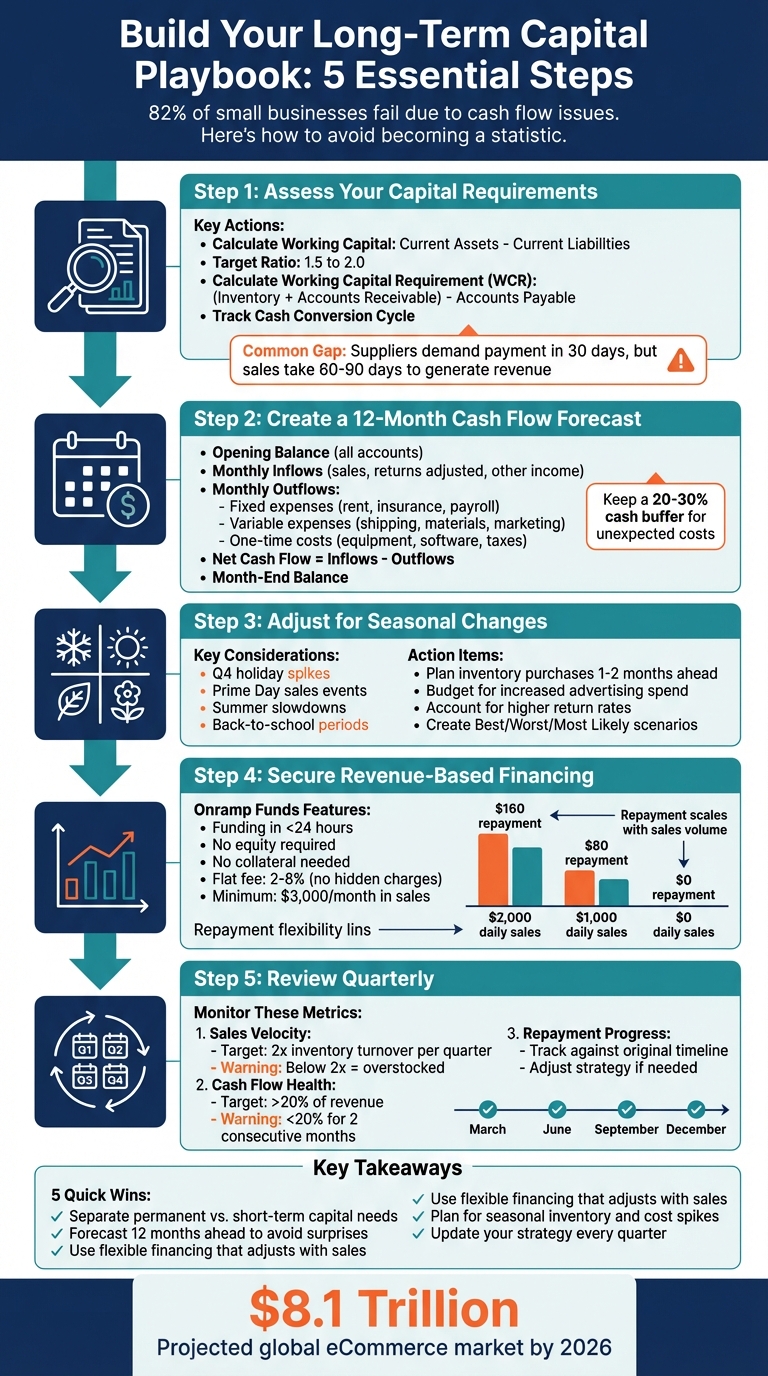
- Separate your funding needs: Permanent working capital (day-to-day operations) vs. short-term capital (seasonal or unexpected spikes).
- Forecast cash flow: Use a 12-month cash flow plan to predict inflows/outflows and avoid surprises.
- Use revenue-based financing: Flexible repayment options that adjust with sales can ease financial pressure.
- Plan for seasonal changes: Anticipate inventory needs and costs during peak periods like holidays.
- Review quarterly: Regular updates to your capital strategy ensure alignment with business performance.
Maximising Your eCommerce Capital Raising and Funding Outcomes → Lonnie Bloom
sbb-itb-d7b5115
Assess Your Capital Requirements
To effectively manage and grow your business, it’s crucial to determine your capital needs and the timing of those needs. This involves analyzing sales trends, operating expenses, and cash flow gaps.
Review Your Sales and Cash Flow
Start by calculating your working capital using the formula: Current Assets – Current Liabilities. Aim for a current ratio between 1.5 and 2, as this indicates healthy liquidity [3]. Next, track your cash flow by subtracting total outflows from total inflows over a given period. This helps you understand where your money is going and when it’s coming in.
"Working capital matters for cash flow because it's the buffer that keeps you from running out of money while you wait for more to come in." - Stripe [3]
To refine this analysis, gather monthly sales data from platforms like Shopify or Amazon. Calculate your Average Order Value (AOV) and adjust for approximately 5% in discounts and returns to determine your net revenue [5]. Pay attention to your cash conversion cycle - the time it takes to turn inventory investments back into cash. A shorter cycle reduces the need for external funding [3].
Timing mismatches can also create cash flow challenges. For instance, if you receive customer payments in 60 days but need to pay suppliers in 30, you might face a capital shortfall [3]. Compare payment terms across all aspects of your operation, from inventory purchases to marketplace payouts, to identify these gaps.
Find Growth Opportunities and Risks
Use your cash flow analysis to spot growth opportunities and mitigate risks. Once you understand your baseline capital needs, explore where additional funding could help scale your business. For example, simulate how a 10% increase in AOV through product bundling might impact your revenue. On the other hand, consider how rising Customer Acquisition Costs (CAC) could affect your cash reserves [5].
"Forecasts aren't about getting every number right, they're about thinking through how your business works and what it needs to grow - plus how you can do that with fewer surprises and greater visibility." - Dan Kang, CFO, Mercury [5]
Develop cohort retention curves to predict reorder rates and align acquisition costs with long-term revenue projections [5]. To pinpoint funding gaps, calculate your Working Capital Requirement (WCR) using the formula: (Inventory + Accounts Receivable) - Accounts Payable [6].
Don’t overlook seasonal fluctuations, such as Q4 holiday spikes or Prime Day sales. Plan ahead for increased inventory and advertising spend during these periods [4] [5]. Be cautious of common risks like overestimating organic growth, rising freight costs, or unexpected stockouts, as these can disrupt your plans [1] [5]. Ultimately, aligning the right type of funding with specific business needs ensures smoother operations and supports growth [2]. These insights also prepare you to secure revenue-based financing with Onramp Funds.
Create a 12-Month Cash Flow Forecast
A 12-month cash flow forecast shows when money flows in and out of your business, giving you a clear picture of your financial health. This insight helps you avoid running out of cash and plan for future growth. Considering that 82% of small businesses fail due to cash flow issues [8], this tool is essential for long-term success.
Start with your opening balance, which is the total cash available across all business accounts (like bank accounts, PayPal, or Venmo) [8]. Then, estimate your monthly cash inflows and outflows. For inflows, rely on your sales data, adjusting for any returns or discounts [5]. Don’t forget to include other income sources such as tax refunds or external funding [7][8].
When it comes to outflows, divide your expenses into three categories: fixed (like rent, insurance, and payroll), variable (such as shipping, raw materials, or marketing), and one-time costs (equipment purchases, software subscriptions, or tax payments) [7][9]. Pay extra attention to months with three bi-weekly payroll cycles, as these can cause a noticeable spike in expenses [8][9].
"A forecast is only as good as the assumptions behind it. Start simple, use directional logic based on real data, and revise over time."
– Dan Kang, CFO, Mercury [5]
To calculate your net cash flow, subtract total outflows from total inflows. Add this figure to your starting balance to find your month-end cash balance [8][9]. It’s important to compare your forecast with actual performance every month. This helps you catch issues like underestimated seasonal trends or late customer payments [7]. Experts suggest keeping a cash buffer of 20-30% to handle unexpected costs [7]. This forecast also helps you spot when you might need external funding, forming a crucial part of your financial planning.
Build Your Revenue and Expense Model
Your revenue model should be grounded in realistic sales projections based on historical data. Use monthly sales figures to analyze trends in order volume and average order value (AOV). For expenses, connect your inventory purchases to your sales forecast. For example, if you expect to sell 1,000 units in a month, calculate when you’ll need to place supplier orders to meet that demand [5].
A simple spreadsheet can help you stay organized. Include columns for each month and rows for revenue streams and expense categories. Don’t forget items like platform fees, marketing costs tied to your Customer Acquisition Cost (CAC), and inventory expenses timed around sales peaks [5]. This format makes it easier to pinpoint months when cash flow might be tight.
Also, account for potential timing mismatches. For example, if your suppliers require payment within 30 days but you won’t receive payouts for 60 days, adjust your forecast accordingly [3]. Even small changes, like negotiating a two-week extension on supplier payments, can significantly improve your cash flow [8].
Once your baseline model is ready, refine it to include seasonal variations.
Adjust for Seasonal Changes
Seasonal trends - like Q4 holiday spikes, summer slowdowns, or back-to-school shopping - should be factored into your forecast [10]. Use historical data to identify these patterns. For instance, if sales typically surge in November and December, plan for increased inventory purchases in the preceding months [5].
Peak seasons also come with higher costs, such as increased advertising budgets, shipping surcharges, and temporary labor for fulfillment [5][8][10]. You might also see a rise in return rates during these periods. Make sure these additional expenses are included in your seasonal adjustments.
To prepare for uncertainty, create "Best", "Worst", and "Most Likely" scenarios. This approach allows you to anticipate how your business might perform during unexpected challenges or weaker-than-expected peak seasons [10][11]. Additionally, time major expenses - like a website overhaul or equipment upgrades - during months when your forecast shows strong cash reserves. Avoid scheduling them just before large inventory investments [8].
Get Revenue-Based Financing with Onramp Funds

Once you've completed your cash flow forecast and pinpointed funding gaps, revenue-based financing can be a smart way to bridge those gaps. It provides capital without requiring you to give up equity or offer collateral. Onramp Funds specializes in financing tailored for eCommerce businesses, with repayments that adapt to your sales performance rather than sticking to rigid monthly schedules [1].
This approach works well with the fluctuating nature of online sales. For instance, if your sales surge during a busy season, your repayments will increase accordingly. On the flip side, during slower periods, your repayment amounts automatically decrease, giving you more flexibility to manage other expenses [13].
How Onramp Funds Works
Onramp Funds connects directly to your eCommerce platforms - like Amazon, Shopify, Walmart, and TikTok Shop - to assess your real-time sales data [1]. Instead of relying on traditional credit scores, they use this data to determine your funding eligibility. You can access capital in less than 24 hours, making it an excellent option for stocking up on inventory or launching a new marketing campaign [12].
Onramp Funds offers three financing options:
- Variable: Repayments adjust daily based on your sales.
- Fixed: Repayments remain consistent each month.
- Rolling Cash Line: A revolving credit option that grows alongside your business.
All these options are unsecured and don't require you to give up equity [1]. The cost structure is straightforward, with a flat fee ranging from 2% to 8% of the funded amount and no hidden charges [12].
Next, you'll learn how to optimize your repayment plans to further improve your cash flow management.
Eligibility Requirements and How to Apply
To qualify for financing, your eCommerce business should generate at least $10,000 in monthly sales and operate on platforms like Amazon, Shopify, Walmart, or TikTok Shop [1]. The application process is quick and straightforward:
- Fill out a short questionnaire to get an instant funding estimate (takes about 1 minute).
- Connect your store's data (around 5 minutes) for a tailored offer.
- Review the offer and, if you accept, receive your funds in under 24 hours.
This streamlined process ensures you get funding that aligns with your business goals. Onramp Funds has a "Great" rating on Trustpilot from 220 reviews, and 75% of their customers return for additional funding [12]. To secure the best offer, make sure to connect all your sales channels during the application process [12].
Set Up Flexible Repayment Plans
Automatic Repayments Tied to Sales
Onramp Funds offers a repayment system that adjusts based on your daily sales. A fixed percentage of your gross daily sales is deducted, meaning your repayments shrink when sales slow down. For example, if your daily sales drop by 50%, your repayment amount drops by the same percentage, helping you maintain cash flow during slower periods.
Here’s how it works for a $50,000 advance with an 8% fee:
- If you generate $2,000 in sales, about $160 is deducted.
- If sales drop to $1,000, only $80 is deducted.
- If you make no sales, no deduction is made.
At this rate, the advance is typically repaid in about 312 days. This system uses secure API connections to track real-time sales and automatically withdraws the agreed percentage - usually between 5% and 10% of gross sales - only on days when revenue is earned. By aligning repayments with actual sales, this approach reduces default risk by 30-50% compared to traditional loans [14].
This repayment model works seamlessly with Onramp Funds’ simple fee structure.
Onramp Funds' Fixed Fee Structure Explained
Instead of loans with compounding interest, Onramp Funds charges a single, upfront fixed fee, ranging from 2% to 8% of the advance amount [14]. For example, if you receive $50,000 in funding, your one-time fee will fall between $1,000 and $4,000. There are no hidden charges, ensuring complete transparency.
This straightforward fee structure makes financial planning easier because you know the total repayment amount from the beginning. The fee is determined by factors like your sales history, growth trends, and chargeback rates. Businesses with consistent annual sales growth above 20% and chargeback rates below 1% generally qualify for lower fees, typically between 2% and 4% [14][15].
Review and Update Your Capital Plan Every Quarter
Running an eCommerce business means navigating constant change - whether it’s holiday sales spikes or shifting market conditions. That’s why reviewing your capital plan at the end of each quarter (March, June, September, December) is so important. By doing this, you can ensure your financing strategy stays in sync with your business’s current performance. Regular updates like these help keep your strategy flexible as your business evolves.
Monitor Key Metrics and Performance
To align your funding decisions with your business’s performance, it’s essential to track three critical metrics every quarter: sales velocity, cash flow health, and repayment progress.
- Sales Velocity: This measures how quickly you’re converting inventory into revenue. A good benchmark is turning your inventory at least twice per quarter. If your sales fall below this 2x mark, it could mean you’re overstocked.
- Cash Flow Health: Healthy cash flow ensures your revenue covers your expenses. Watch for warning signs, like cash flow dipping below 20% of revenue for two consecutive months.
- Repayment Progress: Keep an eye on how your loan repayments are tracking compared to your original timeline. With Onramp Funds, repayments adjust automatically based on sales. For example, if slower sales push your repayment timeline beyond expectations - like hitting only 70% repayment by month nine - it might be time to rethink your inventory purchases or marketing spend. Use your Onramp dashboard to monitor repayment progress and compare it to your 12-month forecast.
Adjust Your Funding Strategy with Onramp Funds
Once you’ve reviewed your metrics, use Onramp Funds’ funding calculator to refine your strategy. This tool lets you reassess your financing needs by factoring in updated figures such as your trailing 12-month revenue, current monthly sales velocity, and any new growth projections.
For instance, if you started the year with $500,000 in annual revenue and $40,000 in monthly sales, but you’re now hitting $55,000 a month, the calculator might show you qualify for a larger advance. Plus, your improved performance could result in more favorable fees.
If your metrics point to challenges - like sales velocity dropping to 1.5x or cash flow turning negative - the calculator can also help you model different scenarios. For example, you could analyze the impact of flat 3% growth (the 2026 eCommerce median [14]) versus a more optimistic 10% increase. This analysis can guide your next steps, whether that’s securing additional funding for inventory, holding steady with your current capital, or focusing on clearing excess stock.
Conclusion
Creating a long-term capital playbook goes beyond simply securing funding - it's about building a financial safety net that adapts as your eCommerce business evolves. By evaluating your capital needs, forecasting cash flow for the year ahead, and revisiting your plan quarterly, you're setting up a system that grows alongside your operations.
This approach emphasizes flexibility and variety in funding strategies. A single-solution approach won't cut it. Instead, your playbook should include diverse funding sources tailored to your business goals. For example, revenue-based financing can support quick inventory turnover cycles of 60–120 days, while other funding options might be better suited for long-term growth initiatives. A diversified capital stack ensures you have the right resources for everything - from launching new products to scaling up your digital marketing efforts.
By including Onramp Funds in your playbook, you gain access to revenue-based financing that adjusts with your sales performance. When sales are booming, repayments scale up; during slower periods, payments decrease to protect your cash flow. With no hidden fees, no collateral requirements, and funding available in as little as 24 hours, you can focus on growing your business without the stress of rigid repayment schedules.
Cash flow challenges remain one of the biggest risks for small businesses. A strong capital playbook ensures you have the liquidity needed for critical investments, whether that's restocking inventory to avoid stockouts or funding marketing campaigns during peak seasons. By updating your strategy quarterly and using tools like Onramp's funding calculator, you can maintain the financial flexibility to grow sustainably in an industry expected to hit $8.1 trillion globally by 2026 [16].
FAQs
How does revenue-based financing help eCommerce businesses handle seasonal sales ups and downs?
Revenue-based financing offers eCommerce businesses a repayment model that adapts to their sales performance. Instead of fixed monthly payments, repayments increase during high-sales periods and decrease when sales slow down. This flexibility helps businesses maintain steady cash flow without the pressure of rigid payment schedules.
This method is particularly helpful during seasonal peaks and dips. It ensures businesses have access to the funds they need - whether it’s for stocking up on inventory, boosting marketing efforts, or covering operational costs - while aligning repayments with their actual income.
What are the key steps to create a 12-month cash flow forecast for my eCommerce business?
Building a 12-month cash flow forecast is a smart way to keep your eCommerce business's finances on track. Here's how to approach it step by step:
Start by determining your current cash balance - this gives you a clear starting point. Then, estimate your monthly cash inflows. These might include revenue from your website, sales on marketplaces, or recurring subscriptions. Use your past data and seasonal trends to make these estimates more accurate.
Next, calculate your monthly cash outflows. These include fixed costs like rent and software subscriptions, along with variable expenses such as inventory purchases and shipping fees.
Once you've got both inflows and outflows figured out, subtract the outflows from inflows to calculate your net cash flow for each month. A positive number means you're in good shape; a negative one signals areas to address.
To keep your forecast reliable, update it regularly. You can use spreadsheets or accounting software to track actual performance against your predictions. And here's a pro tip: plan for different scenarios - optimistic, realistic, and conservative - to prepare for unexpected changes.
By reviewing and fine-tuning your forecast every month, you'll have a better handle on your finances, helping you make smarter decisions and maintain stability for the long haul.
How does Onramp Funds adjust repayments to match my eCommerce sales performance?
Onramp Funds provides a repayment system designed to move in step with your business's sales performance. Payments are based on a percentage of your monthly revenue. This means when sales slow down, your payments decrease, and when sales pick up, they increase. The approach helps ensure payments stay manageable, aligning with your cash flow and supporting your eCommerce growth without straining your finances.
Related Blog Posts
Onramp Funds
Funding built around your sales
Connect your store and see what you qualify for. Repay as a percentage of sales, with no personal credit check.
Funding in as little as 24 hours.
