


Running an eCommerce business comes with challenges like upfront supplier payments, seasonal sales spikes, and unpredictable cash flow. On-demand capital provides a faster, flexible solution compared to loans by offering funding tied to your sales. Here's what makes it ideal for established brands:
- Fast Access: Funding approvals in as little as 24–72 hours, perfect for urgent inventory or marketing needs.
- Sales-Based Repayment: Payments adjust with sales - higher during busy months, lower when sales slow.
- Non-Dilutive: Keep full ownership of your business while accessing funds for growth.
- Tailored for eCommerce: Integrates with platforms like Shopify, Amazon, and more for real-time funding that scales with your business.
This approach helps brands cover supplier costs, stock up for seasonal demand, and invest in marketing without the delays or rigid terms of bank loans. If you're looking to grow while maintaining control, on-demand capital can be the answer.
How To Fund Your Ecommerce Business For Cheap (Or Even Free)
sbb-itb-d7b5115
Common Financial Problems for Established eCommerce Brands
Established eCommerce brands often grapple with financial hurdles that can slow their growth or cause them to miss key opportunities. These challenges arise from the disconnect between the fast-paced demands of online retail and the slower, more rigid nature of traditional financing methods. Below are some of the most pressing issues they face.
Cash Flow Problems from Paying Suppliers Upfront
One major issue is the timing of payments to suppliers. Most manufacturers and wholesalers require payment 30 to 90 days before shipping goods. This means businesses often have to pay for inventory long before they see any revenue from selling it. As a result, capital gets tied up in stock, leaving little room to invest in marketing, restocking popular items, or pursuing growth opportunities.
Managing Seasonal Sales Peaks
Seasonal demand surges - like those seen during Black Friday or back-to-school shopping - present another financial strain. These periods require significant upfront investment to secure inventory, ramp up advertising, and handle increased operational costs. Without sufficient capital, brands risk stockouts or missing out on lucrative seasonal trends, which can hurt both short-term revenue and long-term customer loyalty.
Why Bank Loans Don't Work for eCommerce
Traditional bank loans often fall short for eCommerce brands. For one, banks approve only 38% of loan applications for businesses in their growth phase, and the process can take about three weeks [2]. This delay is problematic in an industry where opportunities - like inventory discounts or advertising deals - can disappear quickly. Plus, banks usually require fixed repayment schedules, which don't account for the month-to-month fluctuations in eCommerce sales.
"The cheapest capital isn't always the best capital - while interest rates matter, growth finance decisions should prioritize speed, flexibility, and covenant structures over rate alone."
- Stan Prokop, Founder, 7 Park Avenue Financial [2]
Banks also tend to prioritize collateral, such as property or equipment, which many eCommerce businesses simply don't have. Instead, these brands rely on strong revenue streams and customer data - assets that traditional lenders often undervalue. Additionally, many banks require personal guarantees, putting the owner's personal assets at risk. This explains why 62% of small and medium-sized businesses cite access to financing as a major barrier to growth [2].
How On-Demand Capital Fixes Cash Flow Issues
On-demand capital takes the hassle out of the traditional bank process, which can take weeks and often drains cash reserves. Instead, it provides funding to eCommerce brands within 48–72 hours, with repayments tied directly to sales performance [6]. This approach bridges the gap between paying suppliers and collecting revenue from customers. For businesses relying on third-party logistics or on-demand fulfillment, this funding model helps secure inventory without piling on high overhead costs [3]. Plus, its revenue-based repayment structure aligns naturally with sales cycles.
Speed is everything in today’s fast-moving market. Take Desert Farms, for example - they used on-demand funding to fuel growth and saw a steady 15% increase in monthly sales [7]. Similarly, Kind Laundry leveraged this type of funding to stock up on inventory, leading to a 35% boost in Black Friday and Cyber Monday sales [7]. These stories show how quick access to capital lets brands jump on opportunities when timing is critical.
Repayment Based on Your Sales
Revenue-based financing changes the repayment game. Instead of fixed monthly payments, businesses repay a percentage of their monthly revenue - usually between 6% and 20% - over a term of 12 to 36 months. The total repayment typically ranges from 1.2 to 1.8 times the initial amount borrowed [6]. This setup adjusts automatically to your sales performance: payments go up during busy seasons and ease off during slower periods. It’s a built-in safety net for managing cash flow during seasonal shifts.
This model also creates a win-win dynamic between capital providers and business owners. Investors only benefit when the business grows, aligning their interests with the brand’s success [6].
Fast Funding When You Need It
What sets on-demand capital apart is its speed. While traditional equity financing can take three to six months for approval, on-demand solutions usually provide funding within 48–72 hours, requiring minimal paperwork [6][7]. Some providers, like Onramp Funds, can even deliver funding in as little as 24 hours. Their streamlined application process - taking under 10 minutes - makes it easy for brands to act quickly on flash sales, inventory discounts, or unexpected supplier opportunities.
Fast funding isn’t just about speed; it’s also about flexibility and scalability.
Funding That Grows with Your Business
On-demand capital grows alongside your business [3]. As your sales and order volumes increase, the available funding expands automatically - no renegotiation needed. For example, if your revenue jumps by 50%, you can access more capital proportionally. On the flip side, if sales slow down temporarily, repayment obligations decrease accordingly [5].
This scalability makes it easier to manage the ups and downs of seasonal peaks or rapid growth. With real-time inventory management systems, you can track sales trends and inventory turnover, fine-tuning your funding needs based on actual performance. Whether you’re preparing for a seasonal surge or responding to unexpected changes, this dynamic funding approach helps maintain optimal inventory levels without putting a strain on cash flow.
How to Use On-Demand Capital in Your eCommerce Business
Once you’ve tackled cash flow gaps, on-demand capital can be put to work in the areas that matter most for eCommerce growth. It’s especially useful for inventory purchases, marketing campaigns, and supply chain management. Each of these areas addresses a specific challenge while keeping your finances steady.
Buying Inventory at the Right Time
One of the biggest perks of on-demand capital is the ability to buy in bulk and take advantage of supplier discounts - sometimes as much as 20–30% off [3]. This means you can stock up during off-peak times or before the rush of seasonal demand without draining your cash reserves.
Quick funding approvals also let you act fast when inventory opportunities arise. Whether it’s responding to a sudden sales spike or securing a great deal, you can maintain the right stock levels without tying up all your cash. Plus, this immediate access to capital ensures your marketing efforts can align seamlessly with inventory availability.
Funding Marketing Campaigns
Marketing often requires quick action, especially for promotions tied to specific events like Black Friday or product launches. On-demand funding gives you the ability to invest in paid ads, influencer collaborations, or SEO strategies to drive revenue right when you need it [4].
What’s even better? The repayment terms are linked to the sales your campaigns generate. This means your advertising spend stays in sync with your revenue. With this flexibility, you can simultaneously fund both your marketing and inventory needs, ensuring you’re ready to meet the demand your campaigns create - especially during high-traffic periods like Q4 or Prime Day [8].
Handling Supply Chain Problems
Supply chain hiccups can be costly, but on-demand capital gives you the flexibility to adapt. Whether it’s switching to a new supplier, paying for faster shipping, or covering the cost of last-mile delivery, this funding helps you stay ahead [3]. For example, if a sea freight delay threatens your inventory, you can quickly fund air freight to keep products available for your customers.
It’s also a lifesaver when onboarding new suppliers who might require upfront payments. With funding available in as little as 24 hours [8], you can avoid waiting around for traditional loan approvals while your operations hang in the balance. This kind of agility ensures your supply chain keeps moving, even when challenges arise.
Why Established Brands Choose On-Demand Capital
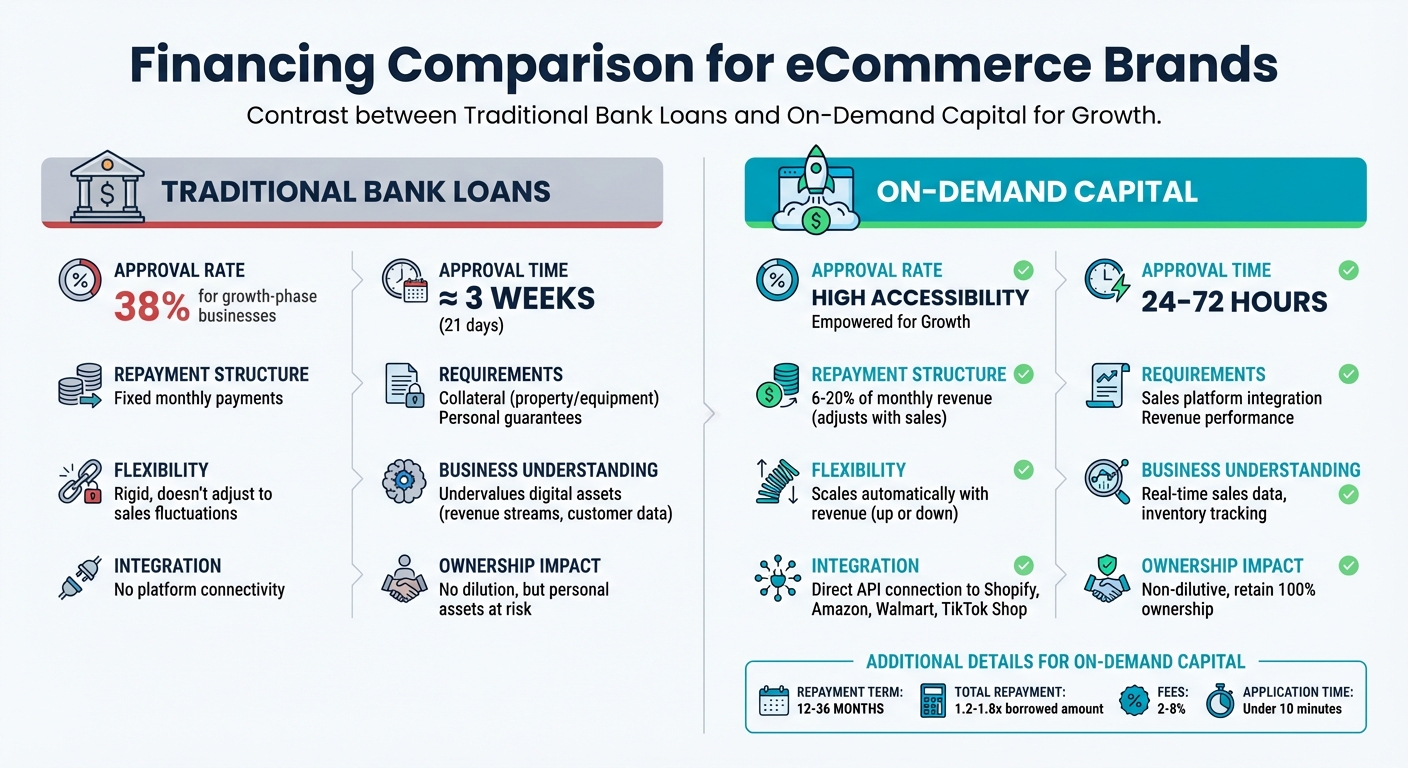
Many established eCommerce brands are moving away from traditional bank loans. Why? They’re drawn to three main benefits: speed, flexible repayment tied to sales, and a funding model tailored specifically for digital retail. These factors are making on-demand capital an increasingly popular choice.
Speed, Flexibility, and Transparent Costs
Traditional banks often take weeks - or even months - to process loans, relying on outdated evaluation methods. On-demand capital providers, on the other hand, can connect directly to your sales platforms like Amazon, Shopify, Walmart, or TikTok Shop, allowing you to access funds in as little as 24 hours [1].
Repayment is designed to align with the natural ups and downs of your business. With revenue-based financing, payments automatically adjust to your sales - lowering during slower periods. If you opt for a line of credit, you have the added flexibility of paying just the interest when cash is tight, while accelerating repayment when your sales pick up. Fees are straightforward, typically ranging from 2–8%, and repayment fluctuates with your business’s performance [1].
Growth Without Sacrificing Ownership
Beyond speed and flexibility, on-demand capital offers another critical advantage: it’s non-dilutive. Unlike equity financing, which requires giving up a stake in your business, on-demand funding lets you convert a portion of future revenue into working capital. This means you can fund new product launches, expand marketing efforts, or explore new sales channels - all while keeping full control over your business and profits [1][9].
Designed for eCommerce Success
Traditional banks often struggle to keep up with the unique dynamics of eCommerce. They rely on rigid processes and fail to account for the rapid changes and opportunities that define online marketplaces [1]. In contrast, on-demand capital providers are built for the digital age. They integrate directly with platforms like Shopify, Amazon, and Walmart via APIs, allowing credit limits to adjust in real time based on your current sales - not outdated historical data.
This tech-driven approach gives providers a clear view of your inventory, sales velocity, and revenue trends [1]. The result? A funding experience that matches the fast-moving world of eCommerce, where opportunities can appear - and disappear - in a matter of days, not months.
Conclusion
Established eCommerce brands often grapple with financial hurdles like upfront supplier payments, seasonal sales fluctuations, and the inflexibility of traditional bank loans. On-demand capital steps in to tackle these issues by providing fast funding, sales-based repayment options, and non-dilutive financing that ensures you retain full ownership of your business.
This funding approach is designed to match the pace of your business. Whether you're preparing for peak season, launching a time-sensitive marketing campaign, or navigating supply chain challenges, on-demand capital offers the flexibility you need. With quick approvals and repayment terms that adjust when sales slow, it’s a solution tailored to the fast-moving eCommerce landscape.
But it’s not just about speed - it’s about control, scalability, and transparency. By syncing with platforms like Amazon, Shopify, Walmart, and TikTok Shop, these capital providers evaluate your business in real time, increasing funding limits as your revenue grows. Traditional credit models are left behind, and your equity stays intact - giving you access to funding that evolves with your business.
If you're looking to accelerate growth without giving up ownership or enduring lengthy approval processes, on-demand capital could be the answer. Connect your store, explore your offer, and secure the funding you need - quickly and seamlessly.
FAQs
How much on-demand capital can I qualify for?
You could be eligible for on-demand funding anywhere between $30,000 and over $50,000,000. The specific amount you qualify for will depend on several factors, including your business's revenue, its growth stage, and your credit profile.
Will sales-based repayment hurt my margins in slow months?
Sales-based repayment models aim to reduce financial strain during slower months. With this approach, your payments fluctuate in line with your revenue, ensuring that repayment aligns with how your business is performing. This flexibility helps safeguard your profit margins, offering a more manageable way to meet financial obligations.
What do I need to connect to get approved quickly?
To speed up the approval process, link your online business account and provide key financial details, such as sales or revenue figures. Services like Onramp Funds use real-time sales data to evaluate applications, often granting approval in just minutes. This efficient approach helps you access the funding you need without delay.
Related Blog Posts
Onramp Funds
Funding built around your sales
Connect your store and see what you qualify for. Repay as a percentage of sales, with no personal credit check.
Funding in as little as 24 hours.
