


Fast-growing eCommerce brands often face cash flow challenges that rigid, single-use funding options like term loans or merchant cash advances (MCAs) can't solve. These traditional funding methods come with fixed payment schedules or high fees that don’t align with the unpredictable sales cycles of online businesses. Seasonal revenue spikes, scaling demands, and inventory costs make flexible funding essential for growth. Revenue-based financing (RBF) offers a better alternative, tying repayments to sales performance, protecting cash flow, and allowing businesses to grow without sacrificing ownership or taking on restrictive debt.
Key Takeaways:
- Single-use capital limitations: Fixed payments strain cash flow during slow months and require reapplications for additional funds.
- Revenue-based financing advantages: Payments adjust with sales, no equity or collateral required, and funding is based on real-time sales data.
- Onramp Funds solution: Provides fast, flexible funding tailored for eCommerce sellers, with transparent fees and repayments tied to daily sales.
For eCommerce brands, choosing a funding model that aligns with their growth cycles is critical to scaling successfully.
Cash Flow Requirements for Growing eCommerce Brands
Ongoing Cash Demands in eCommerce Operations
Running an eCommerce brand means constantly juggling capital needs for inventory, advertising, and platform fees. You’re often buying inventory long before making sales, pouring money into digital ads, and dealing with marketplace fees that eat into your margins. On top of that, payment processing delays (ranging from 2 to 7 days) and payout lags from platforms like Amazon can leave you with frustrating cash flow gaps [1][3].
Here’s a sobering fact: poor cash flow management is behind 82% of small business failures [3]. For growing brands, 20–30% of their capital can get tied up in inventory, while shipping costs alone might consume 10–20% of revenue [1][3]. These cash flow hurdles become even trickier to navigate during seasonal sales cycles.
Seasonal Sales Patterns and Scaling Events
For many eCommerce brands, cash flow feels like a rollercoaster ride, especially during the holidays. Up to 30–50% of annual revenue might come during this period, meaning you need significant upfront capital months in advance [1]. Think about it: you’re buying inventory in summer to prepare for holiday sales, hiring temporary staff, ramping up ad budgets, and possibly renting extra warehouse space. And after the holiday rush? There’s often a slowdown, with lingering costs still to manage.
Scaling adds another layer of complexity. Expanding into new marketplaces, launching fresh product lines, or entering international markets introduces challenges like currency fluctuations, new tax regulations, and longer lead times. Plus, roughly 30% of online purchases end up returned, creating unexpected cash outflows weeks - or even months - after the original sale [8]. To handle these seasonal and scaling pressures effectively, understanding the financial metrics tied to growth becomes essential.
Financial Metrics That Show Growth Pressure
Certain financial metrics, like the Cash Conversion Cycle [6], Inventory Turnover [7], and CAC Payback Period [1][9], can highlight when your growth is starting to outpace your available capital.
Take the example of Paul Voge, Co-founder and CEO of Aura Bora. In 2024, as his sparkling beverage company scaled, he found himself needing credit limits 30 to 40 times higher than what traditional banks could offer to fund large production runs without draining working capital [4]. Similarly, Lindsay Bodeman, VP of Finance at Dude Wipes, faced operational challenges as the company grew. Increased headcount and vendor relationships meant they needed both higher credit limits and more sophisticated cash management systems [4].
The warning signs of growth pressure are hard to miss: shrinking operating margins, reliance on high-interest debt just to restock, and profitable balance sheets paired with empty bank accounts. These challenges make it clear that single-use capital isn’t enough. What’s needed are flexible and scalable financing solutions that can meet the ever-changing demands of eCommerce [3].
Stop Bleeding Cash: Simple E-Commerce Finance for Better Cash Flow & Profit | Sourabh Nolkha
Why Single-Use Capital Fails Scaling eCommerce Businesses
When you’re trying to scale an eCommerce business, cash flow issues are already a challenge. Add single-use capital with rigid terms into the mix, and things can get even trickier.
Rigid Payment Terms vs. Fluctuating Sales
Fixed payments don’t care about slow months. Term loans and SBA loans come with fixed monthly payments, no matter what your sales look like. This can be a nightmare for businesses that make 30–50% of their yearly revenue during peak seasons [1]. Plus, you’re often paying for inventory months before you start seeing any revenue from sales - sometimes as long as 60–120 days [5]. During that waiting period, while inventory is being shipped, listed, and sold, you’re still stuck making those inflexible payments.
Merchant Cash Advances (MCAs) might offer quick approval, but they’re not much better. They take daily or weekly withdrawals, which can strain your cash flow during slow periods or when you’re reinvesting heavily [10][11].
"The challenge isn't just growing - it's growing without disrupting cash flow. Most e-commerce businesses don't fail because they don't have a great product. They fail because they don't have the cash flow to scale when opportunity knocks."
- PEAC Solutions Staff Writer [12]
Reapplication Costs and Scaling Constraints
Every new loan application means starting from scratch. Traditional lenders require you to reapply every time you need more capital. This process involves piles of paperwork and can take weeks or even months to complete [5][12]. That’s a huge problem when the fast-paced eCommerce world demands quick action [12].
Timing matters, too. Applying earlier in the month can cut approval times by up to 35% [5]. Businesses that secure funding at least 45 days before their peak season are 47% more likely to optimize inventory compared to those scrambling for funds less than 30 days before demand spikes [5]. Waiting too long not only delays access to capital but also risks losing out on bulk discounts of 15–25% and missing key sales opportunities [5].
Single-Use Capital Comparison Table
| Feature | Term Loans | SBA Loans | Merchant Cash Advances (MCA) |
|---|---|---|---|
| Payment Structure | Fixed monthly payments [2] | Fixed monthly payments [11] | Daily or weekly percentage of sales [10][11] |
| Flexibility | Low; payments don’t adjust [1] | Low; rigid, government-backed terms [11] | Moderate; still strains cash flow during dips [10] |
| Approval Speed | Slow; weeks to months [12] | Very slow; not ideal for rapid scaling [11] | Very fast; often 24–48 hours [5] |
| Risk for Growth | High risk during seasonal dips [1] | High; often requires personal guarantees and collateral [1] | High; comes with high fees and risk of "debt traps" [9][10] |
The story of Sarah Johnson, founder of Urban Lifestyle Brands, is a great example of what proactive funding can do. In August 2025, she secured $350,000 from Delta Capital Group ahead of the busy Q4 season. The results were impressive: her company expanded its inventory by 65%, ran marketing campaigns that delivered a 340% return on ad spend, and even upgraded its mobile shopping experience before Black Friday [5]. As Sarah put it:
"Securing funding in August completely transformed our holiday season. We increased our inventory breadth by 65% while maintaining faster shipping times than in previous years."
- Sarah Johnson, Founder, Urban Lifestyle Brands [5]
This rigidity in traditional funding options underscores the need for a financing model that adapts to the ups and downs of sales. That’s where revenue-based financing comes in - it’s designed to grow with your business.
sbb-itb-d7b5115
Revenue-Based Financing for eCommerce Growth

Revenue-based financing (RBF) offers a fresh alternative to traditional loans by tying repayments directly to your sales. Instead of fixed monthly payments, you repay a percentage of your revenue - typically between 1% and 25% - until the principal and a flat fee are covered [17]. This means when sales are booming, you pay more, and when sales slow down, your payments decrease. It’s a model designed to protect your cash flow, especially in the unpredictable world of eCommerce.
Payments That Adjust With Sales
One of the standout features of RBF is its ability to scale repayments in line with your sales. For instance, during high-revenue periods like Black Friday or the holiday season, your payments naturally increase because they’re tied to a percentage of your sales. On the flip side, when things slow down - like in quieter months - your payments shrink proportionally [13][16]. This flexibility is a game-changer compared to fixed-term loans, which require the same payment no matter how much you’re selling.
Traditional loans often fail to align with the cash flow cycles of eCommerce businesses, creating a financial strain. RBF, however, eliminates this mismatch by making repayments depend on actual sales [14][17][18]. Since lenders only profit when your revenue grows, they’re motivated to support your success rather than just collect fixed payments.
Growth Capital Without Giving Up Ownership
One of the biggest advantages of RBF? You retain full ownership of your business. Unlike venture capital, RBF doesn’t require you to give up equity, board seats, or voting rights [17][19]. There’s also no need for personal guarantees or hard collateral like real estate [13][16]. Instead, approval is based on your real-time sales performance - not just credit scores or past financial records [14][15].
Michele Romanow, Co-founder of Clearco, highlights this appeal:
"Revenue based financing is often a far more compelling proposition for Founders than venture capital or business loans... Founders get to keep full ownership of their business rather than giving up equity - as is the case with venture capital - and there is no risk of default as there is with a loan." [18]
The global RBF market is expanding rapidly, projected to hit $42.3 billion by 2027, with a compound annual growth rate of 61.8% from 2020 to 2027 [13]. This growth reflects how well the model caters to fast-growing eCommerce businesses that need flexible funding without sacrificing control.
Revenue-Based vs. Single-Use Capital Comparison
| Feature | Revenue-Based Financing | Single-Use Capital (Traditional Loans) |
|---|---|---|
| Payment Structure | Flexible percentage of actual sales [13][14] | Fixed monthly installments [13][14] |
| Cash Flow Effect | Protects liquidity during slumps [13][16] | Can create cash flow issues during slow periods [14] |
| Collateral/Guarantees | Typically not required [13][16] | Often requires personal guarantees or assets [13][15] |
| Approval Basis | Based on real-time sales data [14][15] | Based on credit scores and past financials [13][16] |
| Ownership | 100% retained by founder [19] | Retained, but with potential restrictions [17] |
This adaptable repayment model provides a scalable funding option, making it ideal for growing eCommerce brands.
RBF works especially well for businesses with healthy profit margins since repayments are tied to a percentage of your revenue [13]. To maximize its benefits, use this funding for initiatives with high returns - like stocking up on inventory or scaling proven marketing campaigns [13][15]. Typically, RBF providers offer funding between 1 to 2 times your average monthly revenue, with total repayment caps ranging from 1.2 to 3 times the original amount [14][17]. By accommodating seasonal shifts and growth demands, RBF offers a funding solution that evolves alongside your business, setting the stage for more tailored financing strategies.
How Onramp Funds Supports eCommerce Growth
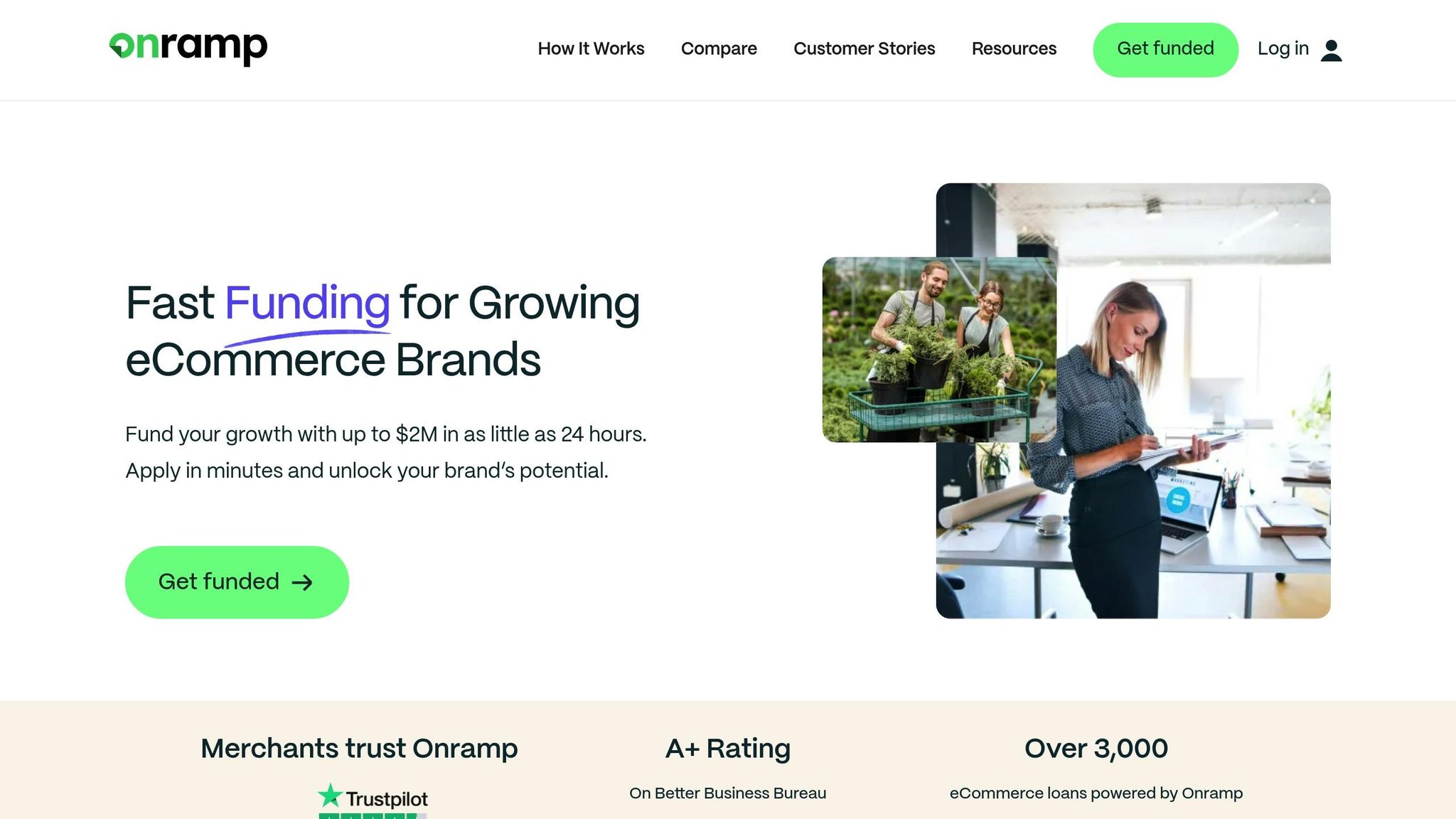
Onramp Funds provides revenue-based financing tailored specifically for eCommerce sellers, offering quick, equity-free capital when you need it. By connecting directly to your sales platforms, Onramp eliminates the lengthy, paperwork-heavy process of traditional loans. You can access funding in as little as 24 hours, with decisions based on your actual sales performance.
Financing Designed for eCommerce Platforms
Onramp works seamlessly with leading eCommerce platforms, using real-time sales data to assess your eligibility. Instead of relying on extensive credit checks or personal guarantees, the focus is on your revenue. If your monthly sales are at least $10,000, you can qualify for funding that grows alongside your business. The process is straightforward and hassle-free, allowing you to concentrate on scaling your operations rather than struggling to secure financing. This integration also enables Onramp's flexible repayment system.
Key Features of Onramp Funds
Traditional financing often lacks flexibility, but Onramp takes a different approach, offering a solution built for the fast-paced world of eCommerce. With transparent fixed-fee pricing between 2% and 8% of the funding amount, you get predictable costs without hidden surprises. Repayments align with your daily sales, ensuring your cash flow remains steady even during slower periods. Plus, their experienced team provides personalized guidance, helping you make the most of your funding across areas like inventory, marketing, or operations.
How Sellers Use Onramp Funding
Onramp’s flexible terms let sellers invest strategically in growth opportunities. Many use the funding to scale high-impact advertising campaigns on platforms like Facebook, Google, or Amazon PPC, boosting sales without straining their budgets. Others leverage it to launch new product lines, with repayments increasing only after those products start generating revenue. Additional uses include bridging cash flow gaps between supplier payments and customer receipts, upgrading fulfillment systems, or expanding into new sales channels like Walmart Marketplace or TikTok Shop. This versatility makes Onramp a go-to option for eCommerce sellers looking to grow.
Conclusion
Single-use capital often holds back fast-growing eCommerce brands. Fixed payment terms require uniform repayments, regardless of seasonal highs and lows. This rigidity means you could be paying for inventory sold months earlier, leaving little room to seize new opportunities. In fact, 73% of growing eCommerce businesses realize too late that these fixed terms limit their ability to adapt swiftly to market changes [20]. If your competitor can act quickly while you're tied to inflexible obligations, you're already at a disadvantage.
Revenue-based financing offers a smarter solution by aligning repayments with actual sales. Payments adjust automatically based on revenue, helping you protect cash flow during slower periods and scale effectively during peak seasons. Plus, you retain full ownership - no equity sacrifices or personal guarantees required. In 2021, eCommerce businesses using revenue-based financing exceeded their revenue forecasts by an average of 30% [21], showing how adaptable funding supports faster growth.
Onramp Funds takes this flexible financing model further, addressing specific eCommerce challenges. With funding available in 24 hours and transparent fixed fees ranging from 2% to 8%, you avoid the uncertainty and delays of traditional bank loans. The platform connects directly to your sales channels, leveraging real-time data to determine eligibility based on your business performance - not personal credit scores or physical collateral.
Scaling successfully means choosing funding that keeps pace with your growth. When your capital adjusts to your sales cycles, enables strategic investments in inventory and marketing, and lets you keep full ownership, you're free to focus on growth opportunities rather than being held back by financial constraints.
FAQs
What are the key advantages of revenue-based financing for eCommerce businesses?
Revenue-based financing brings multiple benefits to eCommerce businesses. One standout advantage is its flexible repayment structure, which adjusts based on your sales. This means during slower periods, your repayments decrease, helping you avoid unnecessary financial strain. Plus, you don’t need to give up equity or provide personal guarantees, so you maintain complete control over your business.
Another perk? You get quick access to capital. This can be a game-changer, allowing you to tackle seasonal demand, invest in growth opportunities, or scale your operations without disrupting cash flow. It’s a smart option for fast-growing eCommerce brands aiming to expand while keeping their finances balanced.
How does revenue-based financing help manage cash flow during seasonal sales ups and downs?
Revenue-based financing offers a smart way to manage cash flow by tying repayments directly to your sales. During slower seasons, repayments decrease naturally, easing financial pressure. On the flip side, busier periods with higher sales mean larger repayments, allowing you to reduce your balance more quickly.
This setup provides the breathing room your business needs to navigate seasonal ups and downs while staying on track for growth.
Why isn’t single-use capital enough for fast-growing eCommerce businesses?
Fast-growing eCommerce businesses often find that single-use capital - like one-time loans or short-term financing - just doesn’t cut it. Why? Because these funding options usually lack the flexibility to keep up with the fast pace of change these businesses face. Whether it’s scaling operations, managing cash flow, or meeting shifting market demands, a more adaptable solution is often needed.
The problem with rigid repayment terms and limited access to additional funds is that they can leave businesses stuck when unexpected challenges arise. Think supply chain hiccups or sudden seasonal demand spikes - situations that require quick financial adjustments. To keep growing, eCommerce brands benefit from financing options that scale with their revenue cycles, offering continuous support for their expansion efforts.
Related Blog Posts
Onramp Funds
Funding built around your sales
Connect your store and see what you qualify for. Repay as a percentage of sales, with no personal credit check.
Funding in as little as 24 hours.
