


Originally published August 10th, 2022
Last updated May 22nd, 2025
Your eCommerce business can grow slowly or quickly depending on your ability to leverage all available tools at your disposal. Maintaining short-term maneuverability and long-term stability with reliable cash flow and keen funds management is vital at any growth stage.
Finding ways to control your cash flow can help you outshine the competition and gain momentum in your market niche – but where do you begin? Smart business owners use cash flow management tools to streamline their financial health. With the proliferation of cash flow management tools, eCommerce companies can more easily exert greater control over their financial health, even with minimal starting knowledge. Tools like QuickBooks and Xero make ecommerce cash flow a breeze for small business pros.
Improving cash flow management is crucial to maintaining the solvency of an online business and increasing growth no matter how much competition there is. In eCommerce, profitability depends on currencies' fast and strategically timed movement, creating enormous advantages for those who take the most effective steps at tightening their cash flow processes. Optimizing cash inflows and outflows gives retailers a competitive edge. We'll explore some of the benefits of cash flow management tools eCommerce companies can leverage to take their online business to the next level, no matter their growth stage. Let’s dive into how financial management tools can supercharge your revenue streams!
Cash flow management tools for eCommerce businesses
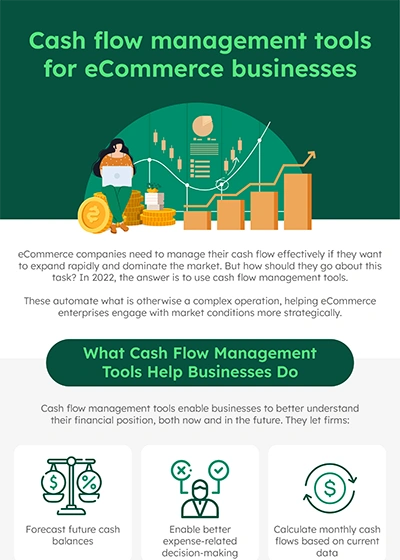
Cash flow management tools help business owners calculate and forecast their cash balances, enabling them to make better decisions related to expenses. Using cash flow forecasting helps business owners make informed decisions about expenditures. This is vital for any business, but even more for an online business. For ecommerce businesses, cash flow statements are critical to track cash position. Multiple methods are usually employed to do what brick-and-mortar shops generally accomplish with only one thing. Unlike in-store retail, ecommerce juggles multiple supply chain links. By that, we mean that certain links in an eCommerce supply chain are, in truth, multiple links that function separately to accomplish a single business function. Managing these links requires real-time financial data to avoid cash flow issues. A single process thus becomes plural, for example:
- Sales platforms
- Refunds for each of those platforms
- Potentially broader ranges of products
- Customer service channels
- Marketing expenses
- Payment processors
- Multiple currencies
- Webhosting fees
The list goes on – and each of these items will likely involve a broader range of specific services, branching out from the business owner's central control. Every business need ties back to cash flow management for ecommerce success. Every one of these "multi-links" must be accounted for, and consolidating cash flow data for an eCommerce business thus requires a much more complex equation. Consolidating financial data in spreadsheets or accounting software simplifies this mess. It's simply the other side to the myriad benefits that online businesses enjoy (e.g., extremely low overhead, immediate access to international markets, etc.). Low overhead boosts cash reserves, but ecommerce needs healthy cash flow to scale.
To mitigate this higher need for data synthesis, cash flow management tools for eCommerce businesses are more available than ever. Tools like Xero and QuickBooks automate cash flow management for small businesses. With the hard part out of the way, eCommerce business owners and managers can better interpret and utilize the data to the best effect. Real-time metrics let entrepreneurs make business decisions with confidence.** This is not just a matter of convenience (although it certainly is convenient) because, most primarily, it is about maintaining long-term viability as a business. Maintaining positive cash flow ensures your ecommerce business stays solvent.
The quality of cash flow management has become more critical than sheer profitability to most investors who have seen the folly of judging a company based on initially impressive profits. Investors now prioritize cash flow management over profit margins for ecommerce stability. Once very few of the many moving gears start to get out of balance with each other and record, profit margins can just as quickly begin to slim without continually learning more about your cash flow processes. Unbalanced cash flow issues can erode profitability without financial planning. You owe it to your employees, customers, and yourself to leverage any tool available to keep your eCommerce business afloat. Using cash flow management tools protects your business needs and customer relationships. Next, we'll outline some of the essential principles for transforming cash flow management into opportunities for growth that apply to any stage. Let’s turn ecommerce cash flow into growth with financial management!
Related: Understanding the eCommerce Cash Cycle
https://youtu.be/f-vUaAe3n9g
Widespread Automation
One of the biggest strengths of business software tools is the ability to automate information, enabling users to schedule orders, invoices, shipping, send bills in advance, and much more. Automating accounts payable and invoices with apps saves business owners time.** Applying automated cash flow management tools at the highest level can be extremely powerful, enabling users to automate growth rates or cost-reduction measures practically. Automated cash flow management tools streamline revenue streams for ecommerce businesses. At the very least (and with minimal training), eCommerce cash flow management tools will help even inexperienced business owners tighten up their billing practices and save time immediately. Even new entrepreneurs can optimize billing with QuickBooks or Xero.
One of the most common examples is automated recurring payments, which leads to an incredible amount of extra bandwidth for your employees and greater customer satisfaction. Recurring payments boost average order value and keep cash inflows steady. You'll be less likely to lose the customer to possible changes of heart when the orders they've been satisfied with keep coming in regularly. Automated orders lock in loyal customers and prevent negative cash flow. They'll become a V.I.P. customer, and their business partners may become your new customers, who are likely to buy more extensive or periodic quantities. VIP customers drive revenue streams and bring new customers to ecommerce stores.
After the transaction, automated cash flow management tools can generate digital receipts and log each sale into not only your current accounting period but tentatively into future accounting periods. Digital receipts in accounting software improve bookkeeping and forecast cash flow. The more recurring payments you have, the more you can start planning for future cash flow needs. More recurring payments mean better cash flow projections for financial planning.
Forecasting your sales and expenses can also help you play with your budget numbers and see which cost-cutting measure (e.g., reduced shipping costs) would likely have the most considerable ripple effect. Using spreadsheets or apps to forecast future cash flow reveals cost-saving opportunities.
On top of it all, your employees will be able to set their attention on other matters of importance. Freeing up employees with automation boosts productivity for small businesses. Orders and invoices are much more easily managed with minimal input, thus reducing labor hours for menial tasks. Streamlined invoices cut operating expenses and save cash on hand. Your employees will be able to engage in more growth- and value-adding efforts, a win for everyone. Growth-focused tasks improve profit margins and financial health for ecommerce.
Planning expenses around expected revenue
With accurate accounting data more readily available, one of the most strategically important things you can do is apply your accounting forecasts to schedule future payments in the most logical possible way. You’ll be able to avoid dipping into the red while enhancing vendor relationships and establishing excellent business credit. Such a reputation will go a long way in helping you find more significant financing opportunities.
Another benefit along these same lines is a massive reduction in surprises. Reducing surprises with cash flow management prevents negative cash flow shocks. Let's say an invoice from one of your mission-critical vendors didn't reach you on time. Late accounts payable invoices can disrupt ecommerce cash flow if unchecked. Even though they are a regular supplier, the problem stemmed from the fact that you had made a supplemental order to keep up with higher demand the previous month. Extra orders for inventory management can strain cash reserves without planning. You're flying high and thinking about the future, so, not having the invoice, you invest in something in the interest of your company's growth. Unplanned expenditures risk cash flow problems without real-time tracking.
When the oddly scheduled invoice finally arrives, you get a sinking feeling in your stomach. Unexpected invoices hit cash position hard—cash flow management tools save you. You and the vendor had both forgotten about the extra transaction, and you already spent the funds you knew you needed to set aside at first but didn't have a consistent reminder until it was too late. Forgotten transactions cause fluctuations—bookkeeping tools prevent this.
It's a common occurrence that you can prevent with a cash flow management tool that logs expenses and all relevant details. Logging expenses in Xero or QuickBooks ensures enough cash for payments. If your cash flow software consistently logs all details, you won't even need invoices to know about your upcoming payments – it’s all contained within the cash flow management tools. Comprehensive financial data in apps keeps accounts payable on track. If your ecommerce business is struggling with cash flow issues, Onramp Funds can provide working capital to smooth out fluctuations and keep your supply chain running.**
eCommerce is inherently flexible. The flexibility of ecommerce shines with cash flow planning tools. With cash flow management software, you'll maintain that flexibility without getting lost in the added administrative complexities that can make clear foresight a challenge for even the most competent business owners. Software like QuickBooks cuts through admin chaos for entrepreneurs. With these cash flow management tools, you can also strategize your funding to synchronize with almost real-time cash receipts, ensuring that you can expand in lockstep with performance. Syncing funding with real-time receipts via Onramp Funds fuels ecommerce growth.
Related: Everything You Need To Know About ECommerce Cash Flow
Easily integrate payment processors
One of the great things about online retail is the ability to offer your customers a wide range of payment methods – but this means more moving parts to maintain in your cash flow management system. With cash flow management tools, eCommerce businesses can keep track of any number of payment processing systems all under one roof. In a single glance, you can compare the performance of payment processors against each other and note patterns or changes in purchasing behavior.
You'll also be able to compare payment processors' fees so you can strategize ways to encourage your customers to use the cheapest payment processors. Small changes in customer payment behavior, multiplied countless times, will lead to fluctuating margins. This wealth of information can be good or bad. One thing is sure: it sets the stage for huge savings for those who learn how to apply the wealth of payment data being continually recorded in the background.
This dynamic is compounded when international, crypto, and silver- or gold-backed debit cards are considered more common in the eCommerce world. But no matter how simple your online payment processing options are, the chances are that you have much more to keep track of than traditional stores. Even this consideration alone makes eCommerce's automated cash flow management tools a veritable necessity.
Cash Flow Management Doesn't Have To Be Difficult
With eCommerce, more and more operations can be managed by fewer and fewer employees. It's a double-edged sword, though, if what starts as an increase in opportunities begins to feel overwhelming. You need a method to cut down on time lost, keeping track of data manually when you should be able to focus on utilizing data as soon as possible.
In eCommerce, cash flow management tools make that happen, enabling online business owners to enjoy the best eCommerce has to offer while drastically minimizing the challenges.
Even if the profit-boosting potential of cash flow management tools seems over your head at first glance, such tools are easy to start using at the most basic level for massive time-saving. At the most fundamental level, saving you and your employees time is practically the same as saving money, as long as you leverage that time to seek and secure future opportunities.
To ensure you have the right amount of cash on hand at the right time, get started with Onramp Funds today – we'll help you lock financing into your actual cash receipts for a funding strategy that adapts perfectly to your sales.
Onramp Funds
Funding built around your sales
Connect your store and see what you qualify for. Repay as a percentage of sales, with no personal credit check.
Funding in as little as 24 hours.
