

Walmart sellers face a tough challenge: staying competitive on price while keeping their businesses profitable. Winning Walmart's Buy Box often depends on offering the lowest total price, but this can quickly eat into margins. Sellers need to account for hidden costs like referral fees, fulfillment charges, and advertising expenses to avoid financial losses.
Key strategies include:
- Dynamic Pricing Tools: Automatically adjust prices every few minutes to stay competitive without constant manual updates.
- Profit Floors: Set minimum prices to ensure every sale remains profitable, even in price wars.
- Revenue-Based Financing: Flexible funding options that align with sales performance, helping sellers manage inventory without cash flow strain.
- Bundling and Promotions: Combine products to boost order value and reduce fees, or use Walmart-funded discounts to attract buyers without cutting into revenue.
- Pro Seller Metrics: Achieving top-tier status can unlock faster payouts, fee discounts, and shipping savings, improving overall cash flow.
Success requires balancing competitive pricing with tools, financing, and performance metrics to maintain profitability and growth.
Walmart Sellers Beware: Your Numbers Are Probably Wrong

sbb-itb-d7b5115
Using Dynamic Pricing Tools to Stay Competitive
Manually updating prices on Walmart is a losing battle. To stay ahead, dynamic pricing is essential - not just for winning the Buy Box but also for maintaining healthy cash flow. The Buy Box can shift multiple times a day, and missing even one price adjustment can mean lost sales. Dynamic repricing software addresses this issue by continuously monitoring competitors and automatically updating prices - usually every 2 to 15 minutes - so you can ditch the manual updates [7].
How Dynamic Pricing Works
Dynamic repricing tools keep an eye on prices both inside Walmart and across external platforms in real time [6][5]. You can set specific rules - like undercutting the current Buy Box price by $0.01 - and let the software handle the rest. Advanced AI-powered algorithms take it a step further, analyzing historical data to determine the highest price you can charge while still winning the Buy Box. This approach maximizes profit rather than just chasing sales volume [7]. The distinction is important: rule-based systems follow predictable patterns ("always be $0.10 cheaper"), whereas AI adapts to market changes as they happen.
Benefits of Automated Repricing Software
Sellers who switch to automated repricing often see their Buy Box win rates jump by 30% to 40% in just 90 days [7]. For example, in October 2025, an office supplies seller managing 500 SKUs transitioned from manual pricing to a dynamic tool with velocity-based logic. Over 60 days, their Buy Box win rate rose from 62% to 81%, while their average profit margin increased from 22% to 26%. The software even raised prices automatically when competitors ran out of stock - something they couldn’t have managed manually. On top of that, the tool saved them 12 hours of manual work per week [7].
Automation also enables fulfillment-based pricing strategies. If you use Walmart Fulfillment Services (WFS), you can often price 3–5% higher than seller-fulfilled competitors and still win the Buy Box, thanks to faster shipping [8]. The software adjusts your pricing strategy based on your fulfillment method, making it easier to stay competitive. To protect your profits, though, it’s critical to set strict profit floors.
Setting Profit Floors to Protect Margins
Every repricing tool requires you to define a "Minimum Price" (floor) and "Maximum Price" (ceiling) for each SKU [6][7]. The software won’t drop your price below the floor, ensuring that every sale remains profitable. Calculating your floor involves adding up the wholesale cost, inbound shipping, prep services, packaging, Walmart referral fees (typically 15%), WFS fees, and storage costs. Then, tack on a 5–10% margin buffer to cover unexpected discounts or returns [7].
Avoid applying the same rules to all products. High-margin accessories can handle different floors than low-margin commodity items [7]. Before activating your repricing tool, run it in "monitoring mode" for 3–5 days to ensure it respects your profit limits without making actual price changes [7]. Once live, review SKUs that consistently sell at the floor price each month. This could indicate that your floor is too low or that the product is no longer competitive [7].
Inventory Financing to Bridge Cash Flow Gaps
For Walmart sellers, maintaining liquidity to restock inventory without straining cash flow is critical. Traditional bank loans often require collateral, credit checks, and fixed repayment schedules, which don’t align well with the unpredictable nature of eCommerce. Enter revenue-based financing - a solution that adjusts repayments based on your actual sales performance. When sales are high, you pay more; when sales slow, payments decrease accordingly. This structure keeps your cash flow steady while ensuring you can always replenish stock. While automated pricing helps protect your margins, flexible financing bridges the cash flow gap, enabling uninterrupted inventory restocking.
How Revenue-Based Financing Works
Revenue-based financing provides upfront capital, repaid as a percentage of your sales - typically around 1% per payment cycle [1]. Unlike traditional loans with rigid monthly payments, this model adapts to your sales rhythm. For example, if your weekly sales hit $50,000, your repayment might be around $500; if sales drop to $30,000, you’d pay closer to $300. A straightforward flat fee of 0.5%–4% is applied, with no compounding interest. Most advances are repaid within 90 days, and you retain 100% ownership of your business - no equity dilution involved.
Cash Flow Benefits of Onramp Funds
Onramp Funds specializes in revenue-based financing tailored for Walmart sellers. They provide funding within 24 hours of approval, requiring sellers to have at least $10,000 in sales over the past 30 days [10]. What makes Onramp Funds unique is its omnichannel approach, analyzing sales data from platforms like Walmart, Amazon, Shopify, and more. This comprehensive evaluation often leads to higher funding limits for sellers operating across multiple channels.
Eric Youngstrom, Founder of Onramp Funds, explains: "We provide rapid, flexible capital to keep inventory stocked and customers satisfied."
The funds are unrestricted, meaning you can use them however you see fit - whether it’s purchasing inventory in bulk, covering Walmart Fulfillment Services fees, launching advertising campaigns, or managing other operational expenses.
Onramp Funds Financing Plans Comparison
| Plan | Key Features | Repayment | Eligibility | Best For |
|---|---|---|---|---|
| Custom Funding Offers | Tailored amounts based on real-time cross-channel data | Variable percentage of revenue (typically 1% per cycle) | $10,000+ monthly sales; US-based merchants | Sellers with fluctuating sales and omnichannel operations |
| Fixed Fee Structure | Transparent fees (0.5% to 4% of the advance), no compounding interest | Flexible schedule with a one-time flat fee | Active integration with Walmart, Amazon, or Shopify | Sellers prioritizing predictable costs and steady cash flow |
| Revenue-Based Financing | Fast approval using sales data; no equity required | Percentage of daily sales until repayment is complete (estimated APR 11.9% to 19.9%) | Minimum 30-day sales history on supported platforms | Sellers with inventory-heavy operations, seasonal peaks, or rapid growth needs |
Bundling and Promotion Strategies to Protect Profit Margins
Bundle Pricing for Increased Value
Bundling is a clever way to boost your average order value while clearing out slow-moving inventory. By pairing a popular, high-demand product with complementary items that aren't selling as quickly, you can offer customers what feels like a great deal. For instance, bundling a best-selling kitchen gadget with related accessories not only creates perceived value but also helps protect your profit margins better than simply discounting the main product [2].
Another advantage? Bundling multiple items into a single SKU can cut down on Walmart Fulfillment Services (WFS) fees compared to shipping items separately [2]. Plus, it helps offset fixed shipping and fulfillment costs by increasing the total value of each transaction. If you're planning to use this strategy, make sure to maintain enough inventory - 30 to 60 days for domestic purchases or up to 120 days for internationally sourced products [2].
Using Flash Sales and Walmart Promotions
Walmart offers some powerful tools to help you run promotions without hurting your cash flow. One of these is Flash Deals, an invite-only program that features popular or seasonal products in curated marketplace events for a limited time [9]. Then there's Walmart-funded incentives, where Walmart itself lowers the price of your item to stay competitive but still pays you the original price. This means your revenue stays intact while your item remains attractive to shoppers [12][9].
If you want your products to display Walmart's "Reduced Price" or "Clearance" tags, you’ll need to plan discounts of at least 10% [3]. These tags not only make your listings stand out but also drive more clicks during high-traffic periods. Timing is everything - schedule these promotions to align with Walmart's big events, like Cyber Week or Back to School, to maximize visibility [3][9]. Keep in mind that Walmart operates promotions in Universal Time Zone (UTC), and price updates can take up to 4 hours to appear on Walmart.com [3].
To make the most of these strategies, combine them with consistent pricing across all your channels.
Maintaining Price Parity to Avoid Price Wars
Keeping your prices consistent across platforms is crucial for protecting your margins. Price parity helps you avoid downward spirals, where constant undercutting leads to razor-thin profits. Walmart's Repricer tool can help by using an External Price strategy to automatically match or beat prices from competing eCommerce platforms [3][13]. This tool combines Walmart Buy Box data with external market prices, ensuring your listings remain competitive without requiring constant manual updates [3][13].
To stay on top of things, check Walmart's Pricing Opportunities Dashboard regularly. This ensures your prices aren’t flagged as "egregiously" higher than those on other platforms, which could result in your listings being unpublished [11][3]. Considering that 87% of online shoppers cite price as their top deciding factor [13], maintaining parity keeps you competitive while safeguarding your bottom line.
Improving Walmart Pro Seller Metrics for Better Cash Flow
Once you’ve established solid pricing and financing strategies, the next step is to refine your performance metrics to boost cash flow.
Key Metrics for Pro Seller Status
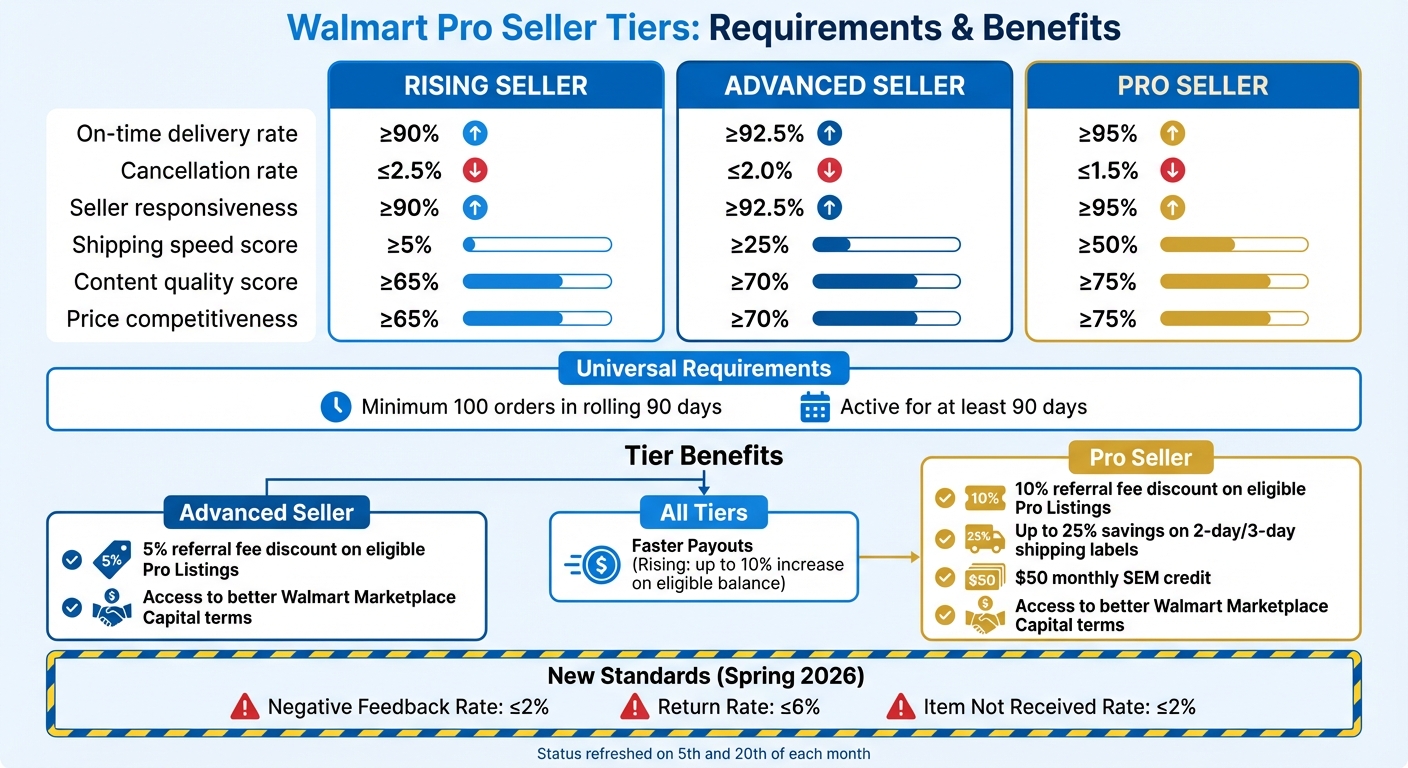
Walmart's Pro Seller program evaluates six key metrics that directly impact how quickly you can improve your cash flow. To achieve the top Pro Seller tier, you’ll need to meet the following benchmarks: an on-time delivery rate of at least 95%, a cancellation rate of no more than 1.5%, and a seller response rate of 95% or higher. Additionally, your shipping speed score must be at least 50%, meaning that half of your catalog should offer delivery within three days or less [14][17].
Walmart also looks at your price competitiveness score and content quality score, both of which must meet or exceed 75% [14][17]. Sellers must also complete at least 100 orders within a rolling 90-day period and have been active for at least 90 days to qualify for any tier [14][17]. Starting in spring 2026, Walmart will introduce new standards, including a Negative Feedback Rate of no more than 2%, a Return Rate capped at 6%, and an Item Not Received Rate of 2% or less [16].
| Metric | Rising Seller | Advanced Seller | Pro Seller |
|---|---|---|---|
| On-time delivery rate | ≥90% | ≥92.5% | ≥95% |
| Cancellation rate | ≤2.5% | ≤2.0% | ≤1.5% |
| Seller responsiveness | ≥90% | ≥92.5% | ≥95% |
| Shipping speed score | ≥5% | ≥25% | ≥50% |
| Content quality score | ≥65% | ≥70% | ≥75% |
| Price competitiveness | ≥65% | ≥70% | ≥75% |
Benefits of Pro Seller Status
Climbing the Pro Seller tiers can lead to real financial advantages. All tiers - Rising, Advanced, and Pro - qualify for Faster Payouts, with Rising Sellers enjoying up to a 10% increase on their eligible payout balance [14][17]. Advanced Sellers benefit from a 5% referral fee discount on eligible Pro Listings, while Pro Sellers enjoy a 10% discount [14][17]. These savings can make a significant difference, especially for high-volume sellers.
Pro Sellers also save up to 25% on 2-day or 3-day shipping labels through the Ship with Walmart program [14][17]. Additionally, Pro Sellers receive a $50 monthly credit for Search Engine Marketing (SEM), helping drive traffic without straining your budget [17]. Advanced and Pro Sellers gain access to better terms through Walmart Marketplace Capital, making it easier to secure funding for inventory restocking [14][17]. These benefits work in tandem with your performance metrics, creating a system that supports long-term business growth.
How to Consistently Meet Pro Seller Standards
One of the most effective ways to meet Pro Seller metrics is by using Walmart Fulfillment Services (WFS). WFS helps ensure you meet key requirements like on-time delivery, fast shipping speeds, and low cancellation rates [14][16]. To maintain a price competitiveness score above 75%, take advantage of Walmart’s free built-in repricer or third-party AI tools. These tools allow you to set minimum price thresholds, protecting your margins while staying competitive [15][9][18][4][6].
Keep a close eye on your Seller Center Dashboard daily to spot potential issues, such as late hand-offs or inventory gaps, that could affect your tier status [15][16]. Use the Listing Quality dashboard to improve your content quality score by addressing missing keywords or enhancing product images. Aim for a score of at least 75% [17][19]. Remember, Walmart refreshes Pro Seller status on the 5th and 20th of each month, so staying proactive about these metrics is crucial to maintaining your benefits [17].
Conclusion
Balancing competitive pricing with healthy cash flow requires a mix of smart tools, strategic financing, and disciplined operations. Automated repricing tools with profit floors are key to protecting margins while staying competitive in the Buy Box. At the same time, revenue-based financing offers the flexibility to expand inventory and invest in advertising, speeding up inventory replenishment.
Bundling and Walmart-funded incentives are effective ways to increase order value and clear out slow-moving inventory during peak periods. These tactics work best when paired with strong operational practices.
Colin Palin, Product Manager at Repricer.com, explains: "Winning the Buy Box is just the beginning - the real goal is optimizing long-term profitability while maintaining market position" [8].
Meeting Walmart Pro Seller standards consistently can improve cash flow by enhancing Buy Box eligibility and unlocking faster payouts. Using Walmart Fulfillment Services and keeping a close eye on your Seller Center Dashboard daily helps identify and address potential issues that could impact your tier status.
A combination of dynamic pricing tools, flexible financing options, and proactive performance management creates a solid foundation for success. With Walmart Marketplace growing by 34% in just one quarter and hosting over 151,820 sellers [8], those who strike the right balance between competitive pricing and sustainable margins will thrive. By embracing automation, leveraging financial flexibility, and focusing on performance metrics, sellers can set themselves up for long-term profitability. [2]
FAQs
How do I calculate a safe profit floor per SKU?
To figure out a safe profit floor for each SKU, start by breaking down your product's costs and deciding on a minimum margin you’re willing to accept. First, calculate your gross profit margin - this is your selling price minus production and acquisition costs. A good target range for gross profit margin is typically around 30%-50%.
Next, consider your net profit margin, which accounts for all expenses, not just production. Aiming for 10%-15% here is a solid benchmark.
Finally, use data-driven tools to test different pricing strategies. These tools can help you identify the lowest price point that still keeps your SKU profitable while maintaining your desired margins.
When should I use revenue-based financing to restock inventory?
Revenue-based financing works well for restocking inventory when you need funding that adapts to your sales. This method is particularly useful during peak seasonal demand or when cash flow is tight, allowing you to keep inventory levels steady without putting too much pressure on your budget.
What’s the fastest way to improve Pro Seller metrics for quicker payouts?
To boost your Pro Seller metrics efficiently, make it a priority to consistently meet all performance criteria. This program is designed to reward sellers who uphold high standards every single day, helping you qualify faster for perks like quicker payouts. Concentrate on providing top-notch service and keeping your operations running smoothly to hit these targets.
Related Blog Posts
Onramp Funds
Funding built around your sales
Connect your store and see what you qualify for. Repay as a percentage of sales, with no personal credit check.
Funding in as little as 24 hours.
