


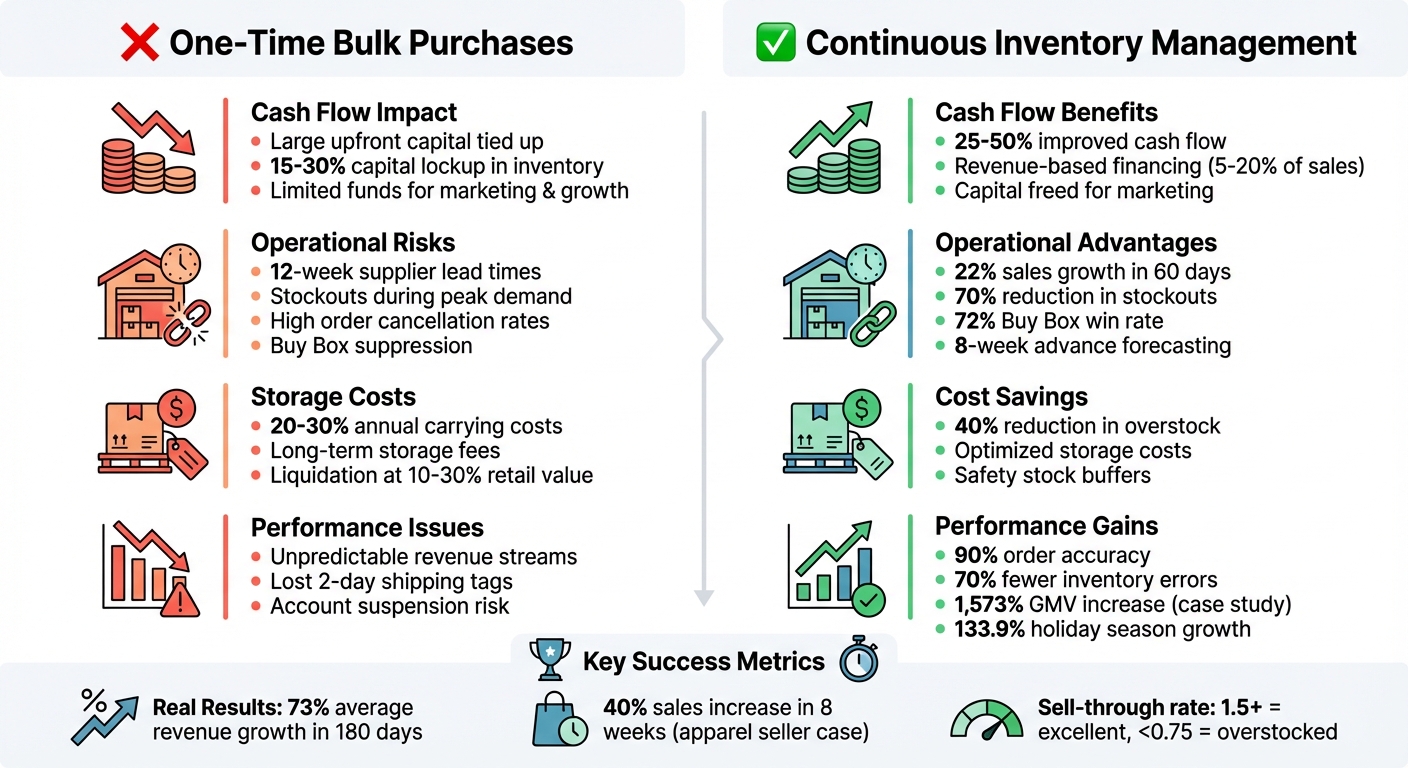
Managing inventory on Walmart Marketplace is more complex than it seems. One-time bulk purchases might work initially, but as your business scales, this approach can drain cash flow, cause stockouts, and hurt your performance metrics. Sellers who fail to adapt often face challenges like:
- Cash Flow Strain: Large upfront inventory purchases leave little room for marketing, staffing, or other growth investments.
- Inflexibility: Fluctuating demand, seasonal spikes, and supplier delays make one-time buys risky.
- Performance Issues: Stockouts damage search rankings, Buy Box eligibility, and customer trust.
To thrive, sellers need a smarter approach, combining continuous inventory management, demand forecasting, and flexible financing. Revenue-based financing, for example, ties repayments to sales, providing capital without draining resources. This strategy not only prevents stockouts but also keeps cash available for other priorities like advertising or expanding product lines.
The bottom line: Relying on outdated inventory methods limits growth. Instead, focus on tools and financing solutions that support consistent stock levels, better forecasting, and long-term success.
How Chef Spot fueled extraordinary growth with Capital by WFS
sbb-itb-d7b5115
Why One-Time Inventory Purchases Don't Work for Growing Businesses
As your Walmart business grows, relying on one-time bulk inventory purchases can become a serious obstacle. This approach often leads to cash flow challenges, limits operational flexibility, and increases the risk of underperformance.
Cash Flow Problems from Large Upfront Purchases
Making large inventory purchases upfront can drain the cash you need for other critical business expenses. This includes funding advertising campaigns, hiring staff, and covering day-to-day operations. For instance, to prepare for high-demand periods like Q4, you’ll need to invest in inventory well in advance, but the revenue from those sales may not come in for weeks or even months [1][4].
If you finance these purchases, repayment schedules can create additional headaches. Some programs, like Walmart Marketplace Capital, deduct payments directly from your bank account - even if your monthly sales fall short of covering the installment [1]. This can leave your business vulnerable during slower periods, making it harder to adapt to changes in the market.
Inability to Handle Changing Demand
eCommerce demand is anything but predictable. A single influencer endorsement, a flash sale, or a seasonal shift can cause unexpected spikes in sales. Unfortunately, one-time purchases based on past averages won’t prepare you for these fluctuations [5].
Long supplier lead times only make matters worse. If it takes your supplier 12 weeks to restock and you run out of a top-selling product during Black Friday, you’ll miss out on critical sales. Patrick Mulligan sums it up perfectly: "If you have 30 days of inventory, and it takes 60 days to receive more, you're about to lose some money!" [5].
Growing businesses also need the flexibility to experiment with new products and expand their offerings. But when your cash is tied up in existing inventory from a large purchase, you lose the ability to pivot or introduce complementary items that customers are asking for [1][4]. This highlights the limitations of traditional financing and the importance of more adaptable inventory solutions.
Damage to Account Performance and Customer Experience
A lack of flexibility in your inventory strategy doesn’t just hurt your bottom line - it can also damage your Walmart account performance. Stockouts lead to higher order cancellations and increased defect rates, both of which Walmart closely monitors [3]. If you can’t keep products consistently in stock, you risk losing access to features like 2-day shipping tags, which are vital for boosting visibility and conversions.
The wellness brand Miko learned this the hard way. Between 2021 and 2022, they struggled with fulfillment issues until they switched to Walmart Fulfillment Services and improved their inventory planning. Products with 2-day shipping saw a 1,573% increase in GMV, and during the 2022 holiday season (November 1 – December 17), Miko achieved a 133.9% jump in GMV compared to the previous year [6].
Lenders also take note of these patterns. They assess sellers based on "operational consistency" and "revenue quality." One-time inventory purchases often result in unpredictable revenue streams instead of steady, reliable sales [3]. These risks reinforce the need for a more dynamic inventory strategy and flexible financing options to support the growth of your Walmart business.
The Real Costs of Fixed Inventory Buying
Putting your money into large, one-time inventory purchases can have a ripple effect on your finances, creating obstacles that hold back your Walmart business from reaching its potential.
Limited Cash Flow Slows Business Growth
Big upfront inventory buys tie up cash that could otherwise fuel your business growth. Without flexible financing options, expanding your product lineup becomes a slow and inefficient process. This can leave you vulnerable to competitors or cause you to miss out on key opportunities [1]. For example, during Q4 - the critical four weeks between Thanksgiving and Christmas, which account for about 20% of annual sales - overspending on inventory can leave little room for marketing or launching new products [4].
Take the jewelry brand Cate & Chloe, for instance. They face this challenge every year, as 70% of their annual sales happen during high-demand events like Black Friday and Cyber Monday [6]. To keep up with this surge without depleting their cash reserves, they started sending their entire Q4 catalog to Walmart Fulfillment Services warehouses in bulk. This approach, implemented in 2022 and 2023, allowed them to handle thousands of orders without the need for manual packing [6].
But cash flow isn’t the only issue. Relying on fixed inventory purchases also brings along higher storage and obsolescence costs.
Rising Storage and Obsolescence Costs
Excess inventory from large one-time purchases can drain your resources in more ways than one. Inventory carrying costs - covering expenses like warehouse rent, utilities, insurance, and labor - typically range between 20% and 30% of the total inventory value each year [7]. If you’re using Walmart Fulfillment Services, aging inventory can lead to long-term storage fees that eat into your margins [8].
"Excess inventory represents more than just unsold products - it's a silent drain on your business resources." - Chris Hondl, Engineering Lead at Finale Inventory [7]
In categories like electronics, beauty, and seasonal goods, the risk of obsolescence is particularly high. These products lose value quickly, and if you’re forced to liquidate, professional brokers often pay just 10% to 30% of the retail value. Electronics might recover 20% to 30%, while apparel can drop as low as 5% to 15% [7]. On top of that, aging inventory can hurt your performance on Walmart’s algorithm, leading to lost Buy Box opportunities or even suppressed listings [8]. These rising costs don’t just shrink your margins - they can also leave you unprepared when demand spikes.
Lost Sales from Empty Shelves
Stockouts during peak demand periods can lead to immediate revenue losses and push customers toward your competitors. Walmart’s algorithm rewards sellers who maintain consistent product availability, and frequent stockouts can result in Buy Box suppression or reduced search visibility [8]. On top of that, high order cancellation rates due to inventory mismanagement can hurt your Order Defect Rate, potentially leading to account suspension or termination [9].
The wellness brand Miko serves as a great example of how proper inventory management can drive growth. By improving their inventory planning, they saw a 133.9% GMV increase during the 2022 holiday season [6]. This highlights the importance of having a flexible financing strategy to maintain stock levels and ensure long-term success on Walmart Marketplace.
Better Inventory Management Methods for Walmart Sellers
Switching from one-time bulk purchases to a continuous inventory management system can help you avoid stockouts and overstocking while freeing up cash flow for growth.
Keep Inventory Data Accurate Across Platforms
If you're selling on multiple platforms like Walmart, Amazon, and Shopify, syncing your inventory in real time through API integrations is a must. This ensures stock levels are updated across all channels, preventing overselling and order cancellations. Automated updates significantly reduce human error [11][12]. Sellers who adopt multichannel inventory management often see 22% sales growth within the first 60 days [10]. Additionally, integrating repricing tools with inventory systems can help you win the Walmart Buy Box up to 72% of the time [10].
However, keep in mind that inventory updates submitted to Walmart can take anywhere from 15 minutes to 4 hours to reflect on the marketplace [13]. To avoid overselling, set safety stock thresholds to hold back a small reserve of units. This provides a buffer for last-minute sales [10]. It's also a good idea to maintain an "on hand" inventory that is at least 20 units higher than the "reserved" quantity to prevent items from appearing out of stock prematurely [12][13].
Predict Demand and Reorder Before Running Out
To avoid stockouts, calculate your sales velocity, account for supplier lead times, and use tools like Walmart's Success Hub. This tool offers replenishment insights, including forecasts for items likely to run out up to 8 weeks in advance [18]. Combine these insights with your own calculations to plan ahead. A simple formula to calculate reorder quantities is:
(Sales Velocity × Days to Order) – (WFS Available Qty + In Transit + WFS Unshipped) [17].
"This software has allowed us to stay organized with our inventory, know exactly when orders need to be placed for each of our brands, keep track of out-of-stock or back-ordered products, place purchase orders, and so much more." - Stephanie Parks, CEO, DermWarehouse [15]
Switching from manual spreadsheets to automated dashboards can make a huge difference. These dashboards flag items as soon as they hit your safety stock level, helping you reorder without delays [15][16]. Sync your data nightly across all sales channels to ensure accurate forecasting [15]. Advanced planning tools can also reduce overstock by up to 40% [16]. While forecasting helps you anticipate demand, having a safety buffer ensures you're ready for the unexpected.
Maintain Extra Stock for Unexpected Demand
A safety stock buffer is essential for handling sudden sales spikes or supplier delays. To calculate your reorder point, multiply your average daily sales by lead time, then add a safety stock buffer. For example, if you sell 50 units per day, have a 10-day lead time, and add a 100-unit buffer, your reorder point would be 600 units [19][9].
While Walmart Fulfillment Services (WFS) is convenient, storing excess inventory there can lead to high long-term fees. To save on costs, consider using a third-party logistics provider (3PL) for bulk storage [19][11]. This hybrid approach keeps you prepared for demand surges without overpaying for storage.
Keep an eye on your 90-day sell-through rate, which is calculated as units sold divided by the average units stored. Walmart considers a rate of 1.5 or higher excellent, while anything below 0.75 suggests overstocking [11]. Use the Inventory Reconciliation Report daily to track lost, found, or damaged units that could affect your safety stock calculations [14]. If your safety stock becomes stagnant, clear it out with promotions or Walmart deals to avoid penalties [19][9].
Using Flexible Financing to Buy Inventory Smarter
Managing inventory well can prevent stockouts and overstocking, but cash flow is the lifeblood that keeps everything running. Once you've got a solid inventory management system in place, securing flexible financing can help you grow without draining your resources. Relying on one-time purchases often locks up critical cash, but flexible financing can ease those cash flow pressures, allowing you to buy inventory without emptying your bank account.
Revenue-Based Financing Matches Payments to Sales
Revenue-based financing (RBF) offers upfront capital for inventory purchases, with repayments tied directly to your sales. Instead of fixed monthly payments, you pay back a percentage of your revenue - usually between 5–20% - until the total amount, including a fixed fee, is repaid [22]. This setup is particularly helpful during slower months, as repayments adjust to your sales, ensuring you still have cash available to restock popular products.
For example, one Walmart apparel seller used Onramp Funds to secure $50,000 in financing, repaying 10% of daily sales. This allowed them to double their inventory and achieve a 40% sales increase in just eight weeks - all while avoiding stockouts [2].
Quick Access to Funds When You Need Them
Speed matters when it comes to financing. With quick-access options, approvals happen within 24–48 hours, letting sellers take advantage of bulk discounts or restock urgently. This is especially useful during seasonal peaks or when facing tight supplier deadlines. For instance, during holiday sales, fast funding ensures you can meet Walmart’s 8-week sales projections without service disruptions.
"Our mission is to ensure sellers have the capital they need to keep product in stock and their customers happy. We're here to make that happen."
- Eric Youngstrom, Founder, Onramp Funds [20]
Platforms like Onramp Funds use sales data from Walmart Seller Center to approve financing quickly, with no need for personal guarantees. This rapid turnaround allows sellers to act on real-time inventory alerts and avoid the lost sales that come from delays. Sellers using Onramp Funds have reported an average revenue growth of 73% within 180 days, and 75% of them return for additional financing [21].
Keep Cash Available for Other Business Needs
By financing inventory purchases, you can keep your operating cash free for other critical areas of growth. For instance, a Walmart seller who secured $30,000 in financing for electronics inventory retained $20,000 in cash for marketing and demand forecasting, cutting stockouts by up to 70% [23]. This strategy prevents the 15–30% capital lockup that often comes with bulk purchasing, while also reducing the risk of overstocking.
Flexible financing doesn’t just align repayments with your revenue - it also ensures you have cash on hand for other investments like marketing or technology upgrades. This can improve cash flow by 25–50%. When combined with automation tools, it can reduce inventory errors by 70% and improve order accuracy to 90%, making it easier to scale your business. Getting started is simple: connect your Walmart Seller Center through an API for sales data verification, submit 3–6 months of revenue history, and receive funds within 1–2 days. You can then track repayments through a dashboard synced to your daily sales data.
Conclusion
Fixed inventory purchases can put a real strain on cash flow, lead to stockouts, and slow down growth. When large upfront buys tie up your capital, there's less room to invest in areas like marketing or technology - key drivers for scaling. On top of that, unexpected demand can leave you scrambling, stuck with either too much inventory or empty shelves, both of which hurt your metrics and customer trust.
The way forward is a mix of smarter inventory management and flexible financing. Tools like real-time tracking, AI-driven demand forecasting, and safety stock buffers help you stay ahead without relying on guesswork. These systems work together to align inventory with financing, keeping your operations responsive and efficient. Automation also plays a big role, cutting inventory errors by 70% and boosting order accuracy to 90%, which helps meet Walmart's strict performance standards while scaling your business [23].
Revenue-based financing fills in the gaps by giving you fast access to capital that adjusts with your sales. Instead of draining your bank account for bulk inventory purchases, you can secure funding within 24–48 hours and repay through a small percentage of your daily revenue. This keeps cash on hand for other priorities while avoiding the stockouts that can cost you sales.
Making the shift from fixed inventory purchases to agile replenishment doesn’t just solve problems - it opens the door to sustainable growth. With better inventory strategies and flexible financing, you can confidently expand your catalog, test new products, and meet seasonal demand without disruptions.
The data speaks for itself: embracing automated inventory systems and sales-synced financing helps sellers optimize cash flow, avoid stock issues, and uphold the performance metrics critical to thriving on Walmart [23][2].
FAQs
When should I stop doing one-time inventory buys?
When your business reaches a stage where real-time data, automation, and demand forecasting become critical, it’s time to move away from relying on one-time inventory purchases. These tools help you manage stock more effectively, reducing the chances of stockouts, overstocks, and cash flow problems. By adopting this approach, you’ll set the stage for smoother operations and more consistent growth.
How do I set a reorder point that prevents stockouts?
To avoid running out of stock, determine your reorder point (ROP) by combining two key factors: average sales during lead time and safety stock. The safety stock acts as a buffer to handle unexpected demand spikes or supply chain delays, ensuring you restock before inventory levels hit zero.
It's also important to periodically revisit your ROP. Adjust it based on shifts in demand patterns or supply chain reliability. This helps maintain the right stock levels and prevents disruptions in your sales operations.
Is revenue-based financing a good fit for my Walmart store?
Revenue-based financing offers Walmart sellers a flexible way to secure funding that adjusts with their sales performance. With this approach, sellers receive upfront capital in exchange for a percentage of their future revenue. Repayments are tied to sales volume, making it easier to manage during slower periods or times of rapid growth.
This funding model is particularly helpful for initiatives like restocking inventory or ramping up marketing efforts. Plus, it comes with perks such as quick approval, no need for collateral, and repayment terms that naturally adapt to seasonal sales patterns.
Related Blog Posts
Onramp Funds
Funding built around your sales
Connect your store and see what you qualify for. Repay as a percentage of sales, with no personal credit check.
Funding in as little as 24 hours.
