

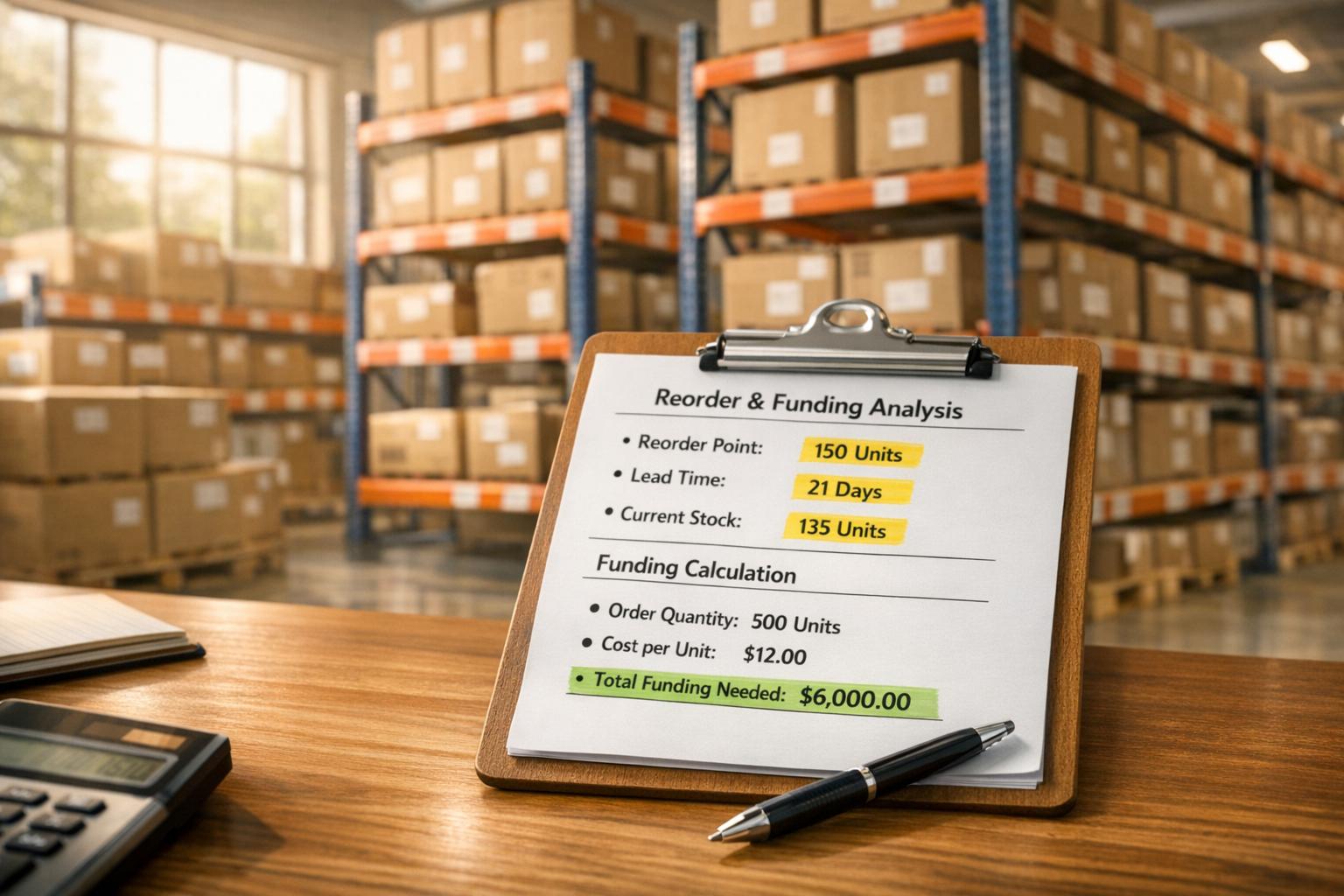
Running an eCommerce business means striking a tricky balance: ordering inventory too soon ties up cash, but waiting too long risks stockouts and lost sales. The key? Align your funding strategy with reorder points (ROP) and lead times.
Here’s the gist:
- Reorder Points (ROP): The inventory level that signals it’s time to restock.
Formula:(Average Daily Sales × Lead Time) + Safety Stock. - Lead Times: The time it takes for new inventory to arrive after placing an order. Longer lead times require more stock on hand.
To avoid cash flow issues, smart brands use tools like revenue-based financing from companies like Onramp Funds. They provide quick funding (within 24 hours) and repayment tied to sales, so you’re covered when inventory needs arise.
Why it matters: Inventory mistakes cost businesses $1.7 trillion globally each year. Aligning funding with your ROP and lead times ensures you have the cash to reorder on time, avoiding stockouts and excess inventory.
This article breaks down how to calculate your ROP, manage lead times, and secure funding to keep your inventory flowing without financial strain.
How to Calculate Inventory Reorder Points and Safety Stock Values
Reorder Points and Lead Times Explained

Before you can align your funding with inventory needs, it’s crucial to understand two key metrics: reorder points and lead times. These metrics act as the triggers for when to place orders and help determine the cash flow required during lead times. Mastering these concepts lays the groundwork for maintaining a consistent inventory flow.
What Is a Reorder Point (ROP)?
A reorder point (ROP) is the inventory level that signals it’s time to place a new order, ensuring you avoid stockouts.
The formula is simple:
ROP = (Average Daily Sales × Lead Time) + Safety Stock
Here’s a breakdown of the components:
- Average Daily Sales: How many units you sell per day.
- Lead Time: The number of days it takes for an order to arrive.
- Safety Stock: A buffer to handle unexpected demand or delays.
"Setting a reorder point is a simple but effective way to keep inventory at a safe level. With a carefully determined reorder point, retailers can not only lower the risk of stockout, but also reduce inventory holding costs."
– Sentao Miao, Assistant Professor of Operations Management, McGill University
It’s important to ensure that your sales and lead time calculations use the same units. A mismatch can lead to errors - either inflating your storage costs (which typically account for 15%–30% of total inventory costs [2]) or resulting in lost sales due to understocking.
How Lead Times Affect Your Inventory
Lead time refers to the period between placing an order and having the items ready to sell. This includes manufacturing and shipping, and it varies depending on factors like supplier location and shipping methods.
Lead times can fluctuate. For instance, a domestic supplier might deliver within 5–7 days, while an overseas manufacturer could take 30–60 days. Seasonal events, like Chinese New Year, can further extend lead times as factories shut down temporarily. Shipping choices also play a role: air freight is faster but costly, while ocean freight is slower but more economical.
"If your inventory is at a level where, if you placed an order right now, you'd expect to just be reaching zero inventory (or down to only your safety-stock cushion) when your order arrived, then it's time to reorder."
– Abby Jenkins, Product Marketing Manager, NetSuite
Longer lead times mean you’ll need more inventory on hand when placing an order. For example, if your lead time is 30 days and you sell 10 units per day, you’ll need at least 300 units in stock, plus safety stock to account for any delays.
How ROP and Lead Times Work Together
The relationship between reorder points and lead times is straightforward: longer lead times require a higher ROP to ensure you don’t run out of stock. This connection is vital to ensure your inventory is replenished just as your current stock runs out.
Here’s an example:
Imagine you sell 20 units a day, have a lead time of 15 days, and keep 50 units as safety stock. Your ROP would be:
(20 × 15) + 50 = 350 units.
Once your inventory drops to 350 units, it’s time to reorder so your shipment arrives just as you hit your safety stock level.
| Component | Definition | Impact on ROP |
|---|---|---|
| Daily Sales Velocity | Average number of units sold per day | Higher sales velocity raises the ROP |
| Lead Time | Days between placing an order and receiving stock | Longer lead times increase the ROP |
| Safety Stock | Buffer inventory for unexpected demand or delays | More safety stock pushes ROP upward |
Aligning your funding with this schedule is essential to cover operational costs during lead times and avoid disruptions. Without proper financial planning tied to these metrics, you could find yourself scrambling for emergency funds or missing out on sales opportunities.
Using Funding to Match Your ROP and Lead Times
Funding Inventory Purchases at Your Reorder Point
When your inventory hits the reorder point (ROP), having access to quick cash is crucial. That’s where Onramp Funds steps in, providing capital within 24 hours. Repayments are tied to your daily sales - typically 5%–10% - which means no fixed monthly payments to worry about. During high sales periods, you pay more; during slower times, you pay less.
What’s even better? This financing is equity-free, so you maintain full control of your business.
"Onramp offered the perfect solution with revenue-based financing to secure the capital we needed to invest in inventory and pay it back at a reasonable time frame once we made sales."
– Jeremy, Founder and Owner, Kindfolk Yoga [1]
The next step is figuring out exactly how much funding you’ll need, based on your sales velocity and lead time.
Calculating Funding Needs Based on Lead Time
Here’s how to calculate your funding requirements:
(Average Daily Sales × Lead Time × Unit Cost) + Safety Stock Cost
Let’s break it down with an example. If you sell 100 units per day at $20 each, with a 10-day lead time and $5,000 in safety stock, your funding need would be:
(100 × 10 × $20) + $5,000 = $25,000.
Onramp Funds simplifies this process by connecting directly to your eCommerce platform - whether it’s Amazon, Shopify, Walmart, TikTok Shop, or others. By analyzing your sales history, they determine your capital needs and provide approvals within days. Businesses with at least $10,000 in average monthly sales qualify for funding.
Once you’ve calculated your funding needs, Onramp’s tools make it easier to secure and manage the financing.
Onramp Funds Inventory Financing Tools

Onramp offers a funding calculator that lets you explore different scenarios before you hit your reorder point. By entering your ROP, lead times, daily sales velocity, and unit costs, you can quickly see projected funding amounts and repayment plans. You’ll get an estimate in under a minute and a tailored offer in about five.
When approved, funds are deposited into your bank account within 24 hours. Nick James, CEO of Rockless Table, shared his experience:
"Applied, got our offer, and had cash in our bank account within 24 hours. Their Austin, TX based team was very professional and helped me deploy the cash to effectively grow our business." [1]
On top of that, repayments are automated and synced with your sales deposits, taking the hassle out of cash flow management. To date, Onramp has supported over 3,000 eCommerce loans, with customers seeing an average revenue increase of 73% within 180 days of funding. Even better, 75% of those businesses choose to borrow again [1].
sbb-itb-d7b5115
Adjusting to Changes in Sales and Lead Times
Tracking Sales and Inventory Patterns
Once your funding aligns with reorder points (ROP) and lead times, staying on top of shifting sales trends becomes the next priority. Sales velocity and supplier lead times are constantly evolving, making it essential to link your eCommerce platform directly to financing tools. Platforms like Onramp Funds integrate seamlessly with Amazon, Shopify, Walmart, TikTok Shop, and others, offering real-time data access. This read-only connection ensures you receive tailored funding offers based on your current performance.
By regularly reviewing metrics like average monthly revenue and inventory turnover, you can identify patterns early - before they escalate into issues. For instance, when daily sales increase and impact your ROP, funding automatically adjusts as a percentage of sales. This prevents fixed payments from exceeding your revenue. It's also important to factor in how seasonal demand and unexpected delays can challenge your inventory strategy.
Managing Seasonal Demand and Supply Delays
Seasonal shifts and unforeseen supply chain disruptions require a more adaptable approach to cash flow. Revenue-based financing offers that flexibility. During busy months, higher sales naturally lead to quicker repayment, while slower periods see payments decrease proportionally to your revenue.
This adaptability is especially helpful when navigating rising manufacturing costs, freight shortages, or inventory stockouts. Torrie V., Founder and Owner of Torrie's Natural, highlighted the ease of this approach:
"Onramp has simplified cash flow by automating everything: easy to request, set it and forget it payments - quick and fast!" [1]
Conclusion
Making sure your funding aligns with reorder points (ROP) and lead times is crucial for maintaining smooth operations. When you calculate your ROP accurately and understand your supplier's lead times, you can pinpoint exactly when to secure funding. This approach helps you avoid cash flow shortages and prevents stockouts that could hurt sales, while also steering clear of excess inventory that ties up valuable cash.
By syncing these metrics, you can build a financing strategy that works seamlessly with your inventory cycle. For instance, revenue-based financing adjusts repayments based on sales, which helps safeguard your working capital during the gap between placing and receiving orders.
Onramp Funds simplifies this process by offering inventory financing with funding available in under 24 hours. Their system integrates with major eCommerce platforms to make real-time, automated adjustments based on your sales. This combination of fast access to capital, straightforward flat-fee pricing, and flexible revenue-based repayments creates a streamlined solution for managing inventory and cash flow effectively.
FAQs
How do I calculate the right reorder point for my inventory?
To figure out your reorder point (ROP), you'll need three essential details: average daily demand, lead time, and safety stock. Let’s break it down:
- Average daily demand: Calculate this by dividing the total units sold during a specific timeframe (like the last 30 days) by the number of days in that period.
- Lead time: This is the number of days it takes for your supplier to deliver inventory after you place an order.
- Safety stock: Add a buffer of extra units to account for unexpected demand spikes or delivery delays, based on your business's specific needs.
Once you’ve gathered these numbers, plug them into this formula:
Reorder Point = (Average Daily Demand × Lead Time) + Safety Stock
When your inventory hits this level, it’s time to reorder. This approach helps you maintain enough stock to cover demand during the lead time while minimizing the risk of running out.
How can I effectively manage longer lead times for inventory?
Managing longer lead times starts with tweaking your reorder point to factor in the additional time it takes for inventory to arrive. Dive into your historical sales data and seasonal trends to estimate how much stock you'll need during the lead time. Don't forget to add some safety stock as a buffer to handle unexpected fluctuations. Make it a habit to regularly review and adjust these thresholds to avoid the headaches of running out of stock or ending up with excess inventory.
To keep your cash flow steady, explore flexible financing options like revenue-based funding or a line of credit. These methods can provide the upfront cash you need to cover inventory costs while aligning repayments with your sales. This way, you’ll maintain liquidity even as you wait for new stock to arrive.
You can also minimize risks by diversifying your suppliers, negotiating shorter or staggered delivery schedules, and using demand-planning tools to sharpen your forecast accuracy. With a mix of smart planning and financial tools, managing longer lead times becomes a smoother part of your overall inventory game plan.
How can revenue-based financing help with managing inventory effectively?
Revenue-based financing (RBF) gives eCommerce businesses upfront funds to purchase inventory, with repayment tied to a fixed percentage of future sales. The beauty of this model lies in its flexibility - payments adjust based on your revenue. When sales slow down, payments decrease; during busy periods, they increase. This adaptability is something traditional loans often don’t offer.
When it comes to managing inventory, RBF can be a game-changer. It helps you cover reorder points and navigate lead-time gaps, ensuring your products are available when customers need them most. It’s especially useful for gearing up for seasonal spikes - you can restock confidently without putting a strain on your cash flow. Because repayments align with your sales, your working capital stays intact, allowing you to maintain the right stock levels, prevent stockouts, and build stronger supplier relationships - all without needing personal guarantees or collateral.
Related Blog Posts
Onramp Funds
Funding built around your sales
Connect your store and see what you qualify for. Repay as a percentage of sales, with no personal credit check.
Funding in as little as 24 hours.
