


For Shopify sellers, the fourth quarter is the most critical sales period of the year, often funding their operations for months ahead. But success in Q4 isn't just about selling more - it’s about managing cash flow wisely to avoid tying up money in excess inventory or missing sales due to stockouts. Here’s how sellers prepare effectively:
- Analyze Past Data: Use Shopify Analytics to identify top-selling products, traffic trends, and customer behavior from previous Q4s. Set clear sales goals based on historical performance.
- Plan Inventory Carefully: Forecast demand using tools like Shopify’s Stocky app, calculate reorder points, and maintain safety stock to balance supply and demand. Collaborate with suppliers early to secure better pricing and avoid delays.
- Secure Flexible Financing: Revenue-based financing options like Onramp Funds provide quick access to capital with repayments tied to sales, ensuring cash flow flexibility during the holiday rush.
- Optimize Marketing: Focus on cost-effective channels like email and SMS, retarget high-intent customers, and prioritize high-ROI campaigns to maximize returns during peak shopping days.
- Monitor Cash Flow: Use break-even analysis to understand minimum sales needed to cover costs, track cash flow daily, and adjust spending or pricing as needed.
Key takeaway: Success in Q4 requires balancing aggressive preparation with smart cash flow management. Start early, set realistic goals, and use data-driven strategies to maximize profits while staying financially secure.
How I’m Going To Make $21m This Q4 With Shopify (Google Ads Edition)

Review Past Q4 Data to Set Realistic Goals
Your previous Q4 performance holds valuable clues for planning this year's strategy. Instead of relying on guesswork for inventory purchases or sales targets, lean on historical data. These numbers can reveal your best-selling products, traffic trends, and areas where you may have lost money - helping you avoid costly mistakes.
Review Historical Sales and Traffic Data
Start by diving into your Shopify Analytics dashboard to compare Q4 2025 with Q4 2024. Pay close attention to metrics like total sales, total orders, conversion rates, and average order value (AOV)[9][10].
For a deeper dive, try ABC Analysis, which follows the Pareto principle: about 20% of your products likely drive 80% of your revenue[9]. Identify these top performers to prioritize them in your inventory planning. Ruby Friel, founder of Still Life Story, shared her experience:
By using Shopify's analytics and reporting to identify bestsellers and sales trends, we were able to grow our revenue year over year by 50% at Christmas.[10]
Also, analyze sell-through rates to understand how quickly products moved during key periods like Black Friday Cyber Monday (BFCM). In 2022 alone, Shopify merchants sold $7.5 billion during BFCM[9]. If certain items sold out in days while others lingered, adjust your stock levels accordingly. Don't forget to review cart abandonment rates, as around 70% of online shoppers abandon their carts[10]. This can help pinpoint friction points in your checkout process.
Keep an eye out for outliers, such as unusual spikes or dips that aren't tied to regular seasonal trends. A viral TikTok post or supplier delays can skew data. Remove these anomalies before forecasting, so your goals aren't based on one-off events[2].
Armed with these insights, you can set clear, data-driven sales goals for the upcoming season.
Set Profitable and Realistic Sales Goals
Turn your findings into SMART goals - Specific, Measurable, Achievable, Relevant, and Time-bound[2]. Instead of a vague aim like "sell more this year", opt for something specific, such as "increase December sales by 10% compared to last year."
Use the growth rate formula to calculate these targets: (Previous period's sales - Sales of the period before that) / Sales of the period before that × 100[11]. For example, if your sales grew 15% from Q4 2023 to Q4 2024, apply that same growth rate to project Q4 2025. If you're a newer store or planning major ad spend changes, try an acquisition-based approach by factoring in your marketing budget, cost per acquisition (CPA), and AOV[11].
If you manage a wide range of products, group them into categories instead of forecasting for individual SKUs. This approach simplifies the process while maintaining accuracy[2]. Don’t overlook return rates - with annual returns projected to hit $849.9 billion (around 19.3% of total sales)[10], high return rates from last year should inform your strategy to protect your margins.
The ultimate goal isn’t just reaching high revenue numbers - it’s ensuring those sales result in usable cash flow without tying up funds in unsold inventory.
Plan Inventory Levels for Q4 Demand
Once you've set realistic, data-driven goals, the next step is to align your inventory planning to meet those objectives. It’s all about finding the sweet spot: having enough stock to meet demand without over-investing in inventory. Why is this balance so critical? Stockouts and overstocks cost retailers nearly $350 billion in lost sales across the US and Canada in 2022[14]. The challenge lies in forecasting demand accurately while staying financially nimble.
Use Demand Forecasting Tools
To predict Q4 demand, combine two years of historical sales data with current market trends[13][2]. Tools like Shopify's Stocky app - free for POS Pro users - analyze your sales history and seasonal patterns to provide purchase order suggestions[12][14]. You can also monitor platforms like Google Trends and social media, where search surges often translate into sales within 2–4 weeks[16].
Key metrics can help you maintain the right inventory levels:
- Safety Stock = (Max daily sales × Max lead time) – (Avg daily sales × Avg lead time)
- Reorder Points = (Avg daily sales × Lead time in days) + Safety Stock
- Lead Time Demand = Stock needed to cover delays in shipment
These calculations can help you avoid costly stock imbalances[13][16]. To further refine your planning, consider pre-order campaigns or "back-in-stock" notifications to gauge customer interest before committing to large inventory orders. Keeping part of your inventory budget flexible for last-minute restocks based on real-time trends can also be a game-changer[16].
Work Closely with Suppliers
Collaborating with your suppliers well in advance can make all the difference. Share your forecasts months ahead to ensure they can meet your needs and lock in favorable pricing. Sylvia Fountaine, Owner and Founder of Feasting at Home, shared her strategy:
Knowing which products sell out right away versus sit on our shelves for months until Christmas is important, so we can not only have adequate and appropriate inventory, but are able to order ahead so artisans have time to produce inventory.[12]
Accurate forecasting doesn’t just ensure timely deliveries - it gives you leverage. Adii Pienaar, Founder of Cogsy, explained:
Any predictability brands can offer manufacturers becomes leverage in the conversation. This way, brands lower their cost of goods sold and spend less to make each dollar of revenue.[15]
Use this leverage to negotiate better terms, like discounted unit prices or extended payment schedules (e.g., moving from Net-30 to Net-60)[15][17]. Also, keep your suppliers informed about key promotional dates, such as Black Friday and Cyber Monday, so they can prepare for demand spikes. Don’t forget to account for factors like overseas holidays (e.g., Chinese New Year) and port congestion, which can stretch lead times during the busy season[15].
Prepare for Supply Chain Disruptions
Supply chain issues are almost inevitable - nearly 90% of companies faced disruptions in 2024, with an average response time of about two weeks[12]. To stay ahead, diversify your supply chain by working with both domestic and international partners. This approach helps you navigate regional disruptions[15]. Keep inventory at around 70% of peak capacity to cover any gaps while waiting for replenishments[2].
Revisit your ABC Analysis to ensure your top-selling products are always in stock[17]. Leandrew Robinson, General Manager of Mesh Logistics at Auctane, highlighted the importance of precision:
If supply chain forecasting isn't accurate down to a couple of weeks, it can cause costly ripple effects that will zap the profitability of an entire quarter or half-year.[15]
To avoid these pitfalls, unify your sales and inventory data across all platforms - Shopify, Amazon, Etsy, and others. Fragmented data can lead to skewed forecasts, but centralized visibility allows you to identify potential delays early and adjust your strategy before it impacts your cash flow[15].
Use Flexible Financing with Onramp Funds
As cash flow plays a key role in Q4 success, having access to flexible financing can make all the difference. The holiday season often requires significant upfront investments, with returns trickling in weeks or even months later. Traditional bank loans can be a poor fit here - they take 60–90 days for approval and come with fixed monthly payments, regardless of how your sales are performing. That’s where revenue-based financing stands out: you get the funds you need quickly and repay them as a percentage of your daily sales, so your payments naturally adjust with your revenue.
How Onramp Funds Supports Q4 Growth
Once you’ve nailed down your inventory and sales strategy, flexible financing helps bridge the gap between upfront costs and delayed revenue. Onramp Funds offers equity-free financing tailored for eCommerce sellers on platforms like Shopify, Amazon, and BigCommerce. The process is fast - connect your store and access funding within 24–48 hours. Instead of relying on your credit score, Onramp evaluates your store’s real-time performance to determine eligibility.
Repayments are simple: a flat percentage (usually 5–15%) of your daily gross revenue is automatically deducted from your sales deposits. This means repayments adjust to your sales - lower during slower periods and higher during busy days - helping you avoid the cash flow strain that comes with fixed loan payments. The total repayment is capped at 1.2–1.5 times the amount you borrow.
To qualify, your Shopify store should show 3–6 months of sales history and generate $10,000–$20,000 in monthly revenue. Stores with a history of 20% or more Q4 growth often qualify faster, as Onramp prioritizes businesses with proven seasonal performance. To ensure your funding aligns with supplier lead times, it’s best to apply by mid-October. Overseas orders typically need 60–90 days to arrive, so early action ensures you’re stocked up before peak shopping days.
Compare Onramp Funds Plans for Q4
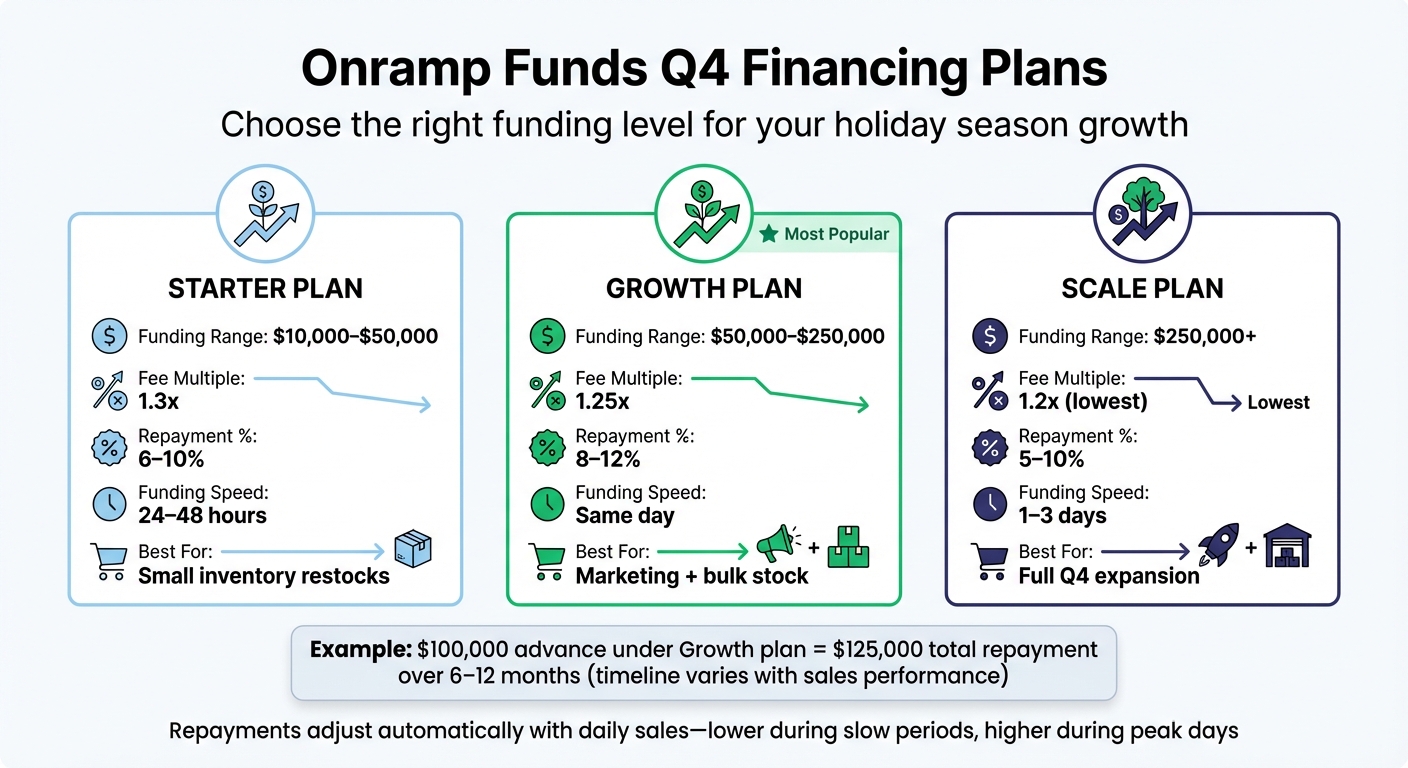
Onramp Funds offers three financing tiers designed to meet the needs of businesses of all sizes during Q4. Whether you’re a smaller seller restocking inventory or a larger operation scaling up for the holiday rush, there’s a plan to suit your goals.
For example, if you take a $100,000 advance under the Growth plan, you’ll repay about $125,000 over 6–12 months. The repayment timeline depends entirely on your sales performance - strong Q4 sales mean you’ll repay faster, while slower months stretch the repayment period without penalties.
sbb-itb-d7b5115
Optimize Marketing Budgets for Maximum ROI
As Q4 approaches, balancing growth goals with tight cash flow management becomes crucial. With financing secured and inventory in place, it's time to make every marketing dollar count. During Black Friday week, ad costs can skyrocket - CPMs (cost per 1,000 impressions) often jump by over 100% [22]. To navigate this, focus on channels that deliver strong results without draining your budget.
Focus on High-Impact Marketing Channels
Email marketing is one of the most cost-efficient tools available, offering a $45 return for every $1 spent [18]. Unlike social media, where algorithms dictate visibility, email provides direct access to an audience already interested in your brand. Shopify even includes free marketing automation for up to 10,000 emails per month [25], making it an excellent option for sellers looking to maximize impact while keeping costs low.
SMS marketing is another standout performer, especially for time-sensitive Q4 promotions. For example, Til You Collapse's 2024 SMS campaign achieved a 70% engagement rate, 21% conversion rate, and a 16x ROI during Black Friday and Cyber Monday (BFCM) [24]. The immediacy and personal touch of text messages make them perfect for flash sales and last-minute deals.
For paid advertising, start with Google Merchant Center's free product listings to appear organically on Google Search, Maps, and YouTube [19]. This approach captures high-intent shoppers without requiring an ad budget. When you do invest in paid ads, focus on platforms your audience already frequents. Short video ads (between 12 and 17 seconds) can boost conversions by 57% over static ads, and starting with text in these videos can increase purchases by 53% [26].
These strategies lay a strong foundation for targeted retargeting campaigns.
Use Retargeting Campaigns for Existing Customers
Retargeting is key to converting visitors who didn’t make a purchase the first time - 96% of visitors don’t buy on their initial visit [20]. By focusing on re-engaging these potential customers, you can avoid the high costs of acquiring new ones during the expensive Q4 season.
Dynamic Product Ads are a great tool for retargeting. They automatically show users products they’ve already viewed, increasing click-through rates by 44% and lowering cost-per-click by 77% [22]. In 2024, Mac Duggal, a luxury apparel brand, used Shopify Audiences' "Retargeting Boost" on Meta and Google to build a 2.3 times larger retargeting audience, doubling their ROAS and cutting their cost per purchase by 3.6 times [21].
Automated abandoned cart email and SMS flows can also recover lost sales during high-traffic periods. Represent, a British streetwear brand, saw great success with this approach in Black Friday 2024. Their cart recovery emails achieved an 8.3% purchase rate, contributing to $1.5 million in revenue on Black Friday alone [24]. To make these campaigns efficient, exclude customers who have already completed their purchase to avoid wasting budget on unnecessary reminders [21][23].
For optimal results, focus on a 3-day retargeting window to target high-intent visitors who are most likely to convert [20][21]. Additionally, upload your existing customer email lists to platforms like Meta or Google to create personalized ads for upselling and cross-selling, which can work effectively even without relying on pixel tracking [20][21].
Monitor Cash Flow and Adjust Strategies
Once your inventory and marketing plans are in place, keeping a close eye on cash flow becomes essential to meet short-term obligations. Even if your books appear healthy, Q4 can bring challenges like ensuring enough cash is available for payroll, rent, and other immediate expenses while marketing campaigns are running and inventory is moving [5]. To avoid cash shortages, track actual inflows and outflows throughout the season.
Use Break-Even Analysis for Financial Stability
Break-even analysis helps determine the minimum sales volume needed to cover your expenses during Q4. The formula is simple:
Break-Even Units = Fixed Costs / (Average Selling Price - Variable Costs) [29].
For example, let’s say your fixed costs - like rent, software subscriptions, and insurance - total $15,000 for the month. If your average selling price after discounts is $50, and each unit costs $20 in variable expenses (materials, shipping, payment processing), you’d need to sell 500 units to break even. Keep in mind that the average Q4 discount in 2023 was 27% [1]. Ensure your holiday pricing stays above your break-even point.
"Break-even analysis is a way to find out the minimum sales volume so that a business does not suffer losses."
- Casandra Campbell, Shopify [29]
Once you’ve calculated your break-even point, monitor your "Margin of Safety", which is the gap between your break-even sales and actual sales. A larger margin gives you more financial breathing room if sales slow unexpectedly. If you find your required sales volume is unrealistic, consider reducing fixed costs, negotiating better deals with suppliers, or adjusting your pricing strategy before the peak holiday period begins [29].
Adjust Strategies Based on Real-Time Cash Flow
During Q4’s busiest times, update your cash flow forecasts frequently - weekly or even daily - to spot potential issues early [1][7]. Focusing on actual cash movements will give you a clearer picture of available funds [27].
If you notice a potential cash shortage during your reconciliations, act quickly. Boost revenue with strategies like flash sales or offering early payment discounts to customers. On the expense side, delay outflows by scheduling vendor payments closer to their due dates or negotiating extended payment terms [6][5].
Take Neil, a grocery chain owner in Chicago, as an example. Facing declining revenues in 2024, he implemented several cash flow strategies: extending supplier payment terms by 30 days, launching a Shopify store for online orders, and adding an in-store deli. By using accounting software to manage inventory and track his changes, Neil saw a 30% increase in operating cash flow within three months [6].
"You can't manage what you don't measure, and if you aren't reconciling, you don't have an accurate picture of your cash position."
- Armine Alajian, CPA and founder of Alajian Group [5]
For additional cash flow improvements, review your inventory regularly. Discount slow-moving items to free up capital for high-demand products [6][5]. If cash remains tight despite strong sales, consider financing options with repayment terms tied to revenue. These can provide some flexibility during unexpected dips [8][28]. Aim to maintain a cash reserve covering three to six months of operating expenses to handle disruptions like supply chain delays or sudden increases in advertising costs [6][5].
Conclusion
Getting ready for Q4 without stretching your finances too thin comes down to three main actions: starting early, making data-driven choices, and maintaining steady cash flow. By kicking off your planning in Q1 or Q2, setting SMART goals, ordering inventory by mid-summer, and securing flexible financing, you’ll be better equipped to tap into the nearly $10 billion spent online during Black Friday [3].
Cash flow problems are no small issue - 82% of small business failures are tied to them, and cost pressures impact 80% of businesses [5]. Take inspiration from success stories: Porter Road turned a $1 million marketing spend into over $11 million in sales by using flexible, sales-based financing, while The Buffalo Wool Co. hit seven figures by securing inventory funding tied to actual sales [3][4].
To avoid a post-holiday cash crunch, aim to keep a reserve covering 3–6 months of expenses, reconcile accounts regularly, and monitor your break-even point [5]. Aligning debt repayment with daily sales instead of fixed monthly payments can help you manage January’s usual revenue dip while fixed costs remain steady [5].
Successful sellers don’t just focus on holiday sales; they plan strategically. This means maintaining inventory at about 70% of maximum capacity, investing in high-ROI marketing before ad costs spike, and turning seasonal shoppers into loyal customers [2][8]. They also keep a close eye on real-time cash flow and adjust strategies as needed.
FAQs
How can Shopify sellers use data to boost their Q4 sales strategies?
Shopify sellers can boost their Q4 sales by leveraging data-driven insights to make smarter, more informed decisions. For instance, digging into historical sales trends and customer behavior can help you predict product demand. This means you can stock just the right inventory to avoid the headaches of either running out of products or being stuck with excess stock.
Key metrics like sales turnover, stockout rates, and real-time customer preferences can be your guide for refining both marketing and inventory strategies. On top of that, using data to implement dynamic pricing - adjusting prices based on demand and inventory levels - can help you maximize profits during those high-traffic shopping periods.
By weaving analytics into your planning, you can better anticipate what your customers want, use your resources more effectively, and make the most of seasonal opportunities, all while keeping your cash flow steady.
How can revenue-based financing help Shopify sellers manage cash flow during Q4?
Revenue-based financing stands out as a smart option for managing cash flow during the hectic Q4 season. What makes it appealing is how repayments adjust based on your sales. When revenue is high, you pay more; during slower months, you pay less. This dynamic approach keeps your expenses in sync with your income, eliminating the stress of fixed monthly payments.
Another advantage? You can access funds quickly - often in as little as 24 hours - without needing to provide collateral or give up equity. This makes it ideal for covering critical expenses like stocking up on inventory, ramping up marketing efforts, or handling operational costs during the holiday rush. Since repayments are tied to your sales performance, it gives you the breathing room to focus on growth while keeping your finances steady. With revenue-based financing, you're better positioned to seize Q4 opportunities and boost profits without stretching your resources too thin.
How can Shopify sellers plan inventory for Q4 without tying up too much cash?
The key to thriving during Q4 lies in preparation - and it all starts with your sales data. Take a close look at past performance to spot trends and predict demand for major shopping events like Black Friday and Cyber Monday. Pair this with seasonal forecasting tools to fine-tune your predictions and set inventory levels that align with expected demand. Timing is everything, so don’t forget to account for supplier lead times and potential delays to ensure your shelves are stocked when it counts.
Real-time inventory management tools can be a game-changer here. They let you monitor stock levels in real-time, helping you avoid the pitfalls of overordering. The goal? Strike a balance: have enough inventory to meet demand without tying up your cash in surplus stock. By staying ahead of the curve and planning strategically, you can make the most of Q4 sales while keeping your cash flow in check.
Related Blog Posts
Onramp Funds
Funding built around your sales
Connect your store and see what you qualify for. Repay as a percentage of sales, with no personal credit check.
Funding in as little as 24 hours.
