


Scaling a business isn’t just about growing revenue - it’s about managing the hidden challenges that come with it. Dashboards often show rising sales, but they miss critical issues like cash flow gaps, rising costs, and inefficiencies that can quietly erode profits.
Key takeaways:
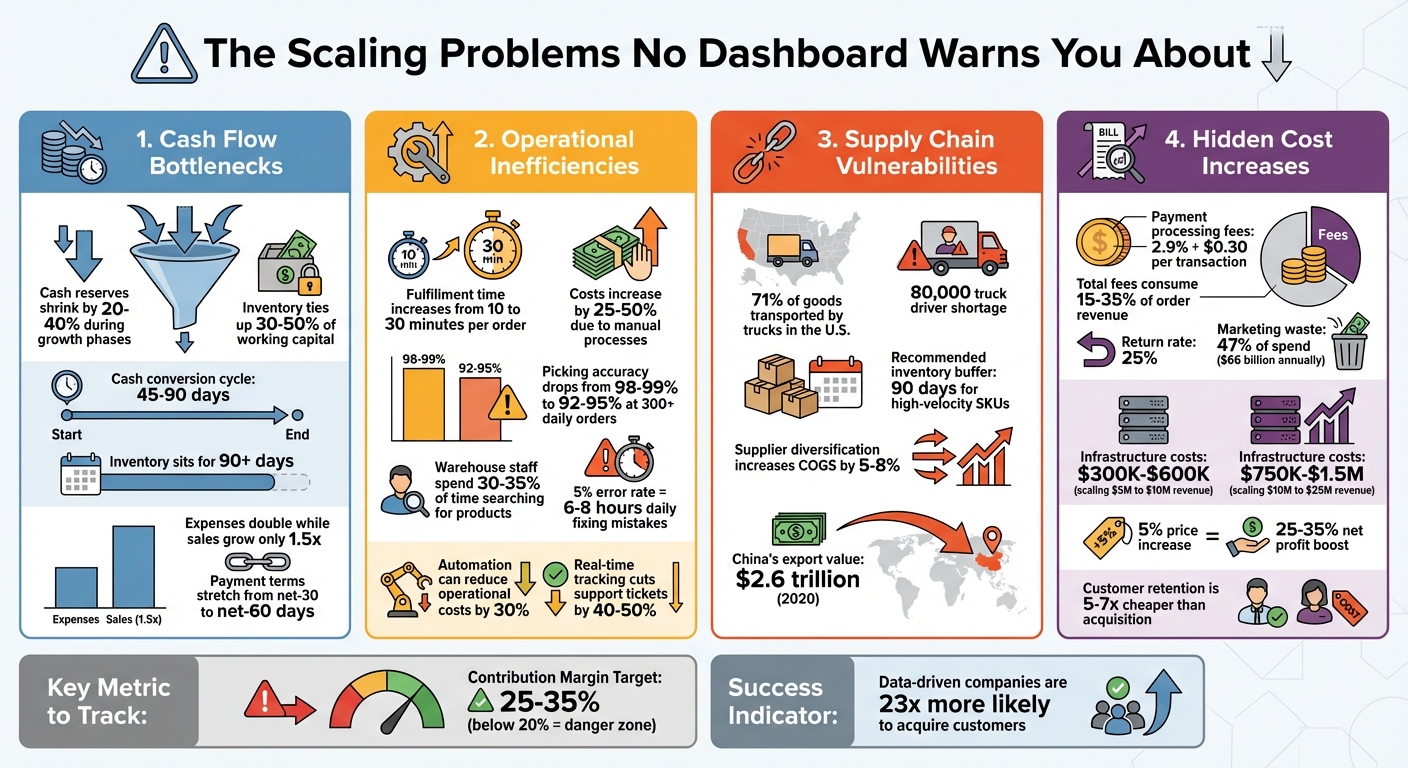
- Cash flow bottlenecks: Growth ties up capital in inventory and delays payments, shrinking cash reserves by 20–40%.
- Operational inefficiencies: Manual processes and outdated systems lead to wasted time, errors, and higher costs.
- Supply chain vulnerabilities: Misaligned inventory and demand spikes lead to costly expedited shipping and lost sales.
- Hidden cost increases: Fees, returns, and expanding infrastructure often outpace revenue growth.
To stay ahead, focus on real-time data, automate workflows, and track metrics like landed margin and stock turn. Flexible financing and smarter investments in technology can help businesses grow without sacrificing profitability.
Cash Flow Bottlenecks During Rapid Growth
How Cash Gets Trapped During Scaling
When businesses grow quickly, revenue might rise, but cash often gets stuck in the process. A big part of this is tied to inventory and operational expenses. Scaling up means stocking more products to meet rising demand, which can stretch your cash conversion cycle to 45–90 days before money starts flowing back in [4][6].
For example, inventory might sit for over 90 days, tying up 30–50% of your working capital [4][6]. Your revenue numbers might look great, but that doesn’t show how much cash is locked in unsold products or delayed payments. A sudden surge in demand - like a viral TikTok trend - can empty your inventory quickly, leaving you scrambling to pay suppliers while waiting for revenue to catch up [5][6].
Manual processes can make things worse. If you're handling 500 orders daily, fulfillment times can jump from 10 to 30 minutes per order, increasing costs by 25–50%. On top of that, 75% of scaling businesses see expenses double while sales grow only 1.5 times [4][5]. Even with strong gross margins, cash reserves can shrink by 20–40% during these growth phases, especially when payment terms stretch from net-30 to net-60 days [5][6].
To navigate these challenges, businesses often need flexible financing options.
Financing Solutions for Cash Flow Gaps
When cash flow gets tight, revenue-based financing can be a game-changer. Unlike traditional loans with fixed monthly payments, this type of financing adjusts repayments based on your daily sales - usually between 5% and 15% of revenue [5]. This means payments automatically scale with your sales, offering much-needed flexibility.
The process is quick and straightforward: approvals are completed in 24–48 hours, and funding amounts are typically 10–20% of your monthly revenue [5]. There’s no need for personal guarantees or giving up equity. Plus, with an effective APR of 10% to 20% - far lower than the 30% or more charged by traditional loans - this financing allows you to purchase inventory during demand spikes, pay suppliers on time, and maintain your growth momentum without depleting your cash reserves.
sbb-itb-d7b5115
Operational Inefficiencies That Slow Growth
Common Workflow Bottlenecks
Your revenue might be climbing, and orders are shipping on time, but what about the inefficiencies lurking behind the scenes? These issues often rear their heads when daily order volumes hit the 200–500 range. At that point, manual processes and disconnected software can no longer keep up.[8]
For example, without automated workflows, picking accuracy can drop from 98–99% to 92–95% once you're handling around 300 daily orders and managing 50+ SKUs.[8] Warehouse staff may spend as much as 30–35% of their time just searching for products instead of retrieving them.[8] On top of that, a 5% error rate on 300 orders means wasting 6–8 hours a day fixing mistakes and resolving customer complaints.[8]
"The fulfillment bottleneck doesn't announce itself with a dramatic failure. Instead, it reveals itself through a pattern of small problems that compound into major operational challenges." – Bizowie[8]
Teams often resort to temporary fixes, but these only postpone the inevitable. Standard dashboards might show completed orders, but they don’t tell the full story. How many attempts were needed to finish an order? How often did someone have to manually recheck data because systems weren’t syncing in real time? These details are often overlooked.[2]
Take the example of a Bristol-based online retailer in March 2025. Their inventory system only updated hourly, leading to overselling during flash sales. Switching to real-time inventory tracking eliminated this issue and boosted customer satisfaction scores by 28%.[10] Similarly, a London digital agency reduced design approval times from four days to less than one by empowering senior designers to handle routine approvals instead of waiting for the creative director.[10]
Fixing these manual inefficiencies is the first step toward streamlining operations with automation.
Automating Operations to Improve Efficiency
Once bottlenecks are identified, automation becomes the key to maintaining efficiency and supporting growth. The goal is simple: cut down on unnecessary manual tasks. Automation can slash operational costs by up to 30%, with over half of companies seeing noticeable savings within the first year.[11]
Start by tracking "manual touches per order" - every time a human has to step in, reconcile data, or fix an error. If this number isn’t decreasing as you scale, you’ve found a problem.[9] Focus first on automating the high-frequency tasks, like order confirmations, stock synchronization across channels, and generating shipping labels. Once these are running smoothly, you can tackle more complex exceptions.[11][12]
For instance, real-time inventory synchronization across all sales channels can prevent overselling, while automated order tracking updates can cut "Where is my order?" support tickets by 40–50%.[13] Transitioning from spreadsheets to a unified system can boost inventory accuracy to over 97% and reduce order cycle times by more than 40%.[9]
Supply Chain Constraints and Demand Surges
Spotting Supply Chain Vulnerabilities
Strong sales numbers can sometimes hide underlying supply chain problems, like missed shipping deadlines or inadequate inventory during demand spikes. These issues may not become apparent until they lead to lost sales.
A major culprit is data latency. Many analytics tools update in batches rather than in real time, creating gaps where orders are placed before stock levels sync across platforms. For sellers on Shopify, Amazon, and Walmart, this can mean an item appears available on one platform but is already sold out on another[2].
Scaling operations - like adding warehouses or increasing SKUs - can also create "phantom inventory." This happens when dashboards reflect total stock but fail to account for units already reserved for orders, undergoing quality checks, or in transit. The result? A misleading picture of what’s actually available for sale.
"Growth makes ops messy, and inventory is where it shows up first, because it's cash you've already spent." – Luke Hodgson, Commerce Thinking[1]
Even healthy gross margins can be undermined by hidden costs such as freight, import duties, and last-mile delivery. Demand surges often force businesses to switch to costly expedited shipping, eroding profits. With trucks transporting 71% of goods in the U.S. but representing just 4% of vehicles on the road, a shortage of 80,000 truck drivers adds to rising logistics costs[14]. Identifying these weak points is essential for managing risks effectively.
Reducing Supply Chain Risks
One way to tackle these challenges is by creating a "single view of stock" - a centralized inventory system that acts as the definitive source for inventory data across all platforms and warehouses[1]. This minimizes discrepancies and miscommunication. Replace manual CSV uploads and batch updates with event-triggered updates to ensure inventory syncs in real time.
For high-velocity SKUs, consider maintaining a 90-day inventory buffer to guard against disruptions[14]. While this ties up more cash initially, it can save money in the long run by reducing the need for costly expedited shipping during demand spikes.
"Forecasting is your greatest ally in the eCommerce world. It allows you to have a clear and comprehensive overview of your business's flows and plan accordingly." – Onramp Funds[14]
Another strategy is to diversify your supplier base, even if it increases your cost of goods sold by 5–8%. Relying on suppliers from a single region - like China, whose export value hit nearly $2.6 trillion in 2020 - makes you vulnerable to regional disruptions such as lockdowns or tariff changes[14].
Lastly, focus on metrics like stock turn and sell-through rates rather than just total inventory value. These indicators reveal whether your inventory is generating sales or simply tying up cash. If you need to finance additional inventory for demand surges, consider revenue-based financing options. These allow repayments to align with sales, keeping your cash flow flexible during uncertain times.
Cash Flow Challenges In E-Commerce
Hidden Cost Increases That Erode Margins
As businesses grow, hidden cost increases can quietly eat away at margins, even when revenue appears to be climbing. These costs often go unnoticed until they’ve already caused damage, making it crucial to identify and address them early.
Tracking Costs That Scale Faster Than Revenue
It’s common to see revenue climbing on dashboards while profits lag behind. The issue? Hidden costs often grow faster than sales, and many analytics tools fail to flag these problems until margins have already been impacted.
Manual operations are a major culprit. As processes expand, so do the associated costs. For instance, every new sales channel adds complexity - reconciling inventory feeds and managing exceptions becomes more time-consuming and expensive.[9]
"Manual operations cost isn't just time spent entering data... it's the cumulative drag created when people have to think, check, reconcile, and fix things that software should already handle." – Xorosoft[9]
Platform fees are another challenge. Tiered pricing structures on marketplaces can cause transaction costs to outpace revenue growth. Payment processing fees, averaging 2.9% + $0.30 per transaction, combined with refunds, chargebacks, and fulfillment fees, can eat up 15–35% of order revenue.[3]
A real-world example: In 2025, Billy Footwear used cost-aware analytics to uncover that three major marketing channels were unprofitable when factoring in shipping, discounts, and processing fees. By reallocating their budget based on true contribution margins rather than inflated ROAS, they achieved 36% revenue growth with only a 7% increase in ad spend.[3] Their breakthrough? Focusing on landed margin - revenue minus all variable costs - not just the supplier invoice.
Infrastructure investments also create challenges. These expenses, like hiring an operations manager or leasing warehouse space, often come in large, upfront blocks. For instance, scaling from $5 million to $10 million in revenue might require $300,000–$600,000 for a finance hire, CRM upgrades, and middle management. Jumping from $10 million to $25 million could mean investing $750,000–$1.5 million for ERP systems and senior-level hires.[16] These costs hit immediately, while revenue takes time to catch up.
"Margin compression during scale-up isn't failure - it's physics." – Eagle Rock CFO[16]
To stay ahead, tracking contribution margin - revenue minus all variable costs - should be a top priority. Aim for a margin of 25–35%; anything below 20% leaves little room for error. Metrics like orders per employee can reveal when labor costs are scaling too quickly. Additionally, reconcile marketing-reported revenue with net revenue after returns and adjustments. Research shows that nearly 47% of marketing spend - about $66 billion annually - is wasted due to broken attribution.[3]
Addressing these rising costs requires proactive investments in technology and improved processes.
Investing to Lower Long-Term Costs
Strategic investments can help businesses combat margin erosion and reduce costs over time. For example, implementing a Warehouse Management System (WMS) with system-directed picking can cut reliance on manual processes, improving accuracy to over 97% and reducing order cycle times by more than 40%.[9] Similarly, one omnichannel brand reduced its month-end financial close from two weeks to under one week by switching from spreadsheets to a unified ERP system.[9]
Timing these investments is key. The "30–50% rule" suggests sizing capacity investments - like warehouse space, staffing, and systems - to 30–50% above current needs, avoiding the cash strain of overexpansion.[16]
Instead of relying solely on annual budgets, tie major expenses to revenue milestones. For instance, hire a third sales manager only when annual revenue hits $8 million. This approach ensures costs align with performance.[16] Establishing a profitability floor, typically around an 8–10% operating margin, can also help businesses pause aggressive spending if margins start to tighten.[16]
Financing options like revenue-based financing can fund these investments without draining cash reserves. Repayments adjust with sales performance, allowing businesses to invest in automation and infrastructure during growth phases while maintaining flexibility during slower periods.
Finally, reducing variable costs offers long-term benefits. Research shows that a 5% price increase, assuming no change in volume, can boost net profit by 25–35%. Additionally, retaining existing customers is five to seven times cheaper than acquiring new ones.[15] These structural changes create lasting margin improvements rather than just temporary fixes.
Conclusion: Addressing Scaling Challenges Before They Become Problems
It's easy to celebrate rising revenue when looking at standard dashboards, but those same dashboards often miss the underlying issues that can derail growth. Cash flow gaps from mismatched inventory needs, operational bottlenecks, and supply chain hiccups quietly eat away at margins. Add to that hidden costs like a 25% return rate, and the picture becomes clear: growth without addressing these challenges can be costly [7].
What sets successful businesses apart from those that stall is their ability to anticipate these issues early. A proactive approach can bridge the gap between operational headaches and long-term growth. Waiting until cash reserves dry up or operations crumble is far more expensive than taking action early. In fact, data-driven companies are 23 times more likely to acquire customers because they solve scaling problems before they escalate into crises [5].
Tackling these challenges head-on minimizes disruptions. For example, Onramp Funds provides revenue-based financing tailored to your sales cycle. This type of funding offers flexibility, with repayments tied to sales performance - typically 2–8% of revenue - allowing businesses to maintain cash flow during slower periods while fueling growth during peak times. Pair this with automation tools that cut fulfillment costs and streamline operations, and you have a powerful combination that addresses both cash flow and efficiency.
The results speak for themselves: stable cash flow, order processing times under 10 minutes, and margins staying above 20%. Businesses that thrive don't just react to problems - they build systems to prevent them. Scaling successfully means identifying challenges early and putting tools like flexible financing and automation in place to ensure smooth growth at every stage.
FAQs
What are the early warning signs of a cash flow crunch during growth?
During periods of growth, some early warning signs of a cash flow crunch can include customers delaying payments, excessive inventory tying up cash, extended payment cycles, and poor cash flow planning. If these problems aren’t tackled quickly, businesses may struggle to meet critical obligations like payroll or supplier payments.
Which three metrics best reveal hidden margin erosion in eCommerce?
To spot hidden margin erosion in eCommerce, focus on three key metrics: contribution margin, true customer acquisition cost (CAC) (factoring in hidden expenses), and cash flow trends. These metrics are like a financial magnifying glass, revealing profitability leaks, unforeseen costs, and cash flow challenges that might quietly chip away at your margins. Keeping a close eye on them ensures you can tackle potential financial issues early and keep your business on a solid growth path.
What should I automate first when order volume starts to spike?
When your order volume surges, the first step is to automate your order processing workflow. Concentrate on streamlining tasks such as sending order confirmations, updating inventory levels, and generating shipping labels. Automation reduces the need for manual input, clears up bottlenecks, and lowers the chance of errors. Plus, it ensures orders are fulfilled on time, even as demand increases. By automating these key processes, you can handle growth more effectively while maintaining accuracy and keeping your customers happy.
Related Blog Posts
Onramp Funds
Funding built around your sales
Connect your store and see what you qualify for. Repay as a percentage of sales, with no personal credit check.
Funding in as little as 24 hours.
