


Running out of cash is one of the top reasons why 90% of eCommerce businesses fail within 120 days. The key to avoiding this? Align your funding with your sales momentum. By securing capital before demand peaks, you can stock up on inventory, scale successful marketing strategies, and seize growth opportunities without cash flow issues.
Here’s how to make it work:
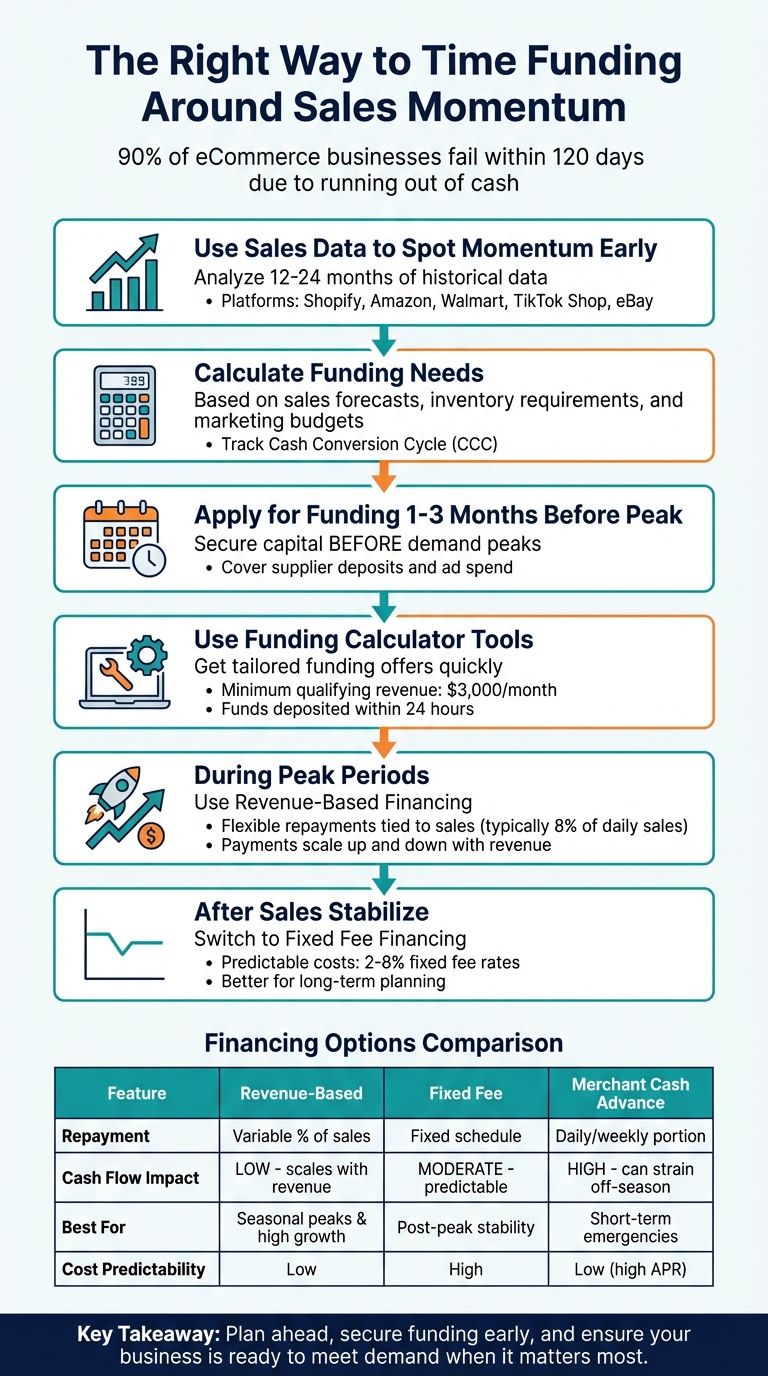
- Use sales data to spot momentum early. Platforms like Shopify and Amazon provide insights into seasonal trends and product performance.
- Calculate funding needs based on sales forecasts, inventory requirements, and marketing budgets.
- Apply for funding 1–3 months before peak sales to cover supplier deposits and ad spend.
- Leverage tools like Onramp Funds' calculator to get tailored funding offers quickly.
- During peak periods, consider revenue-based financing for flexible repayments tied to your sales.
- After sales stabilize, switch to fixed fee financing for predictable costs and long-term planning.
Timing is everything. Plan ahead, secure funding early, and ensure your business is ready to meet demand when it matters most.
How To Fund Your Ecommerce Business For Cheap (Or Even Free)
sbb-itb-d7b5115
How to Identify Sales Momentum
Recognizing sales momentum is essential for eCommerce sellers. It’s the upward trend in revenue that signals a growing demand for your products. Spotting this early allows you to secure funding in advance, ensuring you’re prepared when orders start to surge. This proactive approach can help you avoid scrambling for resources when you need them most.
To identify momentum, dive into your sales data. Understanding when your revenue peaks, which products fly off the shelves, and how your promotions perform can help you predict when extra capital will be necessary. This shifts funding from a reactive move to a planned strategy.
Platforms like Shopify and Amazon provide historical sales data that can reveal these patterns. By analyzing this information, you can uncover when demand spikes and when it slows down.
Finding Seasonal Trends in Your Sales Data
Start by examining your sales history over the last 12–24 months. Look for recurring patterns - are there specific times of the year when sales consistently rise or fall? For many eCommerce businesses, major holidays like Black Friday, Cyber Monday, and the December shopping season are predictable high points. However, your products may have their own unique seasonal trends.
Compare month-over-month revenue to pinpoint your strongest and weakest periods. For example, if November consistently outperforms October, you can prepare by securing inventory funding ahead of time.
Don’t just stop at overall revenue - dig deeper into individual SKU performance. Identify which products are your top sellers during those peak periods and focus on ensuring they’re well-stocked. Historical data can guide you on which SKUs need rapid replenishment versus those that sell steadily, helping you allocate funds more effectively.
Also, take a close look at past promotions. If a discount campaign led to a significant spike in daily orders, that’s a trend worth noting for future planning. Understanding how your promotions impact sales can help you time funding and inventory needs more precisely.
Finally, use analytics tools to track these trends in real time for even greater accuracy.
Using Analytics Platforms to Track Sales Patterns
Platforms like Shopify, Amazon, Walmart, TikTok Shop, and eBay offer built-in analytics tools that make it easy to monitor sales performance. These tools automatically track your sales history and trends, helping you identify momentum without needing to crunch numbers manually [1].
For more advanced insights, consider AI-powered analytics platforms like ThoughtSpot. These tools provide real-time tracking of key performance indicators (KPIs) such as monthly sales growth, average order value (AOV), and revenue per visitor (RPV) [5]. With these insights, you don’t have to wait until the end of the month to assess your performance - you’ll know immediately when momentum is building.
Connecting your store data through read-only integrations can also streamline the process. These integrations analyze your sales history and cash flow automatically, giving you instant insights into your funding needs [1].
One critical metric to track is your Cash Conversion Cycle (CCC). This measures how quickly you turn inventory investments into revenue. A shorter CCC means you’re selling and collecting cash faster, signaling strong momentum. On the other hand, a longer CCC might indicate that adjustments are needed, such as securing additional funding to address potential challenges [5].
Calculating Funding Needs from Sales Forecasts
Turn your sales forecasts into clear capital requirements for inventory, marketing, and operational expenses. Start by reviewing your past sales trends, current cash flow, and any outstanding debts. This will help you secure just the right amount of funding to capitalize on high-growth opportunities. Modern funding platforms make this process easier by connecting directly to your store data and analyzing your performance in real time. These insights can guide your financial planning and ensure your funding strategy is data-informed.
How to Use Onramp Funds' Funding Calculator
Once you’ve established revenue projections, the next step is to translate these into actionable funding estimates. Begin by entering your average monthly revenue into Onramp Funds' funding calculator to receive a baseline capital estimate (minimum qualifying revenue is $10,000).
For a more tailored projection, you can connect your store platform directly to Onramp Funds. This integration allows the system to automatically analyze your sales history and cash flow, giving you a personalized funding offer that aligns with your business’s cash flow capabilities. By leveraging accurate projections, you can time your capital acquisition to coincide perfectly with your peak sales periods.
"We evaluate your sales history, cash flow needs, and debt positions to make you an offer that fits with your cash flow capability." - Onramp Funds
After receiving your funding offer, select the structure that best meets your needs. For short-term requirements like inventory or marketing, variable revenue-based financing is ideal, as repayments adjust based on your sales. If you’re in a steady growth phase, fixed repayment options provide predictability. For ongoing flexibility, a rolling cash line offers access to funds that grow with your business.
Pre-qualification is quick - it only takes a minute - and approved funds are deposited within 24 hours. This speed is essential, especially when preparing for peak sales periods where you need capital ready to deploy immediately.
Spotting and Closing Cash Flow Gaps
Cash flow gaps often occur when supplier or advertising payments are due before you’ve received revenue. This is especially common during periods of high sales momentum, where you’re managing larger orders and increased ad spend.
To identify these gaps, create a timeline of your payment obligations. Map out when you need to pay suppliers for inventory and when advertising bills are due. Then, compare these dates with the expected payment schedule from your sales channels. The difference between these timelines represents the cash flow gap you’ll need to cover with funding.
Addressing these gaps early is critical to avoiding disruptions like stockouts, paused ad campaigns, or delayed shipments - issues that can derail your momentum during key sales periods. Securing funding one to three months ahead of your peak season ensures you have the liquidity needed to seize opportunities without scrambling at the last minute.
"Onramp offered the perfect solution with revenue-based financing to secure the capital we needed to invest in inventory and pay it back at a reasonable time frame once we made sales." - Jeremy, Founder and Owner, Kindfolk Yoga
When to Apply for Funding
Once you've identified sales momentum, the next step is figuring out the right timing for your funding application. Getting this right can mean the difference between smoothly scaling up and struggling to meet demand. For instance, securing capital in February could ensure your products are ready to hit the shelves by June. To stay ahead, aim to apply for funding 1–3 months before your expected sales peak. This gives you enough time to align cash flow with production and marketing needs, ensuring you're fully prepared for the surge in demand.
Why is this timing so important? Because cash outflows - like supplier deposits, minimum order quantities, and marketing expenses - often hit long before you start seeing revenue from sales. Planning ahead ensures you have the funds to cover these upfront costs without scrambling for last-minute solutions.
The type of funding you choose also plays a role in your timing. For example, revenue-based financing offers quick approval, typically within 48–72 hours, while SBA loans may take 60–90 days. If you’re working with Onramp Funds, the process is even faster - pre-qualification takes just a minute, and funds can be deposited within 24 hours.
Apply 1–3 Months Before Peak Sales
To make the most of your funding, align your application with key production milestones. Start by identifying when your manufacturer deposits are due. These deposits, which secure production capacity, are often required 30–90 days before inventory ships. By securing funding well in advance, you can meet these deadlines without stress.
Keep a close eye on your cash flow during Q1, as this period can be tricky. Holiday returns and markdowns often tighten liquidity just as production deposits are due. This can create a cash crunch at the very moment you need capital to fuel growth. Establishing funding lines early ensures you don’t miss production windows or delay important launches.
Funding Inventory and Marketing Before High-Demand Periods
Once your funding is secured, it’s time to allocate it wisely. Inventory comes first - without stock, there’s no revenue. Use your funding to meet minimum order quantities and take advantage of bulk discounts, such as 20% savings on orders over $50,000[4].
After addressing inventory needs, shift your focus to marketing. Start investing in strategies like influencer seeding, content creation, and paid social campaigns before your inventory fully turns over. This builds momentum for your launch. For example, influencer marketing is projected to exceed $40 billion in spend by 2026[3], making it a key area to prioritize. By coordinating inventory and marketing timelines, you can avoid launching campaigns too early or missing out on sales due to insufficient stock.
Revenue-based financing can be particularly helpful here, as repayments scale with your sales. This flexibility allows you to pay more during high-revenue periods and less when sales slow, making it easier to manage cash flow while growing your business.
Managing Funding During and After Sales Peaks
Once you've mapped out your funding needs, the next challenge is managing those funds effectively during and after your sales peaks. As your business rides the wave of increased revenue, it's crucial to align funding strategies with your repayment structure to maintain financial stability.
During peak seasons, managing funds efficiently can make all the difference in profitability. Revenue-based financing is particularly useful during these high-volume periods because repayments are tied directly to your sales. This means that when your revenue increases, so do your repayments. Conversely, during slower months, payments decrease, helping you maintain a steady cash flow.
"On days with higher sales, you'll transfer more back as remittance, but it stays as a fixed percentage. This way, there's very little risk to your cash flow." - Ash Read, Wayflyer [2]
Scaling with Revenue-Based Financing
Revenue-based financing operates on a simple principle: you repay a fixed percentage of your daily sales until the advance is fully paid off. For example, if you generate $10,000 in sales on a peak day, you might remit around 8% of that amount. During slower periods, your repayments naturally scale down, offering flexibility that fixed payment plans can't match.
| Feature | Revenue-Based Financing | Fixed Fee / Term Loans | Merchant Cash Advances |
|---|---|---|---|
| Repayment Schedule | Variable; percentage of sales [6] | Fixed; set schedule [6] | Daily or weekly sales portion [6] |
| Cash Flow Impact | Low; scales with revenue [6] | Moderate; predictable but rigid [6] | High; can strain off-season cash [6] |
| Best Use Case | Seasonal peaks and high growth [6] | Post-peak stability and infrastructure [6] | Short-term emergencies [6] |
| Cost Predictability | Low; depends on sales speed [6] | High; fixed monthly costs [6] | Low; high effective APR [6] |
Once sales levels out, transitioning to a more predictable repayment structure can simplify long-term planning and budgeting.
Adopting Fixed Fee Structures After Peak Season
When the busy season winds down and sales stabilize, switching to a fixed fee structure can help you manage costs more predictably. Financing options like those offered by Onramp Funds provide fixed fee rates between 2–8%, offering clear repayment terms with no hidden costs. This kind of stability is especially useful for planning inventory restocking or funding infrastructure improvements after peak periods.
Fixed fee financing works best when your profit margins are steady, as it allows you to budget for specific repayment amounts. For example, after the Q4 rush, having consistent monthly payments instead of fluctuating ones tied to sales can make it easier to plan ahead and maintain smooth cash flow projections.
Conclusion
Timing funding to align with your sales momentum isn’t just about having money in the bank - it’s about strategically fueling your business to seize growth opportunities when they’re most impactful. Successful brands treat capital like fuel, applying it at just the right moment to drive inventory purchases, marketing efforts, and operational expansion ahead of peak demand.
The approach is consistent among thriving eCommerce businesses. Secure funding 1–3 months before your busiest season to handle supplier deposits and scale marketing. During high-sales periods, revenue-based financing can help by aligning repayments with sales, ensuring cash flow remains steady when it’s most critical. After the rush, switching to fixed fee structures allows for predictable budgeting and planning the next stage of growth.
Consider this: nearly 90% of eCommerce companies fail within their first 120 days, with running out of cash being a top-five reason [2]. The difference between those that falter and those that flourish often boils down to having access to the right capital at the right time.
With tools like sales analytics platforms, funding calculators, and flexible financing options - such as those offered by Onramp Funds - the resources are there. The real question is whether you’ll act early enough to ensure your business is ready to capitalize on its momentum.
FAQs
What sales signals prove momentum is real (not a one-off spike)?
Consistent performance over time is the hallmark of genuine sales momentum. You’ll notice this through patterns like recurring high sales over multiple periods, loyal customers making repeat purchases, and steady or growing spending levels. Other signs include an upward trend in transaction volume, strong customer retention, and healthy conversion rates. When these factors come together - such as increasing customer lifetime value paired with ongoing engagement - it’s a clear sign that the growth is steady and not just a short-lived spike.
How do I estimate how much funding I’ll need without overborrowing?
To figure out how much funding you need without taking on too much debt, start by diving into your sales data and predicting future revenue. Tools like cash flow calculators or sales analytics platforms can help match your funding needs with your sales trends. Prioritize covering inventory and operational expenses during busy times. A good strategy is to secure funding based on a percentage of your projected sales or gross merchandise value (GMV). This way, you only borrow what you need, and repayments stay in line with your actual sales performance.
Should I choose revenue-based financing or a fixed fee after peak season?
Choosing between revenue-based financing and a fixed fee comes down to understanding your cash flow and growth objectives. With revenue-based financing, repayments adjust according to your sales, making it a flexible choice during periods of fluctuating revenue. On the other hand, fixed fees offer predictability but lack the ability to adapt to seasonal sales dips, which could lead to higher costs if sales slow down. For eCommerce businesses looking to align funding with sales trends, revenue-based financing often offers more flexibility and room for growth.
Related Blog Posts
Onramp Funds
Funding built around your sales
Connect your store and see what you qualify for. Repay as a percentage of sales, with no personal credit check.
Funding in as little as 24 hours.
