


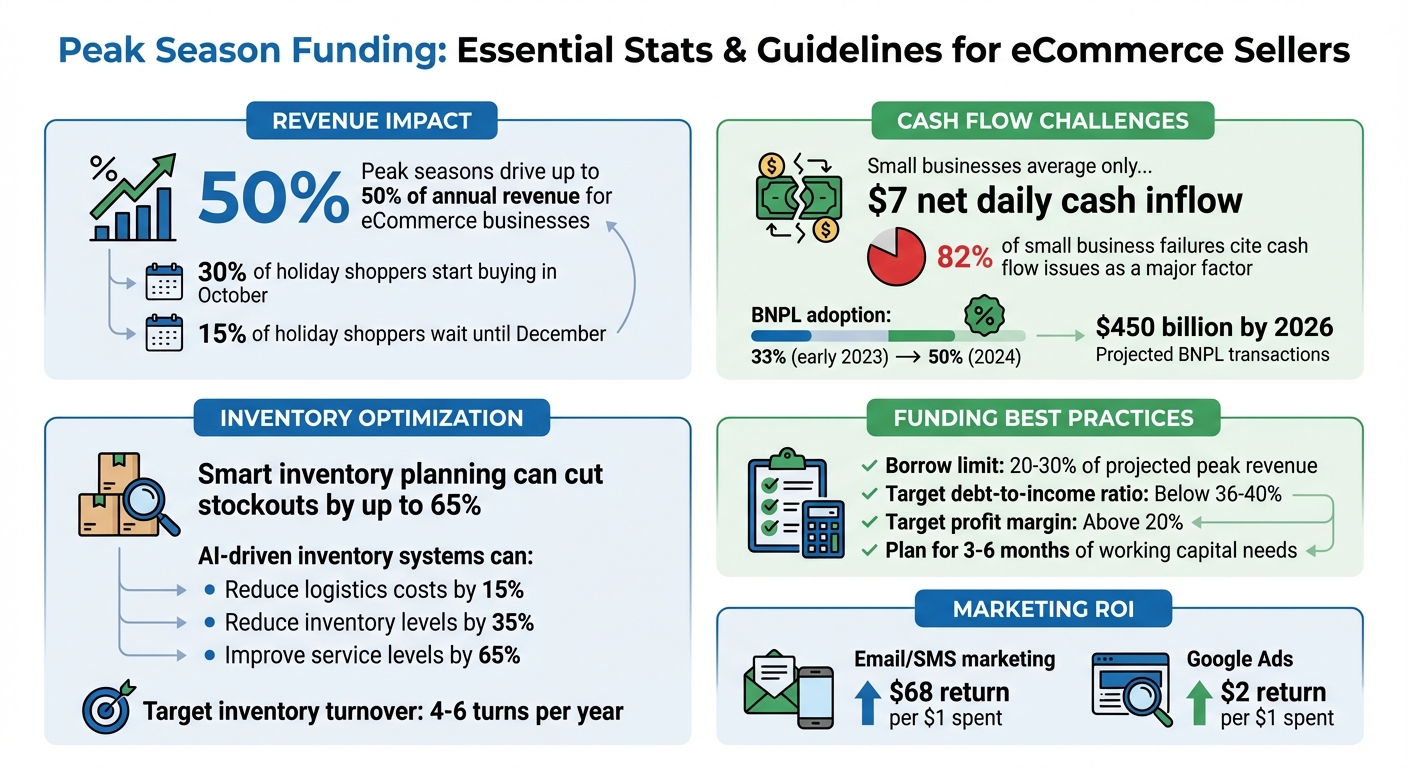
Peak seasons can drive up to 50% of annual revenue for eCommerce businesses, but preparing for them without overextending your finances is a challenge. To succeed, you need to secure funding months in advance for inventory, marketing, and staffing while managing cash flow effectively.
Here’s the problem: upfront costs like supplier deposits and marketing expenses often clash with delayed revenue from sales. Without proper planning, businesses risk running out of stock or overcommitting to debt, leading to financial strain. Solutions like revenue-based financing, inventory loans, and short-term funding can help bridge this gap.
Key Takeaways:
- Cash Flow Timing: Suppliers demand upfront payments, but revenue comes later. Flexible financing can help cover this gap.
- Debt Risks: Fixed loan payments during slow months can hurt profitability. Revenue-based repayment adjusts with sales performance.
- Inventory Planning: Use historical sales data and buffer stock formulas to avoid stockouts or overstocking.
- Funding Limits: Borrow up to 20–30% of projected peak revenue to keep repayments manageable.
- Metrics to Track: Focus on profit margins, inventory turnover, and debt-to-income ratio to maintain financial health.
Peak Season Funding Challenges for eCommerce Sellers
Why Cash Flow Matters During Peak Seasons
Cash flow is the lifeline of any peak season strategy. Without it, eCommerce sellers risk missing out on critical opportunities. The challenge lies in timing: suppliers demand upfront deposits for inventory, while revenue doesn't land in your account until customers make their purchases[2][3]. This creates a tough balancing act, where marketing, hiring, and storage expenses must be covered with limited resources.
For small businesses, the stakes are even higher. With an average net daily cash inflow of just $7, preparing for peak season becomes a daunting task[7]. Stocking inventory months in advance, managing rising ad costs, and hiring temporary staff can feel nearly impossible. While smart inventory planning can cut stockouts by up to 65%[9], that only works if you have the capital to invest in inventory upfront.
The lack of cash flow forces sellers into a tough spot: understock or overcommit. Stock too little, and you risk running out of products, which can hurt your organic rankings and send customers to competitors[5]. Overstock, and you’ll tie up your funds in storage costs, leaving little room for the marketing efforts needed to sell that inventory. Adding to the complexity, the growing use of Buy Now, Pay Later (BNPL) options delays payments even further. BNPL adoption surged from 33% in early 2023 to 50% by 2024, with a projected $450 billion in transactions by 2026[5]. All of this highlights the need for precise cash flow management. Without it, sellers might feel cornered into inflexible debt options that could cause more harm than good.
The Risks of Taking on Too Much Debt
When cash flow runs tight, turning to debt may seem like the only option - but it comes with significant risks. Traditional loans with fixed monthly payments don’t account for the seasonal ups and downs of eCommerce. Even during slow months like January and February, those payments are non-negotiable[7][8]. It’s no wonder that 82% of small businesses that fail cite cash flow issues as a major factor[7].
High-interest debt can quickly eat into profits. For businesses already dealing with slim margins and increased customer acquisition costs during the holidays, these payments can turn what should be a profitable season into a financial drain. And if your sales projections fall short, even by a small margin, you’re left with repayment obligations that stretch far beyond the holiday rush. This limits your ability to reinvest in growth or navigate the inevitable post-holiday slowdown[3][8].
Onramp Funds: Funding Solutions for Peak Season Growth

Revenue-Based Financing for Flexible Repayment
Onramp Funds provides a revenue-based financing model designed to adapt to your sales performance. Instead of rigid monthly payments, you repay a flexible percentage of your sales - whether daily, weekly, or biweekly. This means that during busy times like Black Friday or the holiday season, repayments naturally increase, while slower months see payments decrease accordingly.
This approach helps you avoid the cash flow challenges typical of traditional loans. By aligning repayments with real-time sales, this model ensures you're not stuck with fixed payment schedules during unpredictable periods. With terms ranging from 1 to 6 months, it’s an ideal solution for managing seasonal inventory and marketing needs.
Key Features of Onramp Funds Custom Funding Offers
Onramp Funds takes flexibility a step further by tailoring funding solutions to your business. It integrates directly with major eCommerce platforms like Amazon Seller Central, Shopify, TikTok Shop, and Walmart Marketplace, leveraging real-time sales data for fast approvals - often within 24 hours. This quick access to capital ensures you can meet supplier deadlines without delays. Plus, the funding is unsecured, meaning no collateral is required.
For seasoned sellers, the Rolling Cash Line offers revolving borrowing capacity that grows as your sales increase. You can access funds as often as every two weeks, paying fees only on the amount you use. This enables quick restocking and ensures you’re always prepared for peak demand.
Benefits of Onramp Funds' Fixed Fee Structure
Onramp Funds also simplifies cost management with its clear, upfront fee structure. Whether you opt for fixed or revenue-based repayment, there are no hidden costs or surprise charges. This transparency allows you to accurately budget for seasonal expenses, avoiding the uncertainties of variable interest rates. Knowing your total cost of capital in advance helps you confidently plan inventory purchases and marketing investments while protecting your profit margins.
For those using the Fixed funding option, predictable repayments make it easier to maintain operational stability during periods of strategic growth. This approach ensures you can scale effectively without overextending your finances, keeping cash flow steady and supporting your seasonal success.
How to Use Inventory Financing During Peak Seasons
Matching Inventory Investment With Sales Projections
Planning inventory for peak seasons starts with diving into your historical sales data. Look back two to three years to pinpoint trends - when demand spikes, which products fly off the shelves, and how long the rush lasts. For instance, around 30% of holiday shoppers start buying as early as October, while 15% hold off until December [1]. This means your shelves need to be stocked well before Thanksgiving to meet early demand.
Take your forecasting a step further by analyzing individual SKUs rather than lumping products into broad categories. Pay close attention to your bestsellers and any limited-edition items you plan to introduce. To safeguard against unexpected demand surges or supplier hiccups, calculate your buffer stock using this formula:
(Maximum daily use × Maximum lead time) − (Average daily use × Average lead time) [10]. This ensures you’re not caught off guard, while also avoiding over-investing in slow-moving inventory.
During the busy season, keep a close eye on inventory velocity - daily if possible. If certain products are flying off the shelves faster than expected, make quick adjustments. For example, scale back advertising on items running low or ramp up promotions for overstocked products [4]. This real-time monitoring helps you avoid stockouts that cost you sales or excess inventory that ties up cash after the season ends. This strategy becomes even more effective when paired with inventory loans to fund your scaling efforts.
How Inventory Loans Help Scale Operations
Inventory financing gives you the upfront cash needed to stock up without draining your reserves. As Onramp Funds explains, "With inventory financing, you acquire capital to create a needed inventory and then pay the funds back as the product sells, allowing you to load your shelves without emptying your wallet before the holiday season" [1].
This type of funding doesn’t just cover the cost of products. It can also help with packaging materials, marketing campaigns, and even shipping expenses for returns or exchanges. By securing capital early, you can preorder inventory before suppliers run low and negotiate upfront contracts with shippers to lock in bulk discounts. These steps not only keep your operations running smoothly but also improve your overall return on investment.
sbb-itb-d7b5115
Cash Flow Management During High-Demand Periods
Using Short-Term Financing to Cover Expenses
Peak seasons often create a timing gap between paying for inventory and earning revenue. Suppliers typically require deposits before production begins, with the remaining balance due when the inventory ships - this can be months before sales from Black Friday or the holiday season start rolling in[2][3]. This delay can put a strain on the cash you need for marketing, staffing, and day-to-day operations.
Short-term financing can help bridge this gap by covering supplier deposits upfront and offering extended payment terms[2]. This approach ensures you have the cash flow necessary to reinvest in growth initiatives during the critical lead-up to peak season[2]. As Onramp Funds highlights: "Instead of financing that requires a strict, flat repayment amount every month, look for more flexible solutions that tie repayment schedules and amounts to the actual revenue coming through your store in real time"[7]. This flexibility helps avoid the financial stress of fixed monthly payments, particularly during the slower post-peak periods when sales naturally decline.
By securing liquidity through flexible financing, you can focus on using your capital in ways that drive growth and efficiency.
Focusing Funds on High-ROI Marketing and Operations
Once your funding is in place, the next step is to allocate it wisely to areas that deliver the greatest returns. For example, email and SMS marketing are standout performers, with Omnisend merchants seeing an average return of $68 for every $1 spent[5]. Similarly, Google Ads offers an average return of $2 for every $1 invested[6]. These channels often provide better value compared to costly pay-per-click keywords, which tend to see steep price increases during peak seasons. By prioritizing these high-performing strategies, you can make the most of your marketing budget.
In addition to marketing, investing in operational upgrades can significantly boost your efficiency and scalability. AI-driven inventory management systems, for instance, can cut logistics costs by 15%, reduce inventory levels by 35%, and improve service levels by 65%[5]. For businesses processing 150-500 orders daily, micro-fulfillment solutions can be a game-changer. Stocking your top 100 SKUs locally allows for same-day or next-day delivery, which helps maintain customer loyalty and minimizes the risk of losing sales due to delays[5]. Keep an eye on metrics like on-time delivery rates, first-attempt success rates, and cost per order to ensure your operational spending is as effective as possible[5].
How to Avoid Financial Overextension
Managing seasonal growth effectively starts with strong cash flow practices and setting clear funding limits to keep debt under control.
Setting Appropriate Funding Limits
To steer clear of financial overextension, it's crucial to align your funding needs with realistic cash flow projections. Start by analyzing historical daily cash inflows to determine the capital required for growth versus essential operations[7]. This approach ensures you borrow only what you can reasonably repay.
A good rule of thumb is to cap borrowing at 20–30% of your projected peak revenue[3]. For instance, if you anticipate $200,000 in sales during Black Friday and the holiday season, limit your inventory loan to approximately $50,000. This strategy bridges cash flow gaps caused by upfront supplier payments while keeping repayments manageable with post-peak revenue[3]. Additionally, plan for 3–6 months of working capital needs - covering inventory deposits, marketing expenses, and operational costs - and align these with revenue projections from major sales events[4,6]. Use these forecasts to set specific borrowing caps for growth-focused expenses.
Predictive analytics can be a game-changer here. By matching inventory investments to demand forecasts for specific SKUs, you can avoid over-borrowing. Instead of taking out broad loans, limit funding to high-performing items and adjust dynamically based on sales trends[3,5]. Many retailers begin forecasting holiday demand up to three months in advance, capping inventory loans at projected revenue minus a 20% buffer to account for returns[4,27].
Once you’ve established funding limits, it’s essential to monitor them regularly to ensure your capital stays in line with seasonal performance.
Tracking Key Financial Metrics
If you’re using revenue-based financing, keeping a close eye on financial metrics is critical to ensure repayments track with sales trends. Monitoring the right numbers can help you spot potential overextension before it becomes a major issue. During peak seasons, focus on three key metrics: profit margins, inventory turnover, and debt-to-income (DTI) ratio[7,9].
Your DTI, calculated as monthly debt payments divided by monthly revenue, should stay below 36–40%[7]. For example, if your peak revenue is $100,000 per month but your debt payments total $50,000, your DTI would hit 50%, signaling a risk of cash flow problems. Keeping this ratio under 36–40% helps maintain financial stability during and after peak periods.
Revenue-based financing, which adjusts repayments based on actual sales, can ease the strain during slower post-holiday months[3,4]. Inventory turnover is another critical metric - divide the cost of goods sold by your average inventory value, aiming for 4–6 turns per year in eCommerce[5]. High turnover during the holidays frees up cash faster, while low turnover might indicate overstocking and tied-up funds[3,4].
Finally, aim to maintain profit margins above 20% to ensure long-term sustainability as your business scales. Use integrated dashboards that combine sales, inventory, and debt data to track these metrics in real time. Set alerts to notify you if margins dip below your target threshold[5,27]. This proactive approach can help you stay financially healthy even during high-demand periods.
Conclusion
Achieving success during peak seasons requires funding strategies that drive growth without putting unnecessary pressure on cash flow. By implementing approaches like setting clear funding limits and keeping a close eye on essential financial metrics, eCommerce sellers can thrive during high-demand times such as Black Friday and Christmas while keeping their finances in check. These methods align closely with the principles embraced by Onramp Funds.
Onramp Funds offers a revenue-based financing model that tackles a common challenge for seasonal businesses: syncing repayment schedules with actual sales performance. With payments that adjust - rising during busy periods and easing during slower months - this approach helps sellers avoid cash flow struggles. Combined with a transparent fee structure, this model provides predictable costs and supports sustainable profit margins.
FAQs
How can eCommerce businesses manage cash flow effectively during busy seasons?
Managing cash flow during peak seasons requires precise sales forecasting and careful budgeting. Start by analyzing past sales data to anticipate demand during high-traffic periods like Black Friday or Christmas. Use these insights to guide decisions on inventory, marketing campaigns, and staffing needs. Since inventory purchases often need to be made months ahead, try negotiating extended payment terms with your suppliers to reduce the strain on your cash flow.
If you find yourself needing extra funds to cover gaps between expenses and revenue, short-term financing options can be a lifesaver. For example, revenue-based financing adjusts repayments based on your sales performance, offering some breathing room during slower weeks. Inventory financing can help you access cash tied up in stock, while lines of credit or purchase-order financing allow you to handle bulk orders without stretching your budget too thin. By blending smart planning, controlled spending, and the right financing tools, you can keep cash flowing, avoid running out of stock, and make the most of peak season opportunities.
What makes revenue-based financing a good option for seasonal eCommerce businesses?
Revenue-based financing provides seasonal eCommerce businesses with fast access to funds - often in just 24–48 hours - without the need for collateral or fixed repayment terms. Instead, repayments are tied to a percentage of your sales. This means payments automatically adjust based on your revenue: higher during busy seasons and lower when business slows down.
This repayment model makes it easier to manage cash flow while allowing you to maintain full ownership of your business. It’s an effective way to handle peak season costs, like stocking up on inventory or ramping up marketing efforts, without stretching your budget too thin.
How can businesses decide how much funding they need for peak seasons?
To figure out how much funding you’ll need for peak seasons, start by forecasting your sales and expenses for that period. Take a close look at historical sales trends, expected marketing costs, inventory requirements, and shipping expenses. Once you have these numbers, calculate the difference between your anticipated costs and your projected cash inflows. This will give you a clear idea of the funding required.
It’s important to borrow only what’s necessary to cover this gap, ensuring your revenue forecasts can comfortably handle repayment. This careful planning helps you stay financially stable and avoids stretching your resources too thin during busy times.
Related Blog Posts
Onramp Funds
Funding built around your sales
Connect your store and see what you qualify for. Repay as a percentage of sales, with no personal credit check.
Funding in as little as 24 hours.
