


Walmart Marketplace is growing fast, with sellers increasing from 91,000 in 2021 to over 150,000 in 2022. But scaling your business comes with challenges - especially inventory management. Running out of stock can hurt your sales and metrics, while overstocking ties up cash and space. The good news? You can avoid these pitfalls with smart planning and tools.
Here’s what you need to know:
- Track Inventory: Use Walmart’s tools like the WFS Inventory page and Inventory Health Report to monitor stock levels and avoid supply gaps.
- Forecast Demand: Base restocking decisions on sales history, seasonal trends, and Walmart’s analytics tools like Search Query Reports.
- Automate Management: Sync inventory with third-party tools like Sellbrite or Zenventory to reduce errors and improve efficiency.
- Leverage WFS: Walmart Fulfillment Services can boost sales by 50% on average and simplify logistics.
- Secure Flexible Financing: Services like Onramp Funds offer revenue-based financing, letting you scale inventory without cash flow issues.
How To Use Walmart Seller Inventory Manager (WFS) - Walmart Seller Tools
sbb-itb-d7b5115
Review Your Current Inventory and Operations
Before scaling up, it's crucial to take a close look at your inventory and operations. The Walmart Seller Center's WFS Inventory page helps by categorizing items into three groups: "In stock" (more than 28 days of supply), "At risk" (less than 28 days of supply), and "Out of stock" (zero units) [6][7]. Start by focusing on the "At risk" and "Out of stock" tabs to identify products that need immediate attention [6][5]. This step helps you align your current stock levels with the pace of your sales.
Compare Stock Levels to Sales Speed
To better understand your inventory efficiency, calculate your sell-through rate. Divide the total units shipped in the last 90 days by the average number of units stored. Here's a quick breakdown of what the numbers mean [5]:
- 1.5+: Excellent
- 1.0–1.5: Good
- 0.75–1.0: Average
- Below 0.75: Needs improvement
A low sell-through rate often signals that you're holding onto too much inventory, tying up cash and warehouse space that could be better used for faster-moving products.
For a deeper dive, download the Inventory Health Report from Seller Center. This report provides 1–4 and 5–8 week demand forecasts [5]. It can help you estimate how long your current and incoming inventory will last. Pay close attention to "Surplus units" (inventory exceeding 180 days of supply) and "Aged units" (stored for over 365 days), as these may lead to long-term storage fees [5]. If you're fulfilling orders yourself, keep at least 20 extra units beyond the reserved quantity to avoid stockouts during processing [3][9].
Identify Capacity Limits
Beyond tracking your inventory, assess your operational capacity to handle increased demand. Check the "Unavailable to Sell" column in your reports for units under compliance review or tied up in a Merchandise Transfer Request. These items may temporarily be unavailable for orders, revealing potential bottlenecks in your system [5][4].
Also, evaluate your warehouse space. The "Cube used" metric in the Inventory Health Report shows how much cubic space your inventory takes up in the WFS network [5]. If your warehouse space is nearing capacity, it could delay the arrival of new stock, especially during peak seasons. To avoid running into these issues, plan replenishments before your stock hits the 28-day "At risk" threshold. Use the Inventory Reconciliation Report to monitor lost, found, or damaged units and ensure you're staying on top of inventory issues [6][7][8].
Forecast Demand Accurately
Having a clear picture of your inventory is essential for predicting demand and avoiding both stockouts and overstock situations.
Use Historical Sales and Seasonal Patterns
Start by calculating your sales velocity. Divide the total units sold over 30, 60, or 90 days by the number of days in that period. For instance, selling 600 units in 30 days gives you a velocity of 20 units per day. This number provides a baseline for how quickly your inventory moves.
Walmart's WFS system helps streamline this process by offering "Suggested units" for restocking. These suggestions are based on past sales, seasonal trends, listing quality, and pricing [5]. Metrics like "Days of Supply" can help you determine when to reorder, ensuring your inventory aligns with demand [5].
Seasonal trends are another key factor. Look for recurring patterns in your historical data, such as spikes during the holidays or weather-related demand surges. However, filter out anomalies that are unlikely to repeat. As Parvez Musani, SVP of Walmart Global Tech, explains:
"Historical data doesn't help prepare for major one-off disruptions such as the Covid-19 pandemic, but it can help account for patterns in the data that may repeat themselves" [11].
The Inventory Reconciliation Report is a valuable tool for tracking net inventory movement all the way back to January 1, 2022. This long-term view helps establish a solid baseline for demand [8].
When planning replenishment for WFS, use this formula: (Velocity × Forecasted Days) – (Available + In Transit + Unshipped units) [10]. This calculation highlights any inventory gaps, helping you order the right amount without overstocking.
For a complete forecast, combine these historical insights with real-time customer behavior.
Apply Walmart Search Analytics
While historical data sets the foundation, search analytics provide a window into current customer demand. Walmart's Search Query Reports in Seller Center let you see which keywords shoppers are using, how often they’re searched (frequency rank), and conversion metrics like "Added to Cart" share [14]. These insights can help you identify trending products before demand peaks.
The Assortment Recommendations API is another powerful tool. It highlights "Customer Favorites", showing the best-selling and most-searched items in your category [15]. The Trends API takes this a step further by filtering recommendations by category or brand, helping you spot seasonal demand specific to your product line [15]. Items flagged in these recommendations often sell at twice the pace of others [16].
Pay attention to the "Frequency Rank" metric to identify the most popular search terms for specific time periods [14]. Pair this data with "Added to Cart Share" to gauge actual purchase intent, not just browsing behavior [14]. As John Furner, President and CEO of Walmart U.S., explains:
"Walmart is using artificial intelligence to predict when people are likely to buy certain products, what they will purchase, and even if they will opt to pick up merchandise or have it delivered" [13].
Walmart’s AI-driven forecasting can improve inventory accuracy by as much as 90% [12]. By blending past sales trends with live search data, you can fine-tune your restocking schedule to meet shifting customer needs effectively.
Improve Inventory Management for Walmart Marketplace

Demand forecasts are only as good as the systems supporting them. To thrive on Walmart Marketplace, you need tools that can convert accurate forecasts into real-time inventory updates. A streamlined approach - combining efficient software and fulfillment strategies - ensures your stock is always ready to meet customer demand. This prevents the dual pitfalls of running out of stock or letting inventory sit idle.
Connect Inventory Management Software
Third-party inventory software can bridge your warehouse with Walmart's system, keeping stock levels in sync automatically and avoiding overselling. For example:
- Descartes Finale Inventory updates Walmart listings every 5 minutes, providing near-instant visibility across all channels. It also supports mobile barcode scanning for warehouse teams and manages complex setups like kitting or bundling [20].
- Sellbrite is ideal for sellers managing multiple warehouses or working with third-party logistics providers like Flexport. It centralizes inventory, offers rapid sync speeds, and includes bulk editing tools [17].
- Zenventory updates stock every 15 minutes and sends automated low-stock alerts, complete with reordering suggestions. This eliminates the need for manual checks [18].
"The primary benefit was allowing us to import orders via the API directly into our proprietary software. This allowed us to increase sales on Walmart and eBay" [19].
To maintain consistent listing activity, always keep a safety buffer above your reserved inventory. By integrating these tools, you can lay the groundwork for leveraging Walmart Fulfillment Services (WFS) to further enhance storage and delivery efficiency.
Use Walmart Fulfillment Services (WFS)

Once your inventory is streamlined with advanced software, moving high-demand products to Walmart Fulfillment Services can take your operations to the next level. WFS helps you bypass storage constraints in your own warehouse and offers faster shipping options that boost conversions. Sellers using WFS report an average 50% GMV growth on items tagged with "Fulfilled by Walmart" and "2-day shipping" [24]. Plus, WFS fulfillment costs are 15% lower than those of major competitors, improving overall margins [24].
Walmart's Inventory Transfer Service (ITS) simplifies distribution logistics. Instead of shipping inventory to multiple fulfillment centers, you can send all sortable items to one transfer station. Walmart then distributes the inventory nationwide within 4 business days, ensuring faster deliveries without extra effort [23]. Additionally, Merchandise Transfer Requests (MTR) allow Walmart to move stored inventory between fulfillment centers at no cost to meet regional demand spikes [4].
The Success Hub in Seller Center offers restock recommendations under the "Restock WFS Items" section. These suggestions are based on past sales, seasonality, and listing quality, helping you avoid guesswork when replenishing inventory [5]. WFS also provides prep services, such as poly bagging ($0.60 per unit) and labeling ($0.45 per unit), which can prevent bottlenecks in your warehouse if planned in advance [21].
Standard receiving at WFS takes 2 business days, though this can extend to 10 days during peak seasons or if unplanned prep is needed [24]. To avoid delays, ship holiday inventory by Walmart's recommended dates (October 1 – December 31) [22]. WFS has no minimum or maximum inventory limits, and long-term storage fees only apply after units have been stored for 12 months [22][24].
Get Flexible Financing for Inventory Growth
Growing your presence on Walmart Marketplace often means needing capital upfront to stock inventory before sales revenue starts rolling in. Traditional bank loans with fixed monthly payments can create challenges, especially when you're investing in inventory ahead of sales or during slower periods. This mismatch in timing can drain cash reserves, potentially stalling your growth. Flexible financing from Onramp Funds helps bridge this gap, allowing you to scale inventory without disrupting your operations or cash flow.
Onramp Funds Revenue-Based Financing

Onramp Funds provides a financing solution where repayments are tied to your revenue. Instead of fixed monthly payments, you repay a percentage of the revenue you generate - typically around 1% per payment cycle. For instance, if your sales hit $50,000 during a given period, your repayment adjusts to match your sales performance. This approach safeguards your cash flow during slower seasons while giving you the flexibility to stock up aggressively during peak times.
The platform uses real-time Walmart Marketplace sales data to approve funding within 24 hours, eliminating the need for personal guarantees or collateral. To qualify, sellers need to show at least $10,000 in monthly sales, with financing amounts typically ranging from $150,000 to $500,000, depending on business performance.
Take Peak Performance Apparel as an example. In Q1 2025, they secured $300,000 from Onramp Funds to stock seasonal activewear ahead of spring. CEO Mia Rodriguez used the funds to purchase 15,000 units based on Walmart's demand forecasts. This strategic move led to a 250% sales increase, reaching $1.2 million in just 90 days. The company repaid the loan in seven months with a 9% effective fee.
Fixed Fee Structure for Predictable Costs
Onramp Funds offers a straightforward fixed fee structure, with no hidden charges. This means you know your total repayment cost upfront, making it easier to plan for growth. Repayment terms range from 6 to 12 months, with an effective APR between 11.9% and 19.9%, depending on how quickly you repay.
For example, Home Essentials Co. secured $450,000 in September 2024 to stock up on holiday inventory. By restocking 25 SKUs, they achieved a $2.8 million GMV boost and repaid the loan in 10 months at an 11% fee. Eric Youngstrom, Founder of Onramp Funds, sums it up perfectly:
"Our mission is to ensure sellers have the capital they need to keep product in stock and their customers happy. We're here to make that happen."
Track Key Metrics to Maintain Growth
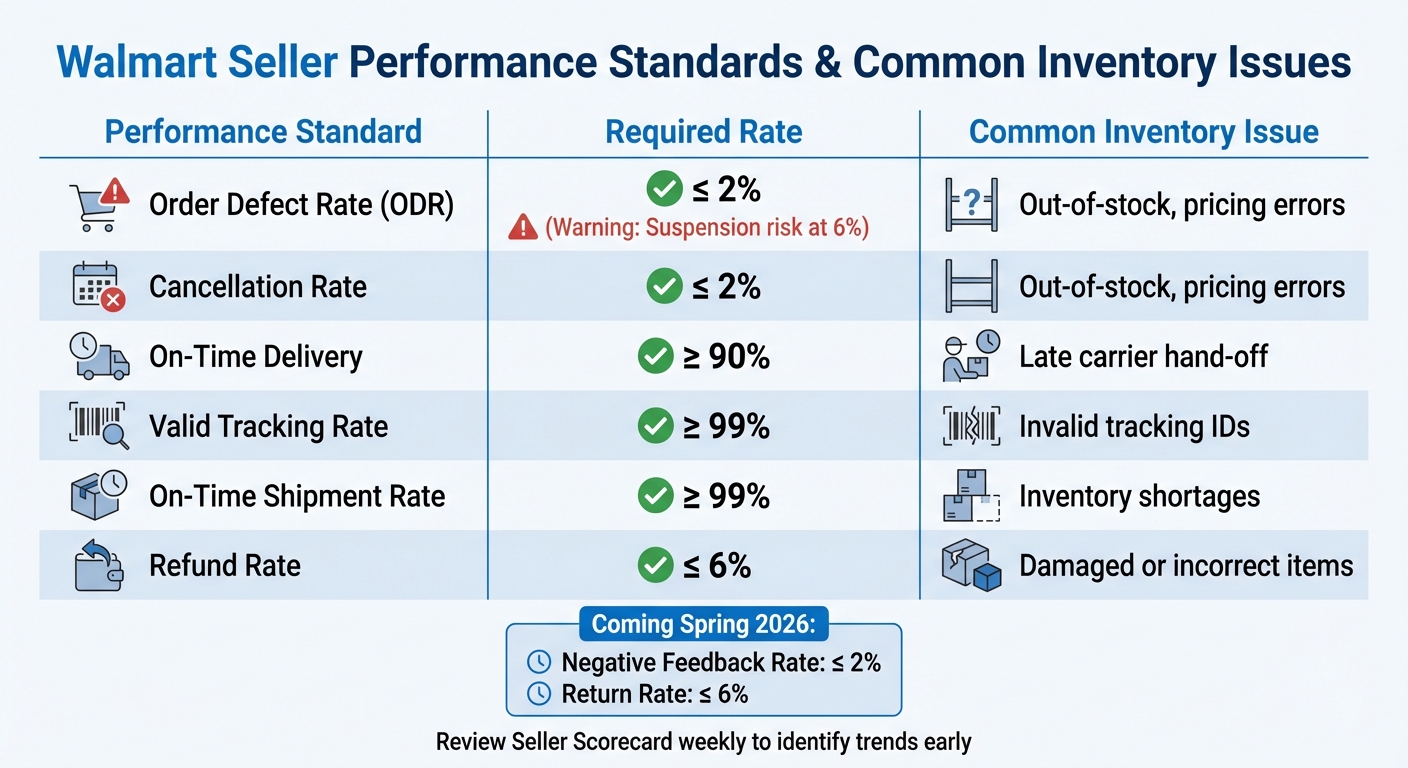
To keep your business thriving, it’s essential to keep an eye on performance metrics. These numbers can reveal potential issues early and help you maintain a healthy seller account. Walmart’s Seller Scorecard highlights eight key metrics that directly affect your ability to grow. For instance, top sellers maintain an Order Defect Rate (ODR) below 2%, while exceeding 6% could result in immediate account suspension [27]. Similarly, your Valid Tracking Rate should stay at 99% or higher, and your On-Time Shipment Rate must also exceed 99% [27][28].
Metrics like high cancellation or refund rates often hint at problems such as inventory shortages, pricing errors, or product quality issues [27][28]. Starting in spring 2026, Walmart will introduce stricter standards, including a Negative Feedback Rate of 2% or less and a Return Rate of 6% or less [28].
Monitor Walmart Seller Scorecard Metrics
Make it a habit to review your Seller Scorecard weekly. This practice can help you identify trends and address problems before they escalate. For example, downloading defect reports allows you to pinpoint specific SKUs that might be pushing up your ODR or cancellation rate. If you’re using Walmart Fulfillment Services (WFS), the Sell-Through Rate is a critical metric to watch. A score above 1.5 is considered "Excellent", while anything below 0.75 is flagged as "Below Average" [5].
Items listed as "At Risk" (with less than 28 days of supply) require immediate reordering [6][5]. Additionally, keeping tabs on Aged and Surplus Units can help you minimize storage fees and free up capital for more strategic investments [5].
| Performance Standard | Required Rate | Common Inventory Issue |
|---|---|---|
| Cancellation Rate | ≤ 2% | Out-of-stock, pricing errors |
| On-Time Delivery | ≥ 90% | Late carrier hand-off |
| Valid Tracking Rate | ≥ 99% | Invalid tracking IDs |
| Refund Rate | ≤ 6% | Damaged or incorrect items |
Update Forecasts and Funding Plans Regularly
As market conditions shift, it’s crucial to adjust your inventory forecasts and funding plans based on performance data. Walmart’s "Suggested Units" tool can help you fine-tune your restocking strategy by analyzing past sales, seasonality, and listing quality [5]. Use the Inventory Health report to review 1–4 and 5–8 week sales forecasts, ensuring your purchasing plans align with actual demand [5].
Your funding plans should also evolve as your business grows. For example, consistent weekly revenue growth might qualify you for larger financing amounts, enabling you to place bigger inventory orders. To stay on top of things, download the Inventory Reconciliation Report daily (available at 7:00 AM PST). This report tracks units sold, lost, found, or damaged in fulfillment centers, giving you real-time insights to adjust forecasts and address discrepancies before they disrupt your cash flow [8].
Conclusion
Scaling successfully on Walmart Marketplace means tackling inventory challenges head-on. By combining regular inventory reviews, precise forecasting, automation, and flexible financing, sellers can maintain steady growth without running into supply chain hiccups.
Accurate forecasting and Walmart's analytics tools play a big role in avoiding costly issues like stockouts or overstocking. Using historical data and automated systems, sellers can transform forecasts into actionable inventory decisions, ensuring their stock levels align with demand.
Automation tools, such as WFS and inventory management software, are game-changers. They can cut errors by as much as 70% and help sellers hit crucial metrics like keeping an Order Defect Rate below 2% and a Valid Tracking Rate at 99% or higher [26]. These systems work in real time to sync inventory, flag low-stock items, and recommend reorder amounts based on 8-week demand forecasts. This approach not only safeguards account performance but also keeps products visible in search results.
Managing cash flow is another key piece of the puzzle. Without proper funding, scaling can stall. Onramp Funds offers revenue-based financing tailored for sellers, allowing them to restock inventory ahead of demand spikes. With repayments set at just 1% of sales per cycle, sellers avoid the burden of fixed monthly payments during slower periods [1][2]. As Eric Youngstrom, Founder of Onramp Funds, explains:
"Our mission is to ensure sellers have the capital they need to keep product in stock and their customers happy. We're here to make that happen" [25].
FAQs
How do I set a safety stock level for Walmart?
To determine an appropriate safety stock level for Walmart, you’ll need to weigh key factors like demand variability, lead times, and your desired service level. Safety stock serves as a cushion, helping to avoid stockouts when demand spikes unexpectedly or supply shipments face delays.
Leverage Walmart’s inventory management tools, such as the WFS Inventory page or the Seller app, to track stock levels efficiently. Pair these with predictive restocking software to accurately forecast inventory needs. This approach ensures you maintain the right balance - enough stock to meet customer demands without tying up resources in excess inventory.
What’s the best reorder point for WFS vs seller-fulfilled items?
The ideal reorder point for WFS (Walmart Fulfillment Services) items relies on predictive restocking calculations. These calculations take into account factors like past sales trends and current inventory levels. The goal? To keep stock available without running into overstock issues.
For seller-fulfilled items, the process is often more manual. Reorder points are usually determined using either manual methods or demand forecasting tools. These approaches help ensure restocking happens at the right time to meet demand efficiently.
How can I spot demand spikes before my sales data shows them?
Using AI-powered demand sensing and real-time data analysis lets you spot demand spikes early. These tools analyze short-term changes and external factors - like social trends or weather patterns - to predict demand shifts with precision. By staying proactive, you can adjust inventory in time and handle sudden changes effectively.
Related Blog Posts
Onramp Funds
Funding built around your sales
Connect your store and see what you qualify for. Repay as a percentage of sales, with no personal credit check.
Funding in as little as 24 hours.
