

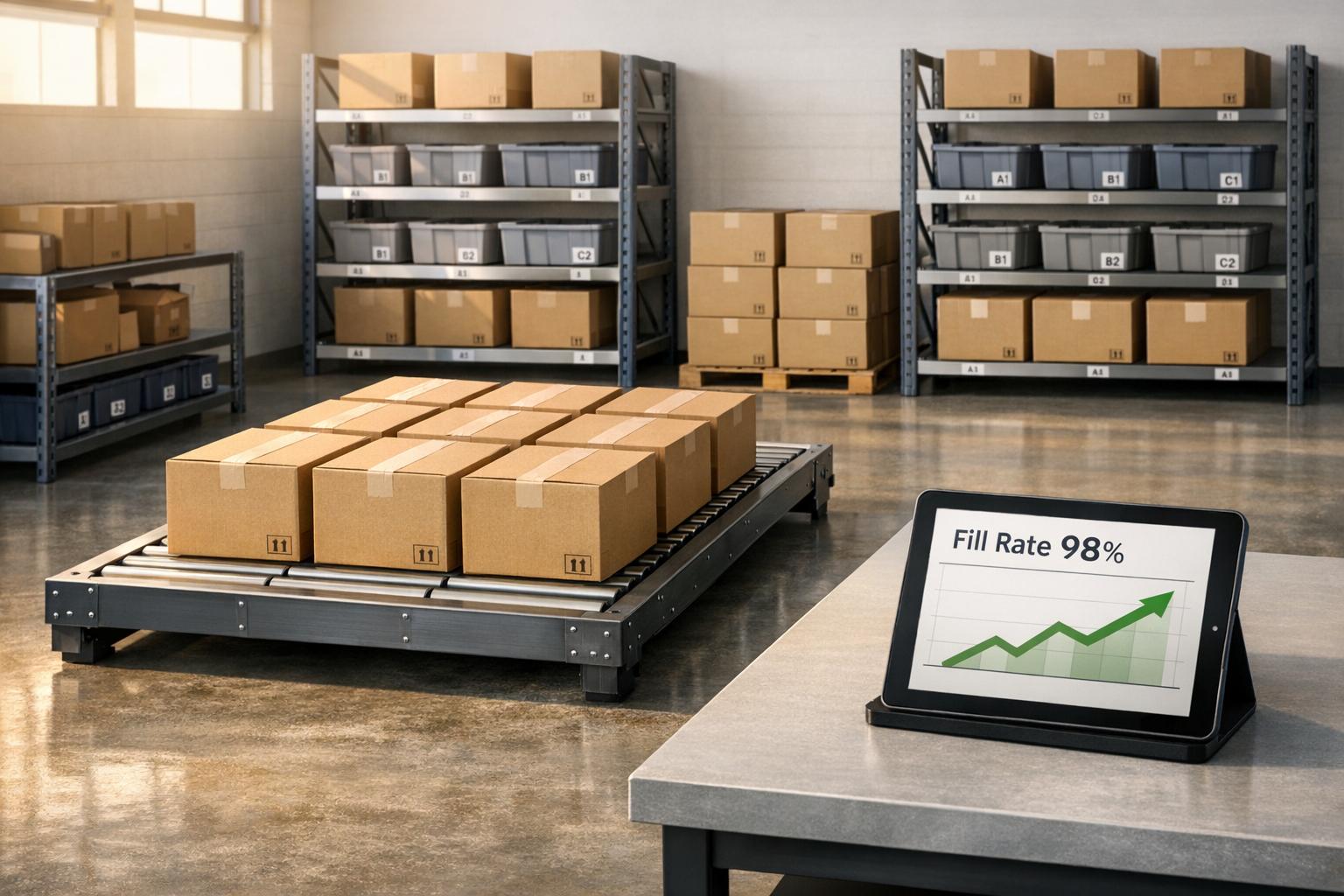
Did you know a 1% drop in your order fill rate can shrink your annual revenue by 1%? This metric, which measures how well you fulfill customer orders without delays or backorders, directly affects your cash flow, customer trust, and operating costs. Striking the right balance - typically a fill rate of 97%-99% - is key to avoiding missed sales and overstocking that ties up capital.
Key Takeaways:
- What is Order Fill Rate? It’s the percentage of orders you can fulfill immediately without delays or stockouts.
- Why It Matters: A low fill rate leads to lost revenue, higher costs, and customer churn. For instance, 70% of shoppers abandon carts when items are out of stock.
- How to Improve It: Use real-time inventory tracking, demand forecasting, and maintain optimal safety stock levels to ensure smooth operations without overstocking.
A high fill rate builds customer trust and stabilizes cash flow, while overstocking or understocking can hurt your business. Learn how to calculate and track this critical metric to protect your bottom line.
How to Calculate Fill Rate & OTIF Metrics to Manage Inventory (On time in full)
sbb-itb-d7b5115
What Order Fill Rate Means for Your Business
Order fill rate measures how well your business can fulfill customer orders right away. Essentially, it’s the percentage of orders you can ship without delays, backorders, or running out of stock [1][3]. Think of it as a performance score for how effectively your inventory meets customer demands [2].
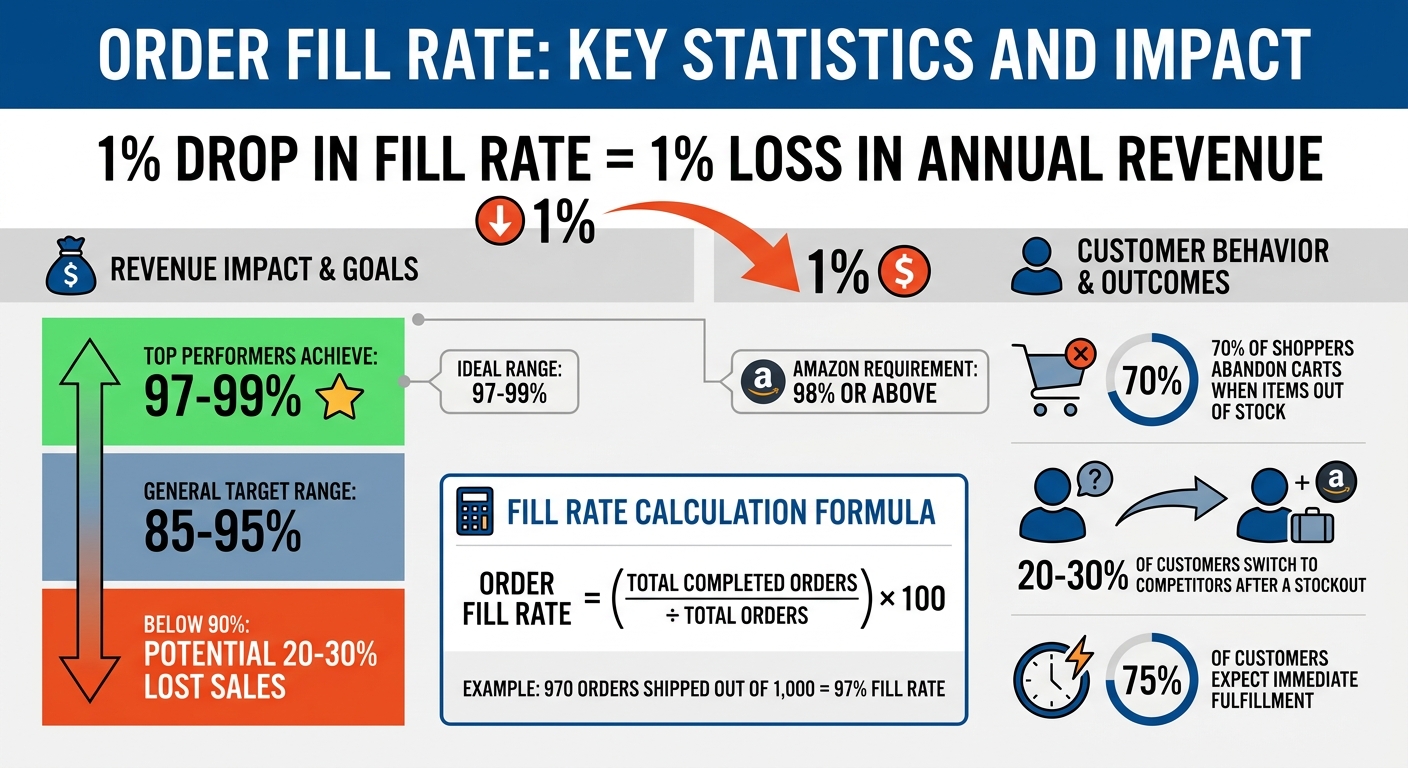
This metric plays a big role in both generating revenue and keeping customers happy. A fill rate of 97% to 99% is ideal for building trust with shoppers who expect fast delivery [2]. Around 75% of customers expect immediate fulfillment, and many won’t stick around if you can’t deliver. In fact, between 20% and 30% of customers will turn to a competitor if they encounter a stockout [2].
Even a small drop in your fill rate can hurt your bottom line. For example, a 1% decrease in fill rate could lead to a 1% loss in annual revenue [2]. Next, let’s break down how to calculate this key metric.
How to Calculate Order Fill Rate
The formula for fill rate is simple:
(Total Completed Orders ÷ Total Orders) × 100.
For example, if you successfully ship 970 out of 1,000 orders, your fill rate is 97% [1][3]. You can calculate this metric over different time periods - daily, weekly, monthly, or quarterly - to spot seasonal trends or identify operational challenges [1].
Some businesses take it a step further by tracking variations like:
- Line fill rate: The percentage of individual product lines fulfilled.
- Unit fill rate: The number of units shipped compared to the number of units ordered.
These more detailed metrics can give you deeper insights into how specific SKUs are performing [1][2]. Once you know how to calculate your fill rate, you can start to understand its ripple effects on cash flow.
How Fill Rate Affects Cash Flow
Meeting customer orders immediately not only boosts revenue but also creates consistent cash flow. This consistency is crucial for forecasting income and managing expenses [2]. On the flip side, a low fill rate doesn’t just cost you individual sales - it also disrupts your revenue stream, making financial planning a challenge [2].
Low fill rates can also drive up costs. When you scramble to fulfill backorders, you might need to pay for expedited shipping or buy inventory at higher prices last minute [2]. These unexpected expenses can shrink your profit margins and strain your cash flow.
However, aiming for a perfect 100% fill rate isn’t always the answer. Overstocking can tie up money in inventory that just sits in storage, potentially racking up warehouse fees instead of generating sales [1][3]. As Flowspace explains:
"A fill rate close to 100% might indicate overstocking, which can tie up capital, waste warehouse space, and increase the risk of inventory loss or damage" [1].
The goal is to strike a balance - fulfilling most orders while avoiding excess inventory that drains your working capital.
What Low Fill Rates Cost Your Business
A drop in your fill rate doesn’t just mean a few missed sales - it can ripple through your entire operation, affecting revenue, customer loyalty, and cash flow.
Lost Sales and Customer Trust
Every unfulfilled order chips away at revenue. For example, a 1% drop in fill rate often translates to a 1% loss in annual revenue [2]. And when customers encounter stockouts, about 70% abandon their carts entirely [2]. Even worse, 20% to 30% of these customers will head straight to a competitor - and many won’t come back [2]. If your fill rate falls below 90%, you could lose 20% to 30% of potential sales. On the flip side, businesses with fill rates between 97% and 99% enjoy stronger customer trust and higher repeat purchases [2]. These lost sales often trigger expensive, reactive measures to recover.
Higher Operating Costs
Stockouts come with hidden expenses. Emergency inventory purchases and rush shipping often carry premium costs [2]. These quick fixes strain cash flow and fail to add real value. On top of that, your team may spend extra hours responding to customer complaints, handling returns, and coordinating special shipments. This not only increases labor costs but also distracts from activities that drive growth. To avoid these problems, some businesses overcompensate by overstocking, which introduces its own challenges.
Cash Tied Up in Excess Inventory
Low fill rates often push businesses to overstock as a safeguard. While this might seem like a solution, it ties up cash that could be used for growth. Overstocking every SKU isn’t practical [2]. Excess inventory comes with its own costs, including warehouse storage fees, insurance, and the risk of products becoming obsolete or damaged. This leaves your capital stuck in inventory instead of being used to support strategic initiatives. The key is finding the right balance - enough stock to meet demand without locking up cash unnecessarily.
How to Improve Fill Rates and Protect Cash Flow
Boosting your fill rate doesn’t mean you need to completely overhaul your operations. With a few targeted strategies, you can improve customer satisfaction while keeping your cash flow healthy.
Use Real-Time Inventory Tracking
Real-time inventory tracking gives you a clear view of stock levels across all sales channels, helping you avoid overselling and reducing the need for large safety stock buffers. Tools like RFID tags and barcode scanners cut down on manual errors and provide instant updates. These systems can integrate your in-store, online, and mobile inventory, ensuring accurate stock displays everywhere [6]. As Hadleigh Reid from DCL Logistics puts it:
"Leaving important metrics to guesswork means leaving money on the table" [4].
Automated replenishment systems can also use this real-time data to trigger restocking at just the right time [6]. Once your tracking is in place, the next step is refining your demand predictions.
Improve Demand Forecasting
Using data-driven forecasting methods can help you predict sales trends and maintain the right inventory levels. By analyzing historical sales, seasonal patterns, supplier lead times, and supply chain data, you can implement "just-in-time" strategies that optimize inventory without risking stockouts [7]. This approach can improve cash flow accuracy, with some businesses achieving up to 90% accuracy in quarterly cash flow forecasts [7][8]. With stronger forecasting, you can better manage your safety stock levels.
Maintain Appropriate Safety Stock
Maintaining the right safety stock ensures you can handle demand fluctuations without tying up too much cash. Start by categorizing your inventory to quickly identify and clear out "dead stock" [7]. A solid order fill rate generally falls between 92% and 98% [4]. High On Time In Full (OTIF) rates also help reduce the need for oversized safety stock buffers. As Oliver Munro from Unleashed Software explains:
"A high OTIF rate also indicates that orders are being fulfilled as expected, which can lead to reduced inventory levels because there is less need for safety stock" [5].
Striking this balance frees up capital for growth while still protecting you against unexpected demand spikes.
Track Fill Rates by Product
Drilling down to monitor fill rates for individual products can reveal where inventory management needs improvement. This level of detail helps pinpoint supply chain issues and shows how much revenue you’re losing due to understocking [4]. For instance, if a product has a 50% fill rate, you’re missing out on half of its potential sales [4]. By analyzing product-specific trends, you can adjust your purchasing strategy instead of applying broad fixes across your inventory.
If cash flow constraints are limiting your ability to stock high-demand items, Onramp Funds offers revenue-based financing. These funds can provide the capital you need to invest in top-performing products, with repayment tied to your actual sales performance.
How to Track Fill Rate Performance
Tracking your fill rate isn't just a one-and-done exercise - it’s about setting up a system to consistently measure how well your inventory management choices are impacting cash flow.
The Fill Rate Formula
There’s more to fill rate than a single calculation. Depending on what aspect of your operations you want to improve, you’ll need to focus on different metrics.
- Order fill rate reflects whether customers received their entire order. It’s a customer-centric metric that highlights reliability [9][1].
- Line fill rate digs into individual order lines. For instance, if a customer ordered five items but received only four, the line fill rate for that order would be 80%, even though the full order wasn’t complete [9][10].
- Unit fill rate gives you a detailed look at how many individual units were shipped compared to how many were ordered. This helps pinpoint problematic SKUs [9].
Here’s a quick breakdown:
For most e-commerce companies, a fill rate between 95% and 98% is the goal [9]. Amazon, however, sets the bar even higher, requiring 98% or above for account health and Buy Box eligibility [9]. As Steve Clark from Planster explains:
"Each percentage point of fill rate has a revenue impact" [9].
With these metrics in hand, you can start identifying trends and addressing any gaps in your fulfillment process.
Monitor Changes Over Time
Keeping an eye on your fill rate weekly or monthly can help you spot supply chain issues early - before they start eating into your bottom line [3]. A sudden dip might point to supplier delays, poor demand forecasting, or unexpected spikes in orders. All of these can hurt your ability to turn orders into revenue.
On the flip side, a fill rate hovering near 100% isn’t always a good thing. According to Flowspace:
"A fill rate close to 100% might indicate overstocking, which can tie up capital, waste warehouse space, and increase the risk of inventory loss or damage" [1].
The goal is balance: a fill rate high enough to capture sales but not so high that you’re sitting on piles of slow-moving inventory. Many businesses aim for 85% to 95%, while top performers shoot for 97% to 99% [1][3][10].
Regular tracking also helps you evaluate whether changes to your inventory strategy are paying off. For example, if you’ve invested in forecasting tools or adjusted safety stock levels, your fill rate trends will reveal if those steps are protecting revenue without overloading inventory. This kind of ongoing analysis can improve efficiency and stabilize cash flow. And for businesses facing cash flow challenges, flexible funding options - like those from Onramp Funds - can provide extra support to keep operations running smoothly.
Conclusion
Your order fill rate has a direct impact on your cash flow - every percentage point matters. A 1% drop in fill rate can lead to a 1% decrease in annual revenue. Combine that with the fact that 70% of shoppers abandon their carts when items are out of stock, and many of them will turn to competitors instead [2].
The consequences don’t stop at lost revenue. Poor fill rates can drive up operating costs through expedited shipping, last-minute inventory purchases, and excess stock that ties up cash. On top of that, between 20% and 30% of customers are likely to switch to a competitor immediately if you can’t fulfill their order [2].
The good news? You have the power to improve your fill rate. Tools like real-time inventory tracking, smarter demand forecasting, strategic safety stock, and stronger supplier relationships can work together to turn unpredictable revenue into dependable cash flow. As Alexander Jarvis wisely notes:
"Perfection in order fulfillment is a mirage - excellence at 97-99% fill rate is your realistic destination" [2].
These strategies don’t just secure today’s sales - they lay the groundwork for consistent financial health. Better fill rates mean more predictable revenue, less operational waste, and stronger financial footing. Meeting customer demand consistently builds trust, which leads to repeat business and long-term growth.
If you need additional working capital to optimize inventory or bridge cash flow gaps, flexible funding solutions like those offered by Onramp Funds can help without requiring you to give up equity.
Every order fulfilled today strengthens your financial future.
FAQs
What’s the difference between order, line, and unit fill rate?
The distinction comes down to what each metric evaluates:
- Order fill rate measures the percentage of entire orders shipped without any backorders.
- Line fill rate focuses on the percentage of individual order lines that are fully fulfilled.
- Unit fill rate tracks the proportion of individual units shipped compared to what was ordered.
These metrics collectively offer a detailed look at fulfillment efficiency and how well inventory is managed across different aspects.
How do I pick a fill-rate target without overstocking?
To set a fill-rate target that avoids overstocking, the key is finding the right balance between meeting customer demand and keeping inventory at a manageable level. Most industries aim for a fill rate between 85-95%, but your target should reflect your specific business needs.
Start by diving into your historical data and analyzing demand trends. Are there seasonal spikes or consistent patterns? Use this information to set a realistic goal. Then, adjust your target based on what matters most to your business - whether it’s minimizing inventory costs, boosting customer satisfaction, or maintaining a steady cash flow.
Once your target is set, keep a close eye on performance. Regularly review your metrics and implement data-driven inventory management practices to fine-tune stock levels. This approach not only helps avoid overstocking but also ensures you maintain high service standards without tying up unnecessary capital.
What’s the fastest way to raise fill rate on my best-selling SKUs?
To boost the fill rate of your best-selling SKUs, prioritize inventory management and order fulfillment. Fine-tune your demand forecasting to ensure you always have enough stock of popular items. Simplify your fulfillment process by automating tasks, verifying shipments for accuracy, and working closely with reliable shipping partners. These efforts lead to quicker, more precise deliveries, which can increase customer satisfaction and drive sales.
Related Blog Posts
Onramp Funds
Funding built around your sales
Connect your store and see what you qualify for. Repay as a percentage of sales, with no personal credit check.
Funding in as little as 24 hours.
