


Revenue growth doesn't always mean you'll have more money to spend. Many eCommerce businesses face this challenge: sales increase, but cash flow struggles. Here’s why:
- Revenue reflects sales made, even if payments haven’t been received yet.
- Cash flow tracks actual money in and out, showing what’s available for expenses.
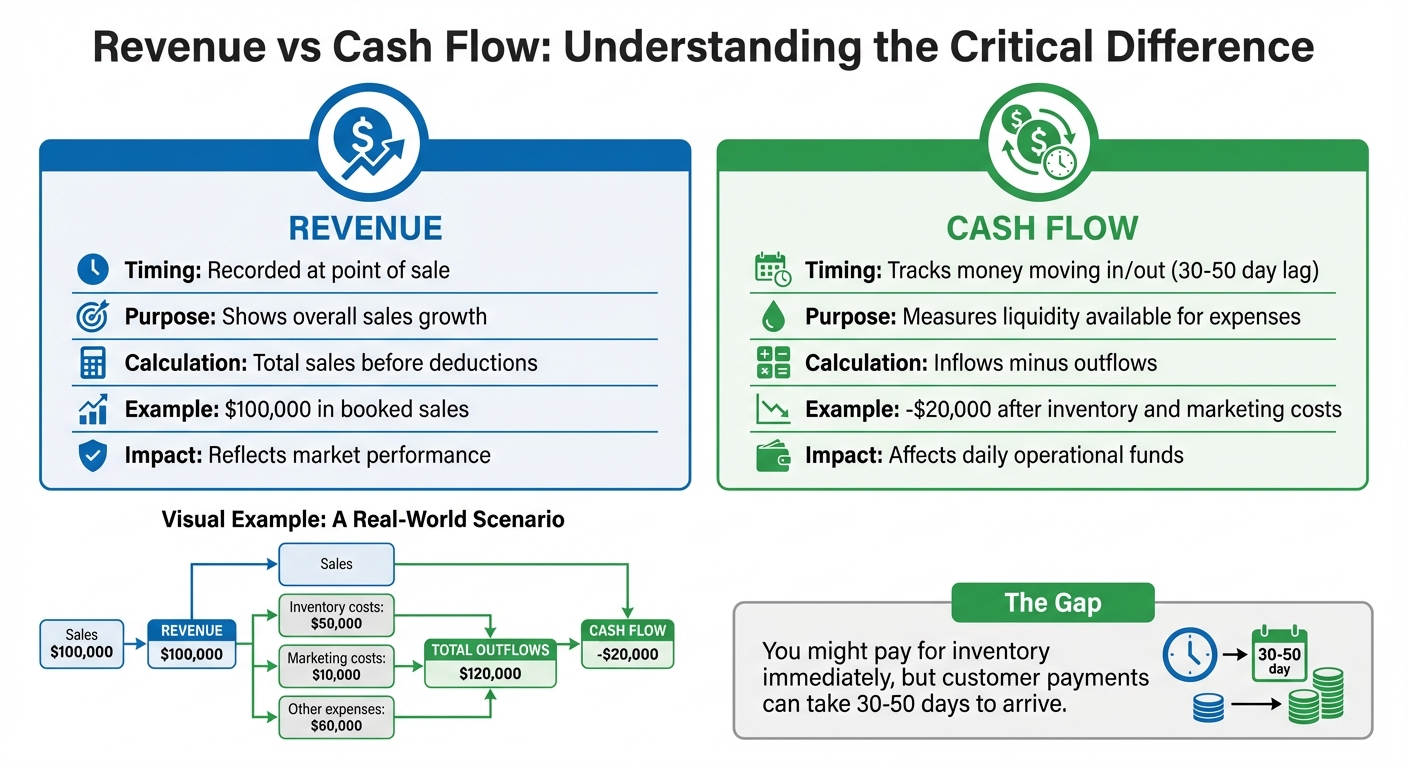
For example, you might record $100,000 in sales but have negative cash flow if $120,000 was spent upfront on inventory and marketing. This timing gap can grow as your business scales, leaving you cash-strapped despite strong sales numbers.
Key challenges include:
- Upfront costs for inventory and ads that drain cash before payments come in.
- Refunds and returns that add to expenses.
- Delayed payments from customers.
To manage this, focus on:
- Cash flow forecasting to predict gaps.
- Smarter inventory management to avoid overstocking.
- Controlled marketing spending based on available cash.
- Negotiating supplier terms for flexibility.
- Short-term financing options like revenue-based funding to bridge gaps.
Balancing sales growth with cash flow is critical to keeping your business running smoothly.
Cash Flow vs. Profit: What’s the Difference? | Business: Explained
sbb-itb-d7b5115
The Gap Between Revenue and Cash Flow
What Revenue and Cash Flow Actually Mean
Revenue represents the total income your eCommerce business earns from sales. It's recorded at the time of sale, even if the payment hasn't been received yet. For example, if your sales total $100,000, your revenue reflects that amount immediately - even if the cash takes weeks to arrive [3].
Cash flow, however, paints a different picture. It’s calculated by subtracting outflows (like supplier payments or ad costs) from inflows (like customer payments). So, even with $100,000 in revenue, your business could have a negative cash flow if you’ve already spent $120,000 upfront on inventory and marketing [4].
This difference in timing is where the gap lies: while you might pay for inventory right away, customer payments might not show up for 30–50 days [4].
How Growing Sales Can Hurt Cash Flow
Ironically, increasing sales can sometimes hurt your cash flow. Why? Because scaling up often requires spending more on inventory and marketing - costs you incur now for revenue you’ll receive later.
For example, imagine an eCommerce store spends $50,000 on inventory and $10,000 on ads to generate $80,000 in sales. Until those customer payments come in (which might take 50 days), the business is operating with negative cash flow [4].
As sales grow, this mismatch can become even more challenging. Doubling sales means doubling upfront costs, which can stretch your cash flow thin. Funds get tied up in inventory and ongoing campaigns, leaving less money for everyday expenses like payroll or supplier payments [4].
Side-by-Side Comparison
Here’s a quick breakdown of the key differences between revenue and cash flow:
For eCommerce businesses, keeping cash flow in check is essential. Even if revenue looks strong, poor cash flow can lead to reliance on credit or missed payments to suppliers [4].
Cash Flow Problems eCommerce Businesses Face
Inventory Costs That Drain Cash
Paying for inventory upfront can tie up much-needed cash, leaving less available for critical expenses like rent or payroll. When businesses invest in stock before making sales, that money remains locked away. Overestimating demand can lead to excess inventory taking up warehouse space, while underestimating it might result in lost sales - all while fixed costs for warehousing and fulfillment continue to pile up. As sales increase, businesses face additional pressure to expand storage and hire more staff, further stretching their cash flow [5].
Marketing Costs and Delayed Payments
Marketing is another major drain on cash flow. Staying competitive in online advertising demands a sizable budget [5]. As eCommerce businesses grow, they also need to invest in things like website hosting, professional design, and better security systems to handle increased traffic and safeguard transactions. These operational upgrades add up quickly, making it even harder to manage cash flow effectively [5].
Refunds, Returns, and Late Payments
Refunds, returns, and delayed payments create more challenges for cash flow. Online retailers must comply with strict customer rights, which often lead to higher refund rates. Handling these returns requires warehouse space, staff to inspect and restock items, and systems to process them efficiently - all adding to costs [5]. On top of that, payment delays - whether from disputes, refund processing, or other issues - can create a significant gap between reported revenue and the cash businesses have on hand for daily operations. Up next, we'll look at strategies to improve cash flow while supporting revenue growth.
How to Match Revenue Growth with Healthy Cash Flow
Forecasting Your Cash Flow
A cash flow forecast helps you spot potential financial shortfalls before they become a problem. By comparing actual cash receipts to recorded sales and mapping out expenses - like inventory, marketing, warehouse costs, and payroll - against expected cash inflows, you get a clear picture of your financial health. This process highlights any gaps in cash availability. Once identified, you can tweak your operations to ensure that revenue growth translates into a steady and reliable cash flow.
Better Inventory Management
Managing inventory wisely is a key way to keep cash flow healthy. Dive into your sales data to pinpoint which products sell quickly and which ones linger on the shelves. For fast-moving items, consider ordering smaller, more frequent batches to avoid tying up too much cash in inventory. A helpful benchmark to keep in mind is the Rule of 40: your combined revenue growth rate and profit margin should exceed 40%[1]. For example, if your revenue growth is around 30%, aim for at least a 10% profit margin to maintain financial stability.
Smarter Marketing Spending
Keeping your marketing budget in check is just as important as managing inventory. Instead of basing your marketing spend on projected revenue, align it with the cash you actually have on hand. Make sure essential expenses are covered before increasing your ad budget[6]. To maximize efficiency, track the ROI of each marketing channel to see which campaigns genuinely contribute to profits. If profit margins are tight, it may be better to focus on organic growth strategies rather than relying heavily on expensive customer acquisition campaigns[2].
Managing Immediate Cash Needs While Growing
After fine-tuning your cash flow forecasting and spending, the next step is ensuring you have access to cash when you need it most - especially during periods of growth.
Keeping Enough Cash on Hand During Growth
Growth often means spending money upfront on inventory, marketing, and operations well before you see the returns. To stay ahead, it’s critical to maintain a cash buffer that cushions you from timing mismatches between expenses and income.
A great way to do this is by using a 13-week rolling forecast to track every dollar flowing in and out. This short-term tool helps you identify potential cash shortages early. For instance, if you’re in eCommerce, peak seasons like Q4 might account for 40–50% of your annual revenue. Allocating 20–30% of those profits as a seasonal reserve can help you weather slower months, like Q1 [7]. With this insight, you can adjust supplier terms or financing plans proactively.
Speaking of suppliers, negotiating better payment terms is another smart move. Extending payment timelines from Net-30 to Net-60 or even Net-90 can keep cash in your business longer. Adjusting deposit structures, such as paying 30% upfront and 70% upon delivery, can also ease cash strain [7][8]. Additionally, leveraging business credit cards through accounts payable platforms lets you pay suppliers immediately while enjoying up to 60 days of "float" [9].
Using Financial Tools to Stay Stable
Even with careful planning, there will be times when your cash needs outpace your reserves. That’s where flexible financing comes into play. These tools can help you bridge gaps without derailing your growth.
Traditional bank loans, with their fixed payments, often don’t align well with fluctuating sales cycles. A more flexible option is revenue-based financing. With this approach, you get an advance based on your sales history and repay it as a percentage of future revenue. This means repayments adjust to your actual cash flow, reducing pressure during slower periods [7].
For eCommerce businesses, platforms like Onramp Funds offer solutions tailored to your needs. They provide equity-free financing with funding available in as little as 24 hours. Repayments are tied to your sales performance, with fees typically ranging from 2–8%. Whether you need cash for inventory or marketing, this approach offers flexibility without the rigidity of traditional loans. Plus, Onramp integrates seamlessly with platforms like Amazon, Shopify, and TikTok Shop, ensuring you can access capital when opportunities arise.
Conclusion
Higher revenue doesn’t always mean more cash in your pocket. This disconnect between sales and available cash can put your eCommerce business at risk. Revenue shows how much you’re selling, but cash flow determines if you can actually keep the business running.
Grasping this difference is essential. As the Wise Advice Team explains:
"As an e-commerce owner, maintaining positive cash flow should be your immediate priority. Without adequate cash flow, even a profitable business can face insolvency" [6].
The good news? You can aim for both growth and liquidity. Monitor your cash flow as carefully as your sales, negotiate better payment terms with suppliers, and set aside reserves for slower periods. Forecasting tools can help you anticipate cash needs, while proactive planning ensures you’re ready to handle shortfalls when growth outpaces available funds. Adjusting your cash management strategies can make all the difference.
Sustainable growth requires balancing expansion with financial stability. For most small businesses, steady annual growth of 15% to 25% is often manageable [2]. Overextending without a solid cash flow plan could leave you struggling just when your business is starting to soar.
Make liquidity your top priority, with profitability as the next focus. The timing gap between revenue and cash flow, as discussed earlier, highlights why having cash on hand is more critical than just showing profits on paper. When your cash flow is steady, you can approach growth opportunities with confidence, avoiding the stress of missed payments.
Start implementing these strategies today to protect and grow your eCommerce business.
FAQs
What’s the fastest way to spot a cash flow gap?
One of the fastest ways to detect a cash flow gap is through cash flow forecasting. By keeping a close eye on your projected inflows and outflows, you can quickly notice red flags like delayed payments, seasonal fluctuations, or surprise expenses. Taking this proactive step allows you to identify potential problems early, giving you the chance to address them before they impact your financial stability.
How much cash should I keep as a reserve?
Maintaining cash reserves that can cover 3 to 6 months of operating expenses is a smart way to keep your business on solid ground. This buffer gives you the flexibility to handle unexpected challenges or sudden changes in cash flow without jeopardizing your operations.
When does revenue-based financing make sense?
Revenue-based financing works well for businesses with steady and predictable income, like eCommerce stores. It’s particularly helpful during periods of fast growth when cash flow might be strained due to factors like delayed payments, inventory purchases, or operating costs. This type of funding offers working capital by leveraging future revenue, without the need for equity or collateral. However, to handle repayments smoothly, it’s essential to have a dependable revenue stream and a clear understanding of your cash flow cycle.
Related Blog Posts
Onramp Funds
Funding built around your sales
Connect your store and see what you qualify for. Repay as a percentage of sales, with no personal credit check.
Funding in as little as 24 hours.
