

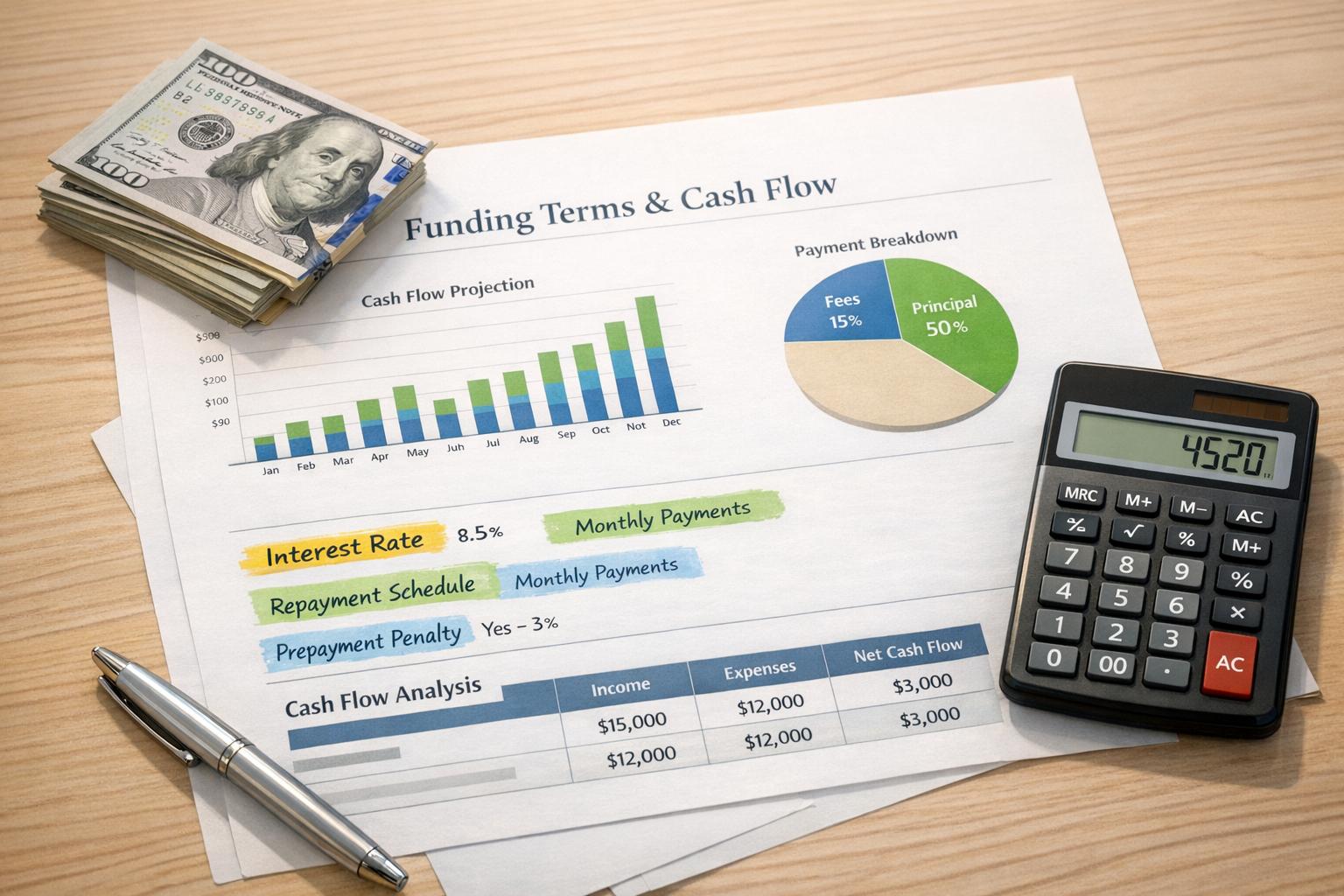
When managing cash flow, funding terms can either help or hurt your business. Here’s why they matter:
- Marketplace payout delays (14–30 days on platforms like Amazon) create cash gaps for eCommerce sellers.
- Repayment structures - like fixed monthly payments - can cause financial strain during slow sales periods, while revenue-based repayment adjusts to your sales, offering flexibility.
- High-interest loans (APRs over 80%) eat into profits, while flat-fee funding (2–8%) is more predictable and easier to budget for.
- Loan durations that don’t align with your cash flow cycle can leave you short on liquidity, especially during seasonal fluctuations.
Key takeaway: The right funding terms ensure you can cover daily expenses, invest in growth, and handle slow periods without cash flow stress. Misaligned terms, on the other hand, can lead to missed payments and tighter margins.
eCommerce Funding Secrets Every Seller Should Know
How Repayment Schedules Affect Cash Flow

Your repayment plan directly influences how much cash you have on hand, especially during slower sales periods. Fixed monthly payments, for instance, remain unchanged no matter how much revenue you generate. This setup can become a burden when sales dip, as the payments take up a larger chunk of your available cash, increasing the likelihood of running short.
Revenue-based repayment, on the other hand, offers a more flexible approach. Instead of a fixed dollar amount, you pay a percentage of your daily sales - usually between 1% and 16% [1]. This means when sales slow, your payments automatically shrink. Conversely, when business is booming, you pay more, allowing you to clear your balance faster. This flexibility is particularly helpful for eCommerce sellers, who often face a 15- to 90-day lag between paying suppliers and receiving payouts from marketplaces [2].
Adding to the challenge, payment terms in the U.S. have grown nearly 50% longer since the pandemic [10]. This means you might wait longer to receive funds while still needing to meet your financial obligations. If you’re locked into fixed payments during a slow period, late fees and interest charges can quickly eat into your profit margins.
Fixed Monthly Payments vs. Revenue-Based Repayment
Traditional loans with fixed monthly payments don’t account for fluctuating cash flow [9]. For example, a $5,000 payment in January or February can strain your finances just as much as it would during peak sales months.
Revenue-based repayment models, such as those offered by Onramp Funds, eliminate this rigidity. Payments are directly tied to your sales performance. For instance, if your monthly sales total $100,000 and your remittance rate is 5%, your payment will be $5,000. If sales drop to $60,000 the following month, your payment adjusts to $3,000. While fixed payments simplify budgeting, revenue-based payments align with your business’s performance, making them especially helpful during seasonal fluctuations or unpredictable sales cycles. This adaptability becomes crucial during slower months, as we’ll explore further.
Managing Cash Flow When Sales Are Low
During periods of low sales, revenue-based repayment provides breathing room by reducing payment amounts, allowing you to focus on essentials like restocking inventory or investing in advertising to drive traffic. This flexibility helps you avoid a cash crunch when revenue dips but fixed obligations remain unchanged.
To further stabilize your cash flow, consider negotiating longer payment terms with your suppliers. If you’re paying suppliers on Net 30 terms but experiencing delays in marketplace payouts, extending terms to Net 45 or Net 60 can better align your outflows with incoming funds.
Another strategy is to offer small early payment discounts to your customers or retail partners, typically between 1% and 2%. Even a modest discount can encourage faster payments, providing you with the liquidity needed to cover operational costs without resorting to reserves or additional debt. Just be sure to negotiate pricing before discussing payment terms, as suppliers may increase prices by 5% to 8% if you request extended terms [10].
Finally, using cash flow forecasting tools based on historical sales data can help you prepare for slower periods. For example, if February is typically 30% slower than December, you can plan ahead by building a cash reserve, adjusting inventory purchases, or ensuring your repayment structure aligns with seasonal dips.
How Interest Rates Impact Cash Flow
When interest rates climb, they can drain cash flow by redirecting money from daily operations to debt repayment. Take high-interest loans like merchant cash advances (MCAs), for example. These can come with APRs that soar past 80% [2]. Let’s say you borrow $10,000 - you're looking at paying $3,000 to $4,000 in fees [3]. That’s money you could have used for essentials like restocking inventory, running ad campaigns, or covering payroll.
Cash flow challenges are already common for small businesses. About 60% of U.S. small businesses struggle with late payments or extended payment terms [7]. If you're waiting 14 to 21 days for Amazon payouts or juggling supplier payment schedules, high interest rates just add to the pressure. You’re left paying more to borrow while your revenue is stuck in limbo. Next, let’s look at how traditional high-interest loans compare to fixed-fee structures.
High Interest Rates vs. Fixed Fees
Traditional high-interest loans can be unpredictable because their costs increase over time. For instance, with a 40% APR, a loan could cost up to 133% of your gross profit if your margins are only 30% [3]. That makes the loan unworkable from the start.
Fixed-fee structures, on the other hand, offer clarity. Onramp Funds, for example, charges a flat fee of 2% to 8% of the funded amount [1]. There’s no compounding interest or hidden charges. Borrow $50,000 with a 6% fee, and you’ll know upfront that you’ll repay $53,000. This transparency allows for better cash flow management, helping you plan for inventory, marketing, and other expenses without worrying about surprise costs.
Ways to Reduce Interest Costs
To control borrowing costs, start by converting all funding offers into a single APR metric. This makes it easier to compare options [2]. Factor rates, discount rates, and origination fees can hide the real cost of borrowing. Once you’ve calculated the true APR, aim for options below 20% - this is considered the "Green Zone" for sustainable borrowing [2]. If the APR exceeds 50%, it’s time to negotiate or rethink the deal entirely.
Another way to ease the burden is by negotiating extended payment terms with suppliers. Moving from Net 30 to Net 60 or Net 90 essentially gives you an interest-free loan, reducing your need to borrow. Early payment discounts can also help. For instance, a 2/10 Net 30 arrangement offers a 36% annualized return [4], which can outperform many funding options.
Finally, consider refinancing high-interest debt into a revenue-based model with annual costs between 6% and 12%. This approach can free up cash for growth and reduce the strain on your business [3].
sbb-itb-d7b5115
How Loan Duration Affects Liquidity
Loan duration determines how long your cash is tied up. Short-term loans can provide quick access to funds, but their repayment terms - typically within 3–12 months - can strain daily operations. For instance, if your business generates $100,000 in monthly revenue with a 45-day cash conversion cycle, you’re likely keeping around $150,000 locked up at any given time [4]. Adding short-term loan repayments to this equation might leave you struggling to maintain liquidity. This issue becomes even more pronounced when repayment schedules don’t align with your sales cycle.
"Traditional financing was never made for the cash flow cycles of eCommerce businesses." – Onramp Funds [1]
Misaligned repayment terms can make liquidity challenges worse. Take Amazon sellers, for example - they often wait 14 days for payouts, while Shopify processes payments weekly. If 15% of your daily revenue is deducted for repayments, total costs can snowball to 30–40% over six months [3]. That’s money you can’t reinvest in inventory or seasonal marketing campaigns.
Revenue-based financing offers a more flexible solution. Instead of fixed daily or weekly payments, you remit between 5% and 25% of your monthly revenue until the loan is repaid [3]. This approach automatically adjusts with your earnings, helping to preserve liquidity during slower periods and allowing quicker repayment during growth spurts. Whether you’re recovering from the holiday rush or managing Net-60 supplier terms, this structure ensures that liquidity is available when you need it most.
Short-Term Loans vs. Revenue-Based Financing
Short-term loans are fast but come with strict repayment schedules. You can access anywhere from $5,000 to $500,000 quickly, but daily or weekly deductions can lock up cash for up to six months - regardless of whether your sales are booming or taking a dip. This can be particularly risky during seasonal slowdowns or while waiting for payout cycles from platforms like Amazon.
Revenue-based financing, on the other hand, adapts to your business’s performance. Payments slow down during low-revenue periods, reducing the strain on your cash flow. The trade-off? Repayment might stretch out over several years, and if your revenue grows faster than expected, you could end up paying more overall. For eCommerce sellers with fluctuating income, though, this flexibility often outweighs the potential higher cost.
Here’s a quick comparison of how each option impacts cash flow:
Selecting Loan Terms That Support Growth
To make financing work for your business, it’s essential to align loan terms with your operational cycle. Start by mapping out your cash conversion cycle and payment inflows. For example, if you operate on Net-30 supplier terms but wait 60 days to receive customer payments, a short-term loan with daily deductions will only widen the gap. Instead, consider revenue-based financing that aligns with your payout schedule, whether that’s Amazon’s 14-day cycle or Shopify’s weekly transfers.
Fashion brand Hedoine is a great example. In 2019, they used $50,000 in revenue-based funding to fuel Instagram and Facebook ad campaigns. Thanks to the flexible repayment structure, which scaled with their revenue, they achieved a staggering 1,106% sales growth in Q1 2020 [3].
Had they opted for a short-term loan with fixed payments, their liquidity could have been drained before they even saw results.
Another way to maintain liquidity is by negotiating supplier terms. For instance, moving from 30% upfront payments to 40% post-shipment can extend your cash runway without additional borrowing. Building a three-month reserve and financing only proven inventory are also smart strategies. Ultimately, the goal is to match your loan duration with your business’s operational needs rather than simply opting for the fastest approval process.
Using Onramp Funds to Improve Cash Flow
Features That Support Daily Liquidity
Onramp Funds is designed to align funding with the natural rhythm of eCommerce operations, addressing cash flow challenges head-on. Once you connect your store, the platform can provide capital in less than 24 hours - a game-changer for bridging payout delays like Amazon's 14-day cycles or Shopify's weekly settlements [1]. This quick access to funds is especially helpful for restocking inventory or kickstarting marketing campaigns when timing is critical.
What sets Onramp apart is its flexible repayment structure. Instead of locking you into fixed monthly payments, which can strain your budget during slower sales periods, Onramp uses a revenue-based model. A small percentage of your daily sales - sometimes as low as 1% - is deducted, meaning payments adjust in real-time. When sales dip, so do your repayments, and when business picks up, repayment speeds up [1]. The financing is equity-free and unsecured, so you retain full ownership of your business without needing to offer collateral [1].
"Our funding is tailored to the ups and downs of eCommerce businesses, where no two days are alike." – Onramp Funds [1]
Onramp also keeps things simple with a flat-fee structure that ranges from 2% to 8% of the funded amount. There are no hidden fees or minimum monthly commitments. The platform integrates seamlessly with leading eCommerce channels like Amazon, Shopify, and Walmart Marketplace, using real-time sales data to craft funding offers that match your needs [1].
Steps to Improve Cash Flow with Onramp Funds
Getting started with Onramp Funds is straightforward and efficient. First, answer a few basic questions to get a funding estimate in just one minute. Then, connect your eCommerce store - a process that takes about five minutes - to receive a tailored funding offer. Finally, review your options and choose the one that best suits your business needs [1].
Once funded, you can use the capital strategically to manage cash flow gaps. For example, cover the 15-to-90-day gap between paying suppliers and receiving marketplace payouts. This allows you to restock inventory without straining your operating budget [1]. Alternatively, invest in high-ROI marketing campaigns, knowing that repayments will scale with your sales rather than locking you into rigid payment schedules.
Onramp offers three repayment models to fit different business needs:
- Variable: Payments adjust daily based on sales.
- Fixed: Consistent payments for predictable budgeting.
- Rolling Cash Line: A revolving credit option that grows with your sales, allowing you to access funds every two weeks and only pay fees on the amount you use [11].
The results speak for themselves: businesses that use Onramp Funds see an average revenue increase of 60%, and 75% of customers return for additional funding [1].
Conclusion
The terms of your funding directly impact your day-to-day cash flow. Fixed payments can become a burden during slow sales periods, while revenue-based repayment adjusts automatically, helping maintain liquidity when times are tight.
A flat fee ranging from 2% to 8% is far easier to budget for than dealing with the unpredictability of daily interest accrual.
Marketplace payment cycles add another layer of complexity. For example, Amazon operates on a 14-day payment schedule with a 7-day reserve, creating a 21-day delay between making a sale and receiving the funds[4]. If your loan payment is due on the 1st but your payout doesn’t hit until the 21st, you could face a cash shortfall. Synchronizing repayment schedules with your actual cash inflows can help avoid these kinds of mismatches and keep your finances on track.
Data shows that optimizing funding terms can free up 5% to 10% of your working capital[7]. This extra capital can be reinvested in inventory, marketing, or simply keeping your operations running smoothly during slower months. On average, businesses that use flexible and transparent funding experience a 60% boost in revenue[1], largely because it removes cash flow obstacles.
The key is to choose funding that matches your cash flow cycle, seasonal trends, and growth stage. Businesses with steady, predictable revenue may find fixed terms suitable, while those with seasonal fluctuations often benefit from flexible repayment options. The right funding strategy ensures you can meet daily operational needs, cover supplier payments, and honor loan commitments - all while positioning your business for sustainable growth.
FAQs
How does revenue-based financing help eCommerce sellers manage cash flow more effectively?
Revenue-based financing (RBF) offers a repayment structure tied directly to your eCommerce store's actual sales, providing flexibility that traditional loans with fixed payments simply can't offer. When sales are booming, repayments go up. But when sales dip - whether it's due to off-season slumps or the need to restock inventory - repayments decrease. This dynamic approach ensures that your outgoing payments stay in sync with your revenue, easing financial pressure during slower times.
Repayment rates usually range between 2% and 8% of your monthly sales, making it straightforward to estimate your maximum repayment under different sales scenarios. For instance, if your store generates $30,000 in sales and your revenue share is 10%, you’d repay $3,000. But if sales drop to $15,000, your repayment would adjust to $1,500. This setup eliminates rigid repayment schedules and collateral requirements, allowing you to channel funds into inventory, marketing, or seasonal campaigns while keeping your cash flow steady and your focus on growth.
What are the advantages of flat-fee funding compared to high-interest loans?
Flat-fee funding brings clear advantages for eCommerce businesses, especially when compared to high-interest loans. One major perk is the predictability it offers - your borrowing cost is set upfront. This means you’ll know exactly what you owe from the start, eliminating the stress of dealing with compounding interest. That level of clarity makes it much easier to budget and manage your repayment schedule.
On the other hand, high-interest loans can be unpredictable. Costs often vary over time, which can put unnecessary pressure on your cash flow. Flat-fee funding, however, provides a stable repayment structure, giving you the freedom to focus on growing your business without the fear of surprise fees or fluctuating payments. It’s a practical way to maintain liquidity and cover operational expenses without added financial strain.
How does matching loan terms to your cash flow cycles help maintain liquidity?
Aligning your loan terms with your business's cash flow patterns can make a big difference. When repayments are timed to coincide with periods of higher revenue, it’s easier to manage your finances without feeling the pinch. This setup helps you avoid the stress of fixed payments during slower months, ensuring you have enough working capital to keep things running smoothly. With better liquidity, you can handle day-to-day expenses, seize growth opportunities, and navigate seasonal ups and downs without unnecessary financial pressure.
Related Blog Posts
Onramp Funds
Funding built around your sales
Connect your store and see what you qualify for. Repay as a percentage of sales, with no personal credit check.
Funding in as little as 24 hours.
