


Deploying capital effectively in eCommerce starts with setting clear ROI targets. ROI, or Return on Investment, measures the profit generated relative to your expenses. For eCommerce sellers, this metric is critical for deciding where to allocate resources, whether it's for marketing, inventory, or technology upgrades. Successful businesses aim for ROI benchmarks of 200%–300% for marketing and 10%–30% for overall operations.
Key strategies include:
- Calculate ROI for Different Investments: Use tailored formulas for inventory, advertising, and technology to ensure accurate benchmarks.
- Set SMART Goals: Define Specific, Measurable, Achievable, Relevant, and Timely ROI targets based on past performance and industry benchmarks.
- Focus on High-Value Customers: Analyze customer lifetime value (CLV) to prioritize segments that generate the most revenue.
- Track and Adjust Regularly: Monitor ROI weekly or monthly and reallocate funds to high-performing channels.
Onramp Funds offers flexible financing tailored to eCommerce businesses, with funding available in under 24 hours and repayment structures that align with your sales. This allows you to invest confidently in initiatives with strong ROI potential while maintaining cash flow flexibility.
Understanding Growth Limitations: How capital controls your ecommerce expansion
sbb-itb-d7b5115
What ROI Means for eCommerce Businesses
Return on Investment (ROI) measures how much profit you earn compared to what you spend. The formula is simple: (Revenue - Expenses) / Expenses × 100%. For instance, if you spend $1,000 on inventory and generate $3,000 in revenue, your ROI is 200%. This means you earned back your initial investment plus an additional 200%.
In eCommerce, ROI applies to various areas like inventory, advertising, and technology upgrades. It’s crucial to account for all expenses - shipping, fulfillment fees, employee time, and software charges - because overlooking these costs can make an investment appear more profitable than it actually is [7][8].
Industry benchmarks suggest that a 10% to 15% ROI is generally acceptable for eCommerce operations, with top-performing businesses reaching up to 30% [3][8]. Marketing campaigns, on the other hand, often aim for a much higher ROI, typically 200% to 300%, meaning $2 to $3 earned for every dollar spent [2]. These benchmarks provide a clear way to assess whether an investment is performing well or falling short. Let’s dive into how ROI is calculated for different eCommerce investments.
How to Calculate ROI for eCommerce Operations
While the basic ROI formula works in many cases, eCommerce often requires more specific calculations depending on the type of investment.
For inventory, ROI is calculated by comparing the revenue from sold products to the total cost of acquiring and storing them. For example, if you spend $5,000 on stock (including storage and shipping) and sell it for $12,000, your ROI is 140%.
For advertising campaigns, the formula is: (Leads × Conversion Rate × Average Sales Price - Costs) / Costs = ROI [7]. Let’s say you spend $500 on Facebook ads, generating 100 leads. With a 2% conversion rate, you gain 2 customers, each spending $300, for total revenue of $600. The resulting ROI is 20%. While this may seem modest, repeat purchases from those customers can significantly boost long-term returns.
Technology investments call for a different approach. Here, you measure the efficiency gains or increased sales capacity against the cost. For instance, spending $2,000 on an augmented reality (AR) tool might boost conversions and reduce returns, improving ROI by increasing sales while cutting costs [2]. These tailored calculations help set realistic ROI benchmarks, guiding smarter spending decisions.
Why ROI Targets Help You Allocate Capital Better
ROI targets are essential for identifying which investments will drive profitability. By setting clear benchmarks, you can quickly evaluate whether a new marketing channel, product line, or technology upgrade is worth pursuing. This keeps your budget focused on initiatives that deliver meaningful returns.
Targets also help pinpoint where additional capital can have the most impact. For example, if one marketing channel significantly outperforms another, shifting more funds to the better-performing channel can maximize profits. As market researcher Kateryna Kosmyna explains:
By knowing their investments' ROI, businesses can make decisions that will maximize their profits and help them stay competitive in a dynamic e-commerce landscape [3].
This strategic approach ensures that every dollar you spend contributes to growth, rather than just covering costs.
How to Set Clear ROI Targets for Your Investments
Setting ROI targets starts with understanding what's achievable for your business. Avoid setting random goals - base them on data from your operations and industry benchmarks. A realistic ROI target should reflect factors like your growth stage, product margins, and customer behavior.
Start by using your current performance as a baseline. For instance, if your recent campaigns delivered a 150% ROI, aiming for 400% might be unrealistic. Instead, focus on steady improvements, such as targeting 175% to 200% ROI, while refining your strategies. Your growth stage also plays a role: businesses in a steady phase often allocate 10% to 15% of revenue to marketing, while those in aggressive growth mode may invest up to 30% [1].
Set SMART goals - Specific, Measurable, Achievable, Relevant, and Timely - to make your targets more actionable. For example, instead of vaguely aiming to "improve ROI", you could specify: "achieve 250% ROI on Facebook ads by June 30, 2026." This level of detail makes it easier to track progress and adjust your spending as needed. Reviewing your historical performance can further refine these targets.
Using Past Performance Data to Set ROI Benchmarks
Your historical data is one of the best tools for identifying what works. Review reports from the past six to twelve months of campaigns, inventory purchases, and technology investments. Look for patterns: Which marketing channels consistently delivered strong ROI? Which products sold the fastest? Were there seasonal trends that impacted returns?
Take Pluto Pillow as an example. During its launch, the company relied on a PR-heavy approach, focusing on personalized media pitches. This strategy resulted in a 30% to 35% journalist response rate, and a single appearance on the Today show generated thousands of sales with minimal marketing costs [2]. Successes like this can serve as benchmarks - if a strategy worked exceptionally well before, it’s worth considering again.
Another example is Luxy Hair, which built a YouTube channel with over three million subscribers by creating evergreen content. Their styling tutorials helped them acquire more than 250,000 customers organically before being acquired by Beauty Industry Group [2]. Their data showed that content marketing delivered better results than paid ads, indicating a clear area for future investment.
Analyzing traffic sources is also key. For instance, compare the ROI of paid search against organic traffic. If organic search drives customers at a lower cost, it might make sense to shift more resources toward SEO and content creation [5]. While historical data helps establish immediate benchmarks, factoring in customer lifetime value (CLV) provides a broader perspective.
Factoring Customer Lifetime Value into ROI Calculations
Customer Lifetime Value (CLV) gives a more comprehensive view of the returns from customer acquisition. The standard formula is:
(CLV - Customer Acquisition Cost) / Customer Acquisition Cost × 100.
For example, if a customer’s lifetime value is $500 and it costs $100 to acquire them, the ROI would be 400%.
Some investments may show modest initial returns but improve as customers make repeat purchases. Using RFM analysis - evaluating Recency, Frequency, and Monetary value - can help you identify which customer segments generate the highest lifetime value [5].
Many eCommerce businesses find that 80% of their revenue comes from just 20% of their customers, making it essential to concentrate marketing efforts on high-value segments rather than spreading budgets thin [5]. This approach highlights how CLV analysis can lead to smarter capital allocation.
Additionally, track metrics like repeat purchase rates and customer satisfaction to fine-tune your CLV calculations. A high CLV can justify higher acquisition costs, while a low CLV might signal the need to cut spending or improve retention strategies [9]. This ensures your ROI targets account for the full value each customer brings to your business.
Methods for Evaluating Investment ROI
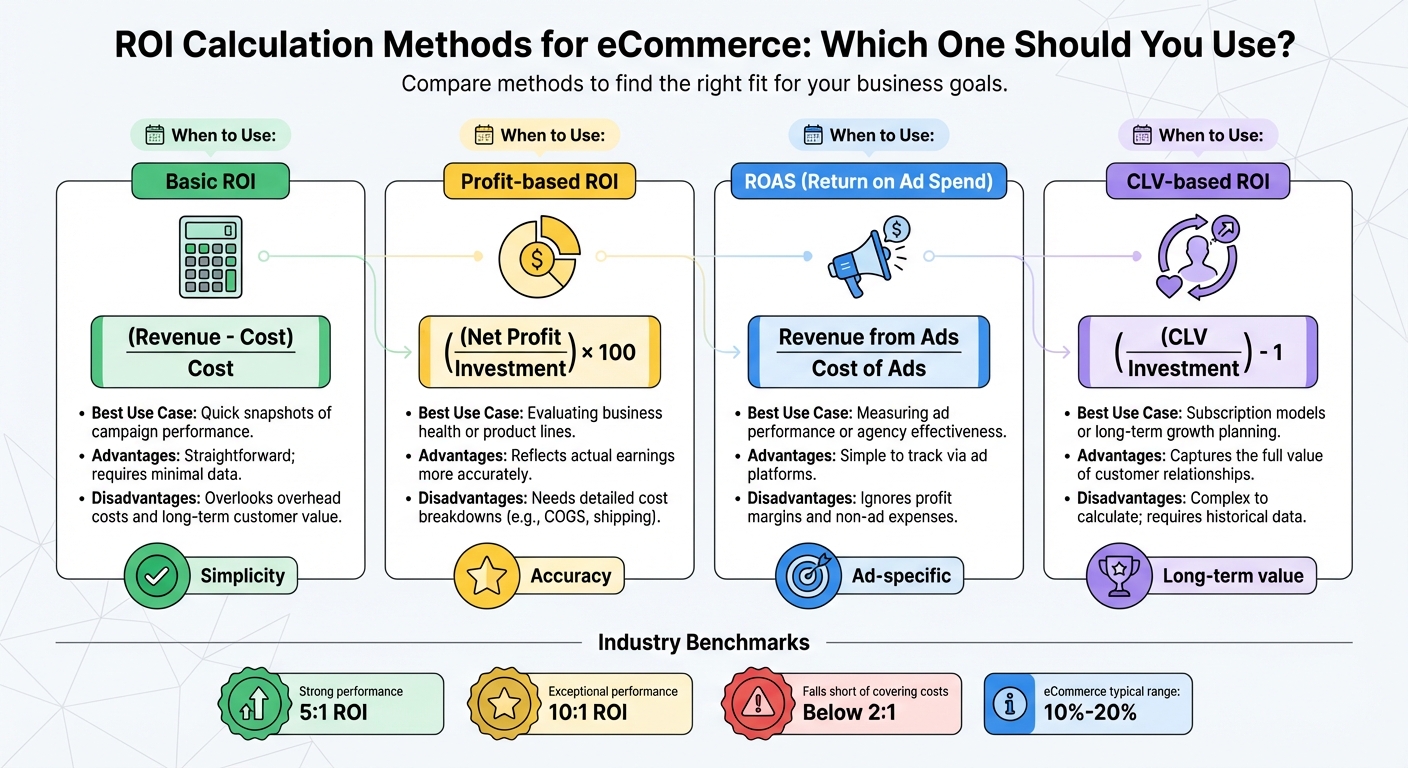
When it comes to calculating ROI, the method you choose depends on the type of investment and the insights you're after. From quick overviews to more detailed profitability assessments, each approach has its strengths and limitations. Here's a breakdown of key ROI calculation methods, their formulas, and when to use them.
Comparing Different ROI Calculation Methods
To put these methods into perspective, industry benchmarks can help you gauge performance. For example, a 5:1 ROI is often seen as strong in marketing, while a 10:1 ROI is considered exceptional [11]. On the flip side, anything below 2:1 typically falls short of covering production and operational costs [11]. In eCommerce, ROI expectations often range between 10% and 20%, though this depends heavily on margins and business models [8].
Finding High-ROI Investment Opportunities
Once you understand how to calculate ROI, the next step is applying it to uncover opportunities for growth. Start by reviewing your current channels. Break down ROI by platform - whether it’s email, social media, organic search, or paid ads - to identify where your budget is yielding the best results [4][10]. For instance, if organic search drives consistent returns, doubling down on SEO and content creation might be worth considering. Likewise, if a specific Facebook ad set outperforms others, reallocate resources there before experimenting with new campaigns.
ROI analysis can also guide inventory decisions. Prioritize high-margin products and adjust stock levels based on their performance [10]. If a product sells quickly and delivers strong margins, increasing inventory for that item is a straightforward way to boost ROI. Additionally, technology investments can yield impressive results. For example, businesses that spend $30,000 to $60,000 on advanced website development often see ROI exceeding 260% in the first year, especially when the upgrades enhance user experience and improve conversion rates [12].
To further improve ROI without increasing ad spend, consider strategies like bundling products, offering upsells, or adding "Buy Now, Pay Later" options at checkout [7]. Streamlining internal operations with automation tools, such as API-first platforms, can also cut down on repetitive tasks and reduce long-term costs [8]. The goal is to ensure every dollar you spend delivers maximum impact for your business.
Using Onramp Funds to Deploy Capital with ROI Targets
When it comes to hitting clear ROI targets, Onramp Funds provides financing options specifically designed to help businesses make the most of their investments. By partnering with a provider that understands the unique cash flow cycles of eCommerce, you can deploy capital with confidence.
Custom Funding Offers Aligned with Your ROI Goals
Onramp takes a tailored approach by analyzing your real-time sales, cash flow, and debt positions through secure, read-only connections to your store. Based on this data, they offer three customized funding options: Variable, Fixed, and Rolling Cash Line, each designed to match your business's spending habits and growth phase.
These funding types are designed to sync with your business cycles. For example, if you're running a seasonal campaign with a 90-day ROI target, the Variable option ensures repayments align with your sales flow.
Jeremy, the founder of Kindfolk Yoga, shares his experience:
"Onramp offered the perfect solution with revenue-based financing to secure the capital we needed to invest in inventory and pay it back at a reasonable time frame once we made sales." [6]
Nick James, CEO of Rockless Table, highlights the simplicity and speed of the process:
"Applied, got our offer, and had cash in our bank account within 24 hours. Their Austin, TX based team was very professional and helped me deploy the cash to effectively grow our business." [6]
So far, Onramp has powered over 3,000 eCommerce loans, with businesses reporting an average of 40% revenue growth within 180 days of partnering [6].
Revenue-Based Repayments and Transparent Fees
One of the standout features of Onramp's model is its revenue-based repayment structure, which adjusts with your sales. During slower months, your repayments decrease, and they increase during peak periods. This flexibility helps protect your ROI and ensures you're not stuck with burdensome fixed costs during downturns.
Onramp also keeps pricing straightforward. Fees range from 2% to 8%, with no hidden charges or compounding interest. Transparency is a priority, and the company has earned an A+ rating from the Better Business Bureau, along with "Excellent" reviews from 225 merchants.
Torrie V., founder of Torrie's Natural, appreciates the convenience:
"Onramp has simplified cash flow by automating everything: easy to request, set it and forget it payments - quick and fast!" [6]
To qualify, businesses need at least $10,000 in average monthly sales and must be a legal U.S. entity. Onramp integrates with major platforms like Amazon, Shopify, TikTok Shop, Walmart, eBay, and WooCommerce. You can use their funding calculator to get an estimate in about a minute, and formal offers are typically delivered within 24 hours [6].
Next, we’ll explore how to monitor and refine your ROI strategy as your business grows.
Tracking and Improving Your ROI Over Time
Once you've allocated funds with clear ROI goals, the work doesn’t stop there. To ensure your investments stay in sync with your growth objectives, consistent tracking and adjustments are essential. Deploy your resources, monitor performance, and refine your strategy to maximize returns.
Metrics and Tools for Monitoring ROI
How often should you track ROI? For new investments, weekly tracking is ideal. Once established, monthly reviews are sufficient, and for stable investments, quarterly updates will do the trick [13]. A side-by-side comparison of projected and actual ROI can highlight which initiatives are thriving and which might need a rethink.
Some key metrics to keep an eye on include:
- Average Order Value (AOV)
- Customer Lifetime Value (CLV)
- Purchase Frequency
- Customer Acquisition Cost (CAC) (which typically ranges from $30 to $50 for retailers [13][4])
Here’s a handy tracking template to help you organize your data:
To track all this effectively, tools like Google Analytics 4 (free for standard use), HubSpot (CRM tracking), and Ruler Analytics (starting at $199/month) can help connect your marketing efforts to actual revenue [14][10]. Be cautious, though - 57% of marketers measure success by lead volume, but leads don’t always translate into revenue [14]. Use your data to pinpoint weak spots and shift your focus to higher-performing channels.
How to Adjust Investments Based on ROI Data
When the numbers are in, it’s time to act. Use your ROI data to reallocate budgets from underperforming channels to those with better potential. For instance, if paid social ads are only hitting 180% ROI against a 250% target, consider shifting funds to email marketing, which typically delivers $36–$42 for every $1 spent [15].
Some real-world examples can provide inspiration. In 2025, BPN (Performance Nutrition) used subscription and purchase history data to identify customers at risk of churning. By targeting them with personalized win-back campaigns, they achieved a 12% re-purchase rate from previously lost customers [16]. Similarly, Faherty analyzed their channel mix to find the most profitable customer sources, generating $1.1 million in incremental revenue by adjusting their budget accordingly [16].
Set clear triggers for action. For example:
- Increase funding when ROI exceeds targets by 25%.
- Cut back if a channel stays below breakeven for two months.
Also, break down ROI by channel while considering CLV. Some channels, like Facebook, may have higher acquisition costs but yield loyal, repeat customers over time [4][10]. If your traffic is solid but ROI is lagging, focus on reducing checkout friction or speeding up your site. Remember, the ideal loading time for eCommerce is under 2 seconds [13]. Small tweaks like these can make a big difference in your bottom line.
Conclusion
Investing capital with clear ROI targets allows you to make informed decisions that drive consistent growth. By setting specific benchmarks and using the formula [(Net Profit − Marketing Expenses) / Marketing Expenses] × 100[2], you can turn spending into a calculated tool for scaling your business. For eCommerce, a healthy ROI typically falls between 200% and 300%, meaning every $1 spent brings back $2 to $3 in return[2].
"Ecommerce ROI gives you the clarity you need to validate your marketing spend and keep your customer acquisition cost in check." – Shopify Staff[2]
Tracking and adapting are just as important as setting goals. Leveraging real-time data allows you to reallocate budgets from low-performing channels to those that deliver better results. Even minor improvements, like a 1% boost in conversion rates, can translate into thousands of dollars in extra revenue without increasing your spending[2]. This methodical, data-driven approach naturally aligns with adopting flexible financing solutions.
Onramp Funds streamlines this process by offering quick, equity-free financing with revenue-based repayments and a straightforward fee structure (ranging from 2–8%). With funding available within 24 hours and a dedicated Austin-based support team, Onramp Funds empowers you to invest in high-ROI opportunities like inventory, marketing, or technology upgrades - without the constraints of fixed monthly payments.
FAQs
How do I set an ROI target that matches my margins?
To align your ROI target with your profit margins, begin by determining your profit margin. Your ROI goal should exceed this margin to ensure profitability. For instance, if your profit margin is 20%, set your ROI target higher than 20% to not only cover costs but also support growth. It's also helpful to look at industry benchmarks for guidance. Regularly monitor key metrics like Return on Ad Spend (ROAS) and ROI, and adjust your targets as needed to stay on track with your growth goals.
What costs should I include so my ROI isn’t overstated?
When calculating ROI, make sure to include all relevant costs associated with your investments. This means factoring in expenses like marketing, inventory, technology upgrades, shipping, and daily operational costs.
Don’t forget about those hidden costs, either - things like chargebacks, software fees, cybersecurity measures, and other overhead expenses. By accounting for these less obvious factors, you’ll get a more accurate picture of your profitability and avoid overstating your ROI.
When should I use CLV-based ROI instead of ROAS?
When you want to evaluate the long-term profitability of your marketing efforts, CLV-based ROI is the way to go. Unlike ROAS, which focuses on the immediate revenue generated from your ad spend, CLV-based ROI takes into account Customer Lifetime Value (CLV). This provides a clearer picture of how your investments contribute to sustained growth over time.
If your goal is to align your spending with long-term customer value, CLV-based ROI is the better choice. On the other hand, ROAS works best for analyzing the short-term performance of individual campaigns. Each metric serves a different purpose, so knowing when to use them can help you make smarter decisions.
Related Blog Posts
Onramp Funds
Funding built around your sales
Connect your store and see what you qualify for. Repay as a percentage of sales, with no personal credit check.
Funding in as little as 24 hours.
