


Fixed capital is all about long-term investments that drive growth. For eCommerce, this means funding assets like inventory, automation tools, and infrastructure to boost efficiency and scale effectively. With global eCommerce sales expected to hit $8 trillion by 2027, smart allocation of fixed capital is key to staying competitive.
Key Takeaways:
- Inventory: Use fixed capital for bulk purchases to cut costs and avoid stockouts. Tools like ABC Analysis and Economic Order Quantity (EOQ) streamline inventory decisions.
- Equipment: Invest in automation tools for warehousing and fulfillment. Decide between leasing and buying based on asset lifespan and cash flow needs.
- Infrastructure: Expand warehouses or upgrade digital systems to handle growth. Flexible financing options like revenue-based funding can ease cash flow challenges.
Tracking ROI through metrics like net profit margin, inventory turnover, and customer lifetime value ensures your investments deliver results. Pairing smart capital allocation with flexible funding creates a solid foundation for growth.
How To Fund Your Ecommerce Business For Cheap (Or Even Free)
sbb-itb-d7b5115
How to Allocate Fixed Capital for Inventory
Allocating fixed capital wisely for inventory can help avoid costly mistakes like overstocking or stockouts - issues that collectively waste an estimated $1.7 trillion globally. By ensuring a steady supply while keeping costs in check, businesses can protect margins and improve efficiency [2].
Think of inventory as a dynamic asset, not just a cost. This means using data-driven strategies to decide what to buy, when to buy it, and how much to order. Let’s break down how these methods can refine your approach.
Techniques like ABC Analysis help prioritize inventory investment. For example:
- A-Class items: These make up about 20% of your stock but generate 80% of your revenue. They deserve the highest priority.
- B-Class items: Require moderate investment.
- C-Class items: Represent the lowest priority for capital allocation [3][4].
"Inventory must be treated as a dynamic asset, directly linked to brand trust, capital efficiency, and competitive positioning." - Workday [2]
Another effective tool is the Economic Order Quantity (EOQ) calculation, which determines the ideal order size to minimize total costs, including ordering, setup, and holding expenses. By reducing these costs, EOQ ensures your capital is used efficiently, supporting overall operational stability. Additionally, balancing safety stock with just-in-time ordering can protect against demand fluctuations and supply chain hiccups without tying up unnecessary capital [2][4].
Bulk Inventory Purchases for Cost Savings
Using fixed capital for bulk purchases can unlock supplier discounts, directly improving profit margins. Suppliers often provide better pricing for larger orders, and during peak seasons, advance bulk orders not only secure stock but also lock in lower costs.
Take Swarovski IL as an example. By optimizing its inventory, the company achieved an 8% increase in profits and an 18% boost in conversion rates. It also reduced deadstock by 29% and increased daily sales of top products by 72% [5]. Bulk purchasing helped reduce minimum order quantities (MOQs) and shortened lead times, offering both cost and operational advantages [5].
These savings can also extend to technology investments, ensuring your inventory management stays in sync with your purchasing strategy.
Inventory Management Systems That Scale
Investing in advanced inventory management systems (IMS) is another smart way to use fixed capital. These systems provide real-time tracking, automated reordering, and multi-channel synchronization. They integrate with platforms like Shopify, Amazon, and eBay to prevent overselling - a critical feature, as 69% of online shoppers abandon purchases when items are out of stock [4].
Modern IMS platforms leverage AI to forecast demand using historical data and market trends. This enables dynamic reorder points that adjust based on factors like sales velocity, supplier lead times, and seasonality [2][4]. Businesses can achieve service levels of 95% to 98% while reducing excess stock [2].
"Poor inventory visibility does more than cause headaches. It costs you sales." - Annie Laukaitis, BigCommerce [4]
The benefits are clear: automated inventory systems can slash operational costs by 25%, improve inventory accuracy by 30%, and increase repeat purchases by 20% [4]. By reducing manual errors, lowering holding costs, and aligning inventory with marketing campaigns, these systems ensure customers find what they need when they need it [2].
Using Fixed Capital to Purchase Equipment
Investing in equipment is a cornerstone of eCommerce success, driving efficiency, cutting labor costs, and fueling growth. But it’s not just about what you buy - it’s also about how you acquire it.
Nearly 80% of U.S. businesses lease or finance equipment, contributing to a $1.3 trillion industry that helps companies manage cash flow while building asset equity [6]. The decision to lease or buy depends on factors like the equipment's lifespan, your cash reserves, and how quickly technology changes in your field.
Recent tax incentives make purchasing equipment even more appealing. For example, enhanced Section 179 deductions allow for up to $2.5 million in write-offs, and 100% bonus depreciation is available starting in 2025 [6]. These incentives can turn hefty upfront costs into immediate tax savings, especially for equipment you plan to use long-term. This sets the stage for exploring automation tools and acquisition strategies.
Automation Tools for Fulfillment and Warehousing
Once you’ve sorted out how to acquire equipment, the next step is choosing automation tools that maximize your investment. Automation can transform your operations, whether it’s conveyor systems, packaging machines, or warehouse robots. These tools speed up repetitive tasks, reduce errors, and lower labor costs, ultimately improving customer satisfaction by minimizing mistakes like incorrect orders or late deliveries.
The scale of your operation should guide your automation choices. A smaller business might start with tools like automated label printers or barcode scanners. Larger warehouses, on the other hand, could benefit from robotic picking systems or automated storage and retrieval systems (AS/RS). Regardless of size, automation delivers measurable benefits: faster order processing, reduced per-unit fulfillment costs, and the ability to scale without adding more employees.
To determine if an automation tool is worth the cost, calculate its payback period. Divide the equipment's price by the annual savings it provides through reduced labor and fewer errors. If the payback period is reasonable, the investment often makes sense - especially when paired with tax incentives.
Leasing vs. Buying Equipment
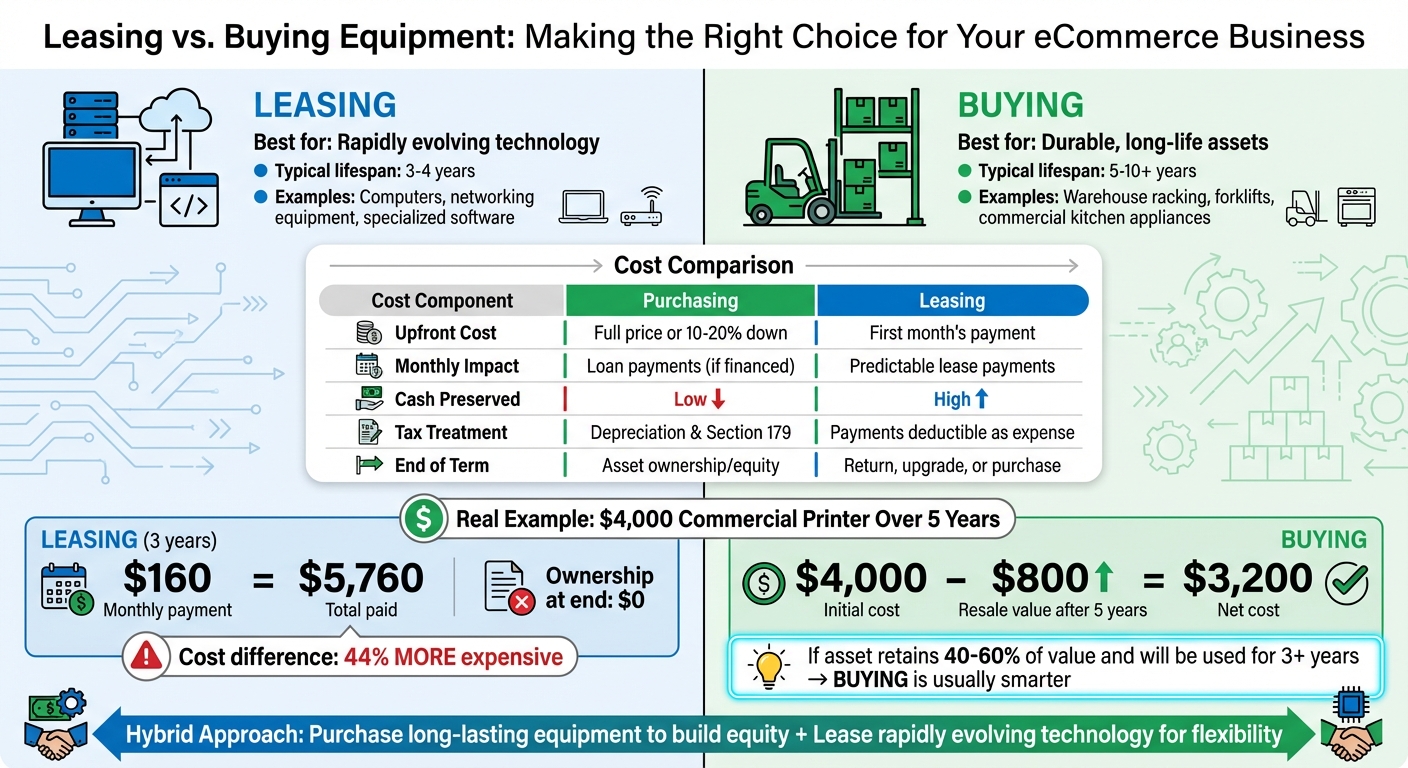
Choosing between leasing and buying equipment is all about balancing flexibility with long-term value. The right choice depends on the equipment’s lifespan and how quickly it might become obsolete.
Buying is often better for durable, long-life assets like warehouse racking, forklifts, or commercial kitchen appliances - items with a useful life of 5 to 10+ years. On the other hand, leasing is a smart move for rapidly evolving technology like computers, networking equipment, or specialized software, which typically have lifecycles of 3 to 4 years [6].
Take a $4,000 commercial printer as an example. If you buy it and sell it for $800 after five years, your net cost is $3,200. Leasing that same printer at $160 per month for three years totals $5,760 - 44% more - and leaves you with no ownership at the end [6]. However, if the printer’s tech is likely to become outdated within three years, leasing shifts that risk to the lessor and makes upgrades simpler.
| Cost Component | Purchasing | Leasing |
|---|---|---|
| Upfront Cost | Full price or 10–20% down | First month's payment |
| Monthly Impact | Loan payments (if financed) | Predictable lease payments |
| Cash Preserved | Low | High |
| Tax Treatment | Depreciation & Section 179 | Payments deductible as expense |
| End of Term | Asset ownership/equity | Return, upgrade, or purchase |
A hybrid approach often works best: purchase long-lasting equipment to build equity, and lease technology that evolves quickly to stay flexible. Always factor in your cash position. If an asset is expected to retain 40% to 60% of its value and will be used for more than three years, buying is usually the smarter choice [6].
Funding Operational Infrastructure with Fixed Capital
Your operational infrastructure - whether it's warehouses, digital systems, or logistics networks - plays a huge role in determining your ability to grow. Fixed capital investments in these areas lay the groundwork for scaling efficiently, helping you avoid cash flow challenges as you expand. By channeling fixed capital into infrastructure, you not only increase capacity but also maintain smooth operations.
The U.S. eCommerce industry pulled in $789 billion in 2020 and is projected to exceed $1.1 trillion by 2024[7]. This rapid growth demands infrastructure that can keep up. Whether you're expanding warehouse space or upgrading your digital tools, these investments can lead to faster fulfillment, fewer mistakes, and the ability to handle sudden spikes in demand.
"The truth is, most e-commerce businesses don't fail because they don't have a great product. They fail because they don't have the cash flow to scale when opportunity knocks."
Equipment financing options, often ranging from 12 to 63 months, allow you to spread out the cost of infrastructure upgrades while keeping cash available for daily needs[10]. This is especially helpful for large-scale improvements like warehouse automation or enterprise software, which can come with hefty upfront costs.
Warehouse Expansion and Optimization
Running out of physical space can quickly put a cap on your growth. Before jumping into expansion, consider optimizing your current setup. Adding vertical shelving or reorganizing layouts - like storing popular items closer to packing areas - can boost storage capacity by 30% to 50% without the need for costly expansion[11].
When expansion becomes unavoidable, warehouse financing can ease the process. Many lenders approve loans based on 50% to 75% of your inventory's appraised value[8]. This means your existing stock can act as collateral, making it easier to secure funding. Planning ahead is key - don’t wait until your current space is bursting at the seams before taking action.
Automated systems are another game-changer for warehouse operations. These systems can cut fulfillment times in half, reduce errors, and lower per-unit costs, making them a worthwhile investment[9].
While expanding physical space increases capacity, digital upgrades ensure your operations stay nimble and efficient.
Digital Tools for Real-Time Operations
A strong digital infrastructure is the backbone of operational efficiency. Tools like Warehouse Management Systems (WMS) and ERP platforms provide real-time insights into inventory, sales trends, and operational bottlenecks. These tools are especially critical for managing sudden demand surges, like those driven by viral trends on platforms such as TikTok Shop[7][9][11].
Real-time monitoring helps you avoid issues like stockouts or delayed shipments during order spikes. A good WMS can also optimize picking routes for workers, cutting labor costs and improving overall workflow.
Digital tools go hand-in-hand with physical upgrades, offering enhanced oversight and control. For example, cloud adoption has reached 78%, while 48% of businesses use Robotic Process Automation and 35% leverage Artificial Intelligence[13]. These technologies integrate seamlessly with existing systems, automating repetitive tasks, reducing errors, and providing the data needed to make accurate forecasts. This ensures that fixed capital investments contribute to sustainable growth.
"Access to higher limits and extended payment terms enables us to keep up with inventory without straining our working capital."
Studies show that a 10-point increase in digital infrastructure readiness correlates with a 0.4-percentage-point increase in regional growth[14]. For eCommerce businesses, this means faster order processing, better customer experiences, and the ability to scale without dramatically increasing labor costs.
How to Optimize Fixed Capital Allocation
Optimizing fixed capital involves balancing immediate operational needs with long-term growth opportunities. Businesses with higher levels of eCommerce activity often see improved profit margins, largely due to strategic investments in inventory, equipment, and operations[1]. By carefully allocating capital to fixed assets like warehouses, machinery, and IT systems, you can enhance long-term value while strengthening your financial position for future growth[12].
eCommerce businesses, in particular, tend to achieve lower capital expenditure-to-sales ratios compared to traditional retail models. This means they get more value out of every dollar spent[1]. Fixed assets - such as warehouse management systems or automation equipment - are especially impactful because they deliver multi-year benefits, like reducing costs and improving efficiency. For example, owning warehouse space can cut fulfillment expenses, while automation systems can lower labor costs[12].
To fund these investments without straining cash flow, exploring flexible financing options can be a game-changer.
Revenue-Based Financing and Flexible Repayment Options
Traditional loans often come with fixed monthly payments, which can be challenging to manage during slower business periods. Revenue-based financing offers a more adaptable solution. With this approach, repayments are tied directly to your sales performance, making it ideal for eCommerce businesses that experience seasonal fluctuations or unpredictable demand spikes.
For instance, Onramp Funds provides equity-free financing with repayments structured as a percentage of sales. This model integrates with major eCommerce platforms and offers funding within 24 hours. During slower months, payments automatically adjust to preserve working capital. The platform charges fixed fees ranging from 2% to 8%, with transparent pricing and no hidden costs.
Here's how revenue-based financing compares to traditional bank loans:
| Feature | Revenue-Based Financing | Traditional Bank Loans |
|---|---|---|
| Repayment Structure | Percentage of sales (flexible) | Fixed monthly payments |
| Approval Speed | 24 hours | 2–6 weeks |
| Equity Requirements | None | Often required for larger amounts |
| Cash Flow Impact | Adjusts with revenue | Constant regardless of sales |
| Minimum Qualification | $10,000+ monthly sales | Extensive credit history and collateral |
This flexibility is especially helpful when making large investments in fixed assets. For example, you can fund warehouse expansions or purchase equipment without the burden of fixed payments during off-peak seasons. The revenue-based model aligns repayment with your business performance, helping you maintain steady cash flow while scaling your operations.
Maintenance and Long-Term Planning
To ensure your fixed assets deliver lasting value, ongoing maintenance and strategic planning are essential. Preventive maintenance schedules can extend the lifespan of equipment, minimize unexpected downtime, and reduce long-term repair costs. Using asset tracking software helps monitor fixed assets throughout their lifecycle, ensuring efficient maintenance schedules and preventing loss or mismanagement. Keeping detailed records of purchase dates, costs, and maintenance history also supports financial reporting and helps you decide when to repair, replace, or upgrade equipment[12].
Regularly evaluating your fixed assets can uncover opportunities to improve productivity and reduce operating costs. Technology evolves quickly, and equipment that was effective two years ago may no longer meet your needs. Sometimes, upgrading existing assets is more cost-effective than buying new ones.
Depreciation is another tool worth leveraging. It’s a deductible expense that lowers tax liabilities, freeing up funds for reinvestment in growth. Work with an accountant to maximize these benefits while ensuring compliance with accounting standards and tax regulations[12].
Measuring ROI and Long-Term Growth
Investing in fixed capital is only worthwhile if you can measure how it impacts your bottom line. Without clear metrics, it’s impossible to know if that new inventory system or warehouse equipment is delivering results. Measuring these outcomes ties together the broader strategy of fixed capital management discussed earlier. As Pooja Sharma from Grazitti explains:
"ROI isn't just another metric; it's a critical compass guiding eCommerce businesses toward profitability" [19].
Thankfully, you don’t need a finance degree to track what matters most. A handful of key metrics can reveal whether your investments are driving growth or draining resources. The challenge lies in identifying which numbers to focus on and interpreting them in the context of your business goals. These metrics also reinforce the operational improvements mentioned earlier.
Key Metrics for Measuring ROI
The starting point is Return on Investment (ROI). This is calculated as (Net Profit / Total Investment) x 100. For eCommerce businesses, an ROI of 10% or higher is typically considered strong, while anything under 6% might indicate the need for a strategic overhaul [19].
However, ROI alone doesn’t paint the full picture. Net Profit Margin - calculated as (Net Profit / Total Revenue) x 100 - provides insight into how efficiently your operations convert sales into profit [15][16]. For instance, if you’ve invested in automation, you should see this metric improve as labor costs drop and fulfillment speeds increase.
Cash flow stability is another key area to monitor. The Cash Conversion Cycle (CCC) measures how quickly you can turn investments in inventory and resources back into cash. The formula involves adding days inventory outstanding to days sales outstanding, then subtracting days payable outstanding [16]. A shorter cycle means faster cash generation, giving you more flexibility to reinvest.
Don’t forget Customer Lifetime Value (CLV), which estimates the total revenue a customer generates over their relationship with your business. It’s calculated by multiplying average purchase value, purchase frequency, and customer lifespan [16]. This metric is especially useful when assessing investments in customer-focused tools like warehouse systems or order management software. Research shows that even a 5% increase in customer retention can boost profits by 25% to 95% [15][17], making CLV a strong indicator of long-term growth.
Another critical metric is your inventory turnover ratio, which measures how effectively you’re converting inventory into sales. Divide your cost of goods sold by your average inventory value. A higher ratio indicates better inventory management and reduced carrying costs [16]. Additionally, keep an eye on your shipping cost percentage - the ratio of shipping expenses to total revenue - to ensure fulfillment costs don’t erode the profitability of your capital investments [15].
| Metric | Formula | What It Tells You |
|---|---|---|
| ROI | (Net Profit / Total Investment) x 100 | Financial gain relative to cost [17][19] |
| Net Profit Margin | (Net Profit / Total Revenue) x 100 | Efficiency of cost management [15][16] |
| Cash Conversion Cycle | Days Inventory + Days Sales - Days Payable | Liquidity and cash flow efficiency [16] |
| Customer Lifetime Value | Avg Purchase Value x Avg Frequency x Avg Lifespan | Revenue potential per customer [16] |
| Customer Acquisition Cost | Total Marketing & Sales / New Customers | Cost-effectiveness of acquiring customers [15][16] |
Forecasting and Performance Tracking
While analyzing past performance is essential, forecasting future impacts is what sets successful businesses apart. Beyond historical data, predictive analytics - leveraging machine learning and real-time customer behavior - can help refine your fixed capital strategy [17][19]. For example, when deciding whether to invest in warehouse expansion or new fulfillment tools, these systems can project how those investments might influence revenue and cash flow over the next 12 to 24 months.
Segmenting your customer base by CLV can help prioritize resources for high-value customers who drive long-term growth [16]. For context, the top 1% of eCommerce customers typically spend 30 times more than the average customer [18], while loyal, repeat customers often contribute over 40% of total profits [18]. Investments that enhance the experience for these customers - like faster shipping or better product availability - often yield outsized returns.
Digital tools can further boost performance. For instance, automated systems with behavior-based triggers for cart recovery or personalized recommendations can significantly improve conversion rates. Products featuring Augmented Reality content, for example, see a 94% higher conversion rate compared to those without [17]. Given that the average cart abandonment rate hovers around 69.99% [15], even small improvements in recovery rates can have a meaningful impact on ROI.
Finally, compare your metrics to industry benchmarks to ensure alignment with your strategic goals. As Annie Asai from Tusk Logistics puts it:
"What gets measured, gets managed. By monitoring important ecommerce KPIs... you can gain valuable insights into the financial health of your operation" [15].
Regular performance reviews - at least quarterly - can help you identify trends early, allowing you to adjust your strategy before minor issues snowball into major setbacks.
Conclusion
Allocating fixed capital wisely sets the stage for long-term growth. By investing in areas like bulk inventory, automation tools, and operational infrastructure, you're creating systems that enhance daily efficiency. The challenge lies in balancing immediate operational priorities with future planning, ensuring your investments align with customer needs and market trends.
This guide has highlighted the importance of strategic investments in inventory, equipment, and infrastructure to support growth. It also covered how to track ROI using metrics like inventory turnover, cash flow forecasting, and asset utilization rates. Routine asset management is critical for maintaining value and ensuring smooth operations. However, these investments are most impactful when paired with flexible financing options.
Accessing capital quickly, without disrupting cash flow or sacrificing equity, can be tough. Traditional financing often comes with fixed repayment terms that don't account for seasonal shifts or growth cycles. Flexible, revenue-based financing offers a solution, enabling investments in inventory expansion, technology upgrades, and infrastructure improvements while maintaining a healthy cash flow [20].
Onramp Funds provides a practical way to implement these strategies while keeping your operations liquid. Offering fast, equity-free funding, Onramp Funds ensures you can access capital within 24 hours. Repayments are tied to your sales performance, eliminating the strain of fixed monthly payments. The platform seamlessly integrates with major eCommerce platforms like Amazon, Shopify, TikTok Shop, and Walmart Marketplace. With transparent fees ranging from 2–8% and dedicated support from an Austin-based team, it provides a straightforward and supportive financing option.
Whether you're preparing for peak season, investing in warehouse automation, or upgrading fulfillment systems, having quick access to flexible capital allows you to act on opportunities without overextending your cash flow. Combining thoughtful capital allocation with adaptable funding creates a scalable, profitable eCommerce operation.
FAQs
How can I decide how much inventory to buy without tying up too much cash?
To keep from locking up too much cash in inventory, pay attention to your cash conversion cycle and demand forecasting. Keep an eye on metrics like Days Inventory Outstanding (DIO) and sync your purchasing with sales trends and supplier lead times. By using historical sales data and predictive analytics, you can better anticipate demand and steer clear of overstocking. This approach helps you manage inventory efficiently, ensuring you have cash available for other business needs while still meeting customer expectations.
When should I lease equipment instead of buying it outright?
Leasing equipment can be a smart choice when managing cash flow is a priority, the equipment will only be useful for a short period, or your business prioritizes flexibility and lower upfront costs. It allows you to sidestep hefty initial investments while staying adaptable to evolving requirements.
What ROI metrics should I track first to show fixed-capital investments are effective?
To get started, keep an eye on your inventory turnover rate and demand forecasting metrics. These two metrics can show how your fixed-capital investments are enhancing efficiency and improving cash flow. By consistently tracking them, you’ll gain a clearer picture of how these investments are influencing your overall business performance.
Related Blog Posts
Onramp Funds
Funding built around your sales
Connect your store and see what you qualify for. Repay as a percentage of sales, with no personal credit check.
Funding in as little as 24 hours.
