


Smart capital planning is the backbone of long-term success in eCommerce. Sellers who thrive know how to allocate funds differently at each stage of growth - launch, scaling, and maturity. Here's a quick breakdown:
- Launch Phase: Focus on market research, product testing, and building inventory.
- Growth Phase: Prioritize scaling operations, increasing inventory, and marketing to capture market share.
- Maturity Phase: Shift to cost-cutting, reinvesting profits, and expanding product lines or markets.
Key strategies include:
- Cash Flow Management: Monitor operating, investing, and financing cash flows. Use metrics like the Operating Cash Flow Ratio (OCFR) to assess financial health.
- Cash Conversion Cycle (CCC): Optimize inventory turnover, customer payments, and supplier terms to improve cash flow efficiency.
- ROI Analysis: Invest in areas with measurable returns, such as high-performing marketing channels, bulk inventory purchases, or operational upgrades.
- Flexible Financing: Revenue-based financing aligns repayments with sales, offering a practical solution for businesses with fluctuating revenue.
Grow Your Ecom Business From £1M - £10M With These Financial Insights
Determining Your Business Stage and Cash Flow Requirements
Before deciding where to allocate your capital, it’s essential to figure out your business stage and cash flow needs. Start by breaking your cash flow into three categories: Operating Cash Flow (daily sales and expenses), Investing Cash Flow (growth-related purchases like equipment or software), and Financing Cash Flow (money tied to loans and debt repayments). Pinpoint which of these categories dominates your spending [5].
To assess your business stage, calculate your Operating Cash Flow Ratio (OCFR). This is done by dividing your operating cash flow by your current liabilities. A ratio of 1.25 or higher signals solid financial health, with a 25% buffer to cover short-term debts. On the other hand, a ratio below 1.0 suggests you're in a challenging growth phase and may struggle to meet current obligations [6]. This ratio helps determine whether your funding is maintaining stability or driving expansion.
If you're constantly short on cash despite strong sales, you may be in a high-growth phase. Businesses in this stage often face a gap between upfront costs (like inventory and marketing) and revenue from sales. To manage this, aim to keep 3–6 months' worth of operating expenses in cash reserves. This buffer can help you weather supply chain disruptions or seasonal slowdowns [4].
Calculating the Cash Conversion Cycle
Once you’ve categorized your cash flow, the next step is to measure how efficiently cash moves through your business. The Cash Conversion Cycle (CCC) is a key metric that tracks how many days it takes to turn cash spent on inventory into cash from sales. The formula is: CCC = DIO + DSO – DPO [7][8]. Here’s what each part means:
- Days Inventory Outstanding (DIO): How long inventory sits before being sold.
- Days Sales Outstanding (DSO): How long it takes customers to pay you.
- Days Payables Outstanding (DPO): How long you take to pay your suppliers.
For most product-based businesses, a CCC of 30 to 45 days is a good target [8]. A shorter cycle means faster cash flow, reducing your reliance on external financing. A negative CCC - where you sell inventory before paying suppliers - is even better, as it means your vendors are essentially financing your operations [7][8].
To calculate these metrics, review a 13-week period of data from your income statements and balance sheets. Track inventory, receivables, payables, revenue, and COGS. Improving your CCC involves tackling all three components. For example:
- Use demand forecasting to lower DIO by aligning inventory levels with actual sales.
- Shorten DSO by adopting electronic payments and automated invoicing.
- Extend DPO by negotiating better payment terms with suppliers. Shifting from upfront payments to net-30 terms can free up significant working capital [7][8]. Even a modest two-week extension on supplier payments can make a noticeable difference [9].
Analyzing Inventory and Sales Patterns
Understanding your inventory and sales trends can provide even more clarity about your financial needs. Inventory ties up cash, so it’s wise to maintain reserves equal to at least twice the value of your current inventory [9]. Keep a close eye on your cost of goods sold (COGS), stock levels, and SKU turnover. Prioritize funding for high-turnover products, as slow-moving inventory can drain resources.
Sales data gives insight into when cash will flow into your business. Track metrics like channel revenue, average order value, and conversion rates to forecast cash inflows. Be mindful of “leaks” in your revenue, such as shipping fees, platform charges, and returns, which grow as sales increase and can reduce actual cash received [5]. High return rates, in particular, can inflate revenue figures, so include your average return rate in financial forecasts to avoid miscalculations [5].
Lastly, conduct monthly audits of recurring expenses like software subscriptions. Eliminating unnecessary costs - sometimes called “zombie spending” - can help preserve cash during slower periods [5][6].
Allocating Capital by Growth Phase
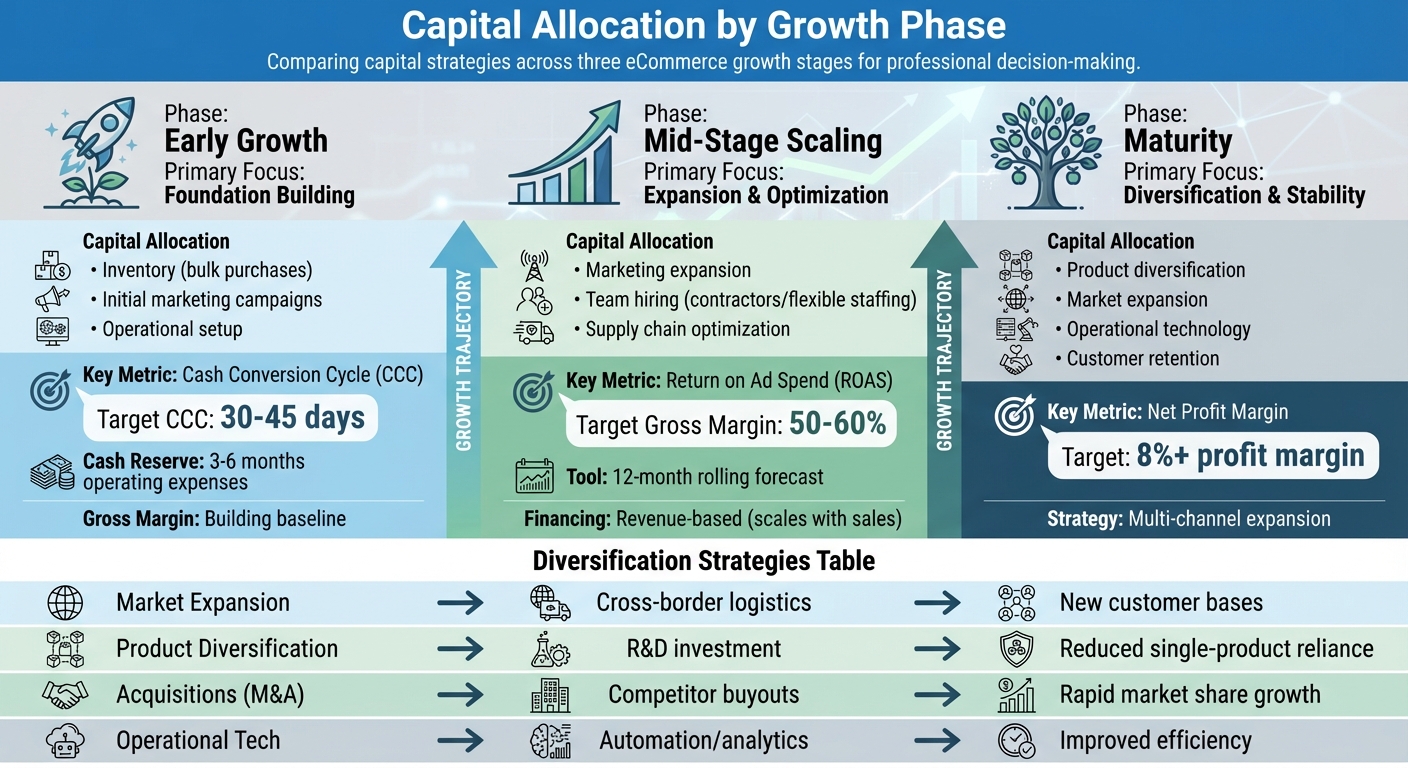
As your business grows, how you allocate capital should evolve to match your current phase of development. Each stage - early growth, scaling, and maturity - demands a different focus to ensure resources are spent wisely. Misallocating funds to the wrong areas at the wrong time can lead to inefficiencies and lost opportunities.
Let’s break down how capital allocation shifts across these growth phases to support operational success.
Funding Early Growth Operations
In the early stages, the focus is on laying a solid foundation. The first priority is securing inventory and stabilizing your supply chain. Use capital to purchase inventory in bulk, which not only helps you save through volume discounts but also ensures you’re prepared for surges in demand [2][1]. Keep a close eye on your working capital cycle - shortening it while maintaining a cash buffer can protect you from supply chain hiccups or delayed payments [10][11].
Marketing is the next critical area. Invest in digital ads and initial campaigns to drive traffic and introduce your brand to potential customers [2]. To maximize returns, don’t just target one-time holiday shoppers - allocate funds to email marketing and retargeting efforts to turn them into loyal, repeat buyers [1]. Lastly, ensure your operational infrastructure is ready to handle growth, including fulfillment, shipping, and website maintenance [2]. Negotiating better payment terms with suppliers or securing bulk discounts can also help preserve cash flow [1].
Financing Mid-Stage Expansion
Once your sales are consistent, it’s time to scale. At this stage, capital should go toward marketing expansion, hiring, and optimizing your supply chain. For consumer brands, maintaining a gross margin of 50–60% is key to profitability during this period [12]. Regularly review margins at the SKU level to catch and address rising costs before they impact your bottom line [12].
To stay ahead of potential cash flow issues, use a 12-month rolling forecast. This allows you to spot gaps early and adjust spending accordingly. Be mindful of payment processor delays - these can range from 1 to 5 business days - and plan ad spend and inventory restocks around them to avoid liquidity problems. Consider flexible staffing solutions, like contractors or third-party services, to adapt quickly to market changes without overcommitting to full-time hires. Revenue-based financing can be particularly helpful here, as repayment scales with sales, making it easier to manage seasonal fluctuations [2][13].
Funding Diversification in Mature Businesses
For established businesses, the focus shifts to diversification and ensuring long-term stability. This might involve expanding into new markets, launching additional product lines, or adopting advanced technologies [3][13].
Customer retention becomes a top priority. Invest in retargeting and email campaigns to keep your existing customer base engaged [1]. Use data analytics to streamline logistics and prevent capital from being tied up in inefficient supply chains [3]. Upskilling your management team is another smart move, especially as operations grow more complex with multi-channel or international expansions [13]. Bridge financing can also provide short-term liquidity during major capital raises. For example, Icelandic Glacial used this strategy in 2025 to continue expanding its brand while waiting for a new investor’s due diligence process to wrap up [3].
Using Revenue-Based Financing for Flexible Capital Access
Revenue-based financing takes a unique approach to funding that fits the way eCommerce businesses operate. Instead of locking you into fixed monthly payments, Onramp Funds ties repayments to a percentage of your monthly revenue - typically between 5–15%. This means your payments adjust as your sales fluctuate, making it easier to manage cash flow during different growth phases. Whether you're stocking up for the holiday rush, testing out a new marketing strategy, or branching into marketplaces like TikTok Shop or Walmart, this repayment model helps you navigate seasonal cycles and strategic investments with ease.
This flexibility is especially useful when you're making big moves, like purchasing inventory in bulk or launching a major ad campaign. Need to ramp up for peak season or adapt to changes in marketplace algorithms? Revenue-based financing gives you quick access to the capital you need - sometimes in as little as 24 hours. This can be a game-changer for brands dealing with fluctuating revenue or seasonal spikes in demand.
One of the standout features of revenue-based financing is that it's non-dilutive. You maintain full ownership of your business, and there’s no need for personal guarantees or collateral. Plus, the repayment terms are straightforward: you pay back the capital along with a flat fee, with no compounding interest. You’ll know exactly what you owe, and the repayment timeline adjusts based on how quickly your sales come in.
As mentioned earlier, syncing repayments with sales cycles is key to managing growth effectively. In the early stages, this type of financing provides fast access to funds for inventory and marketing without the stress of fixed debt. During expansion, it supports scaling into new channels and making bulk purchases. For established businesses, it keeps cash flow steady while funding variable sales channels or seasonal marketing efforts. It’s best suited for short- to mid-term projects with clear returns, rather than long-term initiatives with uncertain outcomes.
Fixed Fee Structure vs. Revenue-Based Financing
Knowing when to use a fixed fee structure versus revenue-based financing can help you pick the right funding option for your needs. Here's a quick comparison:
Fixed fee structures are ideal when your revenue is steady, and you’re planning for long-term investments like upgrading technology or purchasing equipment. On the other hand, revenue-based financing shines in situations where sales are less predictable, allowing you to align repayments with your revenue cycles. This approach helps reduce financial strain and keeps your working capital intact during slower periods.
sbb-itb-d7b5115
Making Investment Decisions with ROI Analysis
When it comes to allocating capital, the smartest approach starts with targeting investments that deliver measurable returns. Instead of spreading resources thin across every opportunity, seasoned sellers zero in on areas that yield concrete results. Metrics like customer acquisition cost (CAC), lifetime value (LTV), conversion rates, and average order value (AOV) are essential. These numbers reveal whether your spending - on marketing channels, inventory, or website upgrades - is actually paying off. By focusing on these key indicators, you can build a solid foundation for detailed ROI analysis, which should guide every financial decision you make.
It’s all about balancing what you spend with what you gain. For instance, consider a $10,000 Facebook ad campaign that generates $40,000 in sales at a 25% profit margin. That’s a 100% return on investment. Compare that to a $10,000 bulk inventory purchase that secures a 15% supplier discount, offering ongoing savings. Both scenarios yield returns, but the value depends on your business stage and cash flow needs.
Timing is another critical factor. During peak seasons, allocating funds to inventory and fulfillment ensures you avoid stockouts, safeguarding revenue. On the flip side, slower periods might be better suited for investments like website upgrades or customer retention strategies, which can deliver better returns than chasing new customers. The goal is to tailor your investments to your business’s growth stage rather than applying a one-size-fits-all strategy.
Before committing funds, assess whether the repayment terms align with your growth projections. For financed investments - whether for campaigns or inventory - the returns must cover the cost of capital and still leave room for profit. Real-time tools can help you monitor performance and adjust underperforming investments quickly. Now, let’s dive into identifying high-return opportunities across different growth phases.
Finding High-Return Investment Opportunities
Building on ROI analysis, experienced sellers focus on investments that directly drive growth. These opportunities vary depending on your business stage. Early on, capital is best spent on digital marketing and inventory purchasing, as these directly boost sales and establish your presence in the market. As your business grows, the focus shifts toward improving infrastructure - think one-click checkout, mobile optimization, and faster fulfillment. While these upgrades might not seem as exciting as launching a new ad campaign, they ensure that every dollar spent on driving traffic translates into revenue.
Prioritize marketing channels that consistently perform well. For example, if Google Shopping ads deliver a 4:1 return while TikTok ads are barely breaking even, allocate more funding to Google until TikTok proves its worth. The same principle applies to product launches - test on a small scale, measure the results, and then scale up successful strategies. Bulk inventory purchases can also offer strong returns by lowering per-unit costs and unlocking supplier discounts, freeing up funds for other critical investments.
For mature businesses, diversification becomes a key strategy. This could mean expanding into related product lines, exploring new sales channels like Walmart or TikTok Shop, or investing in automation to cut operational costs. Use your cash conversion cycle data to pinpoint where your capital is tied up the longest, and target those bottlenecks with strategic investments. Even small changes - like negotiating better payment terms with suppliers or speeding up fulfillment - can free up significant cash flow for reinvestment.
Finally, don’t underestimate the ROI of maintaining reliable operations. Investments in shipping reliability, inventory management systems, and customer service help you avoid the hidden costs of stockouts, late deliveries, and poor reviews. These may not be flashy moves, but they protect your revenue during high-demand periods and lay the groundwork for sustainable growth over time.
Setting Up Governance and Monitoring Systems
Effective governance is the backbone of managing your capital through various growth cycles. Once you've identified high-return opportunities, it's crucial to establish strict rules for how and when capital is allocated. Without clear boundaries, it's easy to overcommit - especially during periods of strong sales when reinvesting everything feels tempting. A rules-based allocation system can help by defining specific limits for spending, timing, and triggers for funding decisions. For instance, you might create a rule to always maintain a set cash reserve, ensuring you're prepared for unexpected disruptions without scrambling for emergency funding [4]. Similarly, setting safety stock thresholds can prevent stockouts that hurt your search rankings and customer trust [4].
These systems work best when they’re tied to measurable metrics, reinforcing the investment strategies and ROI evaluations mentioned earlier. For example, tracking your Cash Conversion Cycle (CCC) can show where your cash is tied up and for how long [10]. Monitoring your current ratio (current assets divided by current liabilities) provides a quick snapshot of liquidity - aiming for a ratio between 1.5 and 2 is typically a healthy target [11]. Keeping an eye on net cash flow and ending cash balance ensures you're spending within your means and maintaining enough liquidity for future growth phases. If your burn rate (cash outflow) starts to exceed your forecast, it's a clear signal to adjust spending immediately. These principles create a structured foundation for the governance measures outlined below, seamlessly integrating with earlier metrics like the CCC and current ratio.
Building Rules-Based Allocation Systems
To avoid overextending resources, start by setting clear spending limits. Decide how much profit will go toward reinvestment versus reserves to maintain a balanced financial position [15]. Another essential guideline is to maintain relationships with alternative suppliers, even if their costs are 10–20% higher. This ensures supply chain stability during disruptions [4].
Your capital allocation should align with your business cycle. For seasonal businesses, consider on-demand funding strategies that secure capital only when inventory needs surge, rather than tying up cash in excess stock year-round [15]. When choosing financing options, look for lenders that don’t charge fees for unused credit facilities, as these fees can add unnecessary costs [14]. Additionally, require data-backed justifications for any funding requests. Before drawing on capital, review your profit and loss statements, cash flow forecasts, and sales projections to confirm the investment aligns with your growth goals and repayment capacity [15].
Once these spending limits are in place, it’s important to monitor them consistently to ensure compliance.
Tracking Financial Health with Real-Time Tools
Real-time visibility into your finances is crucial for staying on top of your cash flow. Tools like Shopify Marketplace Connect can consolidate data from multiple channels, giving you a clear picture of where your capital is being allocated. CashFlowTool integrates with QuickBooks to automate reporting, saving time and reducing errors. For financing, platforms like Onramp Funds offer flexible capital solutions with repayments tied to sales performance, making it easier to match funding with revenue cycles [4].
Establish a regular review process - monthly reviews work well - to audit key financial metrics. Keep an eye on Days Sales Outstanding (DSO) to track how quickly you’re collecting payments, and monitor Days Inventory Outstanding (DIO) to ensure inventory isn’t sitting idle for too long [10]. Watch for red flags, like sudden spikes in DSO at quarter-end or rising DIO without corresponding revenue increases, as these could indicate weak credit controls or inaccurate forecasting [16]. Leveraging demand-sensing tools can significantly reduce forecasting errors - by up to 40% - freeing up cash that would otherwise be tied to excess inventory [16].
Key Takeaways for Multi-Cycle Capital Planning
Effectively managing capital through multiple growth cycles boils down to three main strategies: controlling cash flow, aligning spending with your business stage, and leveraging flexible financing options. Since cash flow problems account for 82% of small business failures[17], it's critical to borrow only what’s necessary - and only for initiatives that drive significant results. This could mean purchasing inventory ahead of peak seasons or investing in marketing campaigns with a clear return on investment (ROI)[17].
Once you’ve got a handle on cash flow, align your budgeting with your current growth phase. A phased budgeting approach ensures every dollar serves a purpose. For example:
- Early-stage sellers prioritize validating their product and building up initial inventory.
- Mid-stage businesses focus on scaling sales channels and improving operational systems.
- Established brands shift their attention to diversifying their offerings and expanding market share[17].
Flexible financing, like revenue-based models, can also be a game-changer. This type of financing adjusts your repayment amounts based on sales performance. For instance, Onramp Funds’ revenue-based financing allows higher repayments during strong sales periods and lowers the burden during slower months, helping you maintain liquidity when it’s most needed[19][20].
Finally, using real-time data and automation tools to track cash flow and profit margins is essential. Regular monitoring can alert you to early signs of declining profitability[18][19]. For Amazon FBA sellers specifically, keeping profit margins above 8% is a key benchmark to ensure the long-term health of your business[19].
FAQs
How can I identify which growth phase my eCommerce business is in?
To pinpoint your business's growth phase, start by examining its financial and operational patterns. Most eCommerce businesses progress through six stages - starting from initial sales, scaling up, and eventually reaching mature growth. Each stage comes with its own set of markers, like revenue patterns, cash flow demands, and investment needs.
Here’s how to figure it out:
- Assess your financial health: Calculate your working capital by subtracting current liabilities from current assets. For instance, if your ratio is below 1.5, it could signal cash-flow challenges. On the other hand, a solid ratio combined with increasing sales might mean you're scaling or moving into mature growth.
- Monitor revenue and cash flow: Check your revenue growth over time and compare it to key milestones, like reaching $10,000 in monthly sales or exceeding $100,000. If you’re consistently facing cash shortages, it could indicate you're in a phase that requires tighter cash-flow management.
- Analyze operational performance: Pay attention to metrics such as inventory turnover, supplier payment terms, and marketing ROI. These can help determine if you’re still building market share or shifting focus toward efficiency and profitability.
By evaluating these factors, you’ll get a clear picture of where your business stands in its growth cycle, helping you make smarter decisions about where to allocate resources and how to plan for the future.
What is the cash conversion cycle (CCC) and why does it matter for your business?
The cash conversion cycle (CCC) gauges the time it takes for a business to turn cash spent on inventory and operations into cash received from sales. Simply put, it measures the gap between paying your suppliers and getting paid by your customers.
Why does this matter? A shorter CCC can significantly boost cash flow, ease financial pressure, and allow for greater flexibility to reinvest in growth opportunities. By fine-tuning your CCC, you can manage working capital more effectively, expand operations smoothly, and stay financially steady - even when navigating rapid growth or market shifts.
What are the benefits of revenue-based financing for eCommerce businesses?
Revenue-based financing offers eCommerce businesses a way to access funding without giving up equity. Instead of handing over a piece of your business, you repay the financing through a small, fixed percentage of your monthly revenue. This means payments adjust naturally - higher when sales are booming and lower during slower months.
This approach gives sellers the ability to invest in key growth areas, like stocking up on inventory, ramping up marketing, or expanding operations, without dealing with collateral or rigid loan terms. It’s a practical way to support growth while keeping your business financially steady.
Related Blog Posts
Onramp Funds
Funding built around your sales
Connect your store and see what you qualify for. Repay as a percentage of sales, with no personal credit check.
Funding in as little as 24 hours.
