


When you’re running an eCommerce business, funding decisions are more than just numbers - they’re tied to your growth, future, and peace of mind. Emotions like fear, risk aversion, or overconfidence often influence these choices, leading to missed opportunities or costly mistakes. But emotions aren’t the enemy - they’re part of the process. The key is balancing emotional instincts with data-driven strategies.
Here’s how to make better funding decisions:
- Understand Emotional Traps: Fear of debt can block growth, risk aversion may limit potential, and overconfidence could lead to overextending.
- Use Data to Decide: Leverage tools and sales metrics from platforms like Shopify and Amazon to guide decisions objectively.
- Set Clear Goals: Define specific funding needs and repayment plans to stay aligned with your business’s cash flow.
Modern funding options, like revenue-based financing, can reduce stress by offering flexible repayment tied to sales. Onramp Funds simplifies this process with fast funding, transparent costs, and personalized support, making it easier to focus on growing your business without unnecessary emotional strain.
Why Emotional Control Decides Who Wins in Business
sbb-itb-d7b5115
Common Emotional Challenges in eCommerce Funding Decisions
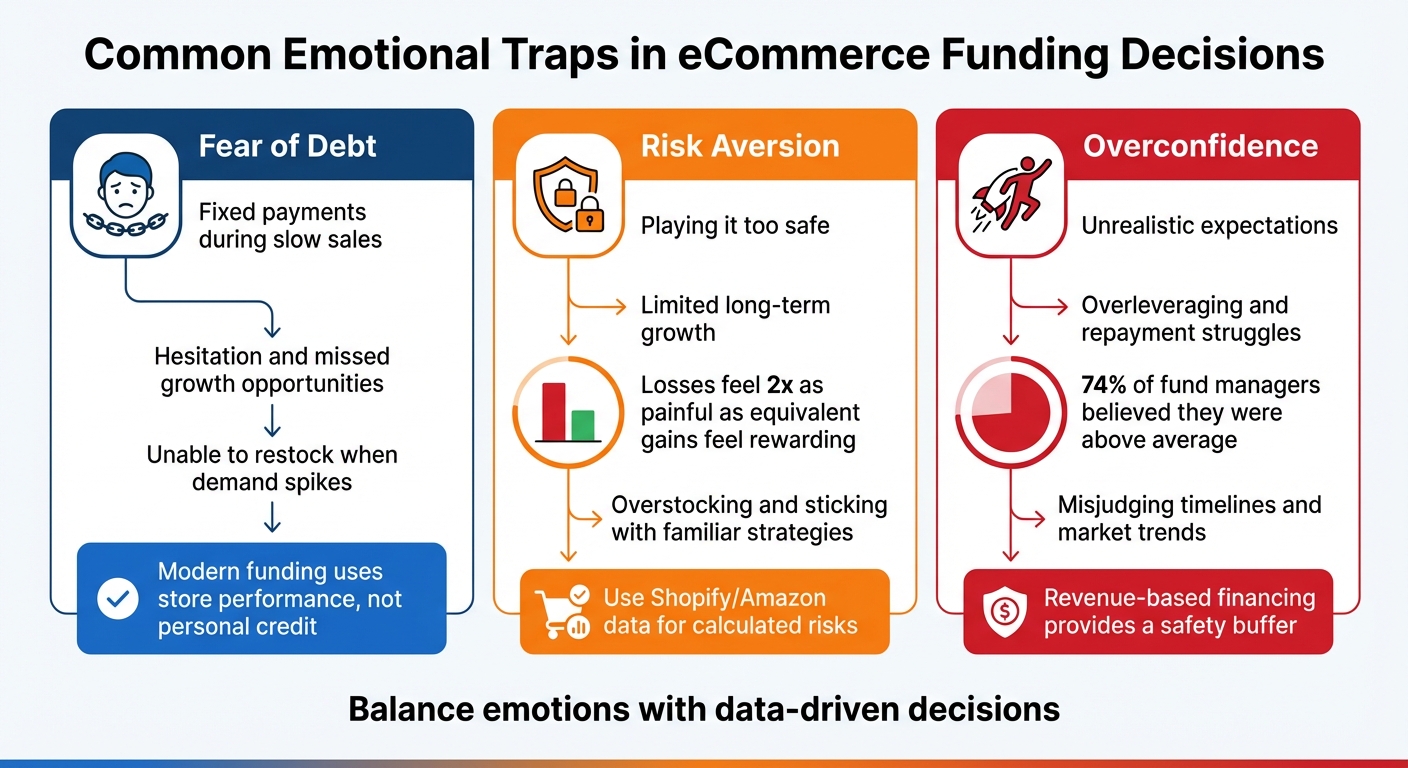
Making funding decisions for your eCommerce business can feel like walking a tightrope. Emotions often play a bigger role than we realize, and understanding them is key to making smarter choices. Let’s break down three common emotional hurdles: fear of debt, risk aversion, and overconfidence. Each comes with its own challenges, but recognizing them can help you stay focused on growth.
Fear of Debt
The word "debt" alone can make many sellers uneasy. It’s not just about owing money - it’s the fear of having fixed payments during slower sales periods or being unable to restock inventory when demand spikes. For some, this fear is amplified by the personal financial risks tied to traditional loans, like credit checks or collateral. These concerns often lead to hesitation or even complete inaction, which can result in missed opportunities to scale your business.
Here’s the good news: modern funding options are designed to ease these fears. Many now rely on your store’s performance data rather than your personal credit score, offering unsecured funding that keeps your personal and business finances separate. This shift makes it easier to approach funding decisions with clarity and confidence.[1]
Risk Aversion
Risk aversion isn’t just about being careful - it’s about focusing too much on potential downsides while ignoring the possible benefits. Studies show that losses feel about twice as painful as equivalent gains feel rewarding.[2] This psychological quirk often drives sellers to play it safe, sticking with familiar strategies or overstocking inventory to avoid running out of popular products. While these choices might reduce short-term risks, they can also limit long-term growth.
The antidote? Data. Platforms like Shopify and Amazon provide performance metrics that can help you make informed, calculated decisions. Instead of letting fear hold you back, you can use these insights to identify opportunities and take well-measured risks.
But while caution can be stifling, overconfidence on the other end of the spectrum can be just as risky.
Overconfidence in Funding Choices
On the flip side, some sellers dive headfirst into funding decisions with too much confidence. This can lead to unrealistic expectations, like assuming a new product launch will generate instant returns or that market trends will always work in your favor. The reality? Success often takes longer than expected, and misjudging timelines can leave you struggling to manage repayments.
A striking example of this bias comes from a survey of 300 professional fund managers - 74% believed they were above average at investing.[3] Overestimating your abilities can lead to overleveraging during peak seasons, which might create repayment challenges down the line.
"I knew that no matter how confident I was in making any single bet, that I could still be wrong." - Ray Dalio, Founder, Bridgewater & Associates[3]
Awareness is the first step to avoiding this trap. Funding models that tie repayments to your actual sales, like revenue-based financing, can provide a buffer. They allow you to pursue growth without overextending yourself, helping you stay grounded even when confidence runs high.
Strategies to Balance Emotions and Rational Thinking
Now that you've pinpointed emotional traps, here's how to keep your decision-making on solid ground.
Recognizing Emotional Biases
Emotions can cloud judgment, so the first step is to recognize when they're influencing your decisions. For instance, confirmation bias might lead you to focus only on information that supports a funding opportunity, ignoring red flags in your cash flow data. Similarly, anchoring could cause you to fixate on an initial loan amount, even if updated sales data suggests a different need [4].
To challenge these biases, try listing reasons not to accept the funding. If you can't come up with any, it might indicate bias [4]. A decision checklist can also help. Include objective benchmarks like minimum profit margins or maximum debt-to-revenue ratios to ensure your choices are guided by logic rather than emotions [5].
"Be fearful when others are greedy and greedy when others are fearful." - Warren Buffett, Chairman and CEO, Berkshire Hathaway [5]
Once you've acknowledged these biases, let your sales data guide you past emotional noise.
Using Data-Driven Tools
Your sales data is a powerful ally against emotional traps. Many modern funding platforms now allow you to link your store - whether on Amazon, Shopify, or TikTok Shop - directly to their systems. This integration provides real-time performance metrics, eliminating guesswork and ensuring funding offers are based on actual numbers [1].
Tools like funding calculators can also shed light on how different repayment structures will impact your cash flow. For example, businesses generating at least $10,000 in monthly sales can often receive pre-qualification estimates in as little as one minute [1]. These tools make it easier to assess options with clarity and confidence.
Setting Clear Financial Goals
Pair your data insights with well-defined financial goals to make informed funding decisions. Replace vague aims like "I need funding to grow" with specific, measurable targets. For example, say, "I need $25,000 for Q4 inventory, which I’ll repay with holiday sales deposits." Additionally, determine what percentage of your monthly revenue you're comfortable allocating to repayments. This approach helps you avoid overextending and ensures your funding aligns with your business's current stage and cash flow capacity [1].
How Onramp Funds Reduces Emotional Stress in eCommerce Financing
Managing finances in eCommerce can be stressful. Onramp Funds steps in to simplify the process, offering solutions designed to reduce the mental strain of financing decisions. With quick access to funds, clear terms, and personalized support, they tackle the most common challenges eCommerce sellers face. Here's how they help ease financial stress.
Fast and Flexible Funding
Waiting for funding can amplify stress, especially when time is critical. Onramp Funds provides access to financing in under 24 hours, ensuring you can get the funds you need by the next day [1]. They offer three funding options tailored to different needs:
- Variable: Repayments adjust automatically based on your sales, so slower months mean lower payments.
- Fixed: Predictable monthly installments for easier planning.
- Rolling Cash Line: A revolving credit line that grows alongside your business.
This flexibility allows sellers to choose a structure that aligns with their financial situation, reducing the fear of taking on debt.
"Having the flexibility to draw funds as we need them has been a game changer for our growth. Andrew and his team's communication and customer service are always excellent - I know I have a true partner with Onramp." - John Doe, CEO at Curriculum [1]
Transparent and Predictable Costs
Unclear fees can create unnecessary anxiety. Onramp Funds eliminates this by using a flat-fee structure ranging from 2% to 8% of the funded amount, with all costs disclosed upfront [6][8]. The funding is unsecured, meaning no collateral is required [1][7]. For sellers with at least $10,000 in monthly sales, this straightforward approach transforms financing into a practical, stress-free tool.
Personalized Support for eCommerce Sellers
What sets Onramp Funds apart is their emphasis on human support. While automation is helpful, it can’t address every concern. Their team works directly with sellers, analyzing sales history and projections to structure financing that makes sense for each business [1]. This hands-on approach helps sellers avoid overly optimistic decisions and ensures funding aligns with their growth capacity.
With a Trustpilot rating of 4.9/5 based on 227 reviews, many eCommerce sellers value this personalized, collaborative approach. It’s not just about providing funds - it’s about building a partnership that lightens the emotional load of financial decisions.
Conclusion
eCommerce funding is a mix of numbers and emotions - leaning too heavily on one while ignoring the other can lead to poor decisions. The challenge lies in striking a balance: combining logical analysis with gut instincts while understanding the emotional weight of taking on debt or scaling your business.
As psychologist Daniel Kahneman wisely said, "True intuitive expertise is learned from prolonged experience with good feedback on mistakes" [9]. This highlights the importance of learning from experience and refining intuition - principles that align with Onramp Funds' philosophy. By recognizing biases, setting clear goals, and aligning funding structures with actual cash flow, you can create a strategy that truly reflects your business's performance.
Onramp Funds makes this process less stressful by simplifying financing. With funding available in under 24 hours, a transparent flat-fee pricing model of 2-8%, and repayment plans tied to sales deposits, they turn financing into a practical tool for growth [1]. Their focus on working with real people who understand the unique challenges of eCommerce ensures you're treated as more than just another customer. This approach helps shift financing from a source of anxiety to a strategic advantage.
When you combine emotional awareness with data-driven decisions, funding becomes a calculated move toward growth. For eCommerce sellers generating $10,000 or more in monthly sales, partnering with Onramp Funds offers not just capital but also the support and flexibility needed to grow without the burden of hidden fees or rigid repayment terms. It’s about more than just funding - it’s about gaining a partner in your journey toward success.
FAQs
How do I know if fear is driving my funding decision?
If you're unsure whether fear is affecting your funding decision, take a moment to reflect. Are emotions like decision anxiety, fear of taking on debt, or risk aversion holding you back? These feelings can cause hesitation, leading to overly cautious behavior and delays - even when funding could be beneficial for your business. When worry or fear outweighs logical reasoning, it’s a strong sign that emotions are driving your choices. Developing self-awareness can help you strike the right balance between your feelings and practical decision-making.
What numbers should I check before taking funding?
Before you commit to funding, it's crucial to take a hard look at your financial situation. Start by analyzing your gross merchandise volume (GMV) and current sales deposits to understand your revenue flow. Next, check your profit margins and cash flow to ensure you can handle repayment without putting too much pressure on your operations.
Don’t stop there - dig deeper into your inventory turnover and operating expenses to identify any potential inefficiencies. Finally, assess your existing debt to determine if you're in a position to responsibly take on more funding.
By grounding your decisions in these numbers, you can avoid letting emotions - like overconfidence or fear of debt - cloud your judgment. A clear financial picture will help you make smarter, more balanced choices.
How much of my monthly sales can I safely repay?
Balancing your cash flow and risk tolerance is key to determining how much you can safely repay. One approach is to opt for a flexible repayment model, such as allocating about 1% of your gross merchandise volume (GMV). This method can help reduce financial pressure. Make sure your repayment plan aligns with your profit margins while keeping your cash flow steady. If you're unsure, it's always a good idea to evaluate your specific financial situation and consult a financial advisor for guidance.
Related Blog Posts
Onramp Funds
Funding built around your sales
Connect your store and see what you qualify for. Repay as a percentage of sales, with no personal credit check.
Funding in as little as 24 hours.
