

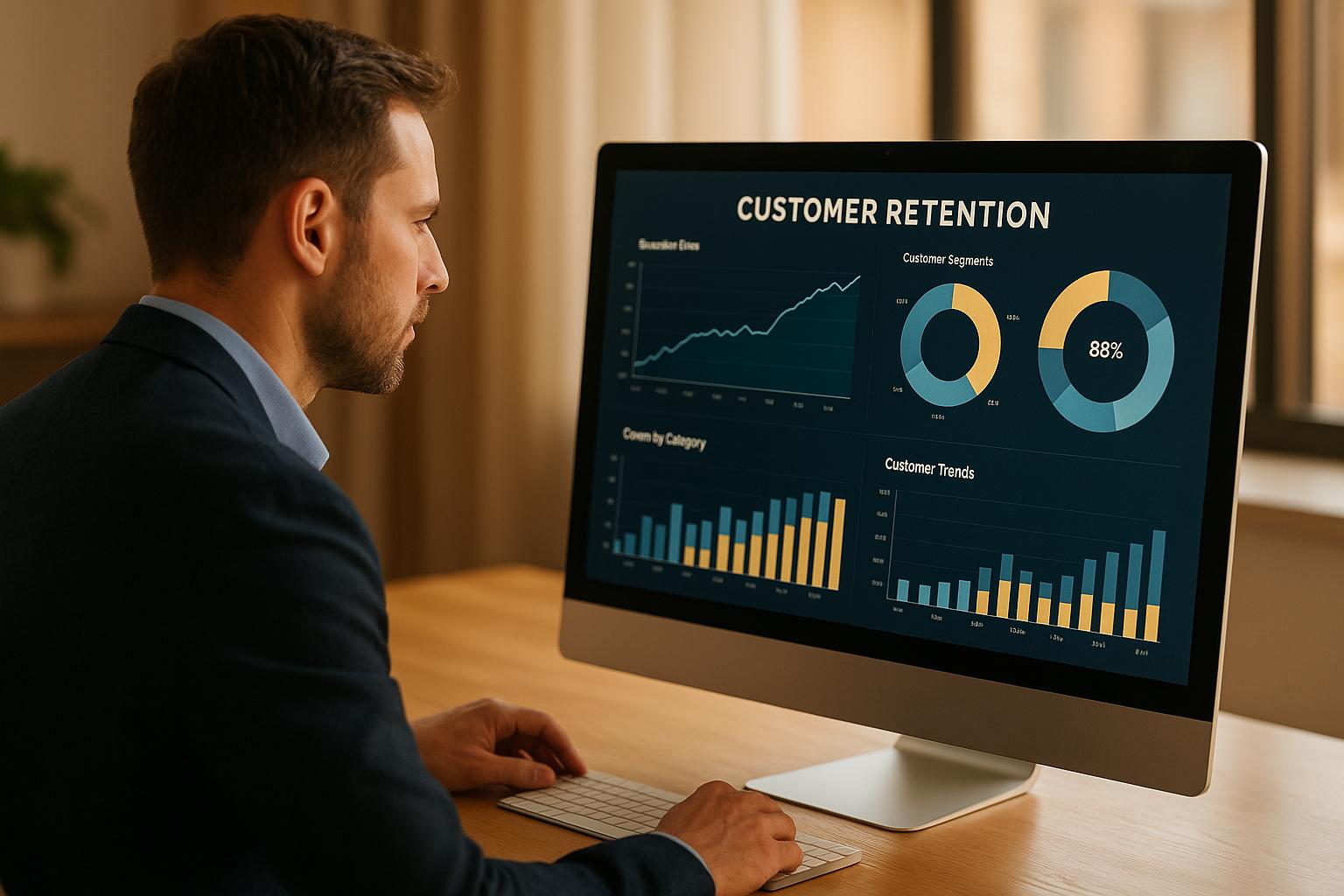
Predictive analytics is transforming how businesses retain customers by shifting from reactive methods to proactive insights. Instead of waiting for signs of dissatisfaction, companies can now predict and prevent churn before it happens. Here's why it matters:
- Retention is cost-effective: Keeping customers costs 5–25x less than acquiring new ones. Plus, loyal customers spend 67% more than new ones.
- Predictive analytics works smarter: By analyzing customer behavior (purchase patterns, engagement, etc.), it predicts churn with up to 90% accuracy, enabling early intervention.
- Personalization drives loyalty: Tailored experiences based on data increase satisfaction and repeat purchases by 20–30%.
- Better ROI: Companies using predictive analytics report 15–25% lower churn rates and 20–30% higher customer lifetime value.
Churn Risk Analytics: How to Predict and Prevent Customer Loss
Standard Customer Retention Strategies: Challenges and Limitations
For years, traditional retention methods have been the backbone of eCommerce. While they’ve served their purpose, they often fall short in meeting the demands of today’s customers, who expect more personalized and proactive engagement. It’s clear that these conventional approaches, while useful, need a fresh perspective to stay relevant.
Overview of Standard Retention Tactics
Here are some of the most common strategies businesses use to retain customers:
- Loyalty programs: These reward customers with points, discounts, or exclusive perks for their repeat purchases.
- Email marketing: Aimed at nurturing customer relationships, these campaigns often include targeted promotions and onboarding sequences to encourage repeat business.
- Customer service improvements: Simplifying account management and making repeat purchases easier are key aspects of this approach.
- SMS marketing: Known for its effectiveness, SMS boasts a 98% open rate and a 42% read rate. Referral programs also fall into this category, offering incentives for both existing and new customers [3].
Limitations of Standard Methods
Despite their widespread use, these strategies have several shortcomings:
- Reactive, not proactive: Many of these methods address issues only after they occur, rather than preventing them in the first place.
- Lack of personalization: This is a major drawback. Research shows that 63% of customers abandon brands due to poor personalization, while 80% prefer businesses that deliver tailored experiences [4].
- High acquisition costs: The cost of acquiring new customers has skyrocketed by 222% in recent years [7]. Yet, 63% of marketers still prioritize acquisition over retention, even though retaining a customer is up to seven times cheaper [4]. This focus is concerning, given that the average eCommerce retention rate hovers between 30% and 38% [5].
- Rising customer expectations: Over 60% of customers now expect better service standards, and 61% would switch to a competitor after just one bad experience [4].
- Scalability issues: As businesses grow, managing personalized interactions manually becomes almost impossible without leveraging advanced data-driven tools.
As Jeff Bezos once said, “If you build a great experience, customers tell each other about that. Word of mouth is very powerful” [6]. Shopify Staff echoed this sentiment, noting, “Satisfaction isn’t enough. A happy customer might still leave if a competitor offers a better deal or if the experience doesn’t meet their expectations consistently” [7].
These limitations highlight the need for a more forward-thinking approach, paving the way for predictive analytics to revolutionize customer retention strategies.
Predictive Analytics: Changing Customer Retention Strategies
Traditional retention methods often leave businesses scrambling to react after customers have already left. Predictive analytics flips this script by enabling companies to anticipate and prevent churn before it happens. This shift marks a major evolution in how eCommerce businesses approach customer relationships. Let’s explore how predictive analytics uses data to forecast churn and guide targeted retention efforts.
How Predictive Analytics Works in Retention
Predictive analytics takes customer data and turns it into actionable insights. By applying statistical techniques and machine learning algorithms, it uncovers patterns and predicts future behaviors. The process starts with gathering various types of customer information, such as purchase history, browsing habits, marketing engagement, and transaction frequency. This data is then analyzed to assign a churn probability score to each customer, highlighting those at risk of leaving. Unlike traditional methods that only react after churn occurs, this approach provides an early warning system.
"It's all about the quality and quantity of your data. The more robust your real-time and historical data, the more accurate your churn prediction models will be. The more accurate your churn predictions are, the more customers you can retain."
– Jessica Schanzer, Lead Product Marketing Manager at Klaviyo [8]
Key metrics tracked by predictive analytics include declining purchase frequency, reduced average order value, increased time since the last interaction, excessive browsing without buying, and negative reviews. These indicators paint a detailed picture of customer behavior that manual analysis simply can't match at scale.
For example, ASOS utilized Azure Machine Learning to create churn prediction models based on customer data like purchase patterns, browsing history, and responses to marketing campaigns. By identifying early signs of disengagement, they sent tailored incentives to at-risk customers. This strategy led to lower churn rates, higher customer lifetime value, better campaign ROI, and shorter purchase intervals [9]. Once customers are flagged as at-risk, businesses can segment them into high, medium, and low-risk groups. This segmentation allows for customized interventions while also uncovering the reasons behind potential churn, enabling companies to address specific issues with personalized solutions.
Benefits of Predictive Analytics in Retention
Predictive analytics offers a range of benefits that can reshape retention strategies. First, it improves forecasting accuracy, helping businesses allocate resources more effectively. Well-trained models can achieve churn prediction accuracy rates of 85–95%, giving companies confidence in their approach [10]. The financial impact is equally compelling - businesses using predictive analytics report 20% lower churn rates, a 15% boost in revenue, and improved customer satisfaction. In fact, 75% of eCommerce companies using this technology see a 15% increase in retention, and retaining customers is far more cost-efficient than acquiring new ones [10].
Another major advantage is personalization on a large scale. For instance, one fashion retailer analyzed customer behavior both online and in-store. By predicting individual preferences and offering tailored promotions, they saw a 20% rise in repeat purchases within six months [12]. Similarly, Netflix uses predictive analytics to study viewing habits and recommend content, contributing to an impressive 93% retention rate [12].
In another example, a global retail chain identified that long checkout lines were driving customers away. By introducing self-checkout kiosks and offering personalized incentives, they managed to increase retention rates by 20% [1]. This targeted approach ensures that resources are focused on high-risk customers, avoiding the inefficiency of generic campaigns.
The broader trend in the industry underscores the growing importance of data-driven retention strategies. AI-powered predictive marketing is expected to generate an additional $800 billion in global eCommerce revenue by 2027, with 80% of retailers projected to adopt predictive analytics by 2026. Furthermore, 92% of executives believe this technology will be critical for business survival in the next three years. Companies using predictive models have reported 20–30% reductions in churn rates and 10–15% increases in customer lifetime value within the first year [10].
These outcomes show that predictive analytics is no longer just a technological tool - it’s becoming essential for eCommerce businesses aiming to build stronger, longer-lasting customer relationships.
sbb-itb-d7b5115
Comparison: Predictive Analytics vs. Standard Retention Methods
Building on the earlier discussion about the advantages of predictive analytics, let’s dive into how it stacks up against traditional retention methods. While both aim to keep customers engaged, their approaches to data and decision-making differ in significant ways. These differences highlight why businesses are increasingly turning to predictive analytics for better retention outcomes.
Traditional retention strategies rely heavily on analyzing past customer behavior. They look at historical patterns to identify trends and then create reactive strategies. For instance, if a company notices customers tend to stop purchasing after three months, it might send generic win-back emails to all customers who haven’t made a purchase recently. This approach often depends on broad assumptions and basic segmentation, which can lead to generalized, less effective campaigns.
Predictive analytics, on the other hand, takes a forward-looking approach. By leveraging machine learning and statistical techniques, it predicts future customer actions, enabling businesses to act before problems arise. This proactive method allows companies to address potential issues while customers are still engaged, rather than waiting until they’ve already left.
The timing difference is key. Traditional methods respond after churn happens, but predictive analytics can identify changes in customer behavior up to six weeks before churn occurs, giving businesses a valuable intervention window [18].
Key Areas of Comparison
Businesses using predictive analytics for retention report impressive results: an average return on investment (ROI) of 5 to 10 times their initial spending, a 15–25% reduction in churn, and a 20–30% increase in customer lifetime value [16][18]. These metrics highlight the stark contrast between predictive analytics and traditional methods.
Accuracy is another major differentiator. Predictive models can forecast churn with up to 90% accuracy and predict customer behavior with over 85% accuracy using digital interaction data like clickstream analysis [16][18]. In contrast, traditional methods rely on subjective predictions and historical averages, which lack the precision of predictive analytics [17].
Predictive analytics also enables businesses to create highly personalized customer experiences. By analyzing individual behavior and intent, companies can tailor interactions, leading to a 20–30% boost in customer satisfaction [16]. Traditional approaches, which often rely on basic demographic segmentation, struggle to achieve this level of relevance.
Predictive analytics drives better marketing results, with success rates 30–40% higher than traditional methods [14]. This is largely due to its ability to deliver the right message to the right customer at the right time, rather than relying on generic campaigns.
The complexity of implementation is another factor to consider. Traditional methods often use spreadsheets and basic business intelligence tools, requiring analysts with moderate data skills. Predictive analytics, however, depends on high-quality historical and real-time data, scalable computing platforms, and skilled data scientists who specialize in machine learning [13]. While this adds to the initial investment, the long-term benefits far outweigh the costs.
Beyond retention rates, predictive analytics delivers financial gains across the board. It can improve retention by 10–15%, increase customer value by 25%, and reduce losses from attrition by up to 20% [14]. These benefits grow over time, creating a competitive edge that traditional methods simply can’t match.
For eCommerce businesses deciding between these approaches, the choice often comes down to resources and growth goals. Traditional methods may require less upfront investment, but predictive analytics offers far better returns and scalability in the long run.
Implementing Predictive Analytics for Retention Success
Switching from traditional retention methods to predictive analytics can feel like a big leap, but when approached methodically, the results often speak for themselves. Predictive analytics allows you to anticipate customer behavior and take action before issues arise, giving you a significant edge in retaining customers. By breaking the process into clear steps and ensuring you have the right resources, you can transform your retention strategy into a powerful, data-driven system.
Steps to Integrate Predictive Analytics
Start by setting clear retention goals. Whether your focus is reducing churn or increasing customer lifetime value, these objectives will guide your data strategy.
Next, gather data from all relevant touchpoints - transactions, website activity, and customer service interactions. Once collected, clean the data by addressing inconsistencies, removing outliers, and filling any gaps. High-quality data is the foundation for reliable insights.
Once your data is ready, build and test predictive models using historical data. Refine these models to ensure they produce actionable insights. When you're confident in their accuracy, deploy them to process data in real time, providing insights that can immediately influence decision-making. But don’t stop there - customer behavior evolves, so your models should too. Regular monitoring and updates are key.
For example, Willow Tree Boutique used predictive analytics to identify high-value customers - those with a projected lifetime value exceeding $500. By targeting this group, they achieved impressive revenue growth [19].
Building the right team is equally important. Bring together data analysts, AI experts, and marketers to ensure insights are translated into practical strategies. Neeti Singhal Mahajan, Vice President of Strategy and Insights at Daily Harvest, highlights the value of this approach:
"Many traditional business functions like operations, demand planning, and corporate finance wind up doing some kind of predictive tasks that rely heavily on assumptions and rules of thumb. Letting the data drive and temper our own assumptions [made us] dramatically more accurate on average with our predictions." [11]
Creating a data-driven culture is another critical step. Train your team to use new tools effectively and encourage decisions based on insights rather than gut feelings. For instance, Tamburlaine Organic Wines worked with a data analyst to implement Shopify Functions that adjusted pricing based on membership duration, sales trends, and customer behavior. This strategy led to an 88% increase in sales [2].
Once your predictive analytics framework is operational, the next challenge is securing funding to scale these efforts.
Funding Predictive Analytics Initiatives
Scaling predictive analytics requires financial resources, but the return on investment often justifies the initial costs. Expenses typically include hiring data scientists, upgrading analytics platforms, integrating data systems, and training staff on data governance. While these upfront costs can seem high, organizations that embrace predictive analytics often achieve 2–3 times the ROI compared to those with less advanced capabilities.
To manage these costs, consider revenue-based financing. This model allows businesses to repay a percentage of their sales rather than fixed monthly payments, easing cash flow pressures during the rollout phase. Companies like Onramp Funds specialize in this type of funding, providing equity-free solutions tailored to eCommerce businesses.
The payoff can be substantial. Many organizations see results within 6–12 months. For example, financial firms adopting predictive analytics have reported a 250–500% ROI in the first year, along with a 25% reduction in operational costs and a 30% boost in customer retention [20].
As your capabilities grow, you can expand from basic churn prediction to more advanced applications like personalized pricing, inventory management, and targeted cross-selling. Predictive models that enable real-time, personalized interventions not only improve retention but also provide a competitive edge. Consistent funding ensures you can sustain and scale these efforts. Troy Petrunoff, Senior Retention Marketing Manager at Every Man Jack, underscores this value:
"I trust and value Klaviyo AI because it saves me time, it helps me leverage our customer data to personalize our email timing and strategies." [19]
The time savings and improved personalization offered by predictive analytics are game-changers for retention and ROI.
Conclusion: The Future of Retention in eCommerce
The evolution from traditional retention methods to predictive analytics is reshaping how eCommerce businesses approach customer retention. Instead of relying on past sales reports or instinct, predictive analytics taps into historical and real-time data to anticipate trends and behaviors. This shift allows businesses to take proactive steps rather than scrambling to react after the fact [15].
Recent data highlights the impact of AI-driven retention strategies. Companies using these methods have reported reductions in churn rates by 10–30% and increases in customer lifetime value by 20–50%. By leveraging data, businesses are also achieving higher repeat purchase rates, underscoring the effectiveness of this approach [21].
Looking ahead, predictive analytics is expected to become the norm by 2025. Tools will analyze everything from customer location to purchase history and preferences, with global eCommerce sales projected to surpass $6.8 trillion - making up 21% of all retail sales worldwide [15]. These systems can predict customer behavior with over 85% accuracy and identify engagement shifts up to six weeks before churn occurs [18]. This foresight lets businesses intervene early, addressing potential issues before they escalate.
Of course, adopting predictive analytics requires investment. Implementation costs can be substantial, which is why flexible funding options are becoming essential [2][23]. Revenue-based financing is emerging as a practical solution, aligning repayments with cash flow. This model is particularly useful for seasonal businesses or those investing in new technologies [22].
Flexible funding plays a vital role:
"Revenue-based financing is reshaping how eCommerce businesses access capital. By offering a flexible, performance-based repayment structure, it provides an attractive alternative to traditional debt and equity financing."
- martini.ai blog [22]
Companies like Onramp Funds are making it easier for eCommerce businesses to invest in predictive analytics without giving up equity or committing to rigid repayment schedules. With repayments tied to a percentage of sales, businesses can scale their analytics capabilities while maintaining financial flexibility. This adaptability supports the transition to proactive, data-driven retention strategies.
The future of customer retention lies in anticipating customer needs rather than reacting to them. Predictive analytics is poised to become the driving force behind eCommerce growth. The real question is: Is your business ready to embrace this transformation? For those looking to stay ahead, combining predictive analytics with flexible funding solutions offers an unmatched opportunity to turn customer retention into a powerful growth engine.
FAQs
How does predictive analytics help improve customer retention in eCommerce?
Predictive analytics helps eCommerce businesses keep their customers by spotting signs of potential churn before it happens. By examining real-time data and applying machine learning, it forecasts future behaviors, like identifying which customers might stop interacting or making purchases.
This approach goes beyond traditional methods that simply analyze past data to explain events. Instead, predictive analytics delivers forward-looking insights, allowing businesses to anticipate customer needs. With this information, they can tailor their outreach, provide well-timed incentives, and enhance overall satisfaction. The result? Happier customers, stronger loyalty, and improved retention rates.
What are the first steps for using predictive analytics to improve customer retention?
To dive into predictive analytics for customer retention, the first step is to gather detailed historical data about your customers. This includes information like their purchase history, engagement habits, and general behavior patterns. This kind of data lays the groundwork for spotting trends and making predictions about future actions.
Once you have the data, use machine learning and statistical models to analyze it. These tools can help reveal patterns and predict outcomes, such as which customers are at risk of leaving or which ones might become high-value clients. With these insights, you can segment your audience and create targeted strategies - think personalized offers or reaching out proactively to those who might churn.
Lastly, make sure your data is accurate, adhere to privacy regulations, and integrate these insights smoothly into your customer engagement processes. By doing this, you'll be able to build a retention strategy that's driven by data and designed for success.
What financial benefits can eCommerce businesses expect by using predictive analytics for customer retention?
Using predictive analytics as part of customer retention strategies can bring measurable financial advantages to eCommerce businesses. By pinpointing customers who are likely to leave and tailoring marketing efforts to their needs, companies can minimize churn, strengthen loyalty, and maximize customer lifetime value. Plus, keeping current customers is significantly cheaper than attracting new ones - often costing up to five times less.
The payoff from predictive analytics lies in increased revenue from loyal customers and reduced marketing costs. Businesses that use these tools often see better retention rates, which translates into steady, long-term growth.
Related Blog Posts
Onramp Funds
Funding built around your sales
Connect your store and see what you qualify for. Repay as a percentage of sales, with no personal credit check.
Funding in as little as 24 hours.
