

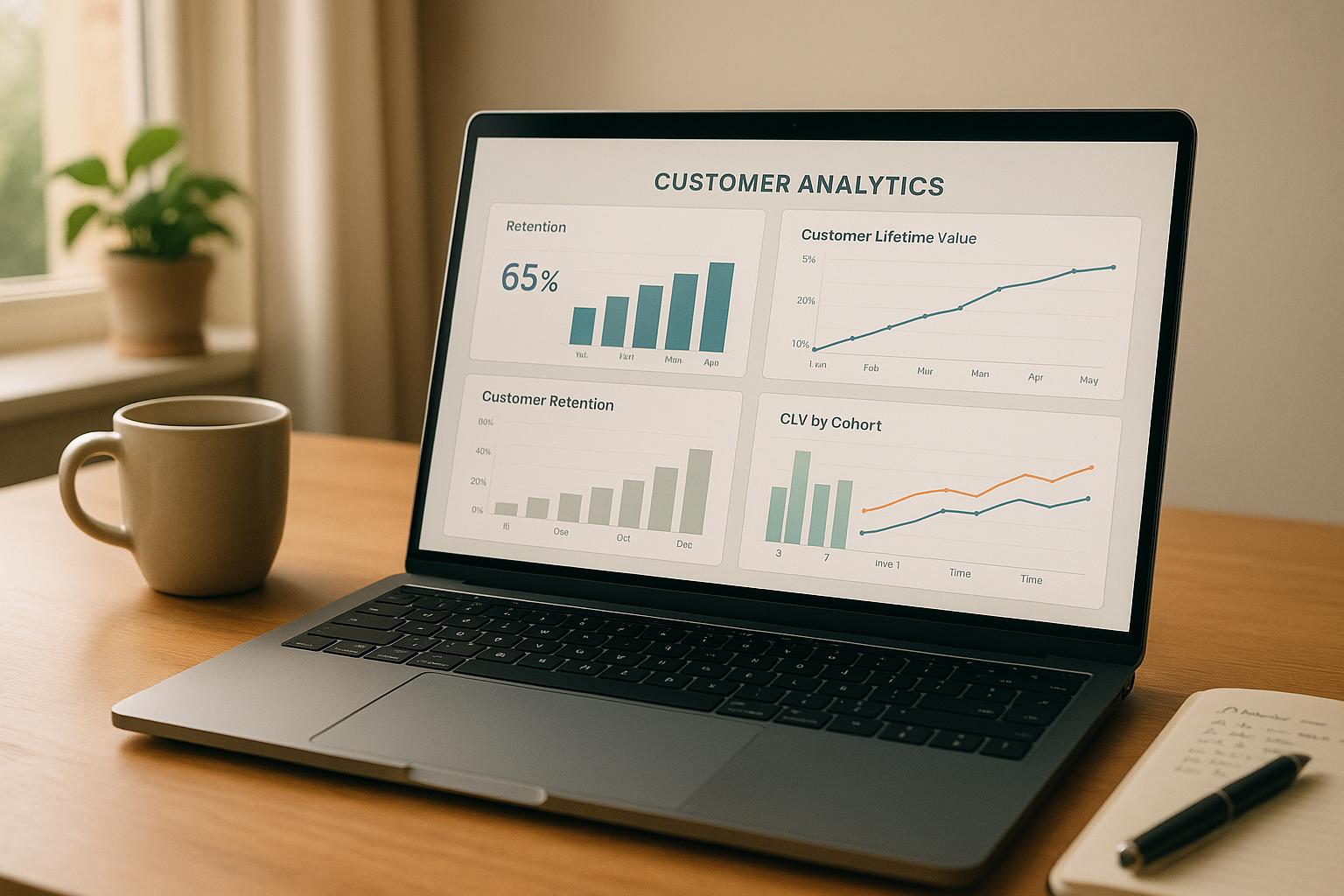
Retention metrics are the driving force behind boosting Customer Lifetime Value (CLV). Why? Because keeping customers loyal is far more cost-effective than acquiring new ones. Here’s what you need to know:
- Retention = Higher Profits: A 5% increase in retention can boost profits by 25% to 95%.
- Returning Customers Spend More: Repeat buyers spend 3x more than first-timers.
- Retention Metrics Matter: Metrics like Customer Retention Rate (CRR), Repeat Purchase Rate (RPR), and churn rate help predict and improve CLV.
Key metrics and KPIs for retention marketing
What Is Customer Lifetime Value (CLV)?
Customer Lifetime Value (CLV) is the total revenue a business can expect to earn from a single customer over the entire duration of their relationship. Unlike metrics that focus on one-off transactions, CLV takes a broader view, summing up all purchases a customer makes over time.
Calculating CLV involves several key components: the average purchase value, how often customers buy (purchase frequency), the length of time they remain customers (customer lifespan), and profit margins. While the formula may seem complex, the insights it provides are invaluable. Instead of focusing solely on short-term sales, CLV encourages businesses to prioritize building long-term relationships with customers. This shift in perspective is crucial for understanding how CLV contributes to eCommerce growth.
Why CLV Matters for eCommerce Growth
CLV isn’t just a number - it’s a game-changer for long-term strategy. By focusing on the lifetime value of customers, eCommerce businesses can unlock several competitive advantages.
First, revenue forecasting becomes more accurate. CLV helps predict future income by focusing on the long-term value of customers rather than short-term sales spikes. This precision aids in better inventory planning, cash flow management, and strategic decisions.
Next, marketing budgets can be used more effectively. Knowing that different customer segments have varying lifetime values allows businesses to allocate resources wisely. For instance, they can spend more on acquiring customers likely to generate higher returns, ultimately reducing the overall cost of customer acquisition.
The financial benefits of CLV are hard to ignore. Retaining customers is far cheaper than acquiring new ones. Even a small increase in retention rates can lead to significant profit growth. This is why focusing on CLV often results in more sustainable growth compared to strategies centered solely on individual transactions.
Finally, customer prioritization becomes data-driven. The Pareto principle often applies here - a large chunk of revenue usually comes from a small group of high-value customers. By identifying and focusing on these customers, businesses can offer exclusive perks, personalized experiences, and premium services that boost loyalty and drive even more value.
3 Key Factors That Determine CLV
Three main factors shape CLV, and understanding these can help businesses identify opportunities to grow customer value. These elements don’t just stand alone - they interact in ways that can amplify their impact.
- Purchase Frequency: This measures how often customers buy from a business in a set time period. Naturally, customers who shop more often contribute more to CLV.
- Average Order Value: This is the amount customers spend per transaction. Even if two customers shop with the same frequency, the one spending more per order will have a higher CLV. Strategies like upselling, bundling, or offering premium products can help increase this value.
- Customer Lifespan: This reflects how long a customer stays engaged before they stop buying. A longer lifespan translates to higher overall value, even if purchase frequency or order amounts remain steady.
| CLV Factor | Revenue Impact | Improvement Strategies |
|---|---|---|
| Purchase Frequency | Multiplies revenue opportunities | Loyalty programs, subscription models, email campaigns |
| Average Order Value | Increases revenue per transaction | Upselling, bundling, offering premium products |
| Customer Lifespan | Extends revenue timeline | Retention programs, personalized experiences, excellent customer service |
These factors don’t just add up - they multiply each other’s effects. For example, a customer who shops more often might develop stronger loyalty, which could extend their lifespan. Similarly, someone who spends more per order might also engage more frequently, boosting their overall value.
The takeaway? Improving any one of these factors can positively impact CLV, but addressing all three can lead to exponential growth. This understanding is key for crafting strategies that not only retain customers but also drive long-term profitability.
Key Retention Metrics That Affect CLV
Retention metrics are essential for identifying loyal customers and spotting opportunities to improve Customer Lifetime Value (CLV).
Customer Retention Rate
Customer Retention Rate (CRR) measures the percentage of customers who continue doing business with you over a specific period. It’s a direct indicator of loyalty and how well you’re maintaining relationships with your existing customer base.
CRR Formula:
((Customers at end – New customers) / Customers at start) x 100
Top-performing companies often achieve impressive retention rates. For example, Amazon Prime maintains an annual retention rate of about 93%, and Apple boasts iPhone retention rates above 90% [1]. These high retention levels directly contribute to increased CLV.
To better understand loyalty drivers, segment your customer base by demographics and use cohort analysis. This approach highlights which groups are most engaged and where loyalty trends shift. Pay close attention to retention inflection points - periods when retention either dips or spikes - to uncover what’s influencing customer behavior.
From here, let’s explore how repeat purchases further amplify CLV.
Repeat Purchase Rate
Repeat Purchase Rate (RPR) tracks the percentage of customers who make additional purchases after their first transaction. Unlike retention rate, which focuses on time periods, RPR zeroes in on purchasing habits and reflects customer satisfaction.
High RPR often signals strong satisfaction. For instance, Amazon Prime members have repeat purchase rates exceeding 60% within 30 days, while Sephora’s Beauty Insider program achieves over 80% annually by offering personalized rewards and exclusive perks [1]. A good benchmark for e-commerce businesses typically falls between 20-40% [1].
The timing between purchases is another valuable insight. Analyzing how long it takes for customers to make a second purchase can help refine remarketing efforts. For example, Warby Parker found that customers who make a second purchase are 75% more likely to make a third, underscoring the importance of converting first-time buyers [1].
Comparing repeat purchase rates across acquisition channels can reveal which sources bring in the most loyal customers. This data helps fine-tune retention strategies and allocate marketing budgets more effectively.
RFM analysis (Recency, Frequency, Monetary) is another powerful tool. By segmenting customers based on their purchasing patterns, you can identify high-frequency buyers who often represent the greatest CLV potential. This segmentation lays the groundwork for targeted retention campaigns, which we’ll discuss further in later sections.
Churn Rate and Its Effect on CLV
Churn rate measures the percentage of customers who stop buying from your business within a specific timeframe. It’s essentially the opposite of retention rate and has a direct impact on CLV by shortening customer lifespans.
While acceptable churn rates vary across industries, understanding the drivers behind churn is critical for your business.
Analyzing churn by customer segments can pinpoint which groups are most vulnerable. High-value customers who churn have a disproportionate effect on CLV, making it essential to identify and address their concerns quickly.
Predictive analytics can help spot at-risk customers before they leave. Warning signs often include reduced purchase frequency, declining engagement with marketing content, or shifts in spending habits. Acting early is often more effective than trying to win customers back after they’ve left.
Exit surveys or interviews can provide direct insights into why customers leave. Common reasons include poor service, more attractive competitor offers, or changing needs. Addressing these root causes can significantly reduce churn.
| Metric | Focus of Calculation | CLV Impact | Key Insight |
|---|---|---|---|
| Customer Retention Rate | Percentage staying active | Extends customer lifespan | Measures loyalty strength |
| Repeat Purchase Rate | Percentage of repeat buyers | Boosts purchase frequency | Reflects satisfaction |
| Churn Rate | Percentage stopping purchases | Shortens customer lifespan | Highlights retention gaps |
How to Analyze Retention Metrics for CLV Growth
Understanding retention metrics is key to improving customer retention and driving Customer Lifetime Value (CLV). By digging into the data, you can uncover opportunities to strengthen customer relationships and boost long-term revenue.
Customer Segmentation for Better Data
Segmenting your customers is a powerful way to turn raw retention data into actionable insights. By grouping customers based on shared traits, you can identify high-value segments and tailor your retention strategies accordingly.
Here are some common segmentation methods:
- Demographic segmentation: Focus on factors like age, location, or income to identify patterns.
- Behavioral segmentation: Look at purchase frequency, spending habits, or product preferences.
- Psychographic segmentation: Consider lifestyle choices and values.
- Geographic segmentation: Analyze location-based behaviors.
For example, Threads Boutique effectively uses geographic segmentation by sending push notifications to customers near their physical store, encouraging in-person visits [5]. This approach bridges the gap between online and offline customer interactions, creating a more cohesive experience.
Since acquiring a new customer is six to seven times more expensive than retaining an existing one [3], segmentation helps allocate resources where they matter most. As Katherine Barchetti wisely said, "Make a customer, not a sale" [4].
Segmentation also helps identify high-value customers - those who shop frequently, spend more, or engage across multiple channels. These customers might benefit from loyalty programs or personalized experiences. At the same time, segmentation can highlight at-risk groups showing declining engagement, allowing you to target them with retention campaigns before they churn.
Once you've segmented your customers, cohort analysis can refine these insights even further.
Using Cohort Analysis to Track Retention Patterns
Cohort analysis takes customer segmentation a step further by grouping customers based on shared characteristics, such as their first purchase date. This method helps track retention over time and reveals trends that might be missed in broader metrics.
For instance, time-based cohorts group customers by when they first interacted with your business. A January 2023 cohort might show how retention trends compare to those from February 2023. This can help pinpoint acquisition periods that yield the most loyal customers.
Behavioral cohorts focus on specific actions or traits. For example, Dropbox discovered that users who engaged with shared folders within their first week were more likely to become long-term customers [6]. This insight allowed them to refine their onboarding process.
To implement cohort analysis, start by selecting a criterion, such as acquisition date. Track retention rates over time for each cohort and compare their performance. For example, Hootsuite might analyze a January 2023 sign-up cohort, splitting it into users who connected their social media accounts versus those who didn’t. This could confirm whether connecting accounts leads to better retention [7].
Cohort analysis is particularly valuable for SaaS businesses. By comparing retention rates across cohorts, companies can identify patterns, predict CLV, and even forecast revenue. However, patience is key - cohort analysis requires time to gather meaningful data [8].
Regular tracking of these metrics ensures you can act on these insights effectively.
Tracking Metrics Over Time
Consistent monitoring of retention metrics is essential for improving CLV. A one-time snapshot won’t reveal long-term trends, but regular tracking can highlight what’s working, what’s not, and where to adjust your strategies.
Start by documenting key metrics like retention rates, repeat purchase rates, and churn rates. Compare these against industry benchmarks: SaaS businesses typically aim for retention rates of 85–95%, while eCommerce businesses might target 20–30% [9]. Across industries, the average repeat purchase rate is 28.2% [2].
Tracking over time allows you to spot seasonal trends, gradual shifts, or sudden changes that could stem from external factors or internal adjustments. For example:
- HubSpot used predictive analytics to reduce monthly churn from 3.2% to 2.1% by analyzing customer behavior [9].
- Slack keeps churn low by monitoring user activity and re-engaging customers showing early signs of disengagement [9].
- Dropbox noticed higher churn among users who didn’t install their desktop app, prompting a targeted onboarding effort [9].
As Veronica Saha, Head of Analytics at Zoopla, explains:
"If you have a good retention rate, then you don't have to work as hard to acquire customers over and over again. Positive brand interactions create a flywheel - when you give your customers a great experience, they'll come back for more and you'll get to understand them better. This customer data then allows you to build more relevant experiences" [2].
Consistent tracking also supports experimentation. Test different retention strategies for various segments or cohorts, then measure the results. This iterative approach helps refine your methods and maximize their impact.
Over time, compare current metrics with historical data and benchmarks. Look for patterns in cancellations, shifts in customer lifespans, or behaviors linked to higher retention. This ongoing analysis lays the groundwork for data-driven decisions that directly enhance CLV.
sbb-itb-d7b5115
Proven Ways to Improve Retention and CLV
Boosting customer loyalty and lifetime value (CLV) requires strategies that build meaningful connections and deliver real benefits. By focusing on these areas, businesses can encourage repeat purchases and deepen customer engagement.
Setting Up Loyalty Programs
Loyalty programs are a proven way to increase retention and CLV. Members of such programs tend to spend significantly more - 13% to 40% more - than non-members, and 79% of consumers report buying more frequently from brands with loyalty programs [15][12][16]. The key? Keep the programs straightforward and rewarding.
Different types of loyalty programs work for different businesses. For instance:
- Points-based programs are great for businesses with frequent purchases, offering rewards like discounts or free items.
- Tiered programs encourage higher spending by unlocking better perks, such as free shipping or exclusive deals.
A great example comes from The Honest Kitchen, which used Yotpo to personalize rewards based on customer data. By tailoring content to individual pets and showing personalized rewards, their referral program’s opt-in rates soared to four times the industry average [14].
Amanda Kwasniewicz, VP of customer experience at Love Wellness, highlights why tailoring these experiences matters:
"Subscribers are a huge part of what keeps our DTC machine going, so we tailor our website experience to be able to identify active subscribers." [12]
Beyond loyalty programs, personalized marketing can further strengthen customer relationships.
Creating Targeted Marketing Campaigns
Marketing campaigns tailored to customer segments and past purchases can significantly boost conversions - by about 8% - and encourage repeat buying. In fact, 82.5% of customers are more likely to return when they feel understood [10][13].
To craft these campaigns, businesses often use RFM analysis (Recency, Frequency, Monetary value) to pinpoint different customer behaviors. For example, Mack Weldon uses email automation to follow up purchases with a simple "click to rate" widget and a product carousel featuring similar items with star ratings. This approach combines personalization with convenience [14].
Molly O'Connell, formerly of Gorgias, explains how automation can scale personalization:
"If you set up your automated email responses smartly, you can do personalization in a 1:many way." [12]
Other effective tactics include SMS campaigns and win-back emails to re-engage customers who might be drifting away. Adding a touch of surprise - like early access to sales or thoughtful gestures - can make a lasting impression.
While personalized campaigns are powerful, it’s equally important to balance engagement efforts with acquisition costs.
Balancing CLV and Customer Acquisition Cost
Striking the right balance between customer lifetime value and customer acquisition cost (CAC) is critical for sustainable growth. With 67% of brands now prioritizing retention over acquisition, it’s clear that keeping existing customers is often more profitable [13]. Even a 5% increase in retention rates can lead to a profit boost of 25% to 95%. Repeat customers not only spend 67% more than new ones but also account for 80% of future profits [10][11][15][14].
Referral programs can play a key role here. For example, Dia & Co’s referral initiative led to over 50,000 shared links, with 40,000 customers participating and an average of 22 conversions per day in the first month [14]. Similarly, Venus et Fleur’s unified approach to online and in-store experiences resulted in a 10–15% annual increase in average order value and a 12% drop in cart abandonment over three years [13].
Amanda Kwasniewicz from Love Wellness sums it up best:
"You have to play with both sides of the coin at the same time." [12]
Using Financing to Fund Retention and CLV Growth
Building strong customer retention often requires a significant upfront investment, and for many eCommerce businesses, this can be challenging without disrupting cash flow. Strategic financing offers a way to bridge the gap, providing the capital needed to implement retention strategies without straining resources.
Funding Retention-Building Activities
Retention-focused strategies demand immediate funding - whether it’s for marketing campaigns, expanding inventory, or improving customer service. These efforts may require an initial investment, but they can significantly boost customer lifetime value (CLV) by improving retention rates.
For example, personalized email and SMS campaigns keep customers engaged between purchases but require funding for automation tools and content creation. Loyalty programs, which encourage repeat business, need a solid setup and ongoing support to succeed. Expanding inventory allows businesses to offer a wider product selection, encouraging customers to return, while enhanced customer service - like adding live chat or phone support - builds trust and fosters loyalty.
The impact of retention investments is clear. A modest 5% increase in retention can lead to profit gains of 25% to 95% [17][18]. Repeat customers, though they make up only 21% of a brand’s customer base, contribute 44% of its revenue [18]. Exceptional customer service plays a key role too - 90% of Americans say it influences their decision to do business with a company [17], and 43% would stop buying from a brand after just one bad experience [18]. Offering multiple support channels, such as live chat, email, phone, and social media, requires funding but strengthens the trust needed for long-term loyalty.
Instead of waiting for surplus cash flow, flexible financing allows businesses to invest in these retention initiatives right away, positioning them for faster growth.
How Onramp Funds Supports CLV Growth
Flexible financing is a game-changer for businesses looking to overcome cash flow challenges. Onramp Funds provides fast, equity-free financing tailored to eCommerce needs, enabling businesses to invest in retention strategies without relying on traditional loans. Unlike fixed monthly payments, Onramp Funds uses a revenue-based repayment model, where payments are tied to sales. This means businesses pay more when sales are strong and less during slower periods, aligning perfectly with the ebb and flow of retention-driven growth.
The platform integrates with popular eCommerce platforms like Amazon, Shopify, BigCommerce, WooCommerce, Squarespace, Walmart Marketplace, and TikTok Shop. By connecting their stores, businesses can access funding in as little as 24 hours, giving them the agility to act on retention opportunities quickly.
Onramp Funds also offers a transparent fee structure, with fees ranging from 2% to 8% and no hidden costs or equity requirements. This allows businesses to invest in CLV-boosting activities without giving up ownership or control. Personalized support from their Austin-based team ensures that businesses - especially those generating at least $10,000 in monthly sales - receive tailored advice on using their funding effectively.
This approach empowers eCommerce businesses to implement impactful retention strategies, such as loyalty programs, personalized marketing, inventory expansion, and enhanced customer service, without waiting for organic cash flow growth. By addressing these needs promptly, businesses can accelerate CLV growth and set the stage for long-term success.
Conclusion: Using Retention Metrics to Drive Business Growth
Retention metrics are the backbone of lasting eCommerce success, shaping both customer lifetime value and overall profitability. It’s no secret that keeping a customer is far more cost-effective than acquiring a new one. In fact, existing customers spend about 67% more than new ones, making retention-focused strategies an essential part of any growth plan [23].
The best eCommerce brands don’t just aim to hold onto customers - they aim to maximize their value over time. Take Sephora, for example. Their Beauty Insider program is a masterclass in retention. By offering perks like birthday gifts, free samples, and bonus point multipliers, Sephora encourages repeat purchases and fosters deep loyalty [22].
"Building a robust customer retention program is not just about keeping customers; it's about building strong customer relationships that drive sustainable growth for your ecommerce business." - Shopify [19]
Metrics like retention rate, repeat purchase rate, and churn provide a clear window into where growth opportunities lie. Tracking these numbers and acting on the insights can give businesses a real edge. Nike’s Run Club app is a standout example. By creating a community around their brand, Nike keeps customers engaged far beyond a single transaction [22].
Retention strategies also deliver quantifiable results. Email marketing, for instance, boasts an impressive average ROI of 45:1 [21], and 80% of companies with loyalty programs report a positive return on investment [20]. These figures underline why taking action based on retention data is so critical.
To make retention efforts work, businesses must invest strategically. Whether it’s through personalized experiences, loyalty programs, or better customer service, every initiative should be evaluated based on its impact on retention metrics and customer lifetime value. For companies eager to scale retention strategies but constrained by cash flow, solutions like Onramp Funds offer the financial flexibility to make these investments possible.
Retention metrics are more than just numbers - they’re a roadmap to sustainable eCommerce growth. By focusing on the right data and aligning it with proven strategies, businesses can build resilience against market shifts and secure long-term success. When retention insights are paired with smart investments, the result is a competitive advantage that grows stronger over time.
FAQs
How do retention metrics affect Customer Lifetime Value (CLV) in eCommerce?
Retention metrics are essential for shaping Customer Lifetime Value (CLV) in eCommerce. They help measure how well a business keeps its customers coming back, offering a clear picture of customer loyalty and satisfaction. When retention rates go up, it means customers stick around longer, and that naturally translates to more revenue per customer.
On top of that, better retention means lower churn - fewer customers walking away. This not only boosts CLV but also cuts down on the costs tied to acquiring new customers. The money saved can then be funneled into growth-focused efforts like expanding inventory or launching marketing campaigns. For eCommerce sellers, keeping a close eye on retention metrics is a smart move for achieving steady growth and profitability.
What are the best ways to boost customer retention and increase customer lifetime value (CLV)?
Improving customer retention and boosting customer lifetime value (CLV) requires strategies that prioritize loyalty and encourage repeat purchases. Here are a few approaches that work well:
- Loyalty programs: Offering rewards for repeat purchases can strengthen relationships and keep customers coming back.
- Personalized experiences: Customizing marketing, product recommendations, and communication to match individual preferences makes customers feel valued.
- Outstanding customer service: Quick, helpful support builds trust and ensures customer satisfaction.
Beyond these, targeted email or SMS campaigns can keep customers engaged, while a smooth onboarding process helps set the tone for a positive experience. Consistently delivering value at every step is key to not only retaining customers but also creating a loyal, long-term customer base that drives revenue growth.
How can businesses effectively balance customer retention and acquisition to boost profitability?
Balancing customer retention with acquisition is crucial for boosting profitability. Retaining customers is often less expensive than bringing in new ones, and loyal customers tend to contribute more to your Customer Lifetime Value (CLV). Many businesses allocate about 60-70% of their marketing budget to retention efforts, especially as their customer base becomes more established.
To strike this balance, focus on reducing churn, enhancing customer satisfaction, and fostering loyalty through personalized experiences and well-targeted campaigns. Simultaneously, make sure your acquisition strategies are cost-effective and aimed at attracting high-value customers who are likely to stay engaged. When retention and acquisition efforts work hand in hand, businesses can achieve steady growth and long-term profitability.
Related Blog Posts
Onramp Funds
Funding built around your sales
Connect your store and see what you qualify for. Repay as a percentage of sales, with no personal credit check.
Funding in as little as 24 hours.
