


Expanding your eCommerce business across platforms like Amazon, Shopify, and TikTok Shop can unlock new revenue streams. But behind the growth, financial challenges often emerge, especially for small businesses. Platform fees, inventory demands, and delayed payouts can create cash flow gaps that strain your operations. For example:
- Platform Fees: Amazon charges up to 15% in referral fees, TikTok Shop takes a 6% cut, and Shopify has monthly fees up to $399.
- Inventory Costs: Managing stock across platforms can lead to overstocking or stockouts, tying up capital unnecessarily.
- Payment Delays: Amazon holds funds for 14 days, while TikTok deducts fees upfront, creating a mismatch between expenses and income.
To navigate these challenges, focus on high-performing platforms, streamline inventory management, and explore revenue-based financing to maintain liquidity. These strategies can help you manage costs while scaling your business sustainably.
Ecom Finance Experts Podcast: Gabe Andres on Cash Flow Management and Smart Financing
sbb-itb-d7b5115
The Hidden Costs of Operating on Multiple Platforms
On the surface, platform fees might seem like the biggest expense when expanding to multiple sales channels. But the real strain on your finances comes from the less obvious operational costs that quietly pile up. These hidden expenses can drain your working capital and leave your reserves stretched thin.
Platform Fees and Commissions
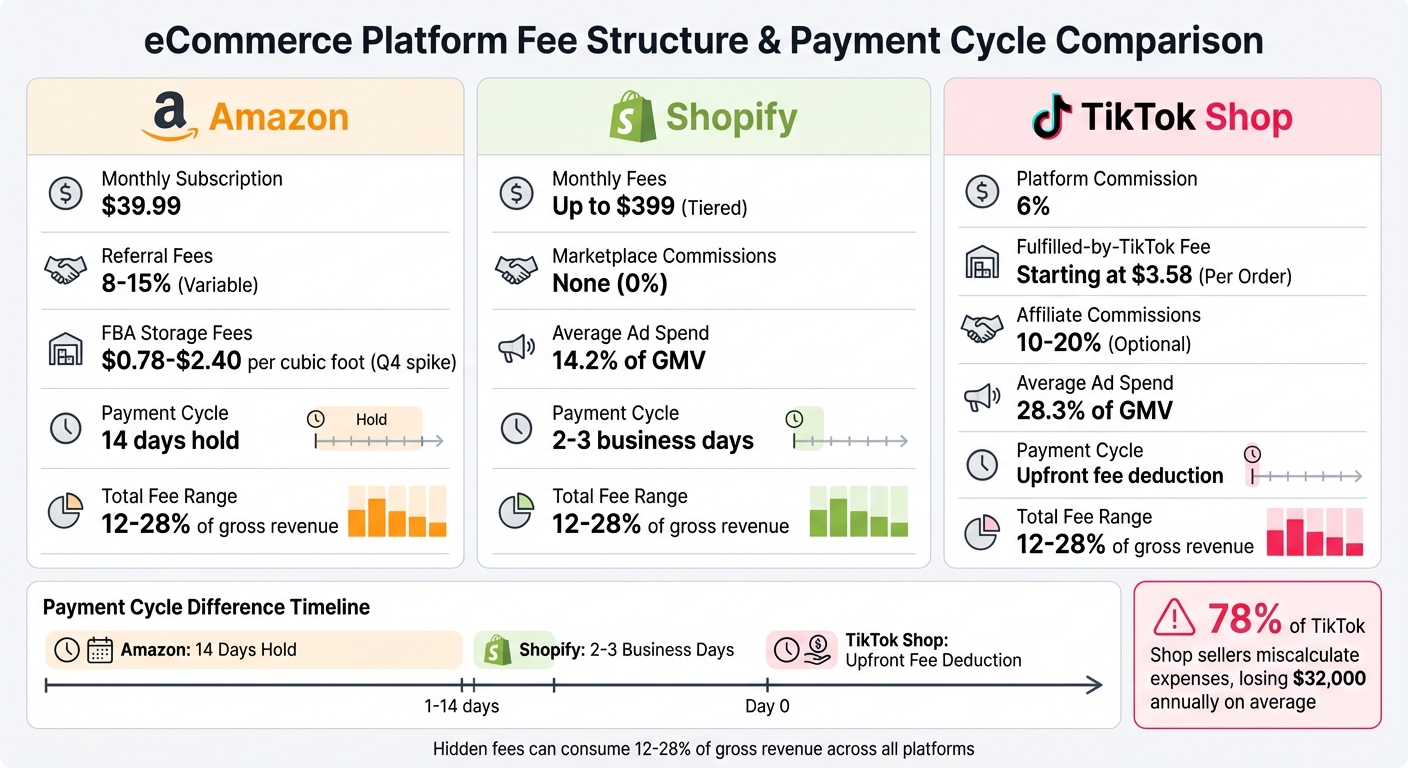
Every platform comes with its own fee structure, and these fees can quickly add up. For example, Amazon charges a $39.99 monthly subscription fee, referral fees ranging from 8–15%, and FBA storage fees that can spike from $0.78 to $2.40 per cubic foot during Q4 [1]. TikTok Shop, on the other hand, takes a 6% commission and has a Fulfilled-by-TikTok fee starting at $3.58. Sellers there also face affiliate commissions of 10–20% and ad spend that averages 28.3% of gross merchandise value (GMV) [4]. While Shopify avoids marketplace commissions, sellers still spend an average of 14.2% of GMV on ads to drive traffic [4]. Altogether, these hidden fees can eat up 12–28% of your gross revenue [4].
Muhammad Ali, Founder of Kixmon LLC, highlights this challenge: "TikTok has higher gross margin potential but can have lower net margin if you don't control your ad/affiliate costs tightly" [3].
And it's not just about the fees themselves. Many sellers underestimate their total costs - 78% of TikTok Shop sellers, for instance, miscalculate their expenses, leading to an average profit loss of $32,000 annually [2].
But platform fees are just the tip of the iceberg. Managing inventory across multiple channels introduces its own set of challenges.
Inventory Management and Storage Costs
Handling inventory across various warehouses can lead to what experts call "phantom inventory" - stock that exists physically but isn't accurately reflected in your systems [5][6]. This disconnect often results in costly problems. Stockouts, for instance, can hurt your product rankings, forcing you to overstock as a precaution, which ties up valuable capital. Globally, inventory distortions, including out-of-stock issues, cost retailers a staggering $1.8 trillion annually, with more than half of that loss attributed to stockouts [6].
Arron Bennett, Founder of Bennett Financials, puts it bluntly: "Selling on multiple channels sounds like a growth strategy until you realize your cash is scattered across three warehouses, two marketplace payment holds, and a pile of inventory that stopped moving six months ago" [5].
The problem becomes even more pronounced when you have excess stock on one platform but are out of stock on another. This mismatch locks up funds that could otherwise be used for critical restocking.
Integration and Operational Expenses
Adding more sales channels often means investing in additional software tools, which can quickly inflate your overhead. On average, expanding to another platform requires 2–3 new software subscriptions, costing between $350 and $600 per month before you've even made a sale [8]. A full suite of tools for inventory management, repricing, analytics, customer service, and accounting can push monthly expenses to $800–$1,400 [8].
Manual processes add even more costs. Processing purchase orders by hand can cost $50–$150 per order, and businesses with disconnected systems often waste 15–20 hours per month reconciling product data [6].
The Rithum Team notes: "The industry knows that disconnected systems are creating blind spots. But it's tough to find a fix when these gaps don't show up as line items on a budget" [6].
Payment delays across platforms further complicate matters. For example, Amazon holds funds for 14 days, while Shopify pays out in two. These timing mismatches can create liquidity gaps, especially when supplier payments are due [5]. Returns add yet another layer of expense, costing US online businesses over $800 billion annually, often due to inconsistent product data across platforms [6].
Together, these hidden costs create significant cash flow challenges, which we'll explore further in the next section.
Cash Flow Challenges in Multi-Platform Expansion
Strong sales don't always guarantee smooth sailing, especially when payment cycles don't align. The gap between paying suppliers and receiving marketplace payouts can leave you scrambling to cover expenses. Let's dig into how delayed payments, ad spend timing, and inventory demands can create serious cash flow headaches.
Delayed Payment Cycles and Settlement Times
Every platform has its own payout schedule, and these differences can create liquidity problems. For example, Amazon holds funds for 14 days, Shopify processes payments in 2–3 business days, and Walmart can take up to 14 days. If you're selling wholesale, payments might not arrive for 30–90 days [5].
"Different marketplaces pay out on different schedules. Amazon might hold funds for two weeks, while your Shopify payments arrive in two days. Even when sales are strong, these timing gaps create cash crunches", says Arron Bennett, Strategic CFO at Bennett Financials [5].
Adding to the pressure, inventory prepayments - often required 60 to 120 days before revenue is generated - further stretch your liquidity. On top of that, immediate deductions for ad spend and storage fees reduce your payouts, leaving less cash on hand for reinvesting in stock [5][7].
Returns also complicate matters. If a return takes up to 90 days to process, your funds and inventory remain in limbo, effectively unavailable for use [5].
Marketing and Advertising Budget Requirements
Cash flow issues don't stop with delayed payouts; upfront marketing costs can pile on the stress. Launching on a new platform often means spending heavily on ads right away, while revenue from these campaigns may take weeks to materialize. You're essentially fronting the cash for marketing while waiting for delayed sales proceeds.
The numbers can be daunting. TikTok Shop sellers, for instance, spend an average of 28.3% of their gross merchandise value on ads, while Shopify sellers allocate about 14.2% [4]. If you're running campaigns across multiple platforms at once, the out-of-pocket costs can snowball as you wait for staggered payments to roll in.
Supply Chain and Inventory Replenishment Costs
Inventory ties up significant amounts of capital, further complicating cash flow. Selling across multiple platforms often means stocking products in various locations or maintaining higher safety stock levels to avoid overselling. This can lock up 20–30% of your capital in warehouse inventory [5]. During peak seasons like Q4, you'll need even more working capital to keep up with demand.
The cash conversion cycle - the time between paying suppliers and receiving customer payments - becomes a critical factor. A longer cycle means tighter liquidity. You might find yourself needing to place new inventory orders while funds from previous sales are still tied up with marketplaces [5].
When inventory runs low, you're forced to make tough decisions. Do you prioritize high-margin channels like your direct website, or fulfill orders on high-fee marketplaces with slower payouts? Either way, you're walking a tightrope. A single misstep can lead to stockouts, hurting your rankings and wasting the ad dollars you've already spent [5].
Strategies to Bridge Hidden Capital Gaps
Overcoming cash flow challenges in eCommerce requires a mix of strategic focus, efficient operations, and adaptable funding solutions. These approaches help ensure capital remains available when needed.
Prioritize High-ROI Platforms
Concentrate your efforts on one or two channels where your target audience is most active. For instance, if you're selling consumer electronics, platforms like Amazon might be ideal. On the other hand, TikTok Shop could be a better fit for brands targeting younger demographics. The goal is to align your products with the platform that best matches your audience.
To gauge success, use the Marketing Efficiency Ratio (MER) instead of relying only on ROAS. MER compares total revenue to overall marketing spend, with a healthy range for most eCommerce brands falling between 3.0 and 5.0 [9]. Another useful metric is Lifetime Value (LTV) by source. A platform that attracts repeat customers may justify higher acquisition costs compared to one that primarily generates one-time buyers [9].
Beyond channel selection, managing inventory effectively is another critical step in maintaining smooth cash flow.
Optimize Inventory and Supply Chain Management
Centralized inventory tracking is essential to avoid overselling and costly rush fulfillment. A great example comes from Skullcandy, which adopted Shopify's unified commerce system in 2025. This change reduced their new product launch time from 1.5 days to just 30 minutes by eliminating synchronization delays [10].
When inventory runs low, prioritize fulfilling orders on higher-margin channels. Tools like ABC analysis can help allocate capital efficiently by focusing on top-performing products. Additionally, set automated reorder points and regularly audit inventory for dead stock. If 20–25% of your inventory remains unsold, it may signal a need for liquidation [5].
Use Flexible Financing Solutions
Revenue-based financing can help bridge the gap between supplier payments and marketplace payouts. Unlike traditional loans with fixed payments, these financing options adjust repayments based on your sales performance. Payments decrease during slow periods and increase when sales are strong.
This flexibility is particularly useful for managing staggered payment cycles across multiple platforms. It allows you to fund inventory, cover upfront advertising costs, and meet supplier Minimum Order Quantity requirements without being constrained by delayed payouts. Approval is quick - typically within 24–48 hours - and requires no collateral, with sales as low as $10,000 qualifying. Fees are transparent, ranging from 2–8%, which is far more manageable than merchant cash advances that can carry effective APRs exceeding 80% [11].
How Onramp Funds Supports Cross-Platform Growth
Fast, Flexible, and Equity-Free Financing
Onramp Funds provides a solution for businesses looking to expand across multiple platforms by offering revenue-based financing linked directly to daily sales. This means repayments flex with your sales - lower sales days or platform payout delays result in reduced payments, easing financial strain [11].
With approvals in under 24 hours and eligibility starting at just $10,000 in monthly sales, this financing option is quick and accessible [11]. Plus, there's no need to give up equity or provide personal guarantees, so you retain full ownership of your business while bridging cash flow gaps [11]. This fast and adaptable model is further supported by a straightforward fee structure, making it easier to manage operational costs.
Transparent Fees and Personalized Support
Onramp keeps things simple with a transparent fee structure ranging from 2–8%, while origination fees typically fall between 1–5% of the funded amount [11]. This straightforward approach is a relief when you're already juggling platform fees like TikTok Shop's 2–6%, Amazon's 15% baseline, or Shopify's payment processing costs. Unlike merchant cash advances, which can have effective APRs exceeding 80%, Onramp provides clear, upfront repayment terms [11].
The Austin-based team also offers tailored support to tackle cash flow challenges across platforms. Whether it's managing TikTok Shop's 10–30% creator payouts or covering Amazon's FBA storage fees, Onramp's approach is designed to fit seamlessly into your eCommerce operations.
Integration with Leading eCommerce Platforms
To streamline your cash flow management, Onramp offers seamless API integrations with top eCommerce platforms like Shopify, Amazon, Walmart Marketplace, and TikTok Shop [11]. These integrations pull real-time data - such as trailing 12-month revenue, order volume, return rates, and ad spend efficiency - so funding offers are accurate and require minimal paperwork.
Repayment is automated, with payments collected as a percentage of sales from your connected platforms. This eliminates the need to manually manage settlement cycles or coordinate payments across multiple channels. By aligning repayments with your cash flow, Onramp reduces administrative work and ensures your operations run smoothly [11].
Conclusion
Managing platform fees, inventory costs, and payment delays can create significant financial hurdles for eCommerce businesses. Expanding across platforms like Shopify, Amazon, and TikTok Shop offers exciting revenue opportunities, but it also introduces challenges that can strain cash flow. From platform-specific fees to juggling inventory across multiple channels and navigating staggered payment schedules, these factors can quickly lead to financial pressure. While cross-border eCommerce continues to grow, turning that growth into profitability often requires careful financial planning [12][14].
To scale effectively, businesses need to identify cash flow gaps early and address them with targeted strategies. Focus on channels that deliver the best return on investment, streamline your operations, and adopt flexible financing solutions to manage shortfalls. Choose platforms based on your products and margins, allocate inventory wisely to avoid tying up cash in slow-moving stock, and use financing options that adapt to your sales cycles. Experts caution that growth without profitability is risky - surging sales volumes can hide weak margins and high operational costs, which may eventually stall expansion [12][13].
Capital gaps don't have to slow your growth across platforms. Onramp Funds provides equity-free financing tailored for eCommerce businesses, offering approvals in under 24 hours, clear fee structures, and smooth integration with platforms like Shopify, Amazon, and TikTok Shop. With repayments that adjust based on your sales, you won't be burdened by fixed payments during slower months. If your business generates at least $10,000 in monthly sales, revenue-based financing can help bridge cash flow gaps and support steady, sustainable growth [11][12].
FAQs
How do I spot a hidden cash gap if sales are rising?
To spot hidden cash gaps during periods of rising sales, shift your attention from just revenue metrics to cash flow. A common red flag is when sales are climbing, but your available cash isn't keeping up. This can happen because of delayed payments across platforms or cash being locked up in inventory.
Key issues to watch for include mismatched timing between cash inflows and outflows, slow inventory turnover, or delays in receiving payments. Tackling these gaps early is crucial. Consider strategies like adjusting inventory levels, renegotiating payment terms with suppliers, or exploring flexible financing solutions to maintain steady cash flow.
What numbers best show if a platform is truly profitable?
The most trustworthy ways to gauge a platform's profitability are contribution margin and net profit. These metrics take into account factors like platform fees, fulfillment costs, returns, and other variable expenses. Relying solely on numbers like gross revenue or ROAS can paint a misleading picture, as they don't provide a full view of the platform's actual financial health.
What's the fastest way to free up cash tied in inventory?
Inventory financing is one of the fastest ways to free up cash locked in your stock. By using your inventory as collateral, you can access working capital in as little as 24 hours. The repayment terms are designed to be flexible, syncing with your sales to help you keep your cash flow steady while scaling your business.
Related Blog Posts
Onramp Funds
Funding built around your sales
Connect your store and see what you qualify for. Repay as a percentage of sales, with no personal credit check.
Funding in as little as 24 hours.
