


Running an eCommerce business means dealing with unpredictable cash flow. Traditional one-time loans, with fixed monthly payments, don’t align with fluctuating revenue, making them less practical for online sellers. Continuous capital solutions - like revenue-based financing and lines of credit - offer flexible, on-demand funding that adjusts to your sales cycles. These options help you cover inventory costs, seize growth opportunities, and manage seasonal slowdowns without financial strain.
Key Takeaways:
- Why One-Time Loans Fall Short: Fixed payments and static funding can cause cash flow issues during slow periods or rapid growth.
- How Continuous Capital Works: Access funds as needed, repay based on sales, and scale funding with your business.
- Benefits: Better inventory management, faster response to market trends, and stronger financial stability.
Switching to continuous capital can help eCommerce sellers thrive by aligning funding with their dynamic business needs.
Problems with One-Time Loans for eCommerce
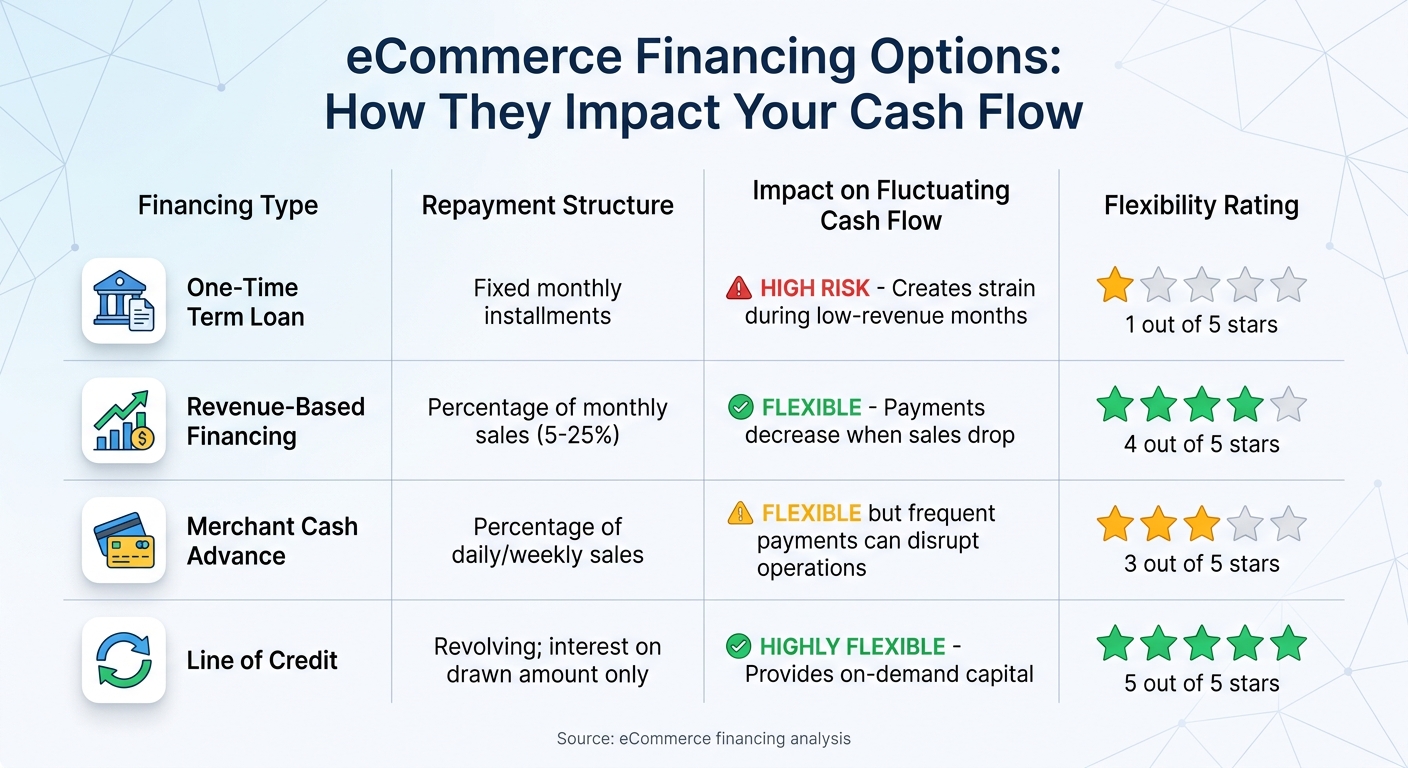
One-time loans often come with a fixed repayment structure and a single disbursement of funds. While this setup might work for businesses with steady income, it poses unique challenges for eCommerce sellers, whose revenue streams can be unpredictable. Let’s dive into the specific issues - like rigid repayment terms and limited flexibility - that make these loans less suited for online sellers.
Fixed Repayment Schedules
One major drawback of one-time loans is the unchanging monthly payment, regardless of how well your sales are performing. This might not be a problem during high-revenue seasons like Black Friday, but it can become a serious burden during slower periods, such as the post-holiday slump. eCommerce sales often follow a seasonal pattern, with significant peaks and inevitable lulls [2].
If your business experiences prolonged periods of slower growth, keeping up with fixed payments could drain your cash reserves, leading to financial strain - or worse, default [4]. This rigidity highlights the need for financing options that can adapt to your business's seasonal cycles.
Limited Flexibility for Operations
Another challenge with one-time loans is their lack of adaptability to the ongoing and often unpredictable needs of an eCommerce business. Whether it’s restocking inventory, launching a marketing campaign, or taking advantage of a supplier discount, these expenses can arise suddenly. Traditional loans don’t allow for additional draws, leaving businesses to either hold onto excess funds (and pay unnecessary interest) or scramble to secure new financing when opportunities or challenges pop up.
Static Funding in a Fast-Moving Market
The eCommerce industry moves quickly, with trends and customer preferences shifting in real time. A one-time loan, approved months earlier, might not be able to keep pace with sudden changes in demand. For instance, if a product unexpectedly goes viral, you might need to scale up inventory rapidly. A static loan simply isn’t agile enough to handle these kinds of situations effectively.
The rigid structure of one-time loans simply doesn’t align with the fast-paced, ever-changing nature of eCommerce. To thrive, businesses need funding solutions that can grow and shift alongside their needs. This is where continuous capital options can step in, offering a more adaptable approach to financing.
sbb-itb-d7b5115
Why Continuous Capital Access Works Better for eCommerce
Continuous funding solutions address the limitations of traditional one-time loans by aligning capital availability with the dynamic needs of eCommerce businesses. Instead of receiving a single, fixed lump sum with rigid repayment terms, sellers benefit from ongoing access to funds that adapt to their real-time requirements and sales performance.
Flexible Capital for Changing Needs
One of the standout benefits of continuous capital is the ability to access funds as needed. Business lines of credit, for instance, let sellers draw funds on demand while only paying interest on the amount they actually use [1][2]. This approach creates a financial safety net for recurring costs like inventory replenishment or seasonal marketing campaigns, without the burden of holding excess cash.
As funds are repaid, the credit limit refreshes, creating a cycle that aligns with the natural cash flow patterns of eCommerce businesses [2][4]. This flexibility is especially useful for seizing unexpected opportunities, such as bulk discounts from suppliers or leveraging a viral social media trend. Many continuous funding platforms can provide capital in as little as 24 hours [2][4].
This adaptable cash flow system naturally supports repayment models that adjust to the ups and downs of sales performance.
Repayment Based on Sales Performance
Revenue-based financing offers a repayment structure tied directly to sales, typically deducting 5% to 25% of monthly revenue until the balance is repaid [4]. This setup is particularly helpful during slower sales periods, as payments decrease when revenue dips.
"When you have a good month, your repayment is higher and you pay your loan off quicker. But if it's a slow month, the amount you pay back decreases, giving you some valuable breathing room." - Uncapped [4]
A great example of this flexibility in action is the fashion brand Hedoine. In late 2019, the company secured $50,000 in revenue-based funding to launch targeted Instagram and Facebook campaigns. This strategic use of capital resulted in a 1,106% increase in sales during the first quarter of 2020 [4]. Achieving such growth would have been far more challenging with a fixed-payment loan, which could have strained cash flow during the ramp-up phase.
This kind of repayment flexibility lays the groundwork for funding options that evolve alongside your business.
Funding That Grows with Your Business
Continuous funding doesn’t just adapt to your current needs - it scales with your business as it grows. Unlike static, one-time loans, this model adjusts automatically based on your turnover, ensuring sufficient capital during growth phases while avoiding excessive borrowing during slower times. Credit limits are typically tied to revenue, allowing them to expand as your business generates more income [4].
For example, Aura Bora, co-founded by Paul Voge, leveraged continuous funding to access credit limits 30 to 40 times higher than those offered by traditional banks. This allowed the company to bridge the gap between manufacturing expenses and retail payments [2].
"Access to higher limits and extended payment terms enables us to keep up with inventory without straining our working capital." - Paul Voge, Co-founder and CEO, Aura Bora [2]
With funding that grows alongside your business, there’s no need to repeatedly reapply for new loans, making it an efficient and scalable solution for eCommerce sellers.
Benefits of Continuous Capital for eCommerce Sellers
Continuous capital can reshape how eCommerce sellers manage their businesses. It tackles key challenges like inventory management and responding swiftly to market shifts, helping sellers stay competitive in a fast-paced environment.
Better Inventory Management
Managing inventory is a balancing act for eCommerce sellers. Overstocking ties up funds, while running out of stock means missed sales. Continuous capital offers a solution by enabling sellers to restock immediately during demand surges, without waiting for revenue from previous sales to clear [5][6].
This advantage becomes critical during peak seasons. For instance, online holiday spending reached a record $257.8 billion between November 1 and December 31, 2025, marking a 6.8% increase year-over-year [7]. Sellers with access to continuous capital could secure bulk discounts from suppliers ahead of the holiday rush, ensuring better profit margins while maintaining sufficient stock [5]. This liquidity also allows sellers to adapt quickly to changing market conditions.
Faster Response to Market Opportunities
Continuous capital doesn’t just optimize inventory - it allows sellers to act on market opportunities at lightning speed. With approvals in minutes and funding in days, sellers can respond to trends and scale their efforts almost instantly [5][6].
For example, during the 2025 holiday season, traffic from AI sources like ChatGPT skyrocketed 693.4%, with conversion rates hitting 11.4% in June 2025 - outperforming direct visits (10.2%) and organic search (5.3%) [7]. Sellers with immediate access to funds could boost ad spending to capture this high-converting traffic without hesitation.
Social commerce further amplifies the need for agility. Platforms like TikTok and Instagram now influence every stage of the sales journey, making it essential for sellers to have liquid capital for real-time social selling campaigns [8]. Whether it’s a trending hashtag or a flash sale, continuous capital ensures sellers can act quickly rather than miss out on these fleeting opportunities.
Stronger Financial Stability
Continuous capital also strengthens a seller’s financial foundation, helping them weather the ups and downs of eCommerce. One of its most valuable benefits is how it smooths out cash flow volatility. Seasonal slowdowns, supply chain hiccups, or changes to platform policies can all strain cash flow. Flexible repayment terms tied to sales performance provide relief during tough times, unlike rigid, one-time loans.
This stability is crucial as eCommerce takes up a larger share of retail. In Q2 2025, eCommerce accounted for 15.5% of total U.S. retail sales, translating to $292.9 billion in transactions [8]. As the industry grows, sellers need financing solutions that can handle both expansion and temporary setbacks without adding stress.
Knowing you have reliable access to capital also enables better long-term planning. Sellers can confidently invest in marketing, negotiate favorable supplier terms, and improve operations - without the fear that a slow month will derail their strategy.
How to Switch to Continuous Capital Solutions
If you're ready to move from one-time loans to a funding model that evolves with your eCommerce needs, here's how to make the switch effectively.
Choosing a Funding Provider
Look for funding providers that seamlessly integrate with major eCommerce platforms like Shopify, Amazon, or TikTok Shop. This integration ensures funding decisions are based on real-time data, which is critical for dynamic businesses [9].
Key factors to consider when selecting a provider:
- Speed: Ensure they can fund you within 24 hours.
- Transparency: Avoid providers with hidden fees for closing, monitoring, or early termination.
- Flexible Repayment: Choose a provider that adjusts repayment amounts based on your sales.
- Collateral Requirements: Confirm that your assets are protected and collateral demands are reasonable [9][10][1][3].
Optimize Your Funding Use
To make the most of continuous capital, align your funding drawdowns with your inventory cycles [10]. Focus on initiatives that are already driving revenue, such as replenishing popular products or scaling up ad campaigns that have demonstrated success [10].
"It's a combination of healthy unit economics and strong working capital management (supported by a purpose-built financing partner) that makes a great business." - Liam Duggan, Author [10]
Keep a close eye on your cash flow. Borrow strategically - pull funds when opportunities arise and reduce your balance during high-revenue periods. Once your balance hits zero, fees stop, giving you more control over your costs [9].
Adding Continuous Capital to Your Financial Plan
Incorporate continuous capital into your overall financial strategy. Schedule funding to align with your marketing and inventory cycles, ensuring your resources are always available when needed [9].
When planning annually, consider how continuous capital can support your growth. Providers that automatically replenish your borrowing capacity as you repay can help you scale without the hassle of constantly seeking new financing [9].
Reserve this type of funding for initiatives with predictable returns, like scaling existing products or campaigns. For riskier investments, like launching new product lines or entering untested markets, explore alternative financing options such as equity [10].
Conclusion
One-time loans often fall short when it comes to meeting the unpredictable cash flow needs of eCommerce businesses. Fixed funding amounts can’t keep up with rapid growth opportunities, and rigid repayment terms leave sellers struggling to adapt to seasonal shifts. It’s no surprise that 35% of eCommerce businesses relying on one-time loans experience cash flow crises every year [11]. These challenges highlight the need for a funding model that’s more in tune with the dynamic nature of eCommerce.
This is where continuous capital shines. Tools like revenue-based financing and revolving credit lines offer a more adaptable approach. Repayments adjust based on sales performance, funding is available on demand, and the model scales alongside your business growth. Companies that adopt these continuous funding methods report 25% higher survival rates and grow revenue 15% faster than those sticking with traditional loans [11].
The advantages are clear in areas that matter most. With on-demand funding, businesses can manage inventory more effectively, respond quickly to viral trends or market shifts, and maintain financial stability during seasonal ups and downs. Throughout this article, we’ve explored how flexible repayment terms, scalability, and real-time responsiveness make continuous capital a game-changer for eCommerce.
To make the most of this approach, partner with providers that integrate seamlessly with your platform, focus on high-return investments, and embrace continuous capital as part of your financial strategy. Experts highlight that performance-linked repayments can cut risk by 50%, making this model a perfect fit for the unpredictable nature of eCommerce [12].
FAQs
How do I know if continuous capital fits my cash flow?
If you're trying to figure out whether continuous capital fits your cash flow needs, think about whether your business requires flexible, ongoing funding that can adapt to how your sales perform. Businesses dealing with fluctuating cash flow - caused by things like seasonal trends, inventory cycles, or marketing campaigns - might find a dynamic credit line to be a perfect match. This type of funding provides revolving access to cash, with payments tied directly to your revenue. It’s a practical way to handle inventory, boost marketing efforts, or scale operations without being locked into the fixed structure of traditional loans.
Will sales-based repayments hurt my margins in strong months?
Sales-based repayments are structured to match your revenue flow. When business is booming, payments increase proportionally. This approach helps protect your margins, as it avoids the pressure of fixed payments that could disrupt cash flow during peak sales periods.
What should I use continuous capital for (and avoid using it for)?
Continuous capital works well for flexible, ongoing needs. It’s perfect for things like managing inventory, funding marketing efforts, or dealing with seasonal sales surges. Essentially, it helps businesses scale and navigate cash flow ups and downs.
However, it’s not a fit for everything. Avoid using it for one-time, predictable costs or fixed-term projects. For example, large purchases or long-term investments are better handled with traditional loans or equity financing.
Related Blog Posts
Onramp Funds
Funding built around your sales
Connect your store and see what you qualify for. Repay as a percentage of sales, with no personal credit check.
Funding in as little as 24 hours.
