


Running an Amazon business? Managing cash flow can be tricky when sales swing between peaks like Prime Day and slower months like January and February. Add Amazon's 14-day payout delays, and you're left juggling supplier payments, inventory costs, and fixed expenses. Here’s what you need to know to keep your cash flow steady:
- Forecast Demand: Use Amazon Seller Central reports or third-party tools to predict sales trends and plan inventory purchases.
- Inventory Management: Balance stock levels with just-in-time ordering and safety stock to avoid stockouts or excess storage fees.
- Flexible Financing: Revenue-based financing adjusts repayments based on sales, unlike fixed loans, making it easier to handle seasonal demand changes.
- Build Reserves: Save 3–6 months of operating expenses to cushion against slowdowns.
- Negotiate with Suppliers: Extend payment terms or secure early payment discounts to improve cash flow.
How Demand Volatility Affects Amazon Sellers
What Causes Demand Volatility
Amazon sellers face several challenges that make demand unpredictable. Seasonal events like Black Friday, Cyber Monday, and Prime Day can cause sales to surge by 2–5× their usual levels, only to plummet in January and February after the holidays. On top of that, global supply chain disruptions can wreak havoc. For example, during COVID-19, lead times stretched from the standard 30–60 days to over 120 days. This left many sellers scrambling - either running out of stock during high-demand periods or being stuck with warehouses full of unsold inventory during slower months.
Adding to the chaos are shifting customer trends. Viral social media moments or sudden changes in preferences can completely upend sales forecasts. Political factors, such as tariffs from U.S.–China trade tensions, can also unexpectedly drive up manufacturing costs. Meanwhile, modern shoppers demand both convenience and speed. When sellers fail to meet these expectations due to stockouts, they risk not only losing revenue but also damaging their reputation [6].
These unpredictable shifts in demand directly tie into cash flow challenges, which we’ll explore next.
Cash Flow Problems from Demand Fluctuations
Managing cash flow becomes a balancing act when demand is so unpredictable. Sellers who overestimate demand often find themselves with excess inventory, tying up precious capital and racking up storage fees that can increase by 20–50% monthly [3][7]. On the flip side, underestimating demand can lead to stockouts, which might cost sellers 30–50% of their income during peak periods. Worse, stockouts can hurt product rankings, and recovering from that can take months [7][4].
Amazon’s mid-2025 changes to FBA storage limits haven’t made things easier. Sellers can now only store five months' worth of forecasted sales instead of six, which raises the risk of stockouts during critical times like Prime Day or Q4 [5].
The cash conversion cycle for eCommerce sellers typically ranges from 60 to 120 days [6]. During peak seasons, sellers face additional expenses like high-cost advertising, seasonal labor, and overtime, which can quickly drain cash reserves. Meanwhile, slower periods bring their own challenges, as ongoing expenses pile up while income drops. Margins can swing widely - anywhere from 10–40% - depending on demand shifts. Sellers who optimize inventory can potentially double the speed of cash reinvestment, but volatility can still result in revenue losses of 20–30% due to stockouts or excessive storage fees [3][7].
sbb-itb-d7b5115
Forecasting Methods to Improve Cash Flow
Using Amazon Seller Central Reports

Amazon Seller Central has some powerful tools that sellers often overlook. For example, the "Detail Page Sales and Traffic by Child ASIN" report (found under Business Reports) provides detailed insights into your sales performance. By looking at last year’s Q4 data, you can establish a baseline for this year’s holiday season. Let’s say you sold 1,200 units in November last year. If your Year-To-Date (YTD) sales are tracking 30% higher this year, you can estimate selling about 1,560 units this November.
For sellers with at least 90 days of sales history, Amazon’s Demand Forecasting Tool - accessible through the FBA Inventory "Details" view - can be a game changer. This tool predicts demand up to 40 weeks into the future, factoring in seasonality, pricing shifts, and shopping trends [9]. It’s a great starting point for planning inventory purchases and managing cash flow.
When forecasting cash inflows, take the average of your last two Amazon settlement amounts and apply your current growth rate. Keep in mind that Amazon disburses funds every 14 days, so there’s always a delay between making a sale and receiving the cash. Monitoring your Cash Conversion Cycle (CCC) is also essential. If this cycle stretches beyond 120 days, you could face cash shortages during growth periods. Don’t forget to account for returns and refunds, as Amazon withholds funds to cover these.
While Amazon’s tools are a solid foundation, more advanced solutions can take your forecasting to the next level.
Third-Party Forecasting Software
If you’re managing multiple SKUs or selling across different platforms, third-party forecasting software can make life much easier. These tools provide near real-time data updates and integrate with platforms like Amazon, Shopify, Walmart, and eBay [9][11]. They also categorize SKUs by sales velocity - labels like "Reorder Now", "Reorder Soon", and "Overstock" help ensure you’re not tying up cash in slow-moving inventory [12].
Take Wild One, a direct-to-consumer pet accessories brand, as an example. They struggled with overstock and unpredictable demand until they switched to Brankit’s AI forecasting engine in 2025. This change allowed them to reduce inventory-related capital by 32%, freeing up cash to expand into new retail channels [11]. As Brankit explains:
"Inventory forecasting isn't just a convenience. It's a cash flow strategy" [11].
Using AI-driven recommendations, brands can cut overstock by as much as 40% [10]. Companies using these tools have also reported a 25% faster inventory turnover rate [11]. On top of that, these platforms consider supply chain complexities - like manufacturing delays, FBA prep time, and shipping schedules - so you can restock at the right time without tying up extra cash [11].
Building a Cash Flow Projection Model
Managing unpredictable cash flow starts with a solid projection model. A simple spreadsheet can do the trick. Create three columns: Cash in Hand (current bank balances and liquid assets), Forecast Cash Inflow (Amazon settlements, wholesale orders, financing), and Forecast Cash Outflow (supplier payments, FBA fees, advertising, and operating expenses) [8]. Map these out over at least 12 months to account for seasonality.
When tracking outflows, include everything: inventory payments due 30–60 days before stock is needed, spikes in advertising spend during promotions, and fixed costs like software subscriptions. Mina Elias, Founder & CEO of Trivium Group, emphasizes the importance of this:
"Having a clear visualisation of your cashflow cycles is a cheat code for Amazon sellers like me" [13].
Drill down to SKU-level payback periods - the number of days it takes to recover the cash invested in a product, including inventory costs, PPC, and launch expenses [8]. This helps you identify which products to scale and which are draining your resources. Update your model every month, or weekly during peak seasons [8]. And remember: showing profits on paper doesn’t always mean you have cash in the bank. A lot of it could be tied up in inventory or pending Amazon payouts.
Amazon sellers' guide to cash flow forecasting: Tips from an accounting expert
Inventory Management for Fluctuating Demand
Managing inventory effectively is crucial for avoiding stockouts, reducing surplus, and keeping your cash flow steady during fluctuating demand.
Just-in-Time Inventory Management
The Just-in-Time (JIT) method helps Amazon sellers cut storage and holding costs while improving cash flow. It also supports a strong Inventory Performance Index (IPI) score, reducing the risk of long-term storage fees and inventory restrictions [11][18].
To implement JIT, calculate your reorder point (ROP) using this formula: average daily sales × supplier lead time + safety stock [17]. For example, if you sell 15 units daily and your supplier takes 20 days to deliver, you'd reorder when your inventory hits 300 units, plus an additional safety buffer. Negotiating with suppliers to lower Minimum Order Quantities (MOQs) allows you to place smaller, more frequent orders that better align with your sales pace [18].
While JIT reduces the cost of excess inventory, keeping a safety stock buffer ensures you're prepared for short-term demand surges.
Safety Stock and Demand Sensing
A safety stock buffer protects against unexpected demand spikes or supplier delays. Use this formula to determine how much extra stock you need:
(Max daily sales × Max lead time) – (Average daily sales × Average lead time) [15]. This ensures you're not tying up too much cash in inventory while still being prepared for surprises.
Beyond historical sales data, pay attention to demand-sensing signals like page views, add-to-cart rates, and conversion rates. These metrics can reveal shifts in customer interest before they show up in sales reports. For Amazon sellers, inventory is classified as "excess" if it exceeds a 90-day supply [16]. By acting on these early signals, you can adjust orders and avoid being stuck with unsellable stock.
Stockouts are equally damaging - retailers lose an average of 4% of annual sales due to out-of-stock items, and 71% of customers will turn to a competitor if your product isn't available [15]. Balancing safety stock with real-time demand signals helps you maintain a faster inventory turnover.
Improving Inventory Turnover Rates
Your inventory turnover rate - calculated as COGS divided by average inventory value - shows how efficiently you’re converting inventory into cash. Sellers using AI-powered forecasting tools have reported turnover rates improving by 25% [11], which means quicker cash flow for reinvestment.
Conduct monthly inventory audits to identify items sitting for over 90–180 days. Move slow sellers through bundles or discounts before Amazon's storage fees increase [17]. Keep an eye on your sell-through rate (units sold ÷ units received) to ensure you’re ordering the right quantities [16]. As 8fig explains:
"Inventory management is a vital component of proper cash flow management because keeping and maintaining profitable inventory on Amazon is cash-intensive. Moving inventory faster helps you realize profit quicker" [14].
Since inventory carrying costs eat up 15% to 35% of a product's value annually [15], every unsold day adds to your expenses. Faster turnover means less money wasted and more profit in your pocket.
Financing Options for Cash Flow Gaps
Demand fluctuations can create cash flow challenges, especially during Amazon's 14-day payout cycle. When your funds are tied up in inventory or delayed by payment schedules, keeping your operations steady can feel like a juggling act. Flexible financing options can help bridge these gaps, ensuring you can restock inventory and maintain ad campaigns without missing a beat. Here’s how Onramp Funds provides a tailored solution for Amazon sellers.
How Onramp Funds Supports Amazon Sellers

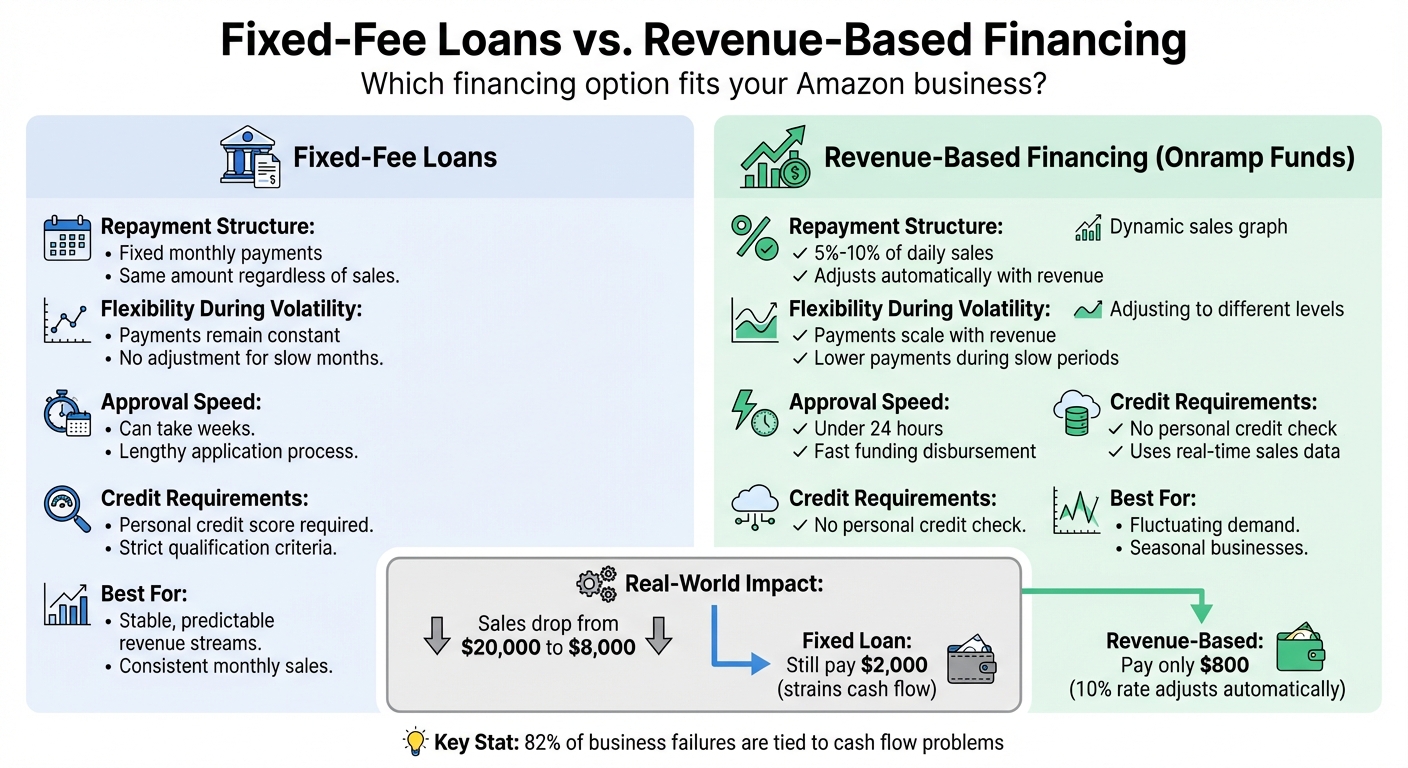
Onramp Funds offers revenue-based financing (RBF), a solution designed specifically for Amazon sellers managing unpredictable demand. Unlike traditional loans with fixed monthly payments, RBF adjusts to your sales performance. You repay a percentage of your daily sales - usually between 5% and 10%. If sales slow down, your repayment amount decreases automatically.
The approval process is fast, typically completed within 24 hours, and funds are disbursed quickly. There’s no credit check involved; instead, Onramp evaluates your real-time Amazon sales data. Plus, this financing is equity-free, meaning you retain full ownership of your business. The capital can be used to restock inventory, fund PPC campaigns, or cover essential expenses during cash flow crunches.
This flexibility is especially useful during time-sensitive situations. For example, if you need to place a large order before Prime Day but won’t see sales revenue for weeks, RBF ensures you can act immediately without waiting for Amazon’s payout cycle or dipping into your reserves. As Onramp Funds explains:
"We only make money when you make money and when repayment won't jeopardize your cash flow." [1]
Fixed Fees vs. Revenue-Based Financing
Deciding between fixed-fee loans and revenue-based financing depends on the predictability of your sales. Fixed-fee loans come with set interest rates and consistent monthly payments, which can work well if your revenue is steady. However, for sellers dealing with seasonal spikes, product launches, or unpredictable demand, fixed payments can become a challenge when sales slow down.
Here’s a quick comparison:
Revenue-based financing is particularly helpful when cash flow is tight. For instance, if your sales drop from $20,000 to $8,000 in a slow month, your repayment reduces proportionally - from around $2,000 to $800 at a 10% rate. In contrast, a fixed loan would still require the full $2,000, potentially draining your working capital. This flexibility can make a critical difference, especially since 82% of business failures are tied to cash flow problems [1]. Aligning repayment with your actual sales can help you weather downturns and keep your business running.
Building Cash Reserves and Controlling Costs
Managing finances effectively goes beyond securing flexible funding. Building up cash reserves and keeping operating expenses in check are critical steps to handle fluctuations in demand. With a solid financial cushion and streamlined operations, you’ll be better equipped to handle slower months without scrambling for alternative funding options.
Setting Aside Emergency Cash Reserves
To safeguard your business, aim to have three to six months of operating expenses saved as a buffer. This reserve can cover essentials like inventory restocking, advertising, payroll, and logistics when unexpected challenges arise, such as delays in Amazon payouts or supply chain hiccups.
Start by monitoring your monthly operating cash flow - subtract inventory costs, payroll, logistics, ad spend, and debt service from your total inflow [8]. This gives you a clear picture of whether you’re building reserves or depleting them. Don’t rely solely on your bank balance; by the time it looks low, it might already be too late to adjust [8].
One way to free up cash is by clearing out slow-moving inventory - anything that hasn’t sold in over 90 days. Additionally, separating finances into dedicated accounts for inventory and operational expenses can help you avoid accidentally dipping into funds meant for product replenishment [14].
Once you’ve established a reliable reserve, you can further improve cash flow by negotiating better terms with suppliers.
Negotiating Better Supplier Payment Terms
While reserves offer a safety net, negotiating favorable payment terms with suppliers can directly boost liquidity. For instance, extending terms to Net 45 or Net 60 allows you to sell inventory and generate revenue before invoices are due. This keeps cash available for priorities like advertising or emergency needs [19].
Start by negotiating with your highest-volume suppliers, as they’ll have the most significant impact on your cash flow [20]. Be upfront about your reasons, such as managing seasonal demand or increasing order volumes. To sweeten the deal, offer commitments like guaranteeing a minimum annual spend or promoting their services within your network [20]. If suppliers are hesitant to make a big change (e.g., moving from Net 30 to Net 90), suggest a compromise like Net 45 [20].
If your cash reserves are strong, consider taking advantage of early payment discounts, such as "5/10 Net 30" (a 5% discount for paying within 10 days instead of 30). This approach not only saves money but also strengthens relationships with suppliers. As Yassir Malik from Sage explains:
"Negotiating favorable payment terms can strengthen your financial position, help you retain more cash, and reduce reliance on loans or overdrafts." [20]
Monitoring and Cutting Operating Expenses
Keeping a close eye on expenses is another essential step. Review your bank statements monthly to identify areas where you’re overspending, like unused subscriptions that quietly drain your cash [14]. If you’re unsure about long-term commitments, opt for monthly software plans instead of annual ones to maintain flexibility [2] [14].
Analyze Amazon fees at the SKU level to ensure each product remains profitable. Track referral fees, FBA fulfillment costs, storage fees, and disposal fees for every listing [8]. For products with high storage fees or frequent returns, consider removing them from your catalog to prevent further losses. If you sell in high-return categories like apparel or electronics, factor refunds into your cash flow models, as Amazon may withhold funds for returns [8].
During busy seasons or periods of uncertain demand, hire contractors or use third-party services instead of committing to full-time employees. This keeps labor costs flexible and aligned with your actual needs [2]. Remember, profit on paper doesn’t always translate to immediate cash flow. Funds tied up in Amazon’s settlement cycle or reserves can leave you short when expenses are due [8]. By controlling costs and maintaining cash reserves, you’ll have the flexibility to navigate these timing challenges effectively.
Conclusion
Demand fluctuations don’t have to throw your Amazon business off track. By combining forecasting, inventory management, strategic financing, and cost control, you create a solid foundation for managing cash flow effectively. Sellers who monitor cash flow in 30-60 day cycles, maintain safety stock, and negotiate better supplier terms often outperform those who only address issues as they arise.
The key is staying ahead. Keeping a close eye on your unit economics allows you to address potential problems early. And when it’s time to restock inventory or ramp up advertising during peak seasons, revenue-based financing from Onramp Funds can provide the flexibility you need - without the burden of fixed monthly payments that can strain cash flow during slower periods.
Regularly reviewing your forecasts can also help you identify low-performing SKUs that drain resources. Redirecting capital to high-margin products - those with 40% margins instead of 10% - can make a huge difference. Amazon Seller Central’s tools, like reorder alerts tied to lead times, can simplify this process. These small but strategic adjustments can create the financial stability that separates thriving sellers from the rest.
FAQs
How do I forecast cash flow with Amazon’s 14-day payouts?
When planning cash flow for an Amazon business, it’s crucial to factor in the delay between making sales and receiving the funds. Amazon processes payouts every 14 days, and it typically takes an additional 3–5 business days for the money to reach your bank account. This means you might not see cash inflows until 17–19 days after the sales occur.
To stay on top of your finances:
- Track your daily sales: This gives you a clear picture of your revenue trends.
- Adjust cash inflow estimates: Shift your expected income by the 17–19 day delay to better align with when funds will actually be available.
- Incorporate expenses: Don’t forget to account for recurring costs like inventory, advertising, and other operational expenses.
Using forecasting tools can make this process much smoother. These tools allow you to simulate different scenarios, helping you manage your working capital effectively and avoid running into cash flow issues, especially during periods of fluctuating demand.
How much safety stock should I keep for each SKU?
The correct amount of safety stock for each SKU hinges on a mix of factors, including how much demand fluctuates, lead times, and your service level objectives. To determine this, you can use formulas designed to factor in these uncertainties. Start by analyzing your historical sales data and supplier delivery schedules. This will help you estimate a buffer that accounts for unexpected spikes in demand.
Is revenue-based financing a good fit for my seasonality?
Revenue-based financing works particularly well for seasonal businesses. Its repayment model adjusts according to your sales performance, meaning you pay more during your peak seasons and less during slower times. This setup helps you maintain steady cash flow and ensures your payments align naturally with your revenue patterns.
Related Blog Posts
Onramp Funds
Funding built around your sales
Connect your store and see what you qualify for. Repay as a percentage of sales, with no personal credit check.
Funding in as little as 24 hours.
