


Amazon sellers face a unique challenge: sales are highly seasonal, with spikes during events like Prime Day and Q4 holidays, but cash flow often lags. Sellers must invest heavily in inventory months before seeing revenue, while Amazon’s bi-weekly payouts and reserve requirements further delay access to funds. This misalignment creates cash flow crunches, even when sales are booming.
Key Issues:
- Seasonal Spikes: Events like Black Friday can account for 30%+ of annual revenue, leaving slower months unprofitable.
- Delayed Payments: Amazon pays sellers every 14 days, with reserves holding back cash for returns or claims.
- Inventory Costs: Upfront investments in stock tie up capital for months, compounded by rising advertising and storage fees.
Solutions:
- Use forecasting tools (e.g., Amazon Demand Forecasting, SoStocked) to predict demand and manage inventory efficiently.
- Implement flexible inventory strategies like just-in-time ordering or hybrid fulfillment (FBA + FBM).
- Adjust cash flow models for seasonal trends, leveraging historical data to prepare for peaks and valleys.
- Consider funding options like Onramp Funds, which provide sales-based repayment to align payments with revenue cycles.
Amazon’s seasonality demands tailored financial strategies. Sellers must plan carefully to maintain liquidity and navigate the platform’s volatile sales patterns.
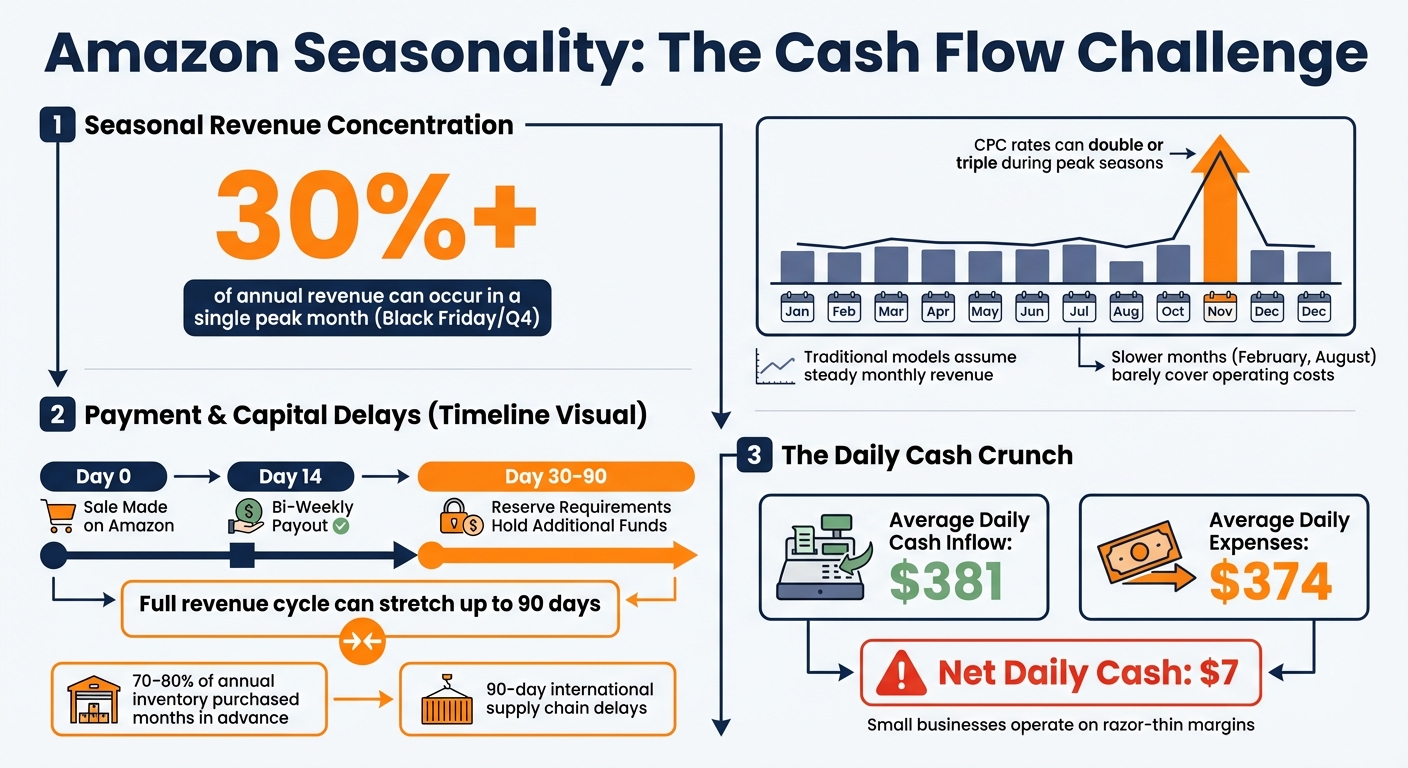
Amazon Seller Cash Flow Challenges: Key Statistics and Timeline
Amazon sellers' guide to cash flow forecasting: Tips from an accounting expert

Why Standard Cash Flow Models Fail for Amazon Sellers
Traditional cash flow models rely on the assumption of steady, predictable monthly revenue with only minor seasonal fluctuations. However, Amazon sellers operate in a completely different reality. Their revenue patterns are marked by extreme highs during specific events - like Prime Day, Black Friday, and the Q4 holiday rush - and sharp lows during off-peak periods. For some sellers, a single month can account for over 30% of their annual revenue, while other months barely cover operating costs. Standard financial tools simply aren't equipped to manage this level of unpredictability, making it essential to address the unique challenges Amazon sellers face.
Sudden Demand Increases
Sales on Amazon can skyrocket during major events, creating dramatic revenue spikes. Instead of a steady income stream, sellers experience erratic swings. For instance, peak months can deliver over 30% of annual revenue, while slower months - like February after the holidays or August during the "ghost month" - can leave sellers scrambling to cover expenses. These cash flow gaps are something traditional budgeting models fail to predict, leaving sellers unprepared for the extremes.
Delayed Payments and Higher Reserve Requirements
Amazon's payment structure adds another layer of complexity. Sellers are paid bi-weekly, meaning there’s a 14-day delay between a sale and receiving the funds. During high-sales periods, Amazon often increases account reserves to cover potential returns, chargebacks, or A-to-z claims. This means sellers may see record-breaking sales but have limited cash on hand. In some cases, the full revenue cycle can stretch up to 90 days, creating a mismatch between rising operational costs and delayed cash inflow.
Capital Locked in Inventory
Preparing for peak sales seasons requires significant upfront investment. Many Amazon sellers purchase 70–80% of their annual inventory months in advance, tying up huge amounts of capital. On top of that, international supply chain delays can hold funds hostage for up to 90 days before the inventory even reaches a warehouse. Meanwhile, peak seasons bring higher advertising costs (like increased Cost Per Click rates), additional staffing needs, and rising storage fees - all of which further strain cash reserves. Unlike flexible repayment options, traditional bank loans demand fixed monthly payments, which can be particularly challenging during slower sales periods.
These hurdles reveal why traditional cash flow models often fall short for Amazon sellers. Addressing these unique challenges requires financial strategies built specifically for the volatile nature of Amazon's marketplace.
How Seasonal Patterns Affect Amazon Sellers
Seasonal shifts on Amazon can throw sellers into a whirlwind of challenges, impacting revenue streams and operational stability. Events like Prime Day and the holiday rush bring spikes in demand, but they also create tough choices around inventory, cash flow, and rising expenses. These challenges ripple across operations, making it harder to maintain balance during these high-stakes periods.
The Inventory Balancing Act
Handling inventory during seasonal peaks is a tricky game. Order too much, and you're stuck with excess stock that eats up capital and storage space. Order too little, and you risk running out of stock just as demand skyrockets, potentially losing sales to competitors. This balancing act isn't just about logistics - it directly feeds into cash flow issues, as money gets tied up in inventory that may not sell immediately.
Cash Flow Squeezes in High-Sales Months
Oddly enough, some of the busiest sales periods can leave sellers strapped for cash. Take November and December, for example - sales might soar, but payment delays and reserve requirements mean sellers don’t see that revenue right away. Meanwhile, they need funds immediately to restock inventory, ramp up advertising, and cover rising costs. Off-peak months like August or February can be just as tough, with sales dipping sharply while fixed expenses like rent, salaries, and software fees keep piling up. It’s a cash flow crunch that doesn’t relent.
Rising Costs Add to the Pressure
Seasonal peaks don’t just boost sales - they also drive up nearly every operational expense. Advertising costs can skyrocket, with CPC rates doubling or even tripling [1][4]. Fulfillment fees, faster shipping demands, extra customer service, and handling returns all pile on, requiring immediate cash outlays. For small businesses operating on razor-thin margins - where daily cash inflows might average $381 against $374 in expenses, leaving just $7 to spare [2] - these surges can quickly destabilize the financial picture. Access to timely cash becomes not just helpful but critical to survival.
sbb-itb-d7b5115
Practical Solutions for Managing Seasonal Cash Flow
Seasonal fluctuations can be challenging for sellers, but with proper planning and tools, you can stay ahead of demand spikes and payment delays. By using forecasting tools and flexible inventory strategies, sellers can navigate Amazon's seasonality with confidence.
Demand Forecasting Tools
Forecasting tools help sellers predict sales trends and prepare inventory accordingly. For instance, Amazon Demand Forecasting, available through Seller Central for Brand Registered sellers, uses past sales data, pricing trends, and promotional history to project sales up to 40 weeks in advance. To access this feature, sellers need at least 90 days of sales history and Brand Registry [5].
For those seeking more customization, Amazon Forecast (AWS) employs machine learning to create probabilistic forecasts. Sellers can prioritize scenarios based on their needs - choosing the 10% quantile to avoid overstocking or the 90% quantile to minimize missed sales during peak periods. Advanced models like DeepAR+ can improve forecasting accuracy significantly, with additional data boosting accuracy even further [6][7].
"Amazon Demand Forecasting isn't just another Amazon Seller Central feature; it's one of the most powerful ways sellers can predict customer demand and prepare their inventory ahead of time." - Brij Purohit, Co-Founder, SellerApp [5]
Third-party platforms like SoStocked and Saras Analytics provide even more tailored solutions. SoStocked offers seasonal models like "Last Year's Sales", which replicates year-over-year patterns, and "Manual Seasonality", where sellers input their own percentage changes [8]. Saras Analytics integrates data from Amazon, Shopify, and ERP systems to predict gross margins and working capital needs [9]. Sellers often use these insights to adjust ad spending - ramping up 2–3 weeks before peak periods and scaling back during slower times. Sharing 6–12 month forecasts with suppliers can also lead to better pricing and shorter lead times for bulk orders [7][8].
With accurate forecasts in hand, sellers can fine-tune inventory strategies to match demand.
Flexible Inventory Strategies
Managing inventory efficiently is key to maintaining cash flow. Just-in-time (JIT) ordering allows sellers to keep stock levels low by ordering only what's necessary, freeing up capital for other expenses. Pairing JIT with safety stock levels - a buffer for unexpected demand - helps balance risk while maintaining flexibility. Additionally, ABC analysis lets sellers prioritize high-margin or fast-moving items, ensuring capital is allocated wisely.
Hybrid fulfillment - splitting inventory between FBA and FBM or third-party logistics (3PL) - is another effective strategy. This approach avoids delays in Amazon's warehouses during peak seasons and provides a backup when FBA stock runs low. Planning 3–4 months ahead is crucial: analyze past data, coordinate with suppliers, and negotiate extended payment terms to align cash outflows with expected revenue. Some sellers even pause PPC campaigns automatically when stock levels dip to prevent wasted ad spend and protect organic rankings [5].
| Inventory Strategy | Purpose | Cash Flow Impact |
|---|---|---|
| Just-in-Time (JIT) | Minimize stock on hand | High; frees up working capital. |
| Safety Stock | Prevent stockouts during spikes | Moderate; requires upfront cash but protects revenue. |
| ABC Analysis | Prioritize high-value items | High; ensures capital spent on profitable SKUs. |
| Hybrid (FBA + FBM) | Redundancy in fulfillment | Moderate; reduces risk of lost sales. |
Beyond inventory, adapting your cash flow model to reflect seasonal trends is essential for year-round liquidity.
Cash Flow Models Adjusted for Seasonality
Standard cash flow models assume steady sales based on recent averages [8]. While this works for evergreen products, it often fails during seasonal surges like Prime Day or the Q4 holiday rush. Seasonality-adjusted models account for recurring peaks and valleys by incorporating historical cycles and external factors like weather or Google Trends [8][9]. These models require at least 1–2 years of clean historical data but offer greater accuracy during peak events and reduce the risk of stockouts [5][4].
"Modern eCommerce runs on data, not intuition. Inventory placement, marketing spend, fulfillment planning, and cash flow all depend on a company's ability to anticipate what customers will buy and when they'll buy it." - Sumeet Bose, Content Marketing Manager, Saras Analytics [9]
| Feature | Standard Models | Seasonality-Adjusted Models |
|---|---|---|
| Core Assumption | Flat or linear sales velocity based on recent averages [8]. | Recurring peaks/valleys based on historical cycles and external factors [8][9]. |
| Advantages | Simple to maintain; requires minimal historical data [7]. | High accuracy for peak events (Prime Day, Q4); prevents stockouts [5][4]. |
| Disadvantages | Under-predicts peak demand and over-predicts low seasons [9]. | Requires 1–2 years of clean historical data for reliability [8]. |
| Relevance | Best for evergreen products with stable demand [9]. | Essential for seasonal categories (apparel, holiday decor, outdoor gear) [8]. |
Leading teams regularly refresh forecasts - daily or weekly - to adapt to market changes quickly [9]. Consistent SKU naming across ERPs, Amazon listings, and ad platforms is also critical, as mismatched IDs are a common cause of forecasting errors. Additionally, hiring contractors during peak periods can help keep fixed costs low during off-seasons [1].
How Onramp Funds Addresses Seasonal Cash Flow Challenges

Even with the best forecasting and inventory strategies, sellers often face a tough challenge: they need cash upfront to stock inventory, but the revenue from those sales comes later. This timing mismatch becomes especially tricky during seasonal peaks when inventory demands skyrocket. Onramp Funds steps in to close this gap by providing funding that aligns seamlessly with sellers' sales cycles.
Fast Funding with Sales-Based Repayment
Onramp Funds offers a game-changing solution by delivering capital within 24 hours of approval. This quick turnaround allows sellers to act fast, taking advantage of limited-time supplier discounts and stocking up well before peak seasons hit [3]. Compare that to traditional bank loans, which can take 2–4 weeks for approval, and it’s clear how Onramp Funds gives sellers a competitive edge.
What makes this even better is their repayment model. Instead of fixed monthly payments, repayments are tied to a percentage of monthly sales. This means payments automatically adjust to match revenue fluctuations. For instance, if a seller earns $200,000 in November but only $40,000 in February, their repayment scales down accordingly [3]. This flexibility ensures sellers aren’t burdened with high payments during slower months.
Clear Fee Structure
Onramp Funds keeps things simple with a transparent fee structure ranging from 2% to 8%. Sellers can easily calculate the cost and plan accordingly. For example, a $50,000 funding amount with a 5% fee means a total cost of $2,500 - no surprises or hidden charges. This clarity helps sellers effectively manage their cash flow during seasonal shifts.
Direct Integration with Amazon and Other Platforms
To make things even smoother, Onramp Funds integrates directly with platforms like Amazon, Shopify, Walmart Marketplace, TikTok Shop, BigCommerce, WooCommerce, and Squarespace [10]. This integration allows the system to access real-time sales data, automatically adjusting repayments based on actual performance [3]. Sellers don’t have to deal with manual reporting or approval delays - the platform handles it all.
Another advantage? Sellers can connect all their sales channels to Onramp Funds, qualifying for larger funding amounts based on their total sales across platforms, not just one [10]. This is especially helpful during seasonal peaks when sellers might be running promotions on Amazon, their Shopify store, and other marketplaces simultaneously. By leveraging this multi-platform approach, sellers can better manage the cash flow crunch that comes with busy seasons.
Conclusion: Managing Amazon's Seasonal Sales Patterns
Amazon’s seasonal sales patterns often create major cash flow headaches for sellers. The Q4 holiday rush and Prime Day demand spikes, combined with bi-weekly payout delays, stricter reserve requirements, and inventory investments, can leave sellers strapped for cash - even when revenue is pouring in. Traditional cash flow models just don’t cut it here. They’re designed for steady income streams, not the rollercoaster of highs and lows that Amazon sellers experience.
To tackle these issues, sellers need strategies that match Amazon’s unique sales cycles. Even with careful planning, there’s always a gap between the upfront costs of stocking inventory and the delayed revenue from sales. This is where flexible financing becomes critical. Sales-based repayment options, for example, adjust payments based on how your business is performing. This means smaller payments during slower periods, which helps ease financial pressure. Considering that the average small business operates with just $7 in net daily cash inflow [2], having access to funding that works with your sales rhythm isn’t just helpful - it’s essential.
FAQs
What’s the best way for Amazon sellers to handle cash flow during seasonal demand spikes?
Amazon sellers can manage cash flow during seasonal spikes by planning carefully and staying adaptable. A great starting point is using sales forecasting tools to estimate demand during busy times like holidays or Prime Day. These tools help you strike a balance - stocking enough inventory to meet demand without tying up too much capital.
Another smart move is exploring flexible financing options to handle upfront costs, whether it's for stocking up on inventory or ramping up ad campaigns. Revenue-based funding, for example, adjusts repayments based on your actual sales, making it easier to manage cash flow when revenue fluctuates. With the right mix of preparation and flexibility, sellers can navigate high-demand seasons with confidence.
How can sales-based repayment options help Amazon sellers manage cash flow?
Sales-based repayment options give Amazon sellers a way to manage cash flow that adapts to their revenue. Instead of fixed payments, the amount sellers repay adjusts based on their sales. This makes it easier to handle slower months without feeling overwhelmed financially.
This repayment method is particularly useful for navigating Amazon's seasonal highs and lows, like the holiday rush or Prime Day spikes. By syncing repayments with sales cycles, sellers can prioritize growth and keep inventory levels steady without the stress of rigid payment deadlines.
How can forecasting tools help eCommerce sellers prepare for Amazon's seasonal sales?
Forecasting tools are essential for eCommerce sellers looking to navigate Amazon's seasonal sales effectively. By analyzing historical sales data, market trends, and external factors, these tools help predict demand with greater accuracy. This means sellers can plan their inventory more efficiently, ensuring they’re well-stocked for high-demand periods like holidays or Prime Day, while avoiding the pitfalls of overstocking during slower seasons.
Using these tools can minimize the risk of running out of stock, optimize cash flow, and enable smarter, data-backed decisions that match seasonal demand patterns. The result? Smoother operations and happier customers during those critical peak times.
