


Scaling your business is exciting, but it comes with financial challenges that can threaten growth. Poor cash flow management is a leading cause of small business failures, with 82% of failures linked to cash flow issues. Here's how to build financial stability while expanding:
- Manage Cash Flow: Identify bottlenecks like inventory overstocking or late payments. Short-term financing, payment term negotiations, and cash flow tracking tools (e.g., QuickBooks) can help.
- Budget and Forecast: Separate fixed and variable costs, plan for multiple scenarios, and use tools like Shopify for accurate projections.
- Emergency Reserves: Allocate a portion of profits to a financial buffer for unexpected costs like tariff hikes or revenue dips.
- Diversify Revenue: Spread risk by expanding sales channels (e.g., Amazon, Shopify) and product offerings to avoid reliance on one source.
- Track Metrics: Monitor key financial indicators like cash conversion cycle and operating profit margins to guide decisions.
Additionally, financing options like Onramp Funds offer quick, flexible capital tailored to eCommerce businesses, ensuring you can seize growth opportunities without straining cash flow.
These strategies can help you maintain financial health while scaling, ensuring your business thrives in a competitive market.

Managing Cash Flow While Scaling
Scaling a business brings its own set of challenges, especially when it comes to managing cash flow. As you grow, you might find yourself paying suppliers upfront, placing larger inventory orders, and waiting longer for customer payments. To keep your cash flow steady, it’s crucial to identify bottlenecks and establish systems that keep money moving.
Find and Fix Cash Flow Gaps
Start by mapping out your cash conversion cycle - the time it takes to turn investments in inventory into cash from customer payments. This will help you pinpoint problem areas. For instance, review your accounts receivable aging reports to spot customers who frequently pay late. Seasonal sales fluctuations can also create gaps; think about winter apparel sitting unsold during warmer months.
Once you identify these issues, take action. For example:
- Adjust inventory levels during slower seasons to avoid overstocking.
- Offer early payment discounts, like 2% off for payments within 10 days.
- Use short-term financing to bridge seasonal cash flow gaps.
These steps can help you address immediate issues and set the stage for optimizing your payment cycles.
Improve Payment Cycles and Supplier Terms
Negotiating better terms with your suppliers can significantly ease cash flow pressures. Start by securing competitive product pricing, then work on extending payment terms. This ensures suppliers don’t pad their prices to offset longer payment periods. Instead of requesting drastic changes upfront, aim for gradual adjustments - extending terms by 10 to 15 days annually over two to three years can make a big difference [4].
To make negotiations mutually beneficial, offer something in return, such as higher monthly order volumes or a longer-term partnership [5]. These incremental improvements not only improve your cash position but also strengthen your financial stability as you scale.
Use Software for Cash Flow Tracking
Real-time tracking tools like QuickBooks can give you a clear picture of your cash flow. These platforms connect directly to your bank accounts and payment processors, eliminating manual data entry and reducing errors. With features like daily cash flow tracking, forecasting, and low-balance alerts, you can stay ahead of potential shortfalls. Weekly cash flow projections, for instance, allow you to anticipate problems early, giving you time to adjust spending, speed up collections, or secure extra funding. This level of visibility is essential for making proactive decisions that support long-term growth.
sbb-itb-d7b5115
Budgeting and Financial Forecasting
While managing cash flow effectively is essential, budgeting and forecasting take it a step further by helping businesses prepare for sustainable growth. To do this, it’s important to distinguish between fixed costs, like warehouse rent, and variable costs, such as shipping fees that can fluctuate. This approach helps predict when you might need additional capital to keep operations running smoothly [1].
Set Achievable Growth Targets
Understanding your product-specific contribution margins is crucial. This data helps identify which products are driving profitability. For instance, a high-margin product that sells quickly can fuel growth, while slower-moving, low-margin items may tie up resources and hurt cash flow [1].
"As a CPG brand, we don't have the luxury of ever planning for stability. It's hard to predict consumer taste or future economic conditions." – Christian Casebeer, Chief Operating Officer at Asset [2].
When creating budgets, it’s smart to plan for multiple scenarios - base, best, and worst-case. This ensures you're prepared for seasonal changes, scaling expenses, or sudden cost surges [6]. For first-year forecasts, breaking projections into monthly intervals can help capture seasonal trends and address short-term cash flow gaps. Don’t forget to factor in scaling costs like new hires, marketing campaigns, or platform upgrades. Automating these processes can make a big difference, as outlined below.
Simplify Planning with Financial Software
Tools like QuickBooks simplify budgeting by using historical data to project revenue, helping you create more accurate forecasts [6]. Shopify also provides helpful resources, including cash flow calculators and sales planning templates, to estimate your monthly inflows and outflows [6].
Financing Options with Onramp Funds
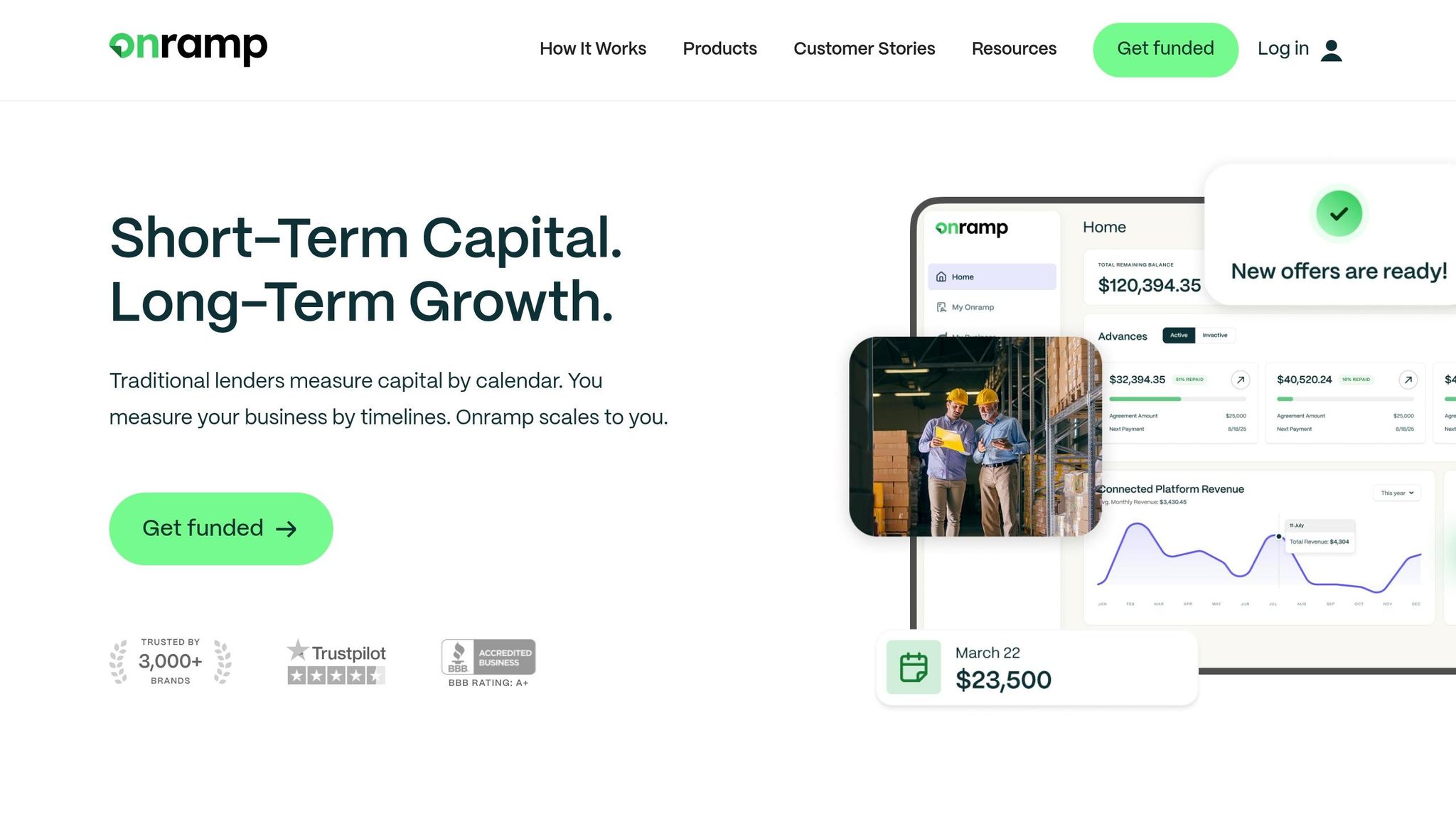
When you're growing your eCommerce business, having quick access to capital can make the difference between grabbing opportunities and letting them slip away. Onramp Funds provides financing tailored specifically for eCommerce businesses, complementing the cash flow and budgeting strategies discussed earlier. Unlike traditional financing, which often fails to align with the unique cash flow cycles of eCommerce, Onramp Funds is designed with these challenges in mind [7].
Tailored Funding for eCommerce Sellers
Onramp Funds offers funding solutions that are customized to your business needs. By connecting your store data - whether from Amazon, Shopify, or TikTok Shop - you can unlock funding options that match your specific requirements. The process is built for speed: you can get an initial estimate in just one minute and access full funding in under 24 hours [7]. This fast turnaround is perfect for situations like restocking inventory during seasonal peaks or ramping up marketing efforts when demand is high.
Transparent Flat-Fee Pricing
Onramp Funds uses a straightforward pricing model with a flat fee ranging from 2% to 8% of the amount funded [7]. This clear structure ensures there are no hidden costs or surprise charges. You’ll know exactly what you owe upfront, making it easier to plan your budget as your business grows. Plus, there are no monthly minimums or unexpected fees to worry about.
Flexible Repayment Options
Understanding the ups and downs of eCommerce sales cycles, Onramp Funds offers a repayment model that adjusts to your daily sales. Payments are calculated as a percentage of your daily revenue - starting as low as 1% - so when sales slow down, your repayment amounts decrease accordingly. For those who prefer a consistent approach, a fixed payment option is also available. These flexible terms have contributed to an average revenue growth of 60% among their clients, with 75% returning for additional funding [7]. This adaptability makes Onramp Funds a valuable part of your financial strategy as you scale your business.
Building Emergency Reserves and Diversifying Revenue
Create an Emergency Fund
Setting aside a portion of your profits as an emergency fund is one of the smartest moves you can make for your business. This financial cushion can help you navigate unexpected challenges like tariff hikes, shipping cost surges, or temporary dips in revenue. For example, in 2020, Loverboy - a beverage company led by CEO Kyle Cooke - achieved a 25% net profit margin with just five employees. This strong financial footing enabled them to qualify for an SBA loan during the pandemic, which they used to address supply chain issues without touching their venture funding. As Cooke put it:
"Everyone thinks venture capital is the holy grail. The truth is, it's profitability." [8]
To build your own buffer, allocate a fixed percentage of monthly profits to your emergency fund. This approach not only helps you cover unforeseen expenses but also allows you to focus on growth opportunities without constantly worrying about cash flow. Recent tariff spikes have shown how reserves can shield businesses from sudden cost increases, while those without a safety net often face severe liquidity issues [2][3].
But creating a financial buffer is just one part of the equation. Diversifying your revenue streams is equally important for long-term stability.
Expand Sales Channels and Product Range
Relying too heavily on a single sales channel or product line can leave your business vulnerable. If the platform you depend on changes its algorithm, updates its policies, or encounters regulatory hurdles, your revenue could take a major hit. Muhammad Joyo, co-founder of elaichi co., experienced this risk firsthand when TikTok's future became uncertain. His solution? Split marketing efforts evenly between TikTok and Instagram. This strategy ensured the business wouldn't collapse if one platform became unavailable. As Joyo explained:
"If one platform disappears, our business doesn't come crashing down with it." [2]
Diversifying your product range is another way to spread risk. You might add complementary products that fit within your existing supply chain or create bundles that appeal to different customer segments. Additionally, selling across multiple platforms - like Amazon, Shopify, your own website, and newer options like TikTok Shop - reduces reliance on any single channel. For instance, when Storelli Sports anticipated tariff increases, founder Claudio Storelli expanded internationally. This move diversified their sales beyond the U.S., helping the business weather domestic policy changes [2].
A multi-channel approach not only protects you from platform-specific risks but also smooths out seasonal fluctuations. By keeping cash flow steady across various channels, you enhance your financial resilience and position your business for sustainable growth.
Tracking Metrics and Adjusting Your Approach
Monitor Key Financial Metrics
Keeping an eye on key financial metrics is essential for steady growth. Building on earlier discussions about cash flow management and budgeting, these metrics allow you to make proactive adjustments. For instance, tracking your operating profit margin helps you measure how well you’re managing expenses as your business expands. It shows net income from core operations before taxes - a critical indicator of efficiency [9].
Similarly, the cash conversion cycle (CCC) provides insight into how long it takes to turn inventory investments into revenue. If your CCC is getting longer, it might mean you’re holding too much inventory or experiencing delays in supplier payments [9]. Other important metrics include customer lifetime value (CLTV), which gives you an idea of the total revenue a customer brings over their relationship with your business, and average order value (AOV), which can uncover opportunities for upselling or bundling products [9].
To avoid overwhelming yourself or your team, focus on a manageable number of metrics. Vaishnavi Shah, Technical Content Writer at ThoughtSpot, suggests:
"Focus on 8-12 KPIs at most to avoid analysis paralysis. It's a good idea to start with 2-3 KPIs from each category (sales, finance, marketing, CX) and add more as your team becomes comfortable." [9]
Set up a review schedule tailored to different types of metrics. For example:
- Daily checks: Operational metrics like website traffic and conversion rates to address immediate issues.
- Weekly reviews: Tactical metrics such as AOV and customer acquisition costs for short-term adjustments.
- Monthly analysis: Strategic KPIs like CLTV and churn rate to spot broader trends [9].
With these insights in hand, you’ll be ready to refine your strategy based on performance data.
Adjust Plans Based on Performance Data
Metrics are only useful if they lead to action. Once you’ve gathered the data, use it to fine-tune your approach. Instead of relying solely on company-wide averages, break down the numbers by specific product categories or customer segments. This detailed analysis can reveal what’s driving growth - or what’s holding you back [9].
A great example of this approach comes from Bolder Band, an online headband retailer founded by JD and Amy Crouse. During the Shopify Build-a-Business competition in 2014, they used benchmarking reports to identify their most valuable customers. By focusing their marketing efforts on the top 20% of customers who generated the majority of revenue, they grew their business to $6.5 million in revenue within three years. At their peak, they were moving nearly $300,000 in product monthly [10]. This kind of targeted adjustment, based on clear data, can significantly strengthen your financial position.
Your cash conversion cycle can also guide operational changes. For example, if cash is tied up, consider streamlining inventory levels or renegotiating supplier terms [9]. Similarly, if certain products show weak contribution margins, it might be time to phase them out and double down on your best-sellers [1].
The key is to treat your financial data as an evolving tool rather than a static report. As Christian Casebeer, Chief Operating Officer at Asset, explains:
"We're less willing to sacrifice profit and loss health for aggressive growth metrics. We will continue to grow, but there is a limit to the cost." [2]
When external factors like algorithm updates, tariffs, or supply chain disruptions arise, your data can help you adapt. For instance, if you notice an over-reliance on a single sales channel or supplier, it’s a clear signal to diversify before potential issues arise [2]. By staying agile and data-driven, you’ll be better equipped to navigate challenges and seize new opportunities.
Conclusion
Scaling your eCommerce business doesn’t have to mean sacrificing financial stability. By applying strategies like optimizing cash flow, tracking contribution margins by product and channel, building emergency reserves, and diversifying revenue streams, you can create a solid financial foundation that weathers market ups and downs.
The potential is enormous, with global online retail sales expected to hit $6.8 trillion by 2028. But this growth comes with challenges. Businesses that lack financial buffers or flexible capital sources are especially vulnerable in today’s unpredictable market [1].
Start by tightening supplier terms, automating financial tracking, and prioritizing high-impact products. Build your safety net with cash reserves, diversified suppliers, and varied marketing channels. These steps will help protect your business from market shocks.
Once you’ve established a strong foundation, securing the right financing becomes key to fueling growth. Onramp Funds offers a tailored solution for eCommerce sellers. Their revenue-based repayment model adjusts with your sales, while a fixed fee pricing structure ensures predictable costs. With funding available in just 24 hours and repayments tied to your actual revenue, you can access the capital you need without straining cash flow during slower periods.
FAQs
What’s a healthy cash conversion cycle for my store?
A healthy cash conversion cycle for your store typically ranges between 30 and 60 days, though this can vary based on your industry and business model. Staying within this range suggests you’re managing inventory, receivables, and payables efficiently - key factors for maintaining financial stability as your business grows.
How much should I keep in an emergency cash reserve?
Maintaining an emergency cash reserve that covers three to six months of operating expenses is a smart move for any business. This cushion can help keep things running smoothly when unexpected challenges arise. However, the exact amount should reflect your business's unique needs and your comfort level with risk. By tailoring your reserve to fit your operations, you’ll be better equipped to handle uncertainties as your business grows.
When should I use revenue-based funding to scale?
Revenue-based funding works well for eCommerce businesses that are growing rapidly and have steady, predictable revenue. Instead of fixed payments, repayments are based on a percentage of your sales, which means you pay less during slower months. This gives you access to capital without the burden of fixed installments, traditional loans, or sacrificing equity in your business. It's especially helpful when you're scaling operations, launching new products, or expanding into new markets - all while keeping control of your business and easing cash flow pressures.
Related Blog Posts
Onramp Funds
Funding built around your sales
Connect your store and see what you qualify for. Repay as a percentage of sales, with no personal credit check.
Funding in as little as 24 hours.
