

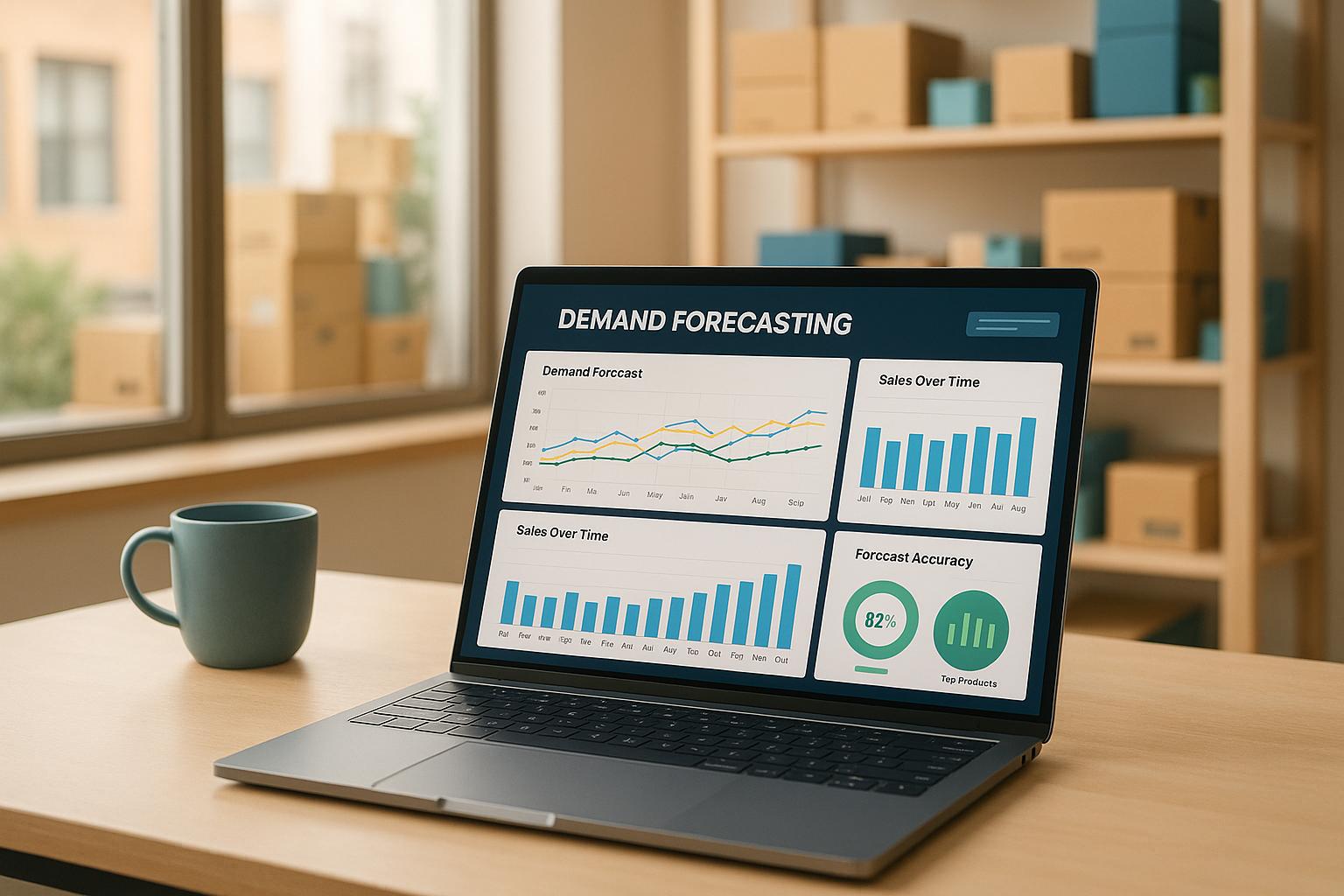
Want to optimize your eCommerce inventory? Accurate demand forecasting is crucial to avoid overstocking, reduce stockouts, and improve cash flow. Here's a quick look at the 10 best demand forecasting tools for 2026 that use AI, machine learning, and real-time data to streamline inventory management:
- Prediko: AI-powered, integrates with Shopify, starts at $119/month.
- Inventory Planner: Forecasts based on trends, starts at $299/month.
- Cogsy: Smart replenishment, pricing from $299/month.
- Fabrikator: Simplifies SKU-level forecasting, starts at $99/month.
- Cin7: Advanced AI for multi-location forecasting, starts at $399/month.
- Brightpearl: Retail-focused, handles peak demand, starts at $1,200/month.
- Unleashed: Real-time demand sensing, starts at $479/month.
- Linnworks: Multi-channel optimization, free plan available.
- Veeqo: 94% forecast accuracy, free plan available.
- Polar Analytics: AI-driven insights, starts at $300/month.
Quick Comparison Table
| Tool | Forecast Accuracy | Starting Price | Key Features | Ideal For |
|---|---|---|---|---|
| Prediko | 93–97% | $119/month | AI-driven, multi-channel integration | Shopify users |
| Inventory Planner | 92% | $299/month | ABC classification, TikTok integration | Mid-size businesses |
| Cogsy | 92% | $299/month | Smart replenishment, cash flow tools | Growing multi-channel brands |
| Fabrikator | 20–40% accuracy improvement | $99/month | SKU-level predictions, real-time syncing | Small to mid-size eCommerce stores |
| Cin7 | 99% availability | $399/month | Multi-location stock management | Large, multi-location businesses |
| Brightpearl | 91% | $1,200/month | Seasonal demand prep, AI trend analysis | Retailers with high seasonal demand |
| Unleashed | 89% | $479/month | Demand sensing, lead time optimization | Businesses with complex supply chains |
| Linnworks | 89% | Free/$200+ | Multi-channel automation | Cross-border eCommerce |
| Veeqo | 94% | Free/$250+ | Multi-channel inventory syncing | Small to mid-size businesses |
| Polar Analytics | 92% | $300/month | AI-powered heatmaps, real-time updates | Data-driven decision-makers |
Choose the right tool based on your sales channels, business size, and forecasting needs to stay ahead in 2026.
7 Best Free And Paid Demand Planning Software
What is Demand Forecasting in eCommerce?
Demand forecasting in eCommerce involves predicting future customer demand for products by analyzing historical sales data and market trends. This process helps businesses anticipate what customers will need and when, enabling better planning and decision-making.
Modern forecasting relies on AI and machine learning to analyze various data sources, such as:
- Historical Sales Data: Includes past purchase patterns, seasonal trends, and year-over-year growth.
- Market Indicators: Covers economic conditions and industry trends.
- Customer Behavior: Tracks shopping habits, cart abandonment rates, and browsing history.
- External Factors: Considers elements like weather, social media trends, and upcoming events.
With advanced analytics, businesses can uncover patterns and connections that might be missed through manual analysis, giving them a competitive edge.
Key Components of eCommerce Demand Forecasting
- Time-Series Analysis: Uses historical data to predict future trends.
- Seasonal Adjustment: Accounts for predictable demand changes during specific times of the year.
- Real-Time Data Processing: Continuously updates forecasts based on current sales.
- Multi-Channel Integration: Combines data from different sales platforms and marketplaces.
Benefits of AI-Driven Forecasting
AI-powered tools bring precision to forecasting by reducing errors associated with traditional methods. They also:
- Improve inventory allocation across warehouses.
- Provide early alerts for potential stock-outs.
- Support better planning for promotions and supply chain needs.
Practical Applications
Demand forecasting has several important uses in eCommerce, including:
- Inventory Planning: Helps determine the right stock levels and reorder points.
- Cash Flow Management: Assists in budgeting for inventory purchases and storage costs.
- Marketing Strategy: Aligns promotional campaigns with projected demand.
- Supply Chain Optimization: Ensures suppliers are prepared to meet forecasted needs.
Today's forecasting tools go beyond basic predictions - they serve as comprehensive business intelligence platforms, offering insights that drive data-backed decisions across all areas of eCommerce operations. Understanding these basics is the first step to choosing the right tool for your business.
1. Prediko

Prediko is an AI-powered demand forecasting platform tailored for eCommerce businesses. Using machine learning, it analyzes over 25 million SKUs across 15+ industries, delivering highly accurate predictions [3].
Key Features
Prediko stands out with features like:
- AI-Driven Analytics: Creates 12-month inventory plans with forecast accuracy between 93% and 97% [2][5].
- Daily Updates: Adjusts predictions every day, eliminating the need for monthly updates [5].
- Multi-Channel Integration: Combines data from Shopify, warehouse systems, and physical POS locations into a single dashboard [6].
Easy Implementation
Prediko integrates with Shopify in just one click, syncing historical sales data, current inventory, and supplier lead times [4]. Most setups are completed within 72 hours [7].
Proven Results
The platform's effectiveness is reflected in its performance metrics:
Additional Tools
Prediko offers more than just forecasting:
- Team Collaboration: Simulate how marketing campaigns impact inventory [2].
- Problem Identification: Automatically detects inventory issues and provides actionable solutions [2].
- Inventory Insights: Weekly reports and quarterly reviews help track performance against industry benchmarks [4].
Pricing Details
Prediko starts at $119 per month, using a revenue-based pricing model [8]. A 14-day free trial is available, letting merchants test its features before committing [9]. Up next, learn how these tools can transform demand forecasting strategies.
2. Inventory Planner

Inventory Planner combines AI-driven analytics with inventory management tools to deliver accurate demand forecasting. Its machine learning adjusts to U.S. market trends, regional weather patterns, and local shopping behaviors.
Core Features and Performance
Here's a snapshot of its performance metrics:
| Feature | Performance |
|---|---|
| Forecast Accuracy | 92% for 3-month projections |
| Time Savings | Saves 23 hours per week on average |
| Stock Optimization | Reduces stockouts by 30% |
| Inventory Turnover | Improves turnover by 25% |
Key Capabilities
Inventory Planner includes an ABC inventory classification system, helping businesses focus on high-value SKUs and flag potential deadstock. Its margin-aware purchasing feature considers both the cost of goods sold and shipping expenses, ensuring profitable inventory decisions. The platform's TikTok Shop integration tracks trending products in the fast-paced social commerce space. Additionally, it works seamlessly with popular eCommerce platforms for smooth operations.
Real-World Success
“Through Inventory Planner’s overstock reports and optimization tools, we freed up $1.5M in working capital and cut our inventory days outstanding by 50%”, says Kos, a leading U.S. retailer [10].
Integration with eCommerce Ecosystems
Inventory Planner connects effortlessly with major U.S. eCommerce platforms and tools, including:
- Marketplaces: Amazon US, Walmart Marketplace, eBay
- Store Platforms: Shopify, BigCommerce, WooCommerce
- Business Tools: NetSuite, QuickBooks Online, ShipStation
Compliance and Eco-Friendly Features
The platform ensures compliance with state-specific sales tax regulations and tracks green initiatives. Its Eco-Stock Dashboard helps retailers maximize tax deductions through donation programs while monitoring carbon footprint metrics aligned with EPA standards.
Pricing
Plans start at $299 per month for up to 1,000 orders. The $499 per month tier, popular among small and midsize U.S. businesses, supports up to 5,000 orders, includes unlimited users, and offers real-time support. A 14-day free trial is available for businesses to explore the platform.
Tips for Successful Implementation
To get the most out of Inventory Planner, businesses should:
- Clean historical data to remove anomalies, such as those caused by the pandemic
- Use custom attribute tags to highlight U.S. market trends
- Adjust forecasts weekly for better accuracy
This tool is ideal for businesses managing over 500 SKUs across multiple sales channels, with annual revenues exceeding $500,000. Following these practices can help maximize the platform’s potential in the eCommerce space.
3. Cogsy

Cogsy leverages AI to analyze historical sales, seasonal patterns, and market trends. With its Smart Replenishment system boasting 92% forecast accuracy (for businesses with at least six months of data), it helps maintain optimal inventory levels and reduces operational costs. Let’s break down Cogsy’s key features and how they deliver measurable results.
Core Capabilities
Cogsy processes multiple data streams at once, offering the following features:
| Feature | Purpose | Performance Metric |
|---|---|---|
| Smart Replenishment | Automates stock level management | 92% forecast accuracy |
| Inventory Health Dashboard | Visualizes stock risks | 37% reduction in excess inventory |
| Surge Alert System | Identifies demand spikes early | 48-hour advance warning |
| Multi-warehouse Optimization | Streamlines stock distribution | 22% reduction in expedited shipping costs |
Advanced Forecasting Technology
The platform’s machine learning engine continuously evaluates historical data and market conditions to provide actionable insights. For example, its Surge Alert system helped a Midwest outdoor retailer handle a 300% surge in demand for portable generators in March 2026, saving the company $150,000.
Integration Ecosystem
Cogsy connects effortlessly with major eCommerce platforms like Shopify, Amazon, Walmart, WooCommerce, and BigCommerce. It also syncs with financial tools such as QuickBooks Online and Xero, making it a flexible addition to your tech stack.
Real-World Impact
“Using Cogsy’s automated replenishment alerts and scenario planning, we reduced stockouts by 75% while maintaining a 98% inventory turnover rate. We’re saving over 20 hours weekly on inventory management tasks”, shares Caraway’s operations team [11].
Financial Planning Tools
Cogsy’s Funds Planner feature aligns inventory needs with cash flow, helping businesses decide when and how much to purchase - especially during seasonal peaks or large inventory investments. When paired with financing solutions like Onramp Funds (https://onrampfunds.com), businesses can bridge cash flow gaps to ensure smooth inventory operations.
Security and Compliance
After a third-party security audit in February 2026, Cogsy scored 98/100 for data protection. It adheres to SOC 2 Type II compliance standards and uses AES-256 encryption to safeguard sensitive business data.
Pricing Structure
Cogsy offers straightforward pricing with monthly plans starting at $299 for basic forecasting and enterprise options beginning at $899. This flat-fee model suits businesses managing inventory budgets between $50,000 and $500,000 per month.
Mobile Accessibility
A 2026 Userlike survey revealed that 63% of Cogsy users handle over 40% of their inventory tasks through the mobile app. This feature is especially valuable for teams spread across different time zones.
Cogsy is an excellent solution for brands managing multi-channel inventory efficiently.
4. Fabrikator

Fabrikator is an AI-powered platform designed to simplify demand forecasting for eCommerce businesses. It turns complex data into actionable inventory decisions, making it especially useful for companies with extensive and diverse product catalogs.
Smart Forecasting Tools
Fabrikator uses AI to predict restocking needs at the SKU level, looking 30–90 days ahead. Businesses using the platform typically experience a 20–40% improvement in forecasting accuracy within three months [12][13].
Seamless Integration
The platform works directly with Shopify, providing real-time inventory syncing. It also automates purchase orders, integrates marketing events, connects with accounting tools like Xero and QuickBooks, and supports fulfillment coordination through ShipHero.
Customer Success Story
“Fabrikator transformed our inventory management process completely. We went from spending 4 hours weekly on spreadsheets to just 20 minutes managing 5,000 SKUs, while maintaining a 98% in-stock rate during the 2023 holiday rush despite a 300% sales spike”, reports Swoveralls' operations team [15].
Data-Driven Insights
With features like ABC analysis and Sales Velocity tracking, Fabrikator helps businesses monitor key metrics such as weeks of inventory cover, open purchase order status, landed cost estimates, and dead stock levels.
Pricing Details
Plans start at $99/month for businesses generating less than $50K in gross sales. Pricing scales affordably for mid-market brands managing 50+ SKUs and operating with 4–8 week lead times [16].
Onboarding and Support
New users receive hands-on setup assistance, including templates for importing historical data and configuring supplier lead times. Ongoing inventory health checkups ensure procurement processes remain efficient.
For example, VIBAe, a jewelry brand, saw a 22% drop in excess inventory and a 35% boost in order fulfillment speed after adopting Fabrikator in Q2 2024 [14].
Next, we'll take a look at another tool helping eCommerce businesses streamline their operations.
5. Cin7

Cin7’s ForesightAI brings a new level of precision to eCommerce demand forecasting, predicting sales trends up to 24 months in advance with impressive accuracy [17].
Enhanced Forecasting Features
With Inventoro integration, Cin7 processes over 120 demand signals daily, boosting prediction accuracy by 40% [21]. This improvement supports smarter product categorization and inventory strategies.
Smart Product Categorization
Cin7 automatically groups products into three key categories:
- Winners: Top-performing items that deserve priority stocking
- Chasers: Products with growth potential
- Losers: Underperforming items that may need inventory cuts
This system helps businesses allocate resources effectively. For example, dedicating 70% of inventory to “winners” can drive better results [17][24].
Practical Results in Action
“Using Cin7’s segmentation, we identified 37 slow-moving SKUs and cleared $120,000 of dead stock. By focusing on our top 20% of products, we achieved a 22% boost in inventory turnover”, says Brian Higgins, Operations Manager at ABC School Supplies [17].
Managing Multiple Locations
Cin7 also simplifies inventory management across various locations with features like:
- Warehouse-specific stock transfer suggestions
- Automated replenishment rules tailored to each site
- Regional demand forecasting
- Real-time updates across all sales channels [18][19]
Integration Options
| Platform Type | Supported Integrations |
|---|---|
| eCommerce | Shopify, BigCommerce, Amazon, eBay |
| Accounting | QuickBooks Online |
| Manufacturing | BOM Management, Production Cost Tracking |
| Analytics | Custom Dashboards, 100+ Built-in Reports |
Pricing Details
Plans start at $399 per month for basic features, with the ForesightAI module available as an add-on starting at $599 per month [17][20].
What’s New for 2026
The 2026 updates introduce tariff cost forecasting, landed cost calculations, and Conversight integration for capacity planning [22][23]. Dynamic safety stock calculations help maintain 99% product availability while reducing excess inventory by up to 20% [21].
For businesses juggling multiple sales channels and complex inventory setups, Cin7 offers a powerful suite of tools and a proven approach to demand forecasting.
6. Brightpearl

Brightpearl uses AI to provide accurate inventory management tailored for mid-sized eCommerce businesses. Its Smart Replenishment feature evaluates historical sales data across multiple channels to predict stock needs up to a year in advance.
The system keeps inventory aligned across channels, automatically generates purchase orders when necessary, and delivers daily, color-coded demand updates. For example, a Texas retailer saw a $1.2M sales increase in one region after managing a 37% demand surge using Brightpearl’s insights. These tools help businesses make informed decisions for retail operations.
Retail-Specific Features
Brightpearl includes specialized metrics for key shopping events, helping businesses prepare for peak demand periods:
| Event Type | Features |
|---|---|
| Prime Day | Analyzes past performance and predicts demand spikes |
| Black Friday | Allocates inventory by channel to meet demand |
| Seasonal Sales | Tracks regional demand and incorporates weather trends |
| Holiday Rush | Optimizes stock across multiple locations |
Implementation and Integration
Brightpearl integrates with major eCommerce platforms and takes about 4–8 weeks to set up. During this process, it analyzes over three years of sales data and more than 150 forecasting variables. Its forecasts cover 50+ metro areas in the U.S., ensuring precise insights for businesses.
Performance Metrics
Brightpearl delivers measurable results, including:
- Reduction in forecast errors from 22% to 9%
- Over 15 hours saved weekly on manual reporting
- 42% fewer stockouts for multi-channel retailers
- Up to 30% reduction in overstock
Pricing
| Plan Level | Monthly Cost | Features |
|---|---|---|
| Standard | $1,200 | Supports 1,500 orders, 5 users, and 5 channels |
| Premium | $2,500–$4,000 | Includes AI trend analysis and 3PL integrations |
| Enterprise | Custom Pricing | Offers scenario modeling powered by machine learning |
Latest Updates
Brightpearl continues to expand its features. The Q2 2026 update adds TikTok Shop trend analysis, using ByteDance’s commerce API for better social commerce forecasting. Inventory predictions refresh every 15 minutes, keeping data accurate across all sales channels.
For businesses juggling inventory across multiple platforms, Brightpearl offers the precision needed to balance stock levels and reduce costs. Its retail-focused tools and automation make it a smart choice for scaling eCommerce operations.
7. Unleashed

Unleashed’s AIM module uses demand fingerprint technology, boasting an 89% accuracy rate, to identify sales anomalies and fine-tune stock levels across multiple channels [30].
Thanks to its partnership with Google Cloud, Unleashed now integrates regional search trend data to provide real-time demand forecasts [28]. Its seasonal adjustment algorithms help businesses cut excess inventory by as much as 35% [29][31].
| Feature | Capability | Impact |
|---|---|---|
| Demand Sensing | Real-time anomaly detection | 6–8% improvement in forecast accuracy |
| Lead Time Optimization | Reduces long lead times | 60% fewer stockouts |
| Seasonal Adjustment | Adapts to seasonal trends | 35% reduction in excess inventory |
| Multi-channel Analytics | Unified demand insights | 99.3% forecast accuracy |
Integration Capabilities
Unleashed integrates seamlessly with leading eCommerce platforms, offering automated synchronization to minimize manual tasks. One jewelry business shared their success story:
“Through our Shopify-Unleashed-Xero integration, we eliminated 35 hours of weekly admin work while maintaining perfect inventory accuracy across all sales channels”, according to a 2026 Capterra review [26][27].
These integrations provide tangible improvements in efficiency and accuracy.
Real-World Performance
Flowstore, working with Radical Cloud Solutions, achieved impressive results:
- 42% cut in inventory write-offs
- 99.3% forecast accuracy for seasonal products
- 18% drop in carrying costs
- 99.7% order fulfillment rate [25][29]
Pricing Structure
Unleashed offers a tiered pricing model to fit different business needs:
| Plan | Monthly Cost | Features |
|---|---|---|
| Base Platform | $479 | Core inventory management |
| AIM Module | +$199 | Advanced forecasting tools |
| Premium Support | +$149 | Priority response (under 2 hours) |
| Implementation | $2,500–$15,000 | Partner-led setup |
Latest Innovations
Unleashed continues to expand its capabilities. A 2026 Accenture study highlighted how the platform managed 12,000 SKUs for an enterprise, unlocking $100–130 million in working capital through better component planning [31]. Additionally, its upcoming B2B portal integration, featured in the 2026 roadmap, aims to meet the rising demand for wholesale channel management [28].
8. Linnworks
Linnworks is a multi-channel inventory management system that processes over $15 billion in annual GMV [33]. It uses AI-powered forecasting tools to predict inventory needs by analyzing location-specific factors and historical sales data across more than 100 marketplaces.
Core Forecasting Capabilities
Linnworks' forecasting engine relies on several data sources to optimize inventory management:
| Data Source | Analysis Approach | Impact |
|---|---|---|
| Historical Sales | 12-month sales analysis | Achieves an 89% success rate in inventory optimization |
| Channel Data | Real-time velocity tracking | Reduces excess inventory by 37% |
| Supplier Data | Lead time analysis | Maintains a 99.5% in-stock rate |
| Seasonal Trends | Year-over-year comparison | Cuts overstock by 52% during peak periods |
Advanced Integration Features
Linnworks integrates directly with major platforms like Amazon, Shopify, and newer marketplaces such as SHEIN and Temu. This ensures smooth data synchronization and provides a unified dashboard for real-time visibility across all sales channels. Key tasks like inventory transfers and reordering are automated, streamlining operations further.
Real-World Performance
A 2023 case study by Graff City highlighted Linnworks' impact on efficiency. By adopting its stock forecasting tools, Graff City reduced inventory management time from 8 hours to just 30 minutes per week - a time savings of 87.5% - while completely eliminating stockouts [35].
Automation Features
Linnworks offers several automation tools to simplify inventory management:
- Smart Alerts: Custom notifications triggered when stock levels drop below set thresholds.
- Dynamic Reordering: Automatically generates purchase orders based on supplier lead times.
- Cross-Warehouse Management: Adjusts stock transfers intelligently based on regional demand.
Pricing Structure
Linnworks provides three pricing tiers to suit different business needs:
| Plan | Monthly Cost | Key Features |
|---|---|---|
| Community | $0/month | 50 SKUs, 3 channels |
| Professional | $200/month | Unlimited SKUs and channels |
| Corporate | $1,390/month | Advanced features for cross-border trade |
Latest Innovations
Linnworks has introduced machine learning algorithms that refine safety stock levels based on sales trends. This has contributed to its 89% success rate in inventory optimization [34].
Seasonal Adaptation
One U.S. retailer used Linnworks' regional holiday forecasting to boost Q4 sales by 18% while reducing Christmas overstock by 52% [32][34].
9. Veeqo

Veeqo achieves an impressive 94% forecast accuracy while managing thousands of monthly orders across various sales channels[37].
Core Forecasting System
Veeqo's forecasting engine evaluates 12 months of sales trends and incorporates key variables:
| Factor | Impact | Optimization |
|---|---|---|
| Sales Uplift | Seasonal changes up to +20% | Adjustments for holiday periods |
| Stock Holding | 45–90 day monitoring | Tracks inventory turnover |
| Lead Times | 14-day average (US suppliers) | Automates reorder points |
| Safety Stock | User-defined minimums | Prevents stockouts |
Multi-Channel Integration
The platform connects with over 50 sales channels, including Amazon, TikTok Shop, and Walmart Marketplace. This integration ensures real-time inventory updates and automated stock adjustments across channels[36].
Advanced Reporting Tools
Veeqo provides detailed reports that help businesses make smarter decisions:
| Report Type | Metrics Tracked | Business Impact |
|---|---|---|
| SKU Profitability | Net profit per product | Improves inventory decisions |
| Sales Velocity | Units sold per channel | Refines channel strategies |
| Inventory Aging | Tracks stock movement | Reduces dead stock |
| Warehouse Value | Real-time inventory worth | Optimizes cash flow |
These reports are easy to access with a simple setup process, enabling quick adoption.
Real-Life Results
“Using Veeqo’s automated demand predictions, we cut excess inventory by 22% and saved $15,000 annually. Its analysis of our three-year sales history provided 94% accurate forecasts for our Q4 2024 holiday inventory needs”, shared eChapps management[37].
Technical Setup
API connections for each sales channel are completed in just 15 minutes[36]. Users need at least six months of historical sales data for accurate forecasts. The system works with Chrome v102+ and Safari 15+, ensuring compatibility and ease of use.
Pricing Options
Veeqo offers a straightforward pricing plan:
| Plan | Monthly Cost | Features |
|---|---|---|
| Free | $0/month | Basic forecasting, 50+ integrations, discounted shipping rates |
| Priority | $250/month | Dedicated account manager, inventory policy exemptions |
| Business | $299/month | Handles up to 3,000 orders/month, advanced reporting |
With an 86% user satisfaction rating based on 128 reviews from SelectHub's 2026 analysis, Veeqo stands out as a trusted tool for inventory and sales management.
10. Polar Analytics (Ask Polar)
Polar Analytics uses its “Ask Polar” natural language interface to provide forecasts with an impressive 92% accuracy rate [38].
AI-Powered Forecasting Engine
The platform utilizes a mix of statistical models and machine learning to create accurate forecasts. Here's a breakdown of its key components:
| Forecasting Component | Description | Business Impact |
|---|---|---|
| ARIMA Modeling | Examines historical sales data | Cuts excess inventory issues by 28% |
| Neural Networks | Analyzes real-time data for better responsiveness | Helps businesses quickly adjust to market changes |
| External Variables | Includes factors like weather and trends | Improves seasonal demand predictions |
| Smart Replenishment | Automates reorder point calculations | Reduces stockouts by 37% |
Multi-Channel Data Integration
Polar Analytics connects with over 45 data sources, such as Shopify, Amazon Seller Central, TikTok Shop, and WooCommerce, to centralize sales data for easier analysis.
Advanced Analytics Features
Using the platform's Demand Heatmaps, Brooklyn-based GlowLab identified a 22% increase in SPF product demand in Southern states. This insight saved them $18,000 in monthly shipping costs and increased turnover by 41% [41].
Enterprise-Grade Performance
The “Peak Planner” module offers 13-week rolling forecasts and accounts for promotional impacts, achieving a 4% margin of error. Real-time analytics further drive business growth, as detailed below:
| Feature | Outcome |
|---|---|
| Peak Planner | Provides 13-week rolling forecasts with a 4% margin of error |
| Real-time Analytics | Boosts revenue by 26% through instant updates |
These tools are tailored to meet the demands of modern eCommerce businesses.
Pricing Structure
Polar Analytics offers several pricing options to fit different business needs:
| Plan | Monthly Cost | Features |
|---|---|---|
| Analyze | $300 | Basic business intelligence and unlimited connectors |
| Analyze & Enrich | $350 | Intraday data refresh and sales forecasts |
| Enrich & Activate | $400 | Conversion API integration and priority support |
| Enterprise | Custom | Dedicated engineering support and SLA guarantees |
Technical Requirements
To use Polar Analytics effectively, businesses need at least 24 months of historical data. The platform is SOC 2 Type II certified, ensuring top-tier security. It also boasts a 4.8 out of 5 average rating from over 120 Shopify app reviews [40]. This robust setup ensures reliable performance for its users.
Real-World Impact
According to the 2024 transparency report, 63% of trial users transition to paid plans. Among them, 84% report better cash flow management within just three months of using the platform [39].
Selecting a Demand Forecasting Tool
Once you've reviewed the top forecasting tools, the next step is to see how well they fit with your current eCommerce setup. Choose a tool that works smoothly with your existing platforms. This ensures real-time data flow, which is crucial for accurate forecasting. Use the following criteria to evaluate integration capabilities.
Integration Criteria
A good demand forecasting tool should include:
- Real-time syncing of inventory and sales data
- Support for multiple platforms to centralize information
- Access to past sales data for more reliable forecasts
- Stable APIs to avoid interruptions
Here's a quick breakdown to help you assess the tool's integration features:
| Integration Aspect | Impact on Business | What to Check |
|---|---|---|
| Data Synchronization | Keeps inventory updates current | Check sync frequency and potential delays |
| Multi-Platform Support | Centralizes data from all sales channels | Confirm compatibility with your platforms |
| Historical Data Access | Enhances forecast reliability | Ensure the tool meets data history needs |
| API Reliability | Prevents system disruptions | Look into API uptime and stability |
Getting Funding for Inventory Purchases
Effective inventory planning depends on accurate demand forecasting and having the right capital available. Revenue-based financing provides:
- Immediate access to funds for inventory
- Repayment tied to your sales performance
- No need for equity or personal credit checks
- Funding determined by your store's performance data
Easy Process and Implementation
- Fast Evaluation: Connect your eCommerce platform to get an instant funding offer based on your store’s performance metrics.
- Strategic Use: Use the funding to align with your inventory needs across sales channels.
“Applied, got our offer, and had cash in our bank account within 24 hours. Their Austin, TX based team was very professional and helped me deploy the cash to effectively grow our business.” [1]
“Onramp offered the perfect solution with revenue-based financing to secure the capital we needed to invest in inventory and pay it back at a reasonable time frame once we made sales. The process was quick, easy, and the support was great.” [1]
Matching Funding to Inventory Forecasts
This approach ensures your funding adapts to your inventory forecasts, working in tandem with the demand forecasting tools mentioned earlier:
| Forecast Element | Funding Approach | Action Plan |
|---|---|---|
| Seasonal Peaks | Access funds ahead of busy periods | Pre-order inventory based on expected demand |
| Growth Trends | Increase funding as your business scales | Gradually boost stock levels |
| Market Changes | Use flexible funding options | Adjust inventory investments based on market trends |
Automated Repayment for Cash Flow
The repayment process is automated, helping you maintain steady cash flow while acting quickly on inventory decisions driven by forecasts.
“Onramp has simplified cash flow by automating everything: easy to request, set it and forget it payments - quick and fast!” [1]
This model is especially helpful for businesses dealing with:
- Seasonal demand shifts
- Fluctuating sales patterns
- Growth opportunities
- Expanding into new markets
Tips for Using Forecasting Tools
Once you've chosen your forecasting tool, make it a key part of your decision-making process. Use it to allocate your budget effectively across inventory, shipping, and marketing to support growth. Ensure all departments work together under a unified strategy so every decision contributes to your broader business objectives.
Conclusion
Demand forecasting tools empower businesses to make smarter inventory decisions, avoiding costly stock shortages or excesses. They help ensure you have the right products available at the right time, keeping operations efficient and customers happy.
Accurate forecasts improve stock availability, reducing the risk of both stockouts and overstocking - both of which can impact profits. This approach directly supports customer satisfaction by ensuring products are consistently available when needed.
For eCommerce businesses, staying ahead of customer demand is critical. Pairing a reliable forecasting tool with Onramp Funds' financing solutions helps you maintain proper stock levels while effectively managing cash flow. This combination enables better resource use across inventory, shipping, and marketing efforts.
However, adopting a forecasting tool is just the beginning. The key is applying these insights consistently to guide decisions and maintain balanced inventory levels. By integrating forecasting with smart financial planning, businesses can build a solid path toward growth and long-term customer loyalty.
FAQs
What should I consider when choosing the best demand forecasting tool for my eCommerce business?
To choose the right demand forecasting tool for your eCommerce business, start by identifying your specific needs. Consider factors such as the size of your business, the platforms you sell on (e.g., Amazon, Shopify), and your budget. Look for tools that offer features like accurate sales predictions, inventory management, and integration with your existing systems.
Additionally, evaluate the tool's ease of use and scalability. A good demand forecasting tool should grow with your business and provide actionable insights to help you make informed decisions. If cash flow is a concern, consider exploring funding solutions that can help you invest in inventory or marketing as you scale.
What are the main advantages of using AI-powered demand forecasting tools over traditional methods?
AI-powered demand forecasting tools offer several key advantages over traditional methods:
- Improved Accuracy: AI algorithms analyze vast amounts of data, identifying patterns and trends that traditional methods might miss, leading to more precise forecasts.
- Real-Time Insights: These tools provide up-to-date forecasts by continuously processing new data, allowing businesses to adapt quickly to market changes.
- Scalability: AI-driven solutions can handle large datasets from multiple sources, making them ideal for growing eCommerce businesses with complex operations.
By leveraging AI, eCommerce businesses can make better inventory decisions, optimize cash flow, and improve overall efficiency.
How can a demand forecasting tool help improve inventory management and cash flow for my eCommerce business?
Using a demand forecasting tool can significantly enhance your eCommerce operations by providing accurate sales predictions. With these insights, you can optimize inventory levels, avoiding costly overstocking or stockouts. This ensures you always have the right products available to meet customer demand.
Additionally, better inventory management helps free up cash that might otherwise be tied to excess stock. This improved cash flow can be reinvested into other critical areas of your business, such as scaling operations, marketing, or purchasing inventory strategically. By aligning inventory with sales trends, you can run a more efficient and profitable business.
Related Blog Posts
Onramp Funds
Funding built around your sales
Connect your store and see what you qualify for. Repay as a percentage of sales, with no personal credit check.
Funding in as little as 24 hours.
