

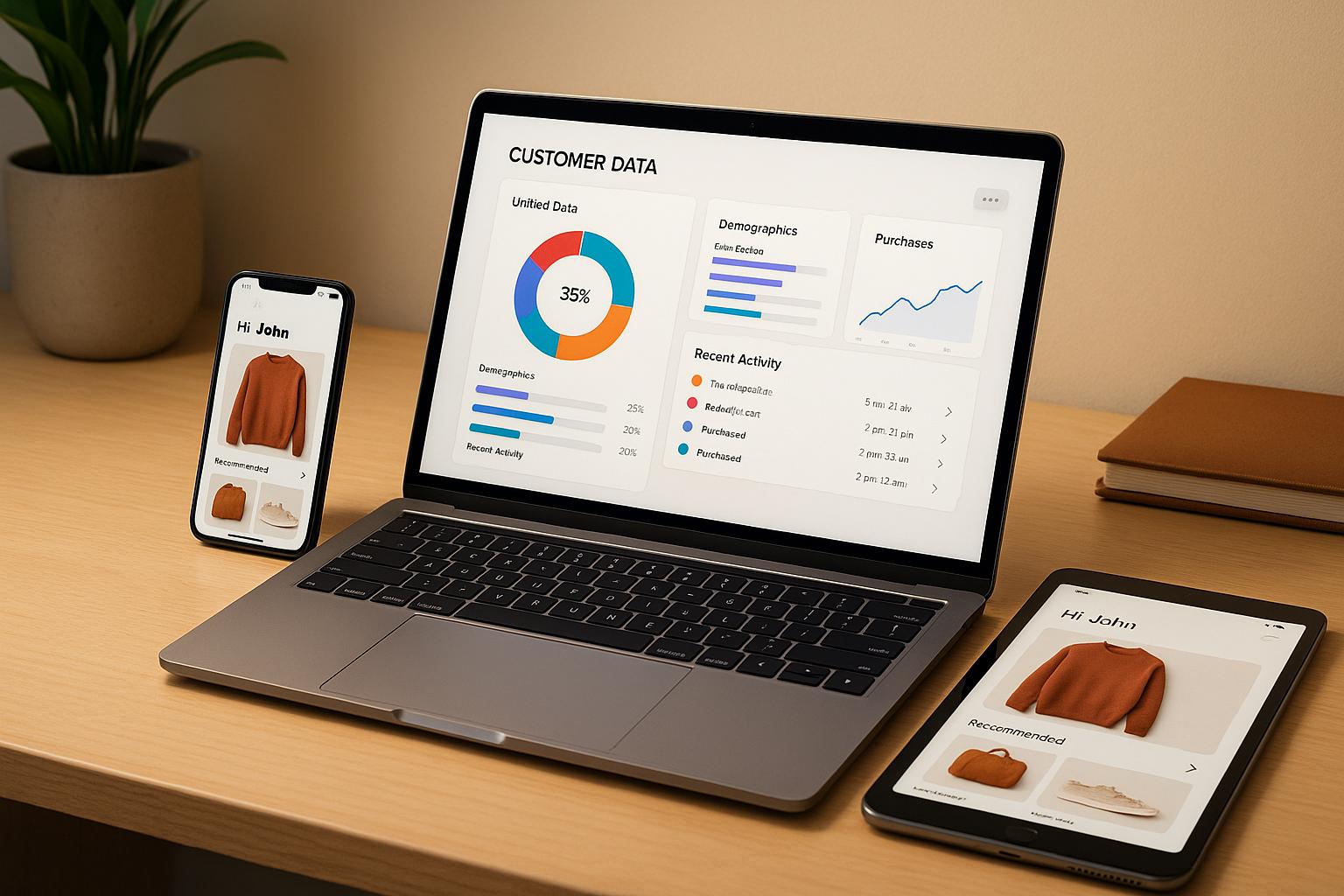
Want to keep your customers coming back? Omnichannel personalization is the answer. By tailoring every interaction - online and offline - you can build loyalty, boost retention, and increase profitability. Here’s why it works:
- Retention is cheaper than acquisition: Acquiring a new customer costs 6-7x more than retaining one.
- Retention drives profits: A 5% retention boost can increase profits by 25%-95%.
- Personalization matters: 78% of customers are more likely to return when brands deliver personalized experiences.
Key Takeaways:
- Unify customer data: Connect data across platforms for a complete customer view.
- Leverage AI: Use AI for real-time, behavior-driven personalization.
- Ensure consistency: Deliver a uniform brand experience across all channels.
- Customize offers: Tailor communication and promotions based on customer behavior.
- Use modular content: Dynamically adjust content to fit individual preferences.
- Test and refine: Continuously measure and optimize personalization strategies.
- Invest wisely: Use flexible financing to fund your personalization efforts.
Omnichannel personalization doesn’t just improve customer experiences - it drives measurable results like higher retention, increased sales, and better customer lifetime value. Let’s dive into how to make it work for your business.
How to implement an omnichannel personalization strategy with Noah Rahimzadeh (Digioh)
1. Use Unified Customer Data
Bringing together customer data from your website, email campaigns, and social media gives you a complete picture of each customer’s journey - from their first interaction to making a purchase. Imagine a customer browsing your site, abandoning their cart, and later engaging with your Instagram post. A unified data system connects these moments, creating a seamless understanding of their behavior.
"Customer Data Integration (CDI) is crucial for creating a comprehensive view of each customer, enabling personalized experiences and data-driven decisions." – Fast White Cat
How to Implement the Personalization Strategy
To unify your customer data, start by breaking down silos between different sales channels. Consider using a Customer Data Platform (CDP) or upgrading your CRM to gather first-party data from multiple sources. The CDP market is expected to grow significantly, from $7.4 billion in 2024 to $28.2 billion by 2028, with a projected CAGR of 39.9%.
Your unified customer profiles should include:
- Demographics: Age, location, and preferences
- Purchase history: Products purchased and buying frequency
- Browsing activity: Pages viewed and time spent on-site
- Customer service interactions: Support requests and resolutions
- Social media engagement: Interactions with your brand on platforms
- Email marketing data: Open rates and click-throughs
- In-store visit details: For businesses with physical locations
Processing this data in real time allows for dynamic personalization, such as adjusting pricing, inventory availability, and marketing triggers instantly.
Impact on Customer Retention Metrics
Take PUMA’s 2024 example: by unifying customer data and tailoring their messaging based on these insights, they saw higher email open rates, rapid database growth, and a surge in newsletter subscribers. A unified system also helps you calculate and optimize customer lifetime value (CLV). With detailed profiles, you can identify your most valuable customers and design campaigns to keep them coming back.
How to Scale Across Multiple Channels
Unified customer data becomes even more effective when used across multiple channels. Studies show that retailers using three or more sales channels generate 143% more revenue than those using fewer. Additionally, 78% of consumers interact with multiple channels during their purchase journey. To make the most of this, your data system should integrate:
- Online platforms: Websites and mobile apps
- Physical stores: Brick-and-mortar locations and pop-up shops
- Marketplaces: Amazon, eBay, Walmart Marketplace, etc.
- Social commerce: Instagram Shopping, TikTok Shop, and similar platforms
- Email and SMS marketing
- Customer service touchpoints
Consistency is key. Ensure your branding, product details, customer policies, and promotions are uniform across all channels. This not only builds trust but also encourages repeat business. Additionally, equip your team to interpret the data and confidently execute personalized strategies.
Compliance with U.S. Privacy and Communication Regulations
Handling customer data comes with a responsibility to follow privacy laws. In the U.S., fourteen states currently enforce comprehensive data privacy laws, with six more set to take effect by 2025 and 2026. These laws often operate on an opt-out basis, requiring businesses to offer customers the option to decline data processing, targeted ads, or profiling.
To stay compliant:
- Collect only essential data and regularly delete outdated information. Update privacy policies as laws evolve and use a Consent Management Platform (CMP) to manage customer permissions .
- Secure your systems with measures like end-to-end encryption and role-based access controls.
- Train your staff to handle sensitive data responsibly and thoroughly vet third-party vendors for compliance with data protection standards.
"Marketers want to break down silos to gain a 360-degree view of customers, but at the same time it's important to limit access to data only to those who specifically need it, and for specific functions." – Adelina Peltea, CMO of Usercentrics
Once you’ve established unified data, the next step is leveraging AI for real-time personalization, taking customer experiences to the next level.
2. Apply Real-Time Personalization with AI and Machine Learning
AI has taken personalization to the next level, creating real-time, tailored customer experiences. By leveraging unified customer profiles, AI and machine learning can analyze every interaction - like browsing habits and purchase history - to deliver highly specific recommendations at just the right moment. This approach goes beyond traditional, static personalization, as AI continuously learns and adapts to each customer's behavior.
"AI models have advanced to the point where they are able to take in vast amounts of user behavior data to drive a 1:1 personalized experience in product discovery. Every search, browse, or recommendation query can be tailored to individuals at scale." – Arvind Natarajan, director of product at GroupBy
AI achieves this by processing multiple data points, such as clicks, time spent on pages, purchase patterns, and search queries. These insights allow for immediate, personalized interactions that feel natural and engaging.
How to Implement the Personalization Strategy
To create dynamic, real-time personalization, combine customer-provided data (zero-party) with behavioral insights (first-party) to build accurate profiles. Use AI-powered tools like collaborative filtering to suggest products based on shared interests among users. Natural language processing (NLP) can also enhance search engines, helping them interpret customer queries and deliver relevant results instantly.
Key AI applications include:
- Predictive analytics: Use browsing and engagement data to predict when customers are likely to make a purchase or abandon their cart. This allows for timely interventions, such as offering discounts or reminders.
- Smart cross-selling and upselling: Recommend complementary products or premium options at the perfect moment, boosting the average purchase value without overwhelming the customer.
By offering these tailored interactions, AI personalization strengthens customer loyalty and encourages repeat business.
Impact on Customer Retention Metrics
AI-driven personalization doesn’t just improve the customer experience - it delivers measurable business results. For example, companies using these tools often see a 10–15% growth in sales, a 10–20% improvement in retention, and a 25% increase in customer lifetime value (CLV). Amazon’s recommendation engine alone contributes to 35% of its sales.
A standout success story is Yves Rocher, which implemented Bloomreach’s real-time recommendation system. The results? A staggering 17.5× increase in clicks on suggested items within the first minute and an 11× higher purchase rate for those recommendations.
How to Scale Across Multiple Channels
Scaling AI personalization effectively means creating a unified experience across websites, mobile apps, social media, and even physical stores. The goal is to maintain context as customers move between these touchpoints, ensuring their journey feels seamless.
Take Etsy, for example. Its AI-powered search system led to a 10% rise in purchases driven by search. Yum Brands also saw a 15% sales increase by applying consistent AI personalization across channels. To achieve similar results, your AI system should adjust promotions and loyalty programs dynamically, tailoring them to resonate with specific customer segments. Whether through email, social media, or in-store interactions, the messaging must stay relevant and engaging.
At the same time, scaling AI systems requires careful attention to privacy regulations, which brings us to the next challenge.
Compliance with U.S. Privacy and Communication Regulations
As AI personalization grows, so does the need to comply with evolving privacy laws. Globally, 71% of countries now have data privacy legislation, and the U.S. is quickly catching up. For instance, Colorado’s AI Act, passed in May 2024, will take effect in 2026, focusing on preventing bias and discrimination in automated systems.
California has also introduced several measures. Assembly Bill 2655, passed in September 2024, requires large platforms to block deceptive election-related content. Additionally, SB 243 and SB 420, enacted in June 2025, regulate chatbot marketing and mandate transparency in automated decision-making. Texas joined the effort with the Texas Responsible AI Governance Act (TRAIGA), signed in June 2025, which prohibits AI systems designed for manipulation or discrimination.
To stay compliant, businesses should:
- Conduct AI assessments before deploying personalization tools.
- Build privacy safeguards into the development process.
- Implement data retention policies to automatically delete outdated information.
- Ensure AI systems provide transparent decision-making processes and include human oversight for key validations.
"AI personalization produces better supply chain efficiencies and inventory predictions through its Chabot platforms while simultaneously helping with virtual shopping support for customers. These technological advancements enhance both business efficiency and focus on customer-oriented e-commerce delivery." – Falope Samson
It’s worth noting that only 34% of organizations have fully mapped how their AI systems handle personal data. To ensure compliance, businesses must understand their data workflows, develop incident response plans tailored to AI, and conduct regular audits. These steps will help maintain both effectiveness and legal compliance in personalization efforts.
3. Create Consistent Cross-Channel Experiences
When you combine unified customer data with real-time personalization, the next step to strengthening customer retention is creating a consistent experience across all channels. Whether customers interact with your brand on social media, your website, a mobile app, or through customer service, they should always feel like they're engaging with the same company. This kind of seamless interaction builds trust and loyalty.
More than half of shoppers use three to five channels before making a purchase. Every interaction shapes their perception of your brand, which is why a unified experience is so crucial.
Here’s how you can implement and scale a consistent brand presence across all channels.
How to Implement the Personalization Strategy
Start by clearly defining your brand identity. This includes your mission, vision, core values, target audience, and unique selling proposition. These elements should guide every interaction your customers have with your brand.
Next, develop a detailed brand voice guide. This guide should outline your brand’s personality, tone, and messaging style, complete with examples of what’s considered “on-brand” versus “off-brand.” It’s also important to account for channel-specific nuances - for example, a casual tone might work well on social media, but emails may require a more formal approach. Despite these differences, the core voice should remain consistent.
Ensure everyone on your team understands and applies the brand voice guide. To maintain uniformity, use centralized content management systems that allow updates to reflect across all channels simultaneously. A unified content calendar can also help you plan campaigns so that every piece of content aligns with your messaging and visual identity.
Another key step is integrating customer data. This helps you maintain context as customers move between touchpoints, ensuring a smooth and personalized experience.
"To connect the customer journey and maintain message consistency, you need to integrate data from all corners of your marketing stack... When you're able to unite your customer data, you unlock transformational insights that lead to more meaningful relationships." – Kara Trivunovic, SVP, CX Studio, Zeta Global
With these steps, you’ll have a strong foundation for delivering consistent experiences across all channels.
Impact on Customer Retention Metrics
The financial benefits of cross-channel consistency are hard to ignore. Companies with robust omnichannel strategies retain 89% of their customers, compared to just 33% for those with weaker strategies. Additionally, presenting your brand consistently across platforms can boost revenue by an average of 33%. Omnichannel shoppers, in particular, deliver 30% higher lifetime value than those who stick to a single channel.
Consistency also strengthens trust. Nearly half of customers - 46% - are willing to pay more for products from brands they trust. By maintaining a consistent presence, you can increase revenue by up to 23%. This emotional connection makes customers less likely to switch brands, even if competitors offer lower prices or discounts.
How to Scale Across Multiple Channels
Scaling a consistent presence across channels requires careful planning and smart tools. Start by creating reusable brand templates for social media posts, emails, presentations, and other content. These templates ensure your visual and verbal identity remains consistent, no matter the platform. Repurposing core content for different channels is another effective way to maximize value while reinforcing your brand message.
Real-time personalization is key to scaling effectively. Use event-driven architectures and stream processing technologies to adapt content and recommendations instantly based on customer behavior. Monitor engagement with analytics tools and schedule regular team check-ins to address any inconsistencies quickly. With 72% of consumers preferring to interact with brands across multiple channels, aligning your scaling efforts with their habits is essential.
Brands that implement these strategies often see measurable results, such as higher email open rates, database growth, and increased newsletter subscribers - all within just a few months.
Compliance with U.S. Privacy and Communication Regulations
As you work to maintain consistency across channels, it’s also important to stay compliant with U.S. privacy laws and communication regulations. When integrating customer data from multiple touchpoints, ensure your processes align with evolving state privacy laws.
Your brand voice guide should include privacy-compliant messaging, so data collection requests and privacy notices match your overall tone while meeting legal standards. Transparency is critical - customers should always understand how their data is being used, whether they’re browsing your website, using your app, or receiving emails. Clear communication about data usage builds trust and fulfills regulatory requirements.
Regular audits of your data flows can help identify and fix compliance gaps before they become problems. As new privacy laws emerge, update your brand voice guide and train your team to adapt your communication approach accordingly. This ensures you stay ahead of legal changes while maintaining trust with your audience.
4. Customize Communication and Offers Based on Behavior
Customizing communication and offers based on customer behavior takes your omnichannel personalization strategy to the next level. By using data on browsing habits, purchase history, and engagement patterns, you can deliver content that feels relevant and personal. This approach not only builds emotional connections but also encourages repeat purchases and long-term loyalty. Behavioral customization refines customer interactions by leveraging unified data and real-time personalization.
How to Implement the Personalization Strategy
To start, collect behavioral data from every interaction point. Pay attention to what customers browse, how long they spend on specific pages, what they add to their carts, and what they ultimately buy. Also, track email opens, social media activity, and customer service interactions - this data forms the backbone of your strategy.
Next, segment your audience based on behavior rather than just demographics. For instance, you could create groups like "frequent browsers who rarely buy", "seasonal shoppers", or "loyal repeat customers." Then, tailor your messaging and offers to match each group's specific patterns and preferences.
Use automated triggers to send communications based on customer actions. For example, set up emails for abandoned carts, post-purchase follow-ups, or re-engagement campaigns. Each message should directly reference the customer's actions and offer relevant next steps or incentives. This ensures your communication is timely and aligned with their behavior.
A great example is Starbucks, which uses its mobile app to track customer purchases and preferences. The app sends targeted offers that encourage loyalty and repeat visits.
Don't forget to test different approaches. Experiment with various subject lines, offers, and messaging styles for each behavioral segment. Monitor the results - such as engagement and conversion rates - and refine your strategy based on what works best.
Impact on Customer Retention Metrics
Behavioral customization has a tangible impact on customer retention. Businesses that excel in personalization generate 40% more revenue from these strategies. For instance, 78% of consumers say they’re more likely to make repeat purchases when content feels tailored to them, and 56% are more inclined to become loyal customers after experiencing personalized interactions. Furthermore, 72% of customers engage only with messages that feel personalized, underscoring the importance of this approach.
Netflix is a prime example of how behavioral personalization can drive long-term success. By using viewing history to recommend content, Netflix keeps users engaged, reduces churn, and fosters loyalty among its subscribers.
Additionally, 60% of consumers report becoming regular customers after a personalized shopping experience, and businesses often see revenue increases of 10% to 15% as a result of these efforts.
How to Scale Across Multiple Channels
Scaling behavioral customization requires unified data collection across all platforms. Your email system, website analytics, social media insights, and mobile app data should feed into a central hub that builds detailed behavioral profiles for each customer.
Set up behavioral triggers that work across multiple channels. For instance, if a customer abandons their cart on your website, they could receive an email reminder, see a retargeting ad on social media, and get a push notification - all referencing the same items and offering consistent incentives.
Sephora’s loyalty program is an excellent example of this. By using personalized data, Sephora sends tailored product recommendations via email, mobile, and in-store experiences. This creates a sense of exclusivity and added value for their loyal customers.
Real-time tracking is essential for keeping customer profiles up to date. Whether a customer makes a new purchase, browses a different category, or interacts with your content, their profile should reflect these changes immediately. This ensures every interaction feels timely and relevant.
AdRoll illustrates this well with its interactive strategy quizzes. These quizzes gather insights about users' goals and tools, offering personalized feature recommendations. This approach increased feature usage by 35% after just one quiz.
Progressive profiling is another key tactic. Instead of collecting all customer information upfront, gather data gradually through ongoing interactions. This allows you to deepen your understanding of customers over time without overwhelming them.
Compliance with U.S. Privacy and Communication Regulations
When implementing behavioral customization, it’s essential to prioritize customer privacy. Always obtain explicit consent before tracking data and explain how this data improves their experience.
Your privacy notices should clearly outline what data you collect and why. Reassure customers that their browsing history, purchase habits, and engagement data are used solely to enhance their interactions - not just for marketing purposes.
Make it easy for customers to opt out of tracking if they prefer. Options like disabling personalized recommendations or limiting data collection should be readily available without restricting access to core services.
Finally, regularly review your data practices to ensure they comply with privacy laws. Whenever possible, anonymize data for analytics and testing to minimize risks while maintaining effective personalization.
sbb-itb-d7b5115
5. Use Modular Content and Dynamic Creative Optimization
Modular content and dynamic creative optimization change the way businesses deliver tailored experiences across various channels. Think of it as creating flexible building blocks - headlines, images, product suggestions, and calls-to-action - that adjust dynamically based on customer data like browsing habits, purchase history, or device type. Here’s how you can start using these strategies effectively.
How to Implement the Personalization Strategy
Start by breaking down your existing content into smaller, adaptable components. Create multiple versions of key elements like headlines, product images, descriptions, and promotional banners. For example, you could develop several headline styles, pair them with different image options, and match them with varied call-to-action buttons.
Next, establish dynamic creative optimization rules that tailor content based on customer behavior and preferences. For instance:
- High-value customers can see premium product recommendations and exclusive offers.
- Budget-conscious shoppers might receive messaging focused on discounts.
- Mobile users benefit from simplified layouts and larger buttons, while desktop users get access to more detailed product information.
With these rules in place, your personalization engine automatically selects the best-performing combination of content for each user, ensuring consistent yet personalized messaging across email, social media, and your website.
"Content personalization is the future of marketing. AI allows us to create unique experiences for every customer." - Jeff Bezos, Amazon founder
Continuously test different content combinations, track performance metrics like headline and image engagement, and refine your modules to improve results.
Impact on Customer Retention Metrics
Personalized content has a direct impact on customer retention and engagement. Companies leveraging AI-driven personalization have reported:
- A 20% increase in sales
- 1.7 times higher conversion rates
- Double the customer engagement
- A 28% reduction in churn
- A 25% boost in marketing ROI
Real-world examples further highlight these benefits:
- Netflix’s recommendation algorithms save the company roughly $1 billion annually by reducing churn, with personalized suggestions proving 3–4 times more effective than generic ones.
- Top-performing companies generate 40% more revenue through personalization efforts.
How to Scale Across Multiple Channels
Scaling modular content ensures consistent messaging across all customer touchpoints. To achieve this, use a centralized content management system that feeds content to all your platforms, including email, websites, mobile apps, and social media. Adjust optimization rules for each channel - social media ads may need bold visuals and concise headlines, while emails can include more detailed product descriptions.
Success stories illustrate the power of this approach. For example:
- AI-driven personalization led to a 30% increase in ROI for marketing campaigns and a 15% jump in customer engagement.
- Nike's personalized email campaigns achieved a 25% higher click-through rate compared to generic emails, doubling their digital sales over three years.
"The ability to segment customers and deliver personalized experiences is a game-changer for marketers." - Marc Benioff, Salesforce CEO
Additionally, implement cross-channel triggers that update content modules based on customer actions. For instance, if someone leaves items in their cart, retargeting ads, email reminders, and website recommendations should all reflect that behavior seamlessly.
Compliance with U.S. Privacy and Communication Regulations
As with any personalization strategy, compliance with privacy laws is critical. Dynamic content optimization relies on transparent data collection practices. Make sure customers understand how their data - like browsing and purchase history - is used to create personalized experiences. Include these details in your privacy policy.
Provide users with clear opt-out options for specific types of personalization, allowing them to control their experience through account settings. During testing and optimization, anonymize customer data whenever possible to reduce privacy risks while still analyzing performance.
Finally, regularly review your content modules to prevent any unintended biases or discriminatory practices. The goal is to enhance the experience for all customers without creating unfair advantages or disadvantages.
6. Test, Measure, and Improve Personalization Strategies
Testing and evaluating your personalization efforts is the key to figuring out what works and avoiding costly guesswork. Without a structured approach, you're essentially taking shots in the dark.
How to Implement the Personalization Strategy
Start with A/B testing to compare how the same personalized idea performs across your website, email campaigns, and social media. By testing across multiple platforms, you can uncover which messaging resonates best in each space and how customers interact across different touchpoints.
Focus on testing elements that drive customer engagement, such as messaging, offers, page layouts, and channel preferences. For example, in an abandoned cart recovery campaign, try sending personalized emails to a small group of users first. Track metrics like engagement rates, click-through rates, and actual conversions before rolling it out on a larger scale.
You can also use machine learning tools to automatically direct traffic toward the best-performing variations. These tools adjust based on how customers behave, helping you maximize results without manual intervention.
This methodical testing gives you actionable insights to fine-tune your personalization strategies and boost customer retention.
Impact on Customer Retention Metrics
When done right, testing and optimizing personalization efforts can lead to noticeable improvements in retention metrics. Companies that rely on real-time data instead of intuition often see gains in customer lifetime value and repeat purchase rates.
Cross-channel testing can also uncover unexpected insights. For instance, high-value customers might engage more with personalized social media ads than email campaigns. Or mobile users may convert better with simplified, tailored layouts. These revelations help you allocate resources effectively and avoid overwhelming customers with repetitive personalization by keeping strategies fresh.
How to Scale Across Multiple Channels
To ensure consistent performance across all platforms, use centralized testing tools that let you run experiments simultaneously across websites, emails, social media, and mobile apps. This unified approach makes it easier to compare results and maintain consistency.
Develop reusable A/B test templates for campaigns that span channels - like abandoned cart recovery efforts involving pop-ups, emails, and retargeting ads. This structured approach helps you figure out the best mix of channels for different customer groups.
Keep the momentum going by automating your testing cycles. Set rules to launch new experiments as soon as the previous ones wrap up. This is especially helpful when managing diverse customer segments or multiple product lines.
Compliance with U.S. Privacy and Communication Regulations
Testing personalization strategies means handling customer data, so staying compliant with privacy laws like California's CCPA is non-negotiable. Be transparent in your privacy policy about how you use data to create personalized experiences.
Build privacy into your strategy from the start. This means embedding security and compliance measures into your workflows instead of adding them later. Define clear data retention policies for testing data and regularly assess vulnerabilities.
As you gather more customer data, it's crucial to keep security measures strong. Use AI and automation to monitor for unusual activity and streamline compliance reporting during audits.
Finally, train your team on privacy best practices. When everyone understands the importance of protecting customer data, they’re more likely to follow proper protocols during testing and analysis. This not only ensures compliance but also builds trust with your audience.
7. Fund Omnichannel Personalization with Flexible eCommerce Financing
Creating personalized experiences across multiple channels requires a substantial upfront investment. From upgrading technology to training staff and restructuring operations, the costs can be daunting - especially when returns might not be immediate. This is where smart financing options can help eCommerce businesses turn ambitious personalization plans into reality.
How to Implement the Personalization Strategy
Start by identifying the touchpoints and use cases that will deliver the most immediate impact. Focus on key digital areas like mobile apps, digital displays, interactive screens, digitally equipped staff, and point-of-sale systems. These are the building blocks of a tailored customer experience.
Revenue-based financing is an effective way to fund these initiatives without draining your working capital. It allows repayments to scale with your actual sales, giving you flexibility as you grow.
Your first step should be investing in a central personalization platform. This unified system acts as the backbone for delivering customized experiences and tracking performance across all channels. While it may require a larger initial investment, it sets the stage for future personalization efforts.
Take Tecovas as an example. They developed custom POS UI extensions that integrate real-time customer data into their Shopify system. This upgrade allows staff to provide tailored recommendations and track customer loyalty both in-store and online.
Impact on Customer Retention Metrics
The financial benefits of omnichannel personalization often outweigh the initial costs. Research shows that companies excelling in personalization generate 40% more revenue than those that don’t. Businesses leveraging omnichannel strategies can boost customer retention by 89%.
Retailers that use unified customer models report an average 8.9% increase in sales. Specific enhancements include larger orders (up to 20% more) and in-store sales growth of up to 40% through "endless aisle" strategies. Conversion rates can also skyrocket - Venus et Fleur saw a 12% drop in abandoned checkouts after implementing unified data systems, personalized greeting messages, and tailored product recommendations.
How to Scale Across Multiple Channels
Once you’ve established a strong foundation, scaling personalization across channels becomes the next step. This requires integrated systems rather than fragmented solutions. Flexible financing can support the adoption of platforms that unify customer data and APIs across various touchpoints.
For instance, Mizzen+Main, a men’s performance apparel brand, connected customer profiles and purchase histories across channels. This allowed them to offer personalized size and style recommendations both online and in-store, resulting in a 27% year-over-year retail revenue increase and a 15% boost in online sales.
To ensure long-term success, prioritize systems that simplify operations and reduce costs. Platforms that streamline management and enhance customer acquisition efficiency deliver a stronger return on investment.
"Customers demand digital-first convenience and are leaning on brands to innovate like never before. They're seeking not just more personalized experiences, but empathetic ones."
– Simon Mulcahy, Salesforce CIO
Compliance with U.S. Privacy and Communication Regulations
Investing in personalization technology also means staying compliant with data privacy laws. As customer trust increasingly hinges on transparent data practices, aligning your systems with regulations like California’s CCPA is critical.
Look for platforms with built-in compliance tools, such as automated data retention policies, security monitoring, and audit trail features. These not only help you avoid penalties but also ensure your financing efforts are well-protected.
Onramp Funds offers revenue-based financing tailored for eCommerce businesses. With funding available in 24 hours and repayment tied to sales, you can invest in compliant personalization strategies without sacrificing equity or straining cash flow. Their platform integrates with major eCommerce systems like Amazon, Shopify, BigCommerce, and TikTok Shop, offering clear fees of 2–8% with no hidden costs.
Comparison Table
Let's take a closer look at how different personalization strategies stack up in terms of complexity, impact, and use cases. This comparison can help you decide where to focus your efforts for better retention results.
*Exact figures for cross‑channel consistency have not been quantified.
What the Data Tells Us
The table reveals distinct differences in how these strategies perform. For instance, companies leveraging AI for customer retention have seen churn reductions of 10–30% and customer lifetime value increases of 20–50% compared to traditional methods. Marketers using AI personalization also report an average 25% boost in marketing ROI.
Real-world examples highlight these trends. Vodafone's adoption of AI-driven personalization cut churn by 20% and improved the efficiency of retention spending by 15%. Similarly, Adobe's AI-powered system has achieved a subscription renewal rate exceeding 90%. Netflix's recommendation engine, which reduces churn, saves the company about $1 billion annually. Starbucks has also reaped the rewards, with a 30% rise in ROI on marketing initiatives and a 15% increase in customer engagement levels.
Balancing Costs and Returns
The upfront investment varies significantly between strategies. Rule-based systems are budget-friendly and quick to implement but often deliver limited results. On the other hand, AI-driven approaches require substantial investment in technology and data infrastructure. However, the returns can be well worth it, with long-term benefits that grow as the system learns and adapts to customer behavior.
Timing also plays a role. Rule-based systems may start showing results within a few months but often hit a ceiling quickly. AI-driven strategies, while requiring 6–12 months to mature, tend to yield ongoing improvements as they refine their understanding of customer preferences.
Tailoring Your Approach
For eCommerce businesses, the choice of strategy should align with your current capabilities. If you already have a robust data infrastructure and a sizable customer base, AI-driven personalization can deliver transformative results. Smaller businesses, however, might find it more practical to start with rule-based systems and transition to advanced solutions as they grow.
It's important to note that AI isn't here to replace marketers - it’s here to enhance their capabilities. A thoughtful, strategic approach is key to making the most of your personalization investments.
Conclusion
Omnichannel personalization has become a powerful way for businesses to truly connect with their customers, creating meaningful interactions across every touchpoint.
The numbers back this up. Retailers that offer point-of-sale financing report a 32% increase in sales and a 56% higher return rate.
"Omnichannel turns spectators into fans by creating unique, tailored experiences".
To get started, businesses can focus on rule-based personalization for quick, impactful results. Over time, scaling up to real-time, cross-channel strategies can strengthen customer relationships even further.
Of course, scaling personalization takes resources. But with flexible financing options, this investment becomes more accessible. For example, with many consumers planning big purchases and exploring buy-now-pay-later options, revenue-based financing from Onramp Funds allows eCommerce businesses to adopt personalization tools while repaying based on their actual sales performance.
From integrating data to delivering dynamic content, every step toward personalization contributes to long-term growth. Leading businesses understand that personalization isn’t a one-time effort - it’s an evolving process. By implementing these strategies, tracking outcomes, and making ongoing improvements, companies can build customer loyalty and achieve sustainable profitability.
FAQs
How can eCommerce businesses unify customer data across platforms to improve personalization?
To bring together customer data from various platforms, eCommerce businesses can rely on Customer Data Platforms (CDPs). These platforms gather data from multiple sources, eliminating silos and creating a comprehensive, real-time profile for each customer. With this unified view, businesses can offer personalized experiences across every channel.
Using APIs to integrate data and ensure consistency across platforms is equally important. Keeping customer information accurate and updated allows businesses to improve personalization, increase engagement, and strengthen customer loyalty effectively.
How can eCommerce businesses comply with privacy laws while using AI for personalized customer experiences?
To navigate privacy laws while leveraging AI for personalization, eCommerce businesses need to prioritize transparency, consent, and strong data management practices. Make it clear to customers how their data is being collected, stored, and used. Always secure explicit consent when required.
It's also crucial to comply with regulations like California's CCPA and follow federal data security guidelines. These steps not only ensure legal compliance but also foster trust with your customers.
Regular audits of AI systems for ethical compliance, combined with solid data governance policies, can significantly reduce privacy risks. Staying informed about changing laws and maintaining open, honest communication about customer data rights are vital steps in creating a trustworthy relationship with your audience.
How can small eCommerce businesses start using omnichannel personalization without a big budget?
Small eCommerce businesses don’t need massive budgets to dive into omnichannel personalization. Start by focusing on creating a smooth and consistent experience across your most important channels, like email, social media, and your website. There are plenty of free or low-cost automation tools available to help you handle tasks like personalized email campaigns or targeted social media ads.
Begin by concentrating on the platforms where your customers are most active. From there, you can gradually expand your efforts as your business grows. Tailoring content to reflect customer behavior, preferences, or previous purchases can make a noticeable difference without breaking the bank. Even small, thoughtful steps toward personalization can strengthen customer connections and boost loyalty over time.
Related posts
Onramp Funds
Funding built around your sales
Connect your store and see what you qualify for. Repay as a percentage of sales, with no personal credit check.
Funding in as little as 24 hours.
