

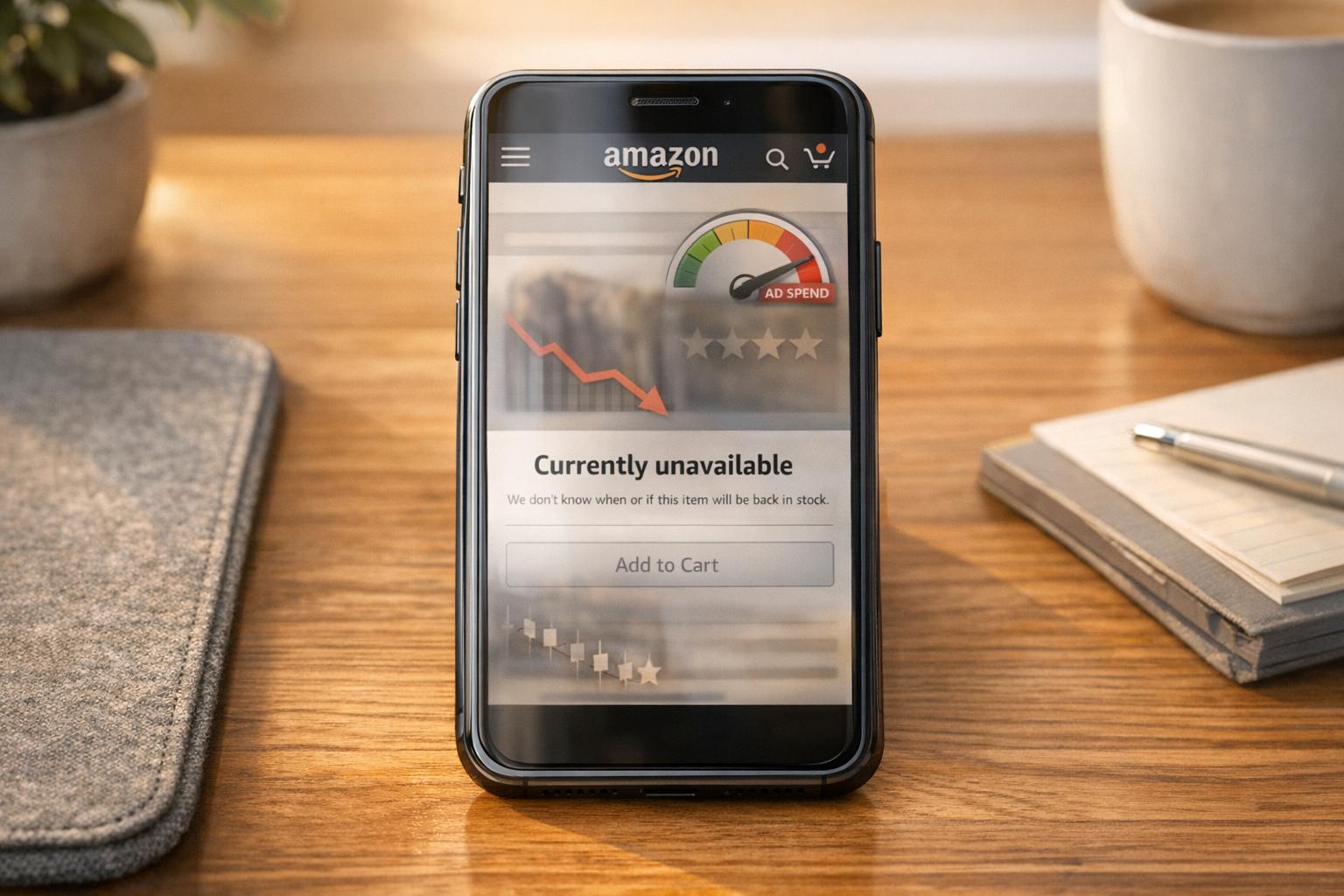
Stockouts on Amazon are more than just missed sales - they hurt your rankings, waste ad dollars, and damage customer trust. Here’s why they’re a big deal and how to avoid them:
- Immediate Impact: You lose Buy Box eligibility, rankings drop, and frustrated customers turn to competitors. Research shows 66% of buyers switch brands during stockouts, and many don’t come back.
- Hidden Costs: Stockouts cost 2–5x the value of the lost sale due to wasted marketing spend, higher restocking fees, and recovery campaigns. For example, expedited shipping can cost 3–10x more than standard freight.
- Ranking Damage: A 7-day stockout can slash organic rankings by 30–50%, requiring 30–60 days of increased ad spend to recover.
- Customer Loss: Stockouts reduce repeat sales by 20% and can permanently damage trust, leading to long-term revenue loss.
How to Prevent Stockouts:
- Demand Forecasting: Use tools like Amazon’s Demand Forecasting or SoStocked to predict trends and reorder on time.
- Safety Stock: Maintain buffer inventory to handle unexpected delays or demand spikes.
- Automation: Implement inventory tracking systems to avoid manual errors and get real-time alerts.
Stockouts hurt your bottom line and reputation. Proactive planning and quick access to financing, like revenue-based loans, can help you manage inventory better and stay competitive.
Amazon Inventory Management Tutorial: Avoiding Stockouts and Excess Inventory
sbb-itb-d7b5115
The Hidden Financial Impact of Stockouts

The Hidden Costs of Amazon Stockouts: Financial Impact Breakdown
Stockouts don’t just mean immediate lost sales - they create a domino effect that can severely harm your long-term visibility and profitability on Amazon. The real cost of running out of stock is often 2 to 5 times the value of the lost sale [2]. These shortages set off a chain reaction of financial losses that build over time, cutting into profits from multiple directions.
Lost Revenue and Wasted Marketing Spend
Every dollar spent on marketing - whether through Amazon PPC, Google Ads, influencer partnerships, or SEO - becomes money down the drain when customers land on an out-of-stock product page [2]. Even though you’ve already covered the Customer Acquisition Cost (CAC), which typically ranges from $10 to $50 per customer for consumer packaged goods (CPG) brands [2], there’s no return if the product isn’t available to purchase.
"Running Amazon ads with an empty shelf? You might as well be burning cash." - Shivam Kumar, Adbrew [4]
For 240 sellers analyzed, stockouts led to an average of $18,000 in lost revenue, thanks to ranking drops, missed Buy Box opportunities, and slow recovery times [5]. Combine this with the sunk costs of marketing efforts, and the financial hit becomes even more painful.
Higher Restocking Costs
Recovering from a stockout isn’t cheap. To restock quickly, businesses often resort to expedited shipping, which can cost 3 to 10 times the normal freight rate [2]. For example, a $5,000 ocean freight shipment could balloon to $25,000 if expedited by air [2]. Beyond shipping, crisis-mode restocking often involves rush production fees, supplier premiums, and reallocating staff to manage the situation - all of which contribute to what’s known as operational chaos costs [2][10].
Customer Acquisition Cost Impact
The financial burden doesn’t stop once inventory is replenished. A stockout can significantly impact your organic search rankings, forcing you to spend heavily on aggressive PPC campaigns and offer steep discounts to regain sales momentum [2][8][5]. Just one week of being out of stock can result in 4 to 6 weeks of reduced visibility and sales as you work to recover [2]. This essentially doubles your CAC because you’re not just acquiring new customers - you’re also trying to win back the ones you lost.
Here’s a breakdown of the compounded costs tied to stockouts:
| Cost Category | Financial Impact | Estimated Cost |
|---|---|---|
| Wasted CAC | Marketing dollars spent without conversions | $10–$50 per customer [2] |
| Expedited Freight | Emergency air shipping vs. standard ocean freight | 3–10x normal rates [2] |
| Recovery Marketing | Higher PPC bids and promotions to regain rankings | 4–6 weeks of impact [2] |
| Lost Cross-Sells | 70% of shoppers abandon carts when items are unavailable, cutting into complementary purchases | 30–40% of basket value [2][9] |
Impact on Amazon Search Rankings and Visibility
When your product goes out of stock on Amazon, the consequences are severe. Amazon penalizes these listings by pushing them out of search results, prioritizing products that are ready for immediate purchase. Why? Because an unavailable product risks driving frustrated shoppers straight into the arms of competitors like Walmart [3][6]. Beyond just disappearing from search results, being out of stock means losing eligibility for the coveted Buy Box. This isn’t just a temporary setback - it can cause long-term damage that lingers far beyond the stockout period.
How Amazon's Algorithm Views Stock Availability
Amazon’s search algorithm treats stock availability as a key trust indicator. When your inventory hits zero, you lose Buy Box eligibility, and your trust and inventory scores take a hit. These scores reflect your historical reliability, and rebuilding them after a stockout isn’t easy [3]. The algorithm also tracks an "inventory depth score", which erodes with every stockout, making recovery even tougher.
In 2025-2026, Amazon’s shift toward "predicted satisfaction" made things even stricter. With machine learning predicting transaction success, a stockout signals zero chance of fulfillment, leading to immediate suppression in search results [13]. Conversion rate - responsible for 30-40% of ranking weight - drops to zero during a stockout, causing a swift and dramatic decline in your rankings [5][13].
Best Seller Rank (BSR) and Recovery Challenges
Your Best Seller Rank (BSR) is tied directly to your sales velocity. When sales stop, your BSR nosedives. Even a short stockout can cause significant damage, and recovery often requires weeks of effort.
Take the example of a coffee brand in 2025. After just six days out of stock, its BSR dropped from #15 to #48. Restocking wasn’t enough - they had to invest in weeks of aggressive promotion to regain their lost momentum [15]. On average, a 7-day stockout can drop your organic ranking by 30-50%, and recovery typically requires 3-4 weeks of steady inventory and 30-60 days of increased ad spend [13][3].
Long-Term Visibility Loss
While your listing is sidelined by a stockout, competitors are gaining ground. This creates a vicious cycle, often referred to as "the reversing flywheel": lost sales lead to a lower BSR, which lowers your organic visibility, further reducing your sales potential when you finally restock [5].
"I've seen sellers spend six months building a product from 20% Buy Box to 75%, then lose it all in a week-long stock-out caused by a customs delay they had zero control over." - Brij Purohit, Co-founder of SellerApp [14]
Consider Sarah Thompson, who owns a kitchenware brand. In October 2025, she shipped her holiday inventory 50 days early, only to face an 11-day port backlog and 12-day FBA receiving delay. Missing the Black Friday window entirely, her Buy Box percentage plummeted from 82% to 14%, her organic rankings dropped from top 10 to page 3, and her Q4 revenue fell to $63,000, a 65% drop from her projections [14].
This example highlights how stockouts can trigger a cascading effect, making recovery harder with each occurrence. The financial and operational risks are clear, emphasizing the importance of strong inventory management and timely logistics planning.
Customer Loyalty and Brand Reputation Damage
Stockouts don't just hurt your bottom line - they can also shake the trust and loyalty of your customers, leading to long-term consequences. When shoppers can't find the products they want, they often turn to competitors, and rebuilding that trust can be an uphill battle. Beyond losing sales, this can also put extra pressure on your customer support team, creating a ripple effect of challenges.
Customers Switching to Competitors
Here's a hard truth: 66% of buyers will look for alternatives during stockouts, and many won't come back [1]. On platforms like Amazon, where competitors are just a click away, 20–40% of customers will go to a rival rather than wait for your product to restock [2]. Once they've had a positive experience with another brand, they may never return. Think about the investment you've made to acquire each customer - ads, SEO strategies, marketing campaigns. Losing a loyal customer to a competitor means losing not just one sale but potentially years of repeat business. And those repeat customers? They're the ones who drive higher lifetime revenue, making their loss even more costly.
Reduced Lifetime Value and Damaged Trust
Stockouts chip away at customer trust. When shoppers see your brand as unreliable, that perception spreads fast. Studies show that 96% of unhappy customers don’t file formal complaints - they simply share their bad experiences with others [16]. A single viral social media post about your brand "always being out of stock" can tarnish your reputation with thousands of potential buyers before you even realize there's a problem. The numbers are stark: stockouts can reduce repeat customer sales by 20% and lower retention rates by 15% [11].
Now consider this: acquiring a new customer can cost 5 to 25 times more than retaining an existing one [16]. Plus, improving customer retention by just 5% can increase profitability by 25% to 95% [16]. Every lost customer isn't just a missed sale - it's years of potential revenue slipping away. And as trust dwindles, your customer service team often bears the brunt of the fallout.
Higher Customer Service Workload
Stockouts don't just frustrate customers - they create chaos for your support team. When items go out of stock, customer service gets bombarded with questions about restock dates, cancellations, and complaints. These inquiries drive up operational costs [3]. The situation worsens if inventory issues lead to overselling across multiple channels. Customers who place orders only to have them canceled are far more likely to leave negative reviews, which can damage your seller rating and further erode trust in your brand.
The bottom line? Stockouts aren't just a logistical hiccup - they're a direct threat to your customer relationships, reputation, and long-term profitability.
Root Causes of Stockouts
To tackle stockouts effectively, you first need to understand what causes them. While stockouts can feel like major disruptions, the underlying reasons are often quite simple: outdated tools, poor forecasting, and tracking errors. Let’s break down the main internal factors that lead to stockouts and highlight why better inventory management is essential.
Poor Inventory Management Systems
Many Amazon sellers still depend on manual processes that just can’t keep up with the fast pace of eCommerce. Using spreadsheets, guessing reorder points, or relying on subjective forecasting might work for a small inventory, but these methods fall apart when scaling up. Sellers often miss critical factors like seasonal demand, upcoming promotions, or viral trends when forecasting. The result? Stockouts. In fact, about 60% of mid-sized eCommerce brands experience a major stockout every week, with out-of-stock rates ranging from 8% to 15% [1].
Warehouse and Supplier Coordination Problems
Even if your forecasting is spot-on, stockouts can still happen when warehouses and suppliers aren’t in sync. Delays in production, transportation hiccups, or limited carrier capacity can all throw a wrench in your supply chain. For example, geopolitical issues in 2024 and 2025 forced carriers to reroute shipments, adding over 10 days to Asia–Europe shipping times [1]. While ocean shipping rates dropped to around $1,669 per 40-foot container in October 2025, practices like "blank sailings" (canceled voyages) continued to cause delays.
On top of that, poor warehouse organization can lead to misplaced products - inventory that’s physically there but not available for sale. Cash flow problems make things worse; the time gap between paying suppliers and receiving Amazon payouts often delays replenishment orders. This creates a vicious cycle where stockouts hurt rankings and sales, making it even harder to recover.
Inventory Tracking Errors
Sometimes, the problem isn’t that you’re out of stock - it’s that your system thinks you are. Inventory tracking errors are common, especially with manual data entry, where mistakes occur roughly every 250 keystrokes [18]. Managing inventory across multiple platforms, like Amazon, Shopify, or TikTok Shop, can amplify these errors. Issues like "phantom inventory" (products listed as available but not actually in stock) or "stranded inventory" (sellable items stuck in a warehouse but not active online) can lead to overselling or lost sales.
A study revealed that about 60% of SKUs are affected by inaccurate inventory records, and fixing these discrepancies can boost sales by 4% to 8% [19]. Regular audits, barcode systems, and real-time multichannel inventory software can help reduce these errors and keep stockouts at bay. Addressing these root causes is crucial for implementing the solutions discussed in the next sections.
How to Prevent Stockouts
Avoiding stockouts is all about staying ahead of demand with smart strategies and modern tools. By leveraging accurate forecasting, setting safety buffers, and automating inventory tracking, you can keep your listings active and your customers happy.
Using Demand Forecasting Tools
Forecasting demand accurately is your best defense against running out of stock. Tools like Amazon's Demand Forecasting, Jungle Scout, SoStocked, and SellerApp analyze sales history, seasonality, and trends to recommend reorder quantities and timing. For example:
- Amazon's Demand Forecasting tool (free for Brand Registered sellers with 90+ days of sales data) projects demand up to 40 weeks ahead [20].
- Jungle Scout's Inventory Manager automates reorder calculations based on sales velocity and supplier lead times [21].
- SoStocked allows detailed adjustments for variables like marketing campaigns or seasonal spikes [22].
- SellerApp integrates inventory forecasting with PPC data, helping you manage ad spend based on stock levels [20][22].
A real-world example? Foxconn used Amazon Forecast, a machine learning tool, to boost forecasting accuracy by 8%, saving approximately $553,000 annually through better inventory and production management [22].
When forecasting, make sure to clean your data. Exclude one-off events like viral social media hits or special promotions, as these can distort future predictions [22][23].
Once your forecast is in place, focus on setting safety stock and reorder points to handle the unexpected.
Setting Safety Stock and Reorder Points
Safety stock acts as your safety net, protecting you from sudden demand surges or supply chain delays. Meanwhile, reorder points tell you when it’s time to restock. Here’s how to calculate them:
- Reorder Point Formula: (Average Daily Sales × Lead Time in Days) + Safety Stock [26][24].
- Safety Stock Formula: Z-score × σ × √L, where σ is the standard deviation of demand, and L is lead time [25].
The Z-score reflects your desired service level. For instance, a 95% service level uses a Z-score of 1.65, while 99% requires 2.33 [25].
"Safety stock is the guardian buffer that shields inventory profits... it specifically addresses variability." - Chris Hondl, Engineering Lead, Finale Inventory [25]
Always pad your lead times. If your supplier says 30 days, plan for 45 to account for potential delays like customs holdups [26]. This is especially crucial during Q4, which typically accounts for 30–40% of annual Amazon sales [24]. For products with high volatility or seasonality, update safety stock calculations monthly; for others, quarterly reviews should suffice [25].
While forecasting and buffers are essential, automation ensures real-time oversight.
Automated Inventory Tracking and Alerts
Manual tracking can lead to costly mistakes. Automated systems eliminate errors by synchronizing inventory data across FBA, FBM, and 3PL operations [27][12]. These tools also complement your forecasting and safety stock strategies.
Set up alerts for stock predicted to last fewer than 30 days, giving you enough time to reorder [5]. Advanced systems can even pause PPC campaigns or adjust pricing dynamically to slow sales when inventory runs low, protecting your Best Seller Rank (BSR) and avoiding a complete stockout [27][5]. Some tools go a step further, generating automated purchase orders based on real-time sales data [28].
Take DAVAN Strategic, for example. By adopting advanced inventory management and data analysis with 8fig in 2022, the company broke free from frequent stockouts, achieved $6.1 million in annual revenue, and was later sold for a 7-figure sum [8][17]. Regularly monitoring your "Days of Supply" metric (current stock ÷ average daily sales) can help fine-tune your reorder points [5].
Combining demand forecasting, safety buffers, and automation creates a solid framework to prevent stockouts, saving you from the ripple effects and hidden costs they can cause.
Financing Solutions for Inventory Management
Managing inventory effectively goes hand-in-hand with maintaining steady cash flow. Even with the best forecasting, cash flow issues can delay restocking, leaving sellers vulnerable to stockouts. Amazon’s 14-day payment cycle often ties up funds, making it harder to replenish inventory quickly when needed. This delay in cash flow is a key factor behind stockouts, which can significantly impact sales performance[29].
Cash Flow Challenges for Inventory Maintenance
For Amazon sellers - 86% of whom rely on FBA - cash flow issues are even more pronounced. FBA fees and delays add to the financial strain, and poor cash flow management is cited as a factor in 82% of business failures[29]. Traditional loans, with their slow approval processes and rigid repayment terms, are often ill-suited to solving these challenges. To address this, sellers are increasingly turning to alternative financing options that offer more flexibility and align repayment with sales performance.
How Revenue-Based Financing Works for Inventory
Revenue-based financing (RBF) offers a flexible solution by tying repayment directly to your daily sales. Instead of fixed monthly payments, you repay a percentage of your sales, allowing payments to adjust automatically if sales slow down. This is especially helpful during seasonal dips or when testing new product lines[31]. Unlike some platform-specific loans that restrict how funds can be used, RBF provides freedom to allocate funds where they’re needed most - whether for off-platform marketing, paying suppliers, or purchasing inventory for channels like Shopify or Walmart[29]. The approval process prioritizes your sales history and business performance over personal credit scores, with repayment fees starting as low as 1% of your Gross Merchandise Value (GMV)[30][31].
Onramp Funds: Fast and Flexible Financing
When stockouts threaten, quick access to funding can make all the difference. Onramp Funds provides same-day approvals and funding within 24 hours, helping sellers respond swiftly to inventory needs or prepare for peak sales periods like Prime Day or Q4[31]. The platform evaluates performance across multiple storefronts - such as Amazon, Walmart, Shopify, and TikTok Shop - to offer funding amounts that reflect your overall business success[29]. With fees ranging from 2–8% and repayments tied to a percentage of sales, Onramp Funds delivers equity-free capital without requiring personal guarantees. This structure ensures businesses aren’t burdened by fixed payments during slower periods. Considering that the average stockout lasts 35 days and could cost you a 5.2% revenue boost, having access to fast, flexible funding isn’t just helpful - it’s critical for staying competitive[8].
Conclusion
Stockouts on Amazon can lead to a domino effect of financial and operational setbacks - lost search rankings, wasted advertising dollars, and customers jumping ship to competitors. Studies reveal that search rankings can plummet by over 28% after just a single day out of stock [7]. Even more alarming, 20% to 40% of shoppers encountering an unavailable product may permanently switch to a competitor [2]. The costs of recovering from stockouts often far outweigh the revenue lost from the initial sale.
"One bad week of empty shelves could erase months of ranking and ad momentum."
The answer lies in proactive inventory management paired with flexible financing. Accurate demand forecasting, effective safety stock levels, and automated inventory alerts are essential tools. But even the most precise planning can fall short without quick access to capital for unexpected delays or surges in demand. Sellers who thrive are those who combine strong inventory strategies with financing solutions that align with their business cycles. This blend of operational foresight and financial flexibility is key to staying competitive.
Considering that the average stockout lasts 35 days and avoiding these disruptions can increase revenue by up to 5.2% [8], the question isn’t whether you can afford to invest in smarter inventory practices and financing - it’s whether you can afford not to. Each day out of stock chips away at your customer base, rankings, and profitability. Keeping your shelves stocked isn’t just about today’s sales; it’s about protecting your long-term growth, reputation, and bottom line.
FAQs
What are the long-term effects of stockouts on Amazon rankings and sales?
Running out of stock on Amazon can hit your business harder than you might think. When your product isn’t available, not only do sales take an immediate nosedive, but your product’s visibility also suffers. Amazon’s algorithm favors listings that are active and performing well. So, when your item disappears from the shelves, it’s likely to drop in search rankings.
The real challenge? Climbing back up. Regaining lost momentum and rebuilding customer trust can take months. And if stockouts happen often, it could damage your reputation - not just with customers but with Amazon itself. That makes it even tougher to maintain steady sales over time.
The takeaway? Keeping your inventory in check is crucial. Solid inventory management strategies can help you avoid these headaches and keep your business running smoothly.
How can I effectively avoid stockouts on Amazon?
Preventing stockouts on Amazon means staying ahead of the game with a mix of smart demand forecasting, efficient inventory practices, and reliable tech tools. Start by digging into your sales trends and seasonal patterns. This helps you predict demand and sidestep those dreaded out-of-stock moments during busy times.
Use real-time inventory tracking to keep a close eye on stock levels, and set up automated alerts to reorder before it’s too late. A safety stock buffer is a must-have - it’s your backup plan for unexpected demand spikes or supply chain hiccups. Inventory management software can also be a game-changer, helping you fine-tune stock levels and simplify reordering.
And don’t forget about flexible financing options, like those from Onramp Funds. These can give you the cash flow boost you need to restock quickly when demand suddenly surges. With these strategies in place, you can reduce stockouts, protect your seller reputation, and keep your Amazon search rankings intact.
How does revenue-based financing help Amazon sellers avoid stockouts?
Revenue-based financing provides Amazon sellers with a flexible way to secure capital by linking repayments to a percentage of future sales. This approach helps sellers restock inventory quickly and handle demand surges during busy seasons or unexpected sales booms, minimizing the risk of running out of stock.
Unlike traditional loans that come with fixed repayment schedules, this funding method adjusts repayments based on actual sales. This flexibility allows sellers to maintain steady inventory levels, avoid penalties, and keep customers satisfied - all without the pressure of rigid loan terms. By ensuring inventory stays consistent, sellers can preserve their search rankings, seize sales opportunities, and remain competitive in Amazon's fast-moving marketplace.
