

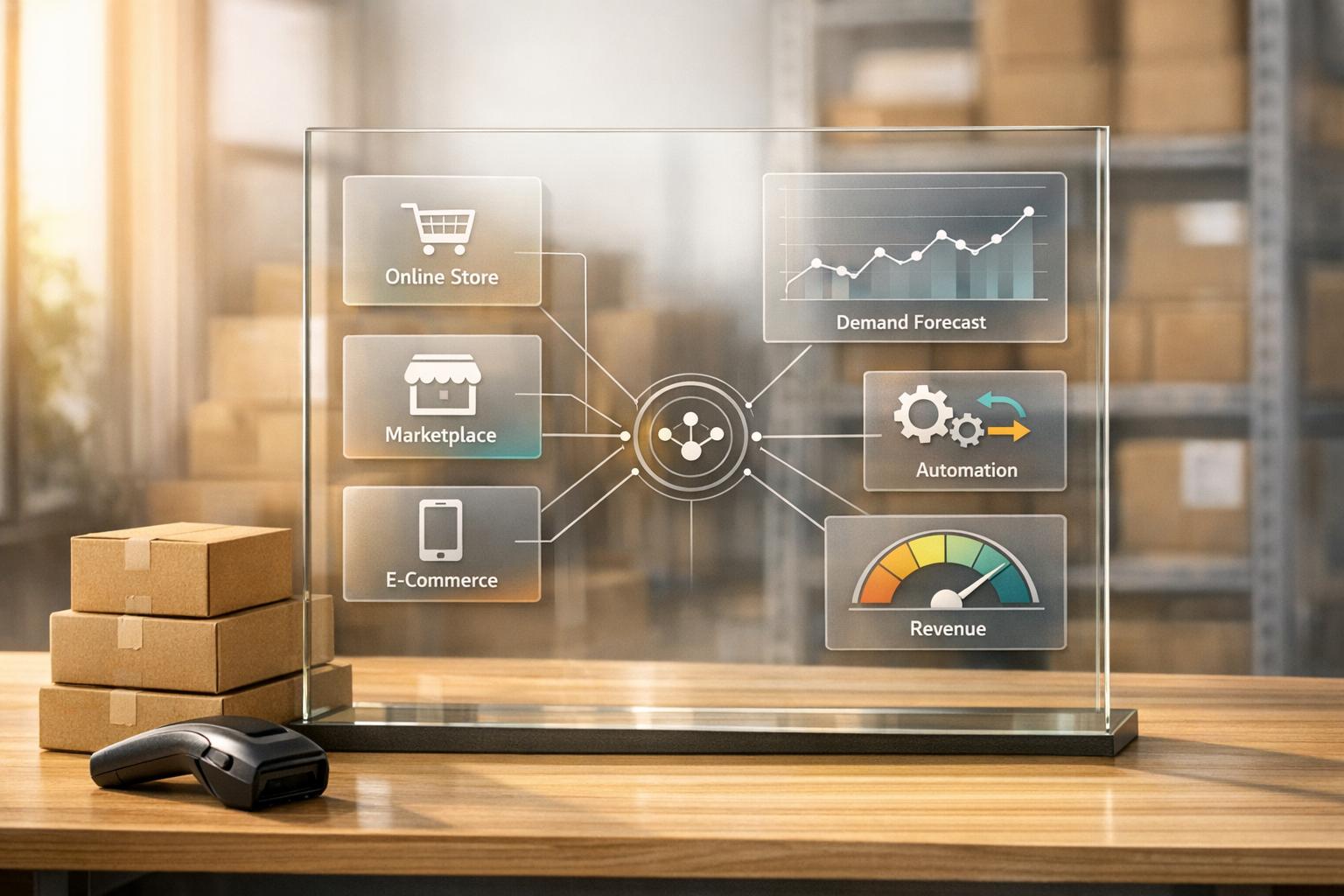
Managing inventory across platforms like Shopify, Amazon, and TikTok Shop is challenging but critical for avoiding overselling, stockouts, and lost revenue. Here’s the gist:
- Key Problem: Platforms operate on separate dashboards, causing delays in syncing inventory updates. This leads to overselling (3–8%), stockouts, and penalties (e.g., Amazon suspends accounts with >2.5% cancellation rates).
- Solution: Centralized, real-time inventory systems with features like bidirectional syncing, automated reordering, and low-stock alerts.
- Benefits: Reduced oversell rates (e.g., from 4% to 0.1%), increased revenue (up to 14%), and improved customer satisfaction.
- Tools: Choose inventory software with native integrations, SKU mapping, and automation for bundles, kits, and multi-location tracking.
- Funding: Revenue-based financing (like Onramp Funds) helps sellers scale inventory quickly without equity loss or rigid repayment terms.
The Complete Guide to Multichannel Inventory Management | Inventory Management System
sbb-itb-d7b5115
Centralizing Inventory Data Across Platforms
Bringing all inventory data into one cloud-based hub allows businesses to avoid sync delays and overselling issues across platforms. This centralized approach ensures smoother operations and more accurate stock management [8][9].
With bidirectional syncing, every sale immediately updates inventory across all connected channels, keeping everything in sync [9][1]. Event-driven triggers further enhance this by enabling near-instant updates [4][9].
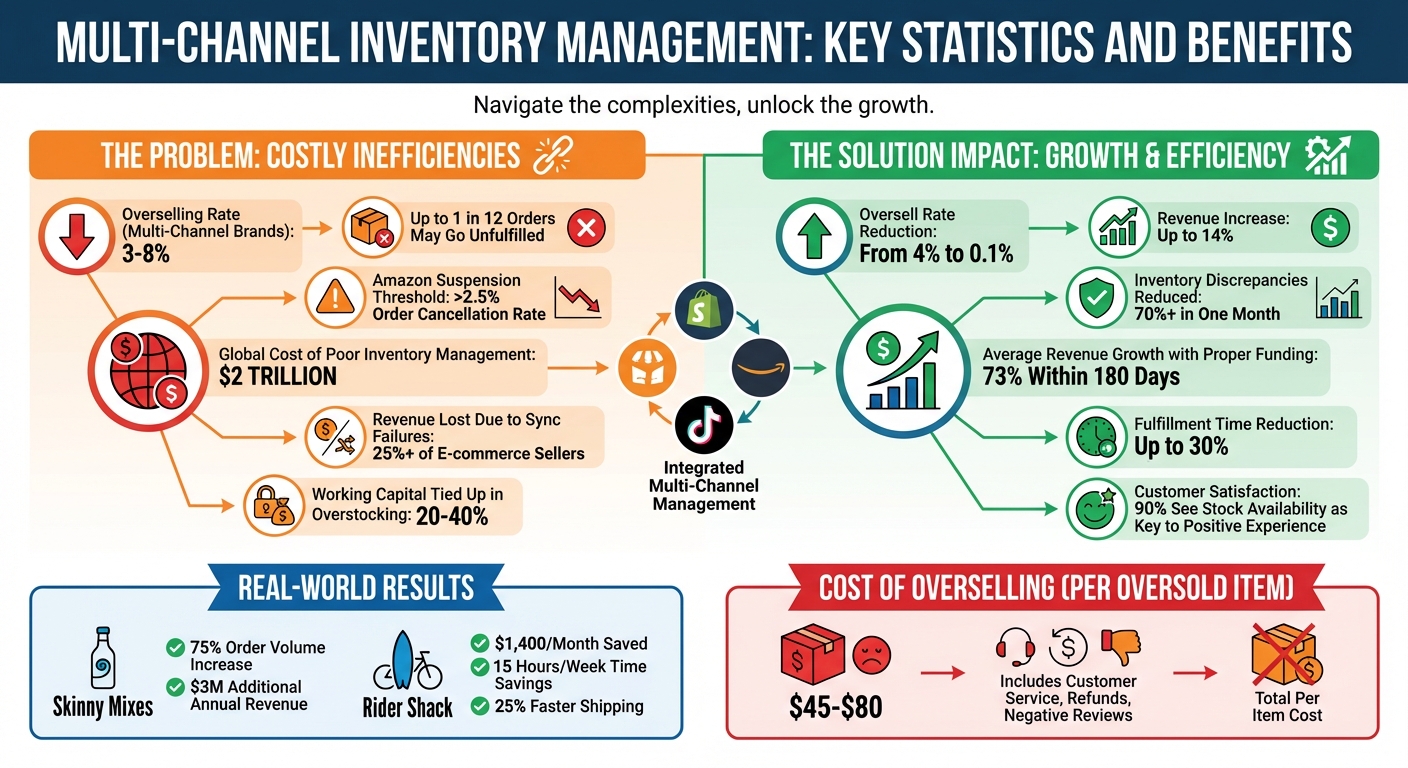
For example, in 2025, an Austin-based brand reduced its oversell rate from 4% to less than 0.1% and boosted revenue by 14% after centralizing inventory between its 3PL provider and multiple sales channels [4].
"Inventory is the backbone of multichannel commerce. If your listings are perfect but your inventory isn't synced, you're one sale away from a refund." – EcomBiz.AI [1]
Another key step is standardizing SKUs. This ensures accurate product mapping across all platforms, avoiding costly errors [8][3][1].
Benefits of Real-Time Inventory Syncing
Real-time syncing bridges the gap between a sale and when other platforms reflect the updated inventory. This prevents overselling, which is crucial for maintaining marketplace seller ratings. For instance, sellers on Amazon face account suspension if their order cancellation rate exceeds 2.5% [4].
Beyond that, real-time updates allow businesses to track stock across multiple locations and route orders to the nearest fulfillment center [6][9]. They also make it easier to calculate "Available to Sell" quantities by factoring in wholesale reserves, safety buffers, and pending orders [4].
Customer satisfaction hinges on stock availability - about 90% of shoppers see it as a key part of a positive buying experience [7]. Accurate inventory management minimizes frustration from unavailable items while maximizing sales opportunities.
Choosing the Right Inventory Management Software
When selecting inventory management software, prioritize tools with native integrations for your sales channels. Direct connections are generally more reliable and less prone to creating data silos compared to third-party middleware [8][6]. Look for software that integrates seamlessly with platforms like Amazon, eBay, Shopify, BigCommerce, and logistics providers such as FBA and 3PL partners.
Key features to look for include:
- Automated reordering and low-stock alerts: These tools can notify you - or even generate purchase orders - when stock falls below a set threshold, helping you avoid stockouts during peak demand [8][9].
- Multi-channel reporting: A centralized dashboard should display real-time stock levels, sell-through rates, and platform-specific performance metrics, all in one place.
Real-world examples show the impact of these tools. In 2025, Skinny Mixes used automation software to sync inventory and bookkeeping across Amazon, Shopify, and QuickBooks. This integration led to a 75% increase in order volume and generated $3 million in additional annual revenue [10]. Similarly, Rider Shack, a surf shop, saved $1,400 per month and cut 15 hours of inventory management time weekly, while also reducing shipping processing time by 25% [10].
Your software should also support SKU mapping to ensure consistent product identifiers across platforms with different naming conventions [1]. Additionally, systems that manage bundle and kit logic are essential - they automatically adjust the quantities of individual components when a bundled product sells. For warehouse operations, barcode scanning features can significantly reduce human errors during picking, packing, and restocking [7].
| Feature | Why It Matters |
|---|---|
| Real-Time Sync | Prevents overselling and protects marketplace seller ratings [8][1] |
| Centralized Dashboard | Offers a single source of truth for all stock levels [8][9] |
| Automated Reordering | Reduces errors and avoids stockouts during busy periods [8][9] |
| Multi-Location Tracking | Enables efficient fulfillment by shipping from the nearest warehouse [6][9] |
Lastly, consider the costs involved. Custom automation solutions for businesses managing around 200 SKUs across five channels may require a setup investment of $45,000, with monthly operating expenses ranging from $1,800 to $2,100 [4]. However, many software providers offer budget-friendly plans with free trials. For instance, QuickSync provides a 14-day free trial for its inventory syncing solution [8].
Next, we'll explore strategies for demand forecasting to further optimize inventory planning across multiple channels.
Using Demand Forecasting for Inventory Planning
Demand forecasting turns past sales data into actionable predictions, helping sellers sidestep both stockouts and overstocking issues. A solid starting point? Use centralized channel data to ground your forecasts in accuracy [1][13].
To refine this further, sellers should combine quantitative and qualitative methods. If you’re dealing with products that have been on the market for over two years, techniques like time-series analysis and moving averages are your go-to tools [12]. On the other hand, new product launches or fast-moving trends - think TikTok Shop favorites - require a different approach. Here, qualitative methods like market research and expert opinions fill in the gaps where historical data is lacking [11][12][14].
ABC-XYZ segmentation is another powerful tool, helping sellers focus their forecasting efforts. This method categorizes products by revenue contribution (ABC) and demand predictability (XYZ). For instance, high-revenue, stable-demand items (AX products) need a different strategy than low-volume, seasonal items (BZ products) [13][10]. By tailoring your approach to each product category, you can fine-tune inventory adjustments across sales channels, concentrating on the items that matter most.
But forecasting isn’t just about quantities - it’s about timing, too. Sellers need to sync their forecasts with supplier lead times and marketplace payout cycles to keep cash flow in check. Take Amazon’s 14-day payout schedule, for example. This delay in liquidity must be factored into reorder plans [3]. To avoid stockouts during busy periods, calculate safety stock using this formula: (Maximum daily sales × Maximum lead time) – Lead time demand [12].
For those looking to level up, AI-powered tools like Prophet and XGBoost are becoming increasingly popular. These tools excel at spotting patterns that traditional methods might miss, such as holiday-specific demand surges or the influence of social media trends [11][14]. In fact, AI-driven forecasting can trim inventory levels by 20% to 30% while still keeping shelves stocked [14]. This tech-savvy approach allows sellers to adapt quickly to changes across multiple platforms. To measure how well your forecasts are performing, track your Mean Absolute Percentage Error (MAPE) - the lower the MAPE, the better your predictions [13]. Armed with these insights, sellers can allocate stock more effectively across all their channels.
Allocating Stock Across Multiple Channels
Once you've nailed down your demand forecasts, the next step is distributing your inventory across various platforms. The goal? Maximize profit while keeping penalties and overselling at bay. By using accurate demand forecasts, you can dynamically allocate stock to where it’s needed most, ensuring both profitability and smooth operations.
A centralized inventory system can make this process seamless. With a unified view, you can calculate a real-time "Available to Sell" number, which updates across all platforms. This approach is key to avoiding overselling, a problem that affects 3% to 8% of multi-channel brands. Without this system, up to 1 in 12 orders might go unfulfilled [4].
Dynamic Stock Allocation Techniques
Relying on static allocation rules won’t cut it when demand spikes. Instead, consider floating stock buffers - a reserve of 10% to 15% of your inventory that isn’t tied to any specific platform. This buffer can be quickly reallocated during demand surges. For example, an Austin-based home goods brand with $22 million in annual revenue implemented this strategy in November 2025. By using real-time sync across Shopify, Amazon, and Walmart - integrating their 3PL (ShipBob) with sales APIs through n8n - they reduced their oversell rate from 4% to under 0.1%. Within 90 days, this move boosted their revenue by 14% by ensuring accurate stock availability [4].
Another effective tactic is channel prioritization during low-stock scenarios. When inventory drops below 50 units, pause listings on lower-margin platforms and reserve the remaining stock for higher-margin sales, such as those on Shopify [4]. For Amazon, dynamic FBA-to-FBM routing is crucial. If your FBA inventory runs out, your system should automatically switch to Fulfilled by Merchant using 3PL stock. This keeps your listings active and prevents lost sales, which is vital since exceeding a 2.5% order cancellation rate could lead to account suspension [4].
Now, let’s explore platform-specific strategies to refine your allocation even further.
Allocation Strategies by Platform
Each platform has its own quirks, and your allocation strategy should reflect that. Here’s a breakdown:
| Platform | Allocation Strategy | Risk Reduction | Holding Costs | Suitability |
|---|---|---|---|---|
| Shopify | Prioritize for high-margin sales; full availability. | Low; full control over customer experience. | Lower; centralized in a 3PL or warehouse. | High; ideal for brand loyalty and DTC sales. |
| Amazon | Use safety buffers; implement FBA/FBM routing. | High; avoids account suspension for overselling. | Higher; includes FBA storage and fees. | High; essential for volume and Prime visibility. |
| TikTok Shop | Real-time sync; frequent updates for viral demand. | Moderate; handles sudden viral spikes. | Moderate; depends on fulfillment speed. | High; great for viral social commerce. |
| Walmart | Pause listings when stock is under 50 units. | High; ensures marketplace compliance. | Moderate; similar to other marketplaces. | Moderate; useful for nationwide exposure. |
For Amazon, maintaining safety buffers is non-negotiable. Always hold back 5 to 10 units that aren’t shown as available. This precaution helps avoid the $45 to $80 cost per oversold item, which includes customer service time, refunds, and potential negative reviews [4]. TikTok Shop, on the other hand, demands high-frequency updates to catch viral spikes early - trending videos can deplete stock in hours.
Finally, standardize your SKUs across platforms. Using one master SKU per item eliminates mapping errors and prevents "phantom stock" issues, ensuring a smoother multi-channel operation [1][3].
Using Automation and Synchronization Tools
Centralized data and accurate forecasting are just the starting points. Automation is what truly ties your inventory system together, especially when selling across multiple channels. Manual tracking simply can't keep up. Imagine two customers buying the last item from different platforms at the same time - by the time you update your spreadsheet, you've already oversold. Automation solves this by syncing stock levels in real-time.
The numbers tell the story. Over 25% of e-commerce sellers lose revenue because their inventory systems fail to sync properly [15]. Accurate stock data isn't just about avoiding errors - it keeps customers happy. In fact, implementing synchronization can reduce inventory discrepancies by over 70% in just one month [7]. That’s less stress for you and more trust from your customers.
"Multi-channel inventory sync isn't just a feature – it's your competitive advantage." - SkuNexus [7]
Take Graeter's Ice Cream, a family-owned retailer in Ohio, as an example. In 2025, they integrated automation tools with their Shopify store to manage inventory across 50+ retail locations and multiple warehouses. Their system automated everything - from dry ice allocation to real-time inventory updates - eliminating bottlenecks during peak demand [7]. Next, let’s explore the automation features that make this possible.
Features to Look for in Automation Tools
The right automation tools should take the burden off your shoulders. For starters, automated reordering can trigger purchase orders when stock hits a preset threshold, ensuring you avoid stockouts. Low-stock alerts are equally important - they help you replenish popular items before they run out, protecting your reputation on platforms like Amazon [7][6].
POS syncing is another must-have. It connects your in-store and online inventory so that a sale in one channel instantly updates the other [6][16]. Dynamic routing is equally powerful, automatically sending orders to the nearest warehouse. This reduces both fulfillment times (by up to 30%) and shipping costs [7][6].
If you sell bundles or kits, look for tools with bundle logic. For example, if someone buys a three-piece set on TikTok Shop, the system should deduct the individual components from shared inventory automatically [1].
Carewell, a retailer specializing in health and caregiving products, is a great example of automation in action. In 2025, they used automation to handle complex dropshipping operations through Shopify. Their system automated purchase orders and vendor communication, improving order accuracy and earning them a spot on Fast Company’s Most Innovative Companies for Retail list [7]. By syncing every Shopify order across their fulfillment network, they eliminated manual data entry entirely.
By automating these key functions, you can streamline your operations and avoid the pitfalls of overselling.
Preventing Overselling with Automated Rules
Overselling can be a nightmare - it’s not just about lost revenue but also the damage it does to customer trust. Automation can help you avoid this by enforcing inventory rules that update stock levels across all channels within seconds.
One effective strategy is to use buffer stock settings. These rules reserve a portion of your inventory as a safety net, keeping it off your sales channels. If your stock dips too low, the system can pause listings on lower-margin platforms while prioritizing higher-margin sales.
During high-traffic periods, like Black Friday or viral product moments, short sync intervals are crucial. Increasing the frequency of updates ensures your inventory data stays accurate, reducing the risk of overselling.
New Look Vision Group, Canada’s largest eyewear retailer, used automation in 2025 to manage their North American operations. Their system routed orders to the nearest warehouse based on customer location and even created shipping labels automatically. This not only sped up fulfillment but also improved accuracy [7].
Finally, always update inventory from your master source. Adjusting stock levels in your central inventory management tool - rather than individual marketplaces - maintains data accuracy and prevents issues like phantom stock [16][1]. By following these practices, you can ensure smooth operations and keep your customers coming back.
Securing Funding for Inventory Scaling
Even with automated inventory systems, having quick access to capital is critical for scaling multi-channel operations. When a product suddenly gains traction on TikTok Shop or demand surges during Q4, waiting weeks for loan approvals can mean missed opportunities and lost sales. Multi-channel sellers need funding that matches the speed of their business. This cash flow challenge calls for a financing solution designed to keep up with rapid sales cycles.
Traditional financing options often fall short for eCommerce businesses. Banks typically require lengthy applications, personal credit checks, and rigid monthly payments that don’t account for fluctuating sales. On the other hand, venture capital often comes with the cost of giving up equity and control. For sellers juggling platforms like Shopify, Amazon, and TikTok Shop, these options can add more hurdles than solutions.
How Onramp Funds Supports Multi-Channel Growth

Revenue-based financing offers a game-changing solution. Instead of fixed payments or sacrificing equity, this model adjusts repayments based on daily sales - higher during peak periods and lower when sales slow down. This flexibility is a lifeline for sellers managing seasonal and platform-specific fluctuations.
Onramp Funds specializes in providing this type of financing exclusively for eCommerce businesses. With equity-free capital available in less than 24 hours after final approval, sellers can act quickly to secure inventory [17]. No personal credit checks are required - funding decisions are based solely on business performance.
Onramp’s impact speaks for itself. Customers experience an average of 73% revenue growth within 180 days of receiving funding, and 75% return for additional financing. The company has facilitated over 3,000 eCommerce loans and boasts an A+ rating from the Better Business Bureau, along with a 4.9/5 score on Trustpilot from 224 reviews [17].
"Onramp offered the perfect solution with revenue-based financing to secure the capital we needed to invest in inventory and pay it back at a reasonable time frame once we made sales." - Jeremy, Founder and Owner of Kindfolk Yoga [17]
The process is simple: sellers securely connect their store platforms, allowing Onramp to analyze sales history and cash flow. Based on this data, the system generates tailored offers. Repayments are automated as a percentage of daily sales deposits, creating a stress-free, "set it and forget it" experience [17].
"Applied, got our offer, and had cash in our bank account within 24 hours. Their Austin, TX-based team was very professional and helped me deploy the cash to effectively grow our business." - Nick James, CEO, Rockless Table [17]
Whether you’re dealing with Lunar New Year factory closures or preparing for a major sales event, fast funding ensures you can stay ahead of inventory demands instead of scrambling to catch up.
Onramp Funds Plans for Sellers
Onramp Funds goes beyond offering flexible financing by tailoring plans to fit different growth stages. To qualify, sellers need at least $10,000 in monthly revenue and a registered business entity (LLC, C-Corp, S-Corp, etc.) based in the United States [17]. From there, funding amounts are customized based on your sales data and cash flow trends.
| Plan Type | Key Features | Best For |
|---|---|---|
| Micro-Growth Funding | Starts with $3,000/month revenue requirement; fast approval; automated repayments | New sellers or those testing additional platforms |
| Scaling Capital | Multiple offers based on sales history; supports all major platforms; no equity required | Established sellers needing bulk inventory for busy seasons |
| Revenue-Linked Repayment | Adjusts with daily sales deposits; lower payments during slow months; flat-fee pricing | Seasonal sellers or those with fluctuating sales |
Flat-fee pricing eliminates the worry of compounding interest or hidden charges. You’ll know exactly what you’re paying upfront, making it easier to calculate the return on investment for inventory purchases [18]. Since repayments are tied to daily sales, the system adapts naturally to your business flow.
For sellers managing inventory across multiple storefronts, this flexibility is a game-changer. Whether it’s restocking fast-moving products on Amazon, launching new items on TikTok Shop, or building a safety stock to avoid overselling, Onramp Funds provides the capital you need to stay ahead. This approach integrates seamlessly with a centralized inventory strategy, ensuring you can deploy resources where they’re needed most.
Best Practices for Multi-Channel Inventory Management
Keeping your inventory in check requires consistent monitoring and fine-tuning. Poor inventory management costs businesses a staggering $2 trillion globally [2], making it clear why staying on top of this process is so critical.
Monitoring Sell-Through Rates and Reordering Trends
Tracking how your products sell across different platforms is crucial for making better restocking decisions. A simple way to gauge performance is by calculating your monthly sell-through rate: divide the units sold by the average stock on hand. This metric helps you identify which products are worth reinvesting in and which ones are tying up your cash unnecessarily [3].
Each sales channel tells a different story. For instance, the demand for a product on Amazon might be completely different from how it performs on your Shopify store or TikTok Shop. By analyzing each platform separately, you can pinpoint where your inventory thrives and where it struggles [3][20].
Another vital metric is days in stock, which measures how long items sit in your inventory before selling. If this number starts climbing, it could mean your products aren’t moving fast enough, leaving your capital tied up. Setting up tiered alerts can help: prioritize fast-moving items with higher thresholds and slow sellers with lower ones [3][5]. During stock shortages, consider pausing listings on low-margin platforms and focusing on high-margin channels like your own website to maximize profits [5][20].
Some companies have seen game-changing results from better monitoring. Skinny Mixes, for example, integrated Amazon, Shopify, and QuickBooks to automate their processes, boosting order volume by 75% and adding $3 million in annual revenue [10]. Rider Shack also reaped benefits by centralizing inventory tracking, saving $1,400 per month and cutting 15 hours of management time each week [10].
Working with Vendors and Conducting Regular Audits
Beyond monitoring numbers, building strong vendor relationships and performing regular audits can elevate your inventory management system. Start by calculating supplier lead times using past data - this helps you predict exactly how long it takes for orders to arrive, ensuring your forecasting stays on point [22]. Automating reorder points is another smart move. Set triggers that automatically generate purchase orders when stock dips below a certain level, reducing the chances of stockouts caused by manual delays [21].
Instead of halting operations for full physical inventories, try cycle counting. Audit your most valuable and in-demand products quarterly, and review your entire inventory every six months [24][25]. This method keeps your records accurate without interrupting sales. If discrepancies pop up, investigate immediately to uncover potential issues [25].
To streamline audits, use ABC analysis. Group your inventory into three categories: 'A' items (high-value, low-frequency), 'B' items (moderate value and frequency), and 'C' items (low-value, high-frequency). Focus your efforts on 'A' items, as they typically generate the majority of your revenue [25].
Don’t overlook in-transit inventory either. Knowing what’s en route and when it will arrive prevents overordering and helps you hit restock windows on time [4]. Keeping open lines of communication with your vendors is equally important. Address lead time changes and quality concerns as soon as they arise to avoid disruptions.
Conclusion
Managing inventory across platforms like Shopify, Amazon, and TikTok Shop can feel overwhelming, but the strategies outlined here aim to simplify the process and give you more control over multi-channel operations.
Centralizing your inventory is a game-changer. Every sale on one platform instantly updates across all channels, reducing the risk of phantom stock and improving visibility. This real-time syncing minimizes errors and makes it easier to adapt to sudden sales spikes. Add demand forecasting into the mix, and you can use historical sales data and seasonal trends to predict what stock you’ll need. This not only avoids overstocking - which can tie up 20–40% of your working capital - but also keeps shelves stocked and customers happy [8][2][19].
Automation takes it a step further. By syncing inventory in real time and setting up automated reorder triggers, you can shift from micromanaging SKUs to managing by exception. This saves time and helps protect your revenue by maintaining accurate stock levels and avoiding overselling penalties [8][23][6].
Access to funding also plays a crucial role. Services like Onramp Funds provide revenue-based financing that scales with your sales, offering quick access to capital without requiring equity. With funding available within 24 hours and repayment terms tied to your actual sales, you can maintain safety stock, restock inventory quickly, and take advantage of growth opportunities without worrying about cash flow delays. This ensures you're always prepared to meet demand, no matter how quickly it rises.
FAQs
What’s the fastest way to stop overselling across channels?
To avoid overselling, the best approach is to use a centralized system that syncs inventory in real time. Pair this with strategies like keeping safety stock buffers, enforcing strict out-of-stock controls, and setting up automated updates. These measures ensure your inventory levels are accurate and consistent across all sales channels, reducing the risk of stock mismatches.
How do I set safety stock and buffers for each platform?
To manage safety stock and buffers effectively, you need to calculate additional inventory that guards against stockouts due to fluctuating demand or supply chain hiccups. Use formulas tailored for e-commerce, which take into account both demand variability and lead times. Set clear reorder points for each sales platform, adjusting for uncertainties in demand and supply. Leveraging inventory management tools to automate these calculations can ensure you maintain the right stock levels across all your channels.
How much inventory financing should I take to restock safely?
The amount of inventory financing you’ll need hinges on a few key factors: demand forecasts, platform payout cycles, and inventory turnover rates. Ideally, your financing should cover the expected sales during your restocking period while also accounting for potential payment delays from platforms. This approach helps you avoid frustrating stockouts. By planning carefully, you can keep your inventory at just the right level without stretching your resources too thin.
Related Blog Posts
Onramp Funds
Funding built around your sales
Connect your store and see what you qualify for. Repay as a percentage of sales, with no personal credit check.
Funding in as little as 24 hours.
