

Marketplace rules can significantly impact your cash flow and profitability. Whether you sell on Amazon, eBay, or TikTok Shop, understanding each platform's fees, payment schedules, and policies is essential for managing your business effectively. Here’s a quick breakdown:
- Amazon: Operates on a 14-day payment cycle, with fees ranging from 30–40% of sales. Sellers often need to maintain a cash buffer due to delayed payouts and high operational costs like inventory storage and fulfillment fees.
- eBay: Payments typically take 4–7 days. The platform charges 12.9% + $0.30 per transaction, with additional fees for listings and penalties for poor account health.
- TikTok Shop: Known for its viral trends, it has a 31-day payout hold for new sellers. Fees, including affiliate commissions, can reach up to 45% of gross sales.
To navigate these challenges, sellers should:
- Plan for delayed payouts by maintaining cash reserves or securing financing.
- Understand fee structures to protect profit margins.
- Align inventory and funding decisions with platform-specific policies.
A well-structured financial strategy tailored to each marketplace can help you manage working capital and improve profitability.
How Amazon's Policies Affect Cash Flow Management
Amazon operates on a 14-day payment cycle, with funds typically arriving 3–5 business days after the cycle ends [1]. This means nearly three weeks can pass between making a sale and having access to the cash. As a result, sellers often find themselves funding new inventory orders before receiving payment for previous ones. Additionally, Amazon may impose Reserve Funds, withholding a portion of your balance to cover potential claims, chargebacks, or returns. If your account experiences high Order Defect Rates or policy violations, further holds may be applied, tightening cash availability even more. These delays emphasize the need for careful cash flow management, especially when combined with Amazon's fee structures and inventory policies.
Payment Delays and Working Capital Needs
The bi-weekly payment cycle creates a need for sellers to maintain a cash buffer just to keep operations moving. For categories with high return rates, like apparel or footwear, Amazon may delay releasing funds until the return window closes, extending the wait even further. Performance metrics also play a big role - strong account health helps avoid administrative holds that can freeze your working capital.
For sellers using Fulfillment by Amazon (FBA), the payment process can be smoother since Amazon handles customer service and returns. However, sellers using Fulfillment by Merchant (FBM) often face longer delays due to potential disputes over shipping. To bridge the gap between Amazon’s payout schedule and day-to-day operational costs, consider securing a line of credit. Pairing this with accounting software that syncs with your Amazon account can provide real-time profit tracking and precise cash flow forecasting.
Fee Structures and Profit Margins
Amazon’s fees can add up quickly, and many sellers underestimate their impact - often by 20–40% - if they don’t account for all the different types. These include referral fees, fulfillment fees, storage fees, aged inventory surcharges, low-inventory-level fees, inbound placement fees, and returns processing costs [2].
- Referral Fees: Typically range from 8% to 15%, depending on the category [2].
- Storage Fees: Monthly fees can triple during Q4 (October–December) [2].
- Returns Processing Fees: For high-return categories, this fee often matches the original fulfillment fee, significantly reducing margins [2].
For example, a kitchen gadget priced at $29.99 with an $8.00 supplier cost saw its margin drop from 45% to 25% after factoring in an 8% return rate, 15% Advertising Cost of Sales (ACOS), and inventory risks [2]. To protect margins, sellers need to fully understand these fees and adjust their pricing or strategy accordingly.
Small adjustments like optimizing packaging can make a big difference. Reducing product dimensions by even one inch can prevent items from being classified as "oversized", potentially saving $0.50–$1.00 or more per unit [2]. Similarly, using "Amazon Optimized Splits" to ship to multiple locations (3–5) can lower inbound placement fees, which might otherwise exceed $1.58 per unit [2].
Inventory Restrictions and Funding Decisions
Amazon’s inventory policies can also impact cash flow. For instance, products flagged as having "excessive inventory" may face shipment restrictions, forcing sellers to rely on existing stock [3]. If you remove inventory to avoid aged inventory surcharges, Amazon prevents that item from being sent back to FBA for 90 days [3]. These rules make long-term cash flow planning crucial for affected SKUs.
Aged inventory surcharges now apply after 181 days, down from the previous 365-day threshold [2]. To avoid these fees, review inventory at the 150-day mark and create removal orders as needed [2]. Maintaining at least 28 days of supply helps avoid low-inventory-level fees, which range from $0.32 to $0.97 per unit [2]. Setting replenishment alerts at 35 days can help you stay ahead of stock shortages.
Amazon Warehousing and Distribution (AWD) offers another option for over 80% of FBA products [3]. AWD has no enrollment fee and allows inventory transfers to the fulfillment network when supply drops below healthy levels, helping bypass some FBA inbound restrictions [3]. However, stranded inventory - items stuck in fulfillment centers without an active offer - can block new shipments for that specific FNSKU until resolved [3]. These challenges highlight the importance of aligning funding and inventory decisions with Amazon’s evolving policies.
sbb-itb-d7b5115
Working with eBay's Policies to Improve Funding
eBay’s specific rules play a major role in shaping how sellers manage their cash flow and funding strategies. Adjusting your approach to align with these policies can make a big difference in how smoothly your operations run.
In 2021, eBay transitioned to its Managed Payments system, replacing the instant PayPal payouts many sellers were accustomed to. Now, payments follow a scheduled process: payment verification (0–2 days), eligibility for payout (often tied to delivery with an additional 0–2 days), payout initiation, and finally, bank processing (1–5 business days). For experienced sellers with streamlined workflows, payouts typically take 4–7 days. However, newer sellers may face risk-related holds lasting up to 30 days. Factors like shipping speed and account health heavily influence how quickly funds are released [4]. Understanding this system is key to improving both payout times and fee management.
Managed Payments and Cash Flow Timing
Payout speed is directly tied to shipping efficiency and how quickly tracking information is uploaded. For example, uploading tracking details on the same day as the order can lead to an average payout time of 6.2 days. In contrast, delays of two or more days can push that average to 11.5 days. Similarly, items delivered within three days tend to result in payouts within 6.4 days, while deliveries taking over seven days average a much longer 10.2 days before funds are released.
To improve cash flow, sellers can take several steps:
- Switch from weekly to daily payouts in the eBay Seller Hub to accelerate fund availability.
- Use shipping tools like ShipStation or Pirate Ship to ensure tracking details are uploaded in real time.
- Ship all orders within one business day to reduce payout delays.
- Maintain strong account health by keeping your transaction defect rate below 0.5% and your late shipment rate under 3%.
Additionally, having a cash reserve equal to at least twice your average payout cycle can help cover operating expenses during any unexpected delays [4].
Fees and Listing Costs
Beyond payout timing, understanding eBay’s fee structure is essential to protecting your profit margins. Each month, sellers are given 250 free listings; additional listings cost $0.35 each. eBay also takes a final value fee of 13.6% on the first $7,500 of sales and 2.35% on amounts beyond that, along with a per-order fee ($0.30 for orders under $10 and $0.40 for orders over $10).
Seller performance can also impact fees. A “Below Standard” rating adds a 6% penalty to the final value fee, while high return rates for “item not as described” may tack on another 5%, potentially increasing costs by up to 11%. To avoid these extra charges, focus on accurate product descriptions and responsive customer service.
For sellers listing more than 250 items monthly, upgrading to a Basic Store subscription ($21.95/month when billed annually) can help reduce insertion fees. Tools like QuickBooks or Webgility can also be used to sync payouts and fees automatically, ensuring profit margins are calculated based on net proceeds rather than gross sales [5][6].
TikTok Shop: Adjusting Capital Strategies for Viral Trends

TikTok Shop's fast-paced, viral environment creates unique financial challenges that demand quick and adaptable strategies. While financial agility is a necessity for any major marketplace, TikTok Shop's unpredictable trends make precise capital planning even more critical. Understanding its specific fee structures is key to navigating the impact on seller profitability.
Commission Structures and Seller Profitability
TikTok Shop uses a tiered fee system that can significantly affect seller margins. The referral fee alone has risen over time, reaching 8% of net GMV in 2026 (up from 2% in 2023 and 6% in 2024). On top of this, sellers face a 2.9% + $0.30 transaction fee and average affiliate commissions of about 13% by 2026. Together, these costs bring the effective take rate to anywhere between 30% and 45% of gross merchandise value [8].
Returns add another layer of complexity. For example, if a customer returns a $30 product after the creator has already been paid (a process that typically takes 15 to 31 days), the seller absorbs the product cost, shipping cost, and the non-refundable affiliate fee. This could result in a total loss of $47.44 - 158% of the original sale price [7].
"Revenue is vanity. Profit is sanity. In 2026, knowing your TikTok Shop fees down to the cent is the difference between scaling a brand and going bankrupt."
– Editorial Staff, TikAdSuite [8]
To counter these margin pressures, sellers might consider bundling low-cost items into kits to increase the average order value, which helps offset the fixed transaction fees. Testing price hikes of around 10% could also work, as TikTok's impulse-buy nature often keeps conversion rates steady even with slightly higher prices [8]. These tactics are essential before addressing broader concerns like payout delays and funding.
Payout Delays and Funding Solutions
TikTok Shop's payout system is tied to order delivery confirmation [9]. Elite sellers with a Shop Performance Score (SPS) of 4.0 or higher can access funds within a day, but new sellers face a mandatory 31-day holding period [9]. High return rates can complicate cash flow further, as refunds exceeding incoming revenue can trigger a "zero-dollar payout", where TikTok deducts the shortfall from future payouts, potentially leaving sellers with no cash flow during that cycle [9].
After accounting for fees, commissions, and returns, most established sellers retain about 67.3% of their GMV [9]. For quicker access to funds, sellers might opt for PayPal withdrawals, which clear in about one business day with a 0.9% fee, compared to ACH transfers, which cost $0.05 but take longer [9].
Inventory Management for Trending Products
Managing inventory on TikTok Shop is a unique challenge, as viral trends can lead to sudden sell-outs and overwhelming order volumes. These rapid shifts can strain both inventory and fulfillment systems, similar to the challenges seen on platforms like Amazon.
"It kind of turns everything we all know about demand planning on its head."
– Feliz Papich, Senior Vice President of Digital Technology, Crocs [10]
To keep up with these unpredictable surges, sellers should invest in analytics tools that provide real-time insights within 24–48 hours, rather than relying on older sales data. Building a flexible supply chain for quick restocking and expedited shipping is also crucial. Some brands have even chosen to offer a smaller, more curated product selection on TikTok Shop to maintain better control over inventory levels during these volatile demand spikes [10].
Marketplace Fees and Financial Strategies Compared
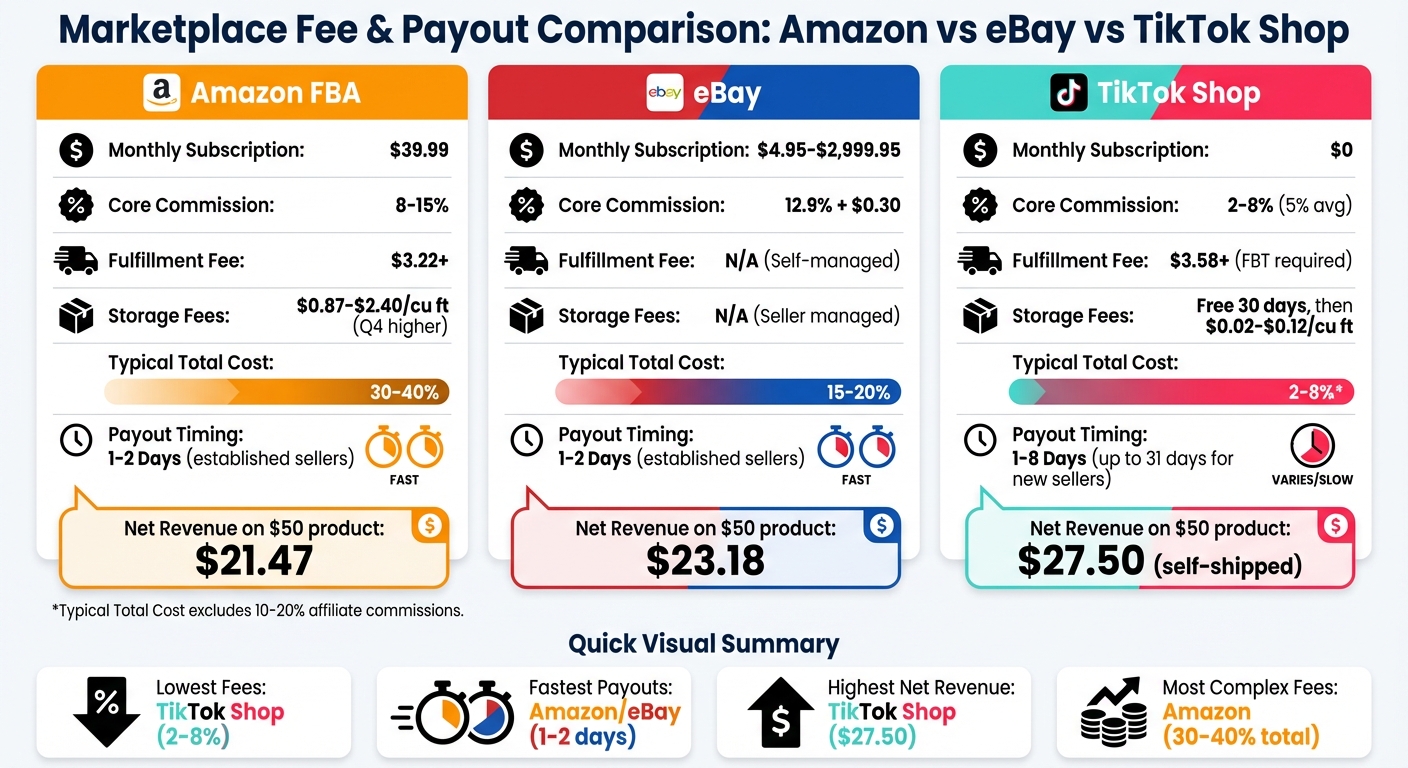
Marketplaces vary significantly in their fee structures, payout timelines, and inventory management options, all of which can influence your cash flow and profitability. Let’s break it down:
Amazon has one of the most intricate fee systems. Sellers pay a $39.99 monthly subscription fee, referral fees ranging from 8–15%, and FBA fulfillment costs starting at $3.22 per unit. Altogether, total selling costs on Amazon usually fall between 30% and 40% of the sale price [11][13].
eBay, in contrast, offers a simpler fee structure. Its Final Value Fee is 12.9% plus $0.30 per transaction, with subscription plans ranging from $4.95 to $2,999.95 per month. On average, sellers can expect total costs of 15–20% [11][14].
TikTok Shop stands out with no monthly subscription fees. It charges a base commission of about 5%, though some categories have referral fees as high as 8% plus $0.30. Including affiliate commissions (10–20%), total costs typically range from 2% to 8% [11][12].
Payout timing also plays a crucial role in managing working capital. Established sellers on Amazon and eBay receive payments within 1–2 days. TikTok Shop, however, has a payout window of 1–8 days for established sellers, but new sellers might face holding periods of up to 31 days [15].
Storage fees add another layer of complexity. Amazon charges $0.87 per cubic foot during most of the year, increasing to $2.40 in Q4. Long-term storage fees kick in after 181 days, reaching $6.90 per cubic foot or $0.15 per unit by day 365 [11]. TikTok Shop provides 30 days of free storage per inbound shipment, then charges between $0.02 and $0.12 per cubic foot. Meanwhile, eBay leaves inventory management entirely up to the seller. If sellers exceed their listing allotments, they face a $0.35 fee per item [11].
Here’s a quick comparison of key metrics across the three platforms:
Marketplace Fee and Payout Comparison Table
| Metric | Amazon (FBA) | eBay | TikTok Shop |
|---|---|---|---|
| Monthly Subscription | $39.99 | $4.95 – $2,999.95 | $0 |
| Core Commission | 8% – 15% | 12.9% + $0.30 | 2% – 8% (5% avg) |
| Fulfillment Fee | $3.22+ | N/A (Self-managed) | $3.58+ (FBT required) |
| Storage Fees | $0.87 – $2.40/cu ft | N/A | Free for 30 days, then $0.02–$0.12/cu ft |
| Typical Total Cost | 30% – 40% | 15% – 20% | 2% – 8%* |
| Payout Timing | 1 – 2 Days | 1 – 2 Days | 1 – 8 Days (up to 31 days for new sellers) |
*Note: TikTok Shop total cost excludes affiliate commissions (10–20%) [11][14][15].
To see how these differences play out, consider reseller Emma's experience. In early 2025, she noticed that eBay's promoted listing ads and shipping fees were cutting into her profits by 12%. By reallocating 60% of her inventory to platforms with lower fees and reducing her eBay ad spend, she boosted her monthly profit margin by 34% within three months [14]. For a $50 product with a production cost of $15, net revenue breaks down as follows: $21.47 on Amazon FBA, $23.18 on eBay, and $27.50 on TikTok Shop (self-shipped) [11].
How Onramp Funds Supports Marketplace Sellers
Flexible Financing Built for eCommerce
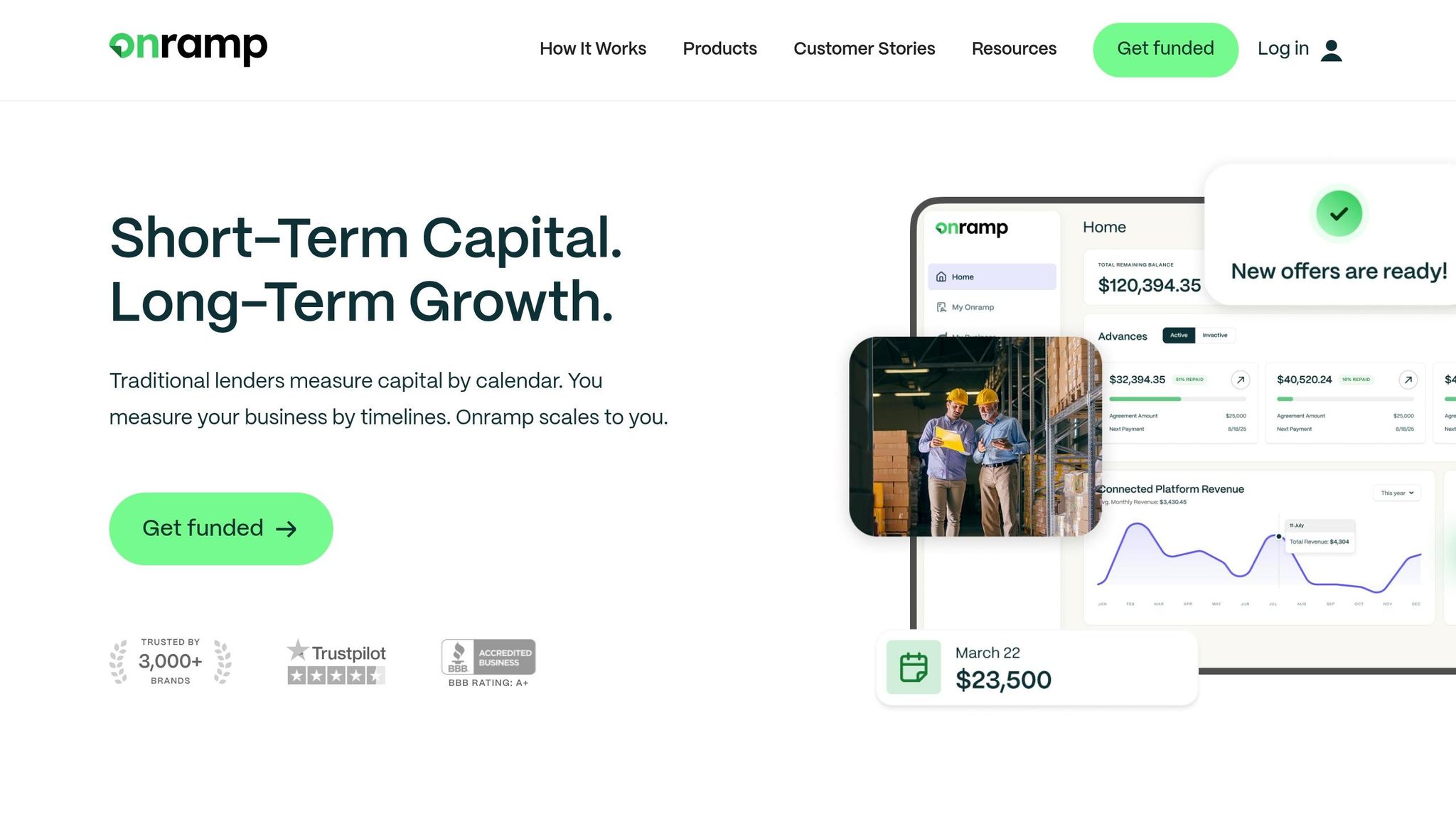
Marketplace sellers often face cash flow challenges due to platform-specific policies, and traditional loans rarely solve these issues. That’s where Onramp Funds steps in, offering revenue-based financing tailored to the needs of eCommerce businesses on platforms like Amazon, eBay, and TikTok Shop. With funding available within 24 hours of approval, sellers can quickly seize opportunities, like riding the wave of a viral trend [16].
Repayments are tied to your sales, not fixed monthly amounts. This means payments automatically adjust during slower periods, giving you breathing room when sales dip. When revenue grows, repayment scales alongside it, making it easier to expand your business without the stress of rigid schedules. Onramp Funds also keeps things simple with a transparent fee structure ranging from 2–8%, free of hidden charges or late fees. Plus, its seamless integration with major platforms like Amazon, eBay, TikTok Shop, Shopify, and Walmart Marketplace uses real-time sales data to streamline funding decisions - no tedious paperwork or manual verification needed. This approach directly tackles the cash flow gaps that many marketplace sellers struggle with.
Eligibility and Integration Benefits
Onramp Funds is designed to be accessible, requiring just $10,000 in monthly sales to qualify. The Austin-based team provides personalized support to help sellers navigate the unique hurdles of different marketplaces.
Because this funding operates independently of any single platform’s internal programs, you have the flexibility to manage your cash flow across all your sales channels. For instance, you might use Amazon FBA for steady sales volume while leveraging TikTok Shop to capture trend-driven demand. Onramp Funds allows you to consolidate your financing needs into one solution, avoiding the complications of juggling multiple platform-specific capital programs. This unified approach simplifies your operations and helps you focus on growing your business.
Conclusion
Key Points Recap
- Cash Flow Challenges
- Amazon's payment structure, including delays and fees (8–15%), often forces sellers to hold 2–3x more inventory, tying up anywhere from $50,000 to $200,000 in working capital [18].
- eBay's Managed Payments system speeds up payouts by roughly 70%, but sellers must carefully plan for listing fees to avoid surprises [21].
- TikTok Shop's viral trends, combined with 2–8% commissions, demand adaptable funding to capitalize on fleeting opportunities [17].
- Strategic Financing Adjustments
An eCommerce finance expert from HBS Online says, "Revenue-based financing aligns repayments with actual cash inflows, reducing default risk by 60% for marketplace sellers vs. term loans, enabling focus on growth amid volatile rules." [20]
These findings emphasize the importance of tailoring your financing approach to meet marketplace demands. By auditing payout schedules and identifying working capital gaps, sellers can unlock $20,000–$100,000 for reinvestment [17]. A well-aligned capital strategy can transform these challenges into opportunities for growth and success.
FAQs
How much cash should I keep on hand for payout delays?
To handle payout delays from eCommerce marketplaces, it's crucial to have enough cash on hand to cover critical expenses such as inventory, advertising, and storage. A good rule of thumb is to keep reserves that cover 1–2 months of operating costs. Since payout delays can vary widely - anywhere from 8 to 60 days depending on the platform - take the time to calculate your monthly expenses. Adjust your reserves based on these figures to ensure your business runs smoothly during those waiting periods.
Which marketplace fees most often surprise sellers?
Sellers are often caught off guard by Amazon's tiered FBA fee structure, which adjusts based on a product's price. These fees can eat into profit margins, especially for items with higher price points. Knowing how these fees scale is essential for planning your finances effectively.
How do I fund inventory when a product suddenly goes viral?
When a product takes off and demand surges, getting funds quickly becomes a top priority to restock and keep up. Two great options can help:
- Inventory financing: This allows you to use your current inventory as collateral to access working capital.
- Revenue-based financing: A fast way to secure funds based on your sales, making it a solid choice for businesses experiencing rapid growth.
To stay ahead, plan your inventory needs by analyzing sales trends. This approach ensures you're ready to restock efficiently while keeping cash flow steady during those high-demand periods.
Related Blog Posts
Onramp Funds
Funding built around your sales
Connect your store and see what you qualify for. Repay as a percentage of sales, with no personal credit check.
Funding in as little as 24 hours.
