


Selling on multiple platforms like Amazon, Shopify, and TikTok Shop can boost your business but complicates cash flow. Each platform has unique payout schedules and fees, creating challenges like delayed payments, inventory strain, and misaligned supplier timelines. For example, Amazon operates on a 14-day payout cycle, while TikTok Shop advances 80% of daily sales but has unpredictable viral spikes. Managing these differences is critical to avoid stockouts, missed marketing opportunities, and cash gaps.
Key Takeaways:
- Amazon: Long payout cycle (14 days) with upfront inventory costs.
- Shopify: Flexible payouts but requires heavy ad spending upfront.
- TikTok Shop: Fast payouts but high risk due to refunds and viral sales.
To grow effectively, sellers need funding solutions that align with revenue cycles. Onramp Funds offers fast, equity-free financing with flexible repayments based on sales performance, helping you maintain cash flow and seize growth opportunities across platforms. Proper planning and timely funding are essential for success.
Financial Challenges of Selling on Multiple Platforms
Different Cash Flow Cycles for Each Platform
Each platform operates on its own cash flow timeline, which can create challenges for sellers. Take Amazon, for example - it demands significant upfront inventory investments, often around $50,000, to keep up sales momentum and maintain the Buy Box. However, sellers must wait 30 to 45 days to recoup that money due to Amazon's 14-day post-shipment payout schedule and the additional time needed for order processing and shipping [5].
Shopify offers more flexibility with payout timing, allowing sellers to choose daily or weekly deposits that align with their direct sales. But this control comes at a cost. Sellers must cover customer acquisition expenses - like Meta ads, Google Shopping, and email campaigns - before seeing any revenue. TikTok Shop, on the other hand, provides a faster cash flow by advancing 80% of daily sales, enabling quicker reinvestment into trends and creator campaigns [6]. However, this speed introduces risks, as refunds and fees (ranging from 6%–8%) can disrupt cash availability [6].
These varying cash flow schedules make inventory management even trickier when selling across multiple platforms.
Managing Inventory Across Multiple Channels
Each platform has unique inventory demands. Amazon prioritizes deep stock levels to ensure consistency, while TikTok Shop thrives on fast-moving, trend-driven products. Balancing these requirements is no small feat.
Real-time inventory synchronization is critical to avoid overselling or stockouts. For example, a seller might tie up $50,000 in Amazon inventory for 45 days, spend $20,000 on TikTok creator campaigns (with 80% of daily sales advanced), and allocate $15,000 to Shopify ads. Despite generating $100,000 in monthly revenue, this setup could still leave a seller with a 30-day cash gap [5][7].
Adding to the complexity, each platform’s marketing strategy places unique pressures on cash flow.
Platform-Specific Marketing Costs
Marketing expenses vary widely depending on the platform, creating additional financial hurdles. Amazon sellers typically allocate 15%–30% of their revenue to pay-per-click advertising, with higher-revenue brands shouldering the largest expenses [7]. TikTok Shop adds another layer of cost, requiring upfront payments to influencers to spark viral moments - often before any sales come through. Meanwhile, Shopify focuses on owned-channel marketing, such as email campaigns, SMS strategies, and retargeting ads. These efforts aim to build long-term customer relationships but require significant upfront investment, with returns materializing over time [8].
The challenge lies in pre-funding these distinct marketing strategies, which often don’t align with supplier payment schedules. This highlights the importance of precise cash flow management to sustain growth across multiple platforms.
sbb-itb-d7b5115
Cash Flow Challenges In E-Commerce
How Onramp Funds Helps Time Your Capital Correctly
Onramp Funds provides funding solutions designed to align perfectly with your business's cash flow and operational needs. By syncing directly with your sales platforms, they ensure funding matches your revenue cycles and marketing demands. Here's how Onramp Funds addresses the challenges of managing multi-channel cash flow with speed, transparency, and smart integration.
Fast, Equity-Free Funding
Need funds quickly? Onramp Funds can deliver capital within 24 hours - no equity required and no personal guarantees involved. This quick access to cash ensures you're ready to act when inventory needs spike or a marketing opportunity arises. Plus, repayments are flexible, automatically adjusting to your sales performance. When sales are strong, you pay more; when they dip, you pay less.
Transparent Pricing Without Surprises
Budget planning becomes easier with Onramp's straightforward pricing. Fees range from 2% to 8%, depending on your business profile and funding amount, and you'll know the exact cost upfront. There are no origination fees, prepayment penalties, or hidden charges. This clarity makes it simple to calculate the cost of funding for key investments like inventory purchases or marketing campaigns.
Real-Time Integration with Sales Platforms
Onramp Funds integrates directly with platforms like Amazon, Shopify, and TikTok Shop, accessing real-time sales data to streamline funding decisions. This eliminates the need for manual updates and ensures funding offers are based on your actual performance, not just projections. For sellers managing multiple channels - often eight or more - this automation is a game-changer, making it easier to stay on top of cash flow across platforms [2].
When to Secure Funding for Multi-Channel Growth
Having access to capital at the right time can help you avoid inventory shortages and keep your momentum going. The trick is to plan ahead and secure funding before your needs become urgent. Here’s a breakdown of when to secure funding to support your multi-channel growth.
Funding Before Product Launches and Campaigns
Getting funding in place before a product launch is essential. You’ll need money for market research, product development, and pre-launch essentials like landing pages and email lists [10][12]. Securing funds early also ensures your inventory arrives on time, which is especially important when juggling diverse payout cycles [12].
A solid ad strategy is key here. Plan to target new audiences, re-engage past visitors, and nurture existing customers across platforms like Amazon, Shopify, and TikTok Shop - all at the same time.
Using a pre-order model can also work to your advantage. It creates a sense of urgency and generates early cash flow ahead of your official launch [12]. Don’t forget to install tools like Google Tags and Facebook Pixels before launching to capture accurate CPA (cost per acquisition) and ROAS (return on ad spend) data [11].
Increasing Ad Spend During High-Growth Periods
When a TikTok video goes viral or a campaign starts performing better than expected, having capital ready to go is a game-changer. Pre-funding ad spend lets you capitalize on these moments without straining your operational cash flow [4]. Waiting until you’re out of cash to apply for funding can mean missing out on big opportunities.
Aligning your funding with peak shopping seasons - like the holiday rush in Q4 or back-to-school periods - can help you maximize sales. However, these times also bring increased competition [9][10]. For B2C sellers, securing capital well before these high-demand periods is critical. This gives you enough time to stock up on inventory and ramp up your ad campaigns.
Estimating Your Funding Needs with the Calculator
Once you’ve identified the right times to secure funding, use the Onramp Funds calculator to refine your financial strategy. This tool helps you estimate the loan amount you’ll need and how repayments might impact your cash flow. Simply input your projected monthly sales, growth rates, and desired loan amount to get a clear picture of your financial outlook [4].
The calculator provides a breakdown of the total repayment amount, effective APR, and how payments align with your sales. Onramp’s repayment model adjusts to your sales performance - allowing you to pay more during strong sales periods and less when sales dip. By modeling different scenarios, you can see how seasonal changes might affect your obligations. This level of insight is crucial when managing cash flow across multiple sales platforms with varying payout schedules [4].
Adjusting Repayments to Match Platform Revenue Patterns
Selling across multiple channels often means dealing with inconsistent and unsynchronized cash flows. Each platform has its own payout schedule, which can complicate cash management. For example, TikTok Shop might experience sudden viral sales surges that quickly drain your inventory, leaving you scrambling to restock [1].
Traditional fixed monthly loans don’t account for these revenue fluctuations. If your repayment amount stays the same while sales on one platform slow and another platform delays payouts, you could run into cash flow shortages. Revenue-based financing offers a better solution. With this type of funding, repayments are tied to a fixed percentage of your daily or weekly sales across all connected platforms [13]. When sales dip, repayments automatically decrease. When sales spike, repayments adjust to match the increased cash flow. This dynamic approach aligns financing with the natural ebbs and flows of multi-channel sales.
Matching Payments to Platform Revenue Schedules
To keep cash flow steady, it’s crucial to connect your funding to your entire sales ecosystem, not just one storefront. Relying on platform-specific funding can create mismatches, especially if your primary sales shift to a different marketplace like Amazon or Walmart [13]. Multi-channel revenue-based financing solves this by adjusting repayments based on your total connected sales, ensuring operating capital remains intact even during unpredictable periods.
This flexibility is particularly important when managing different platform revenue cycles. For instance, TikTok Shop might empty your inventory after a viral spike, but the funds needed to restock could still be tied up in Amazon’s 14-day payout cycle [3]. Flexible repayments that align with actual cash flow allow you to navigate these timing gaps without penalties [13]. It’s a smarter way to manage capital for sustained growth across multiple platforms.
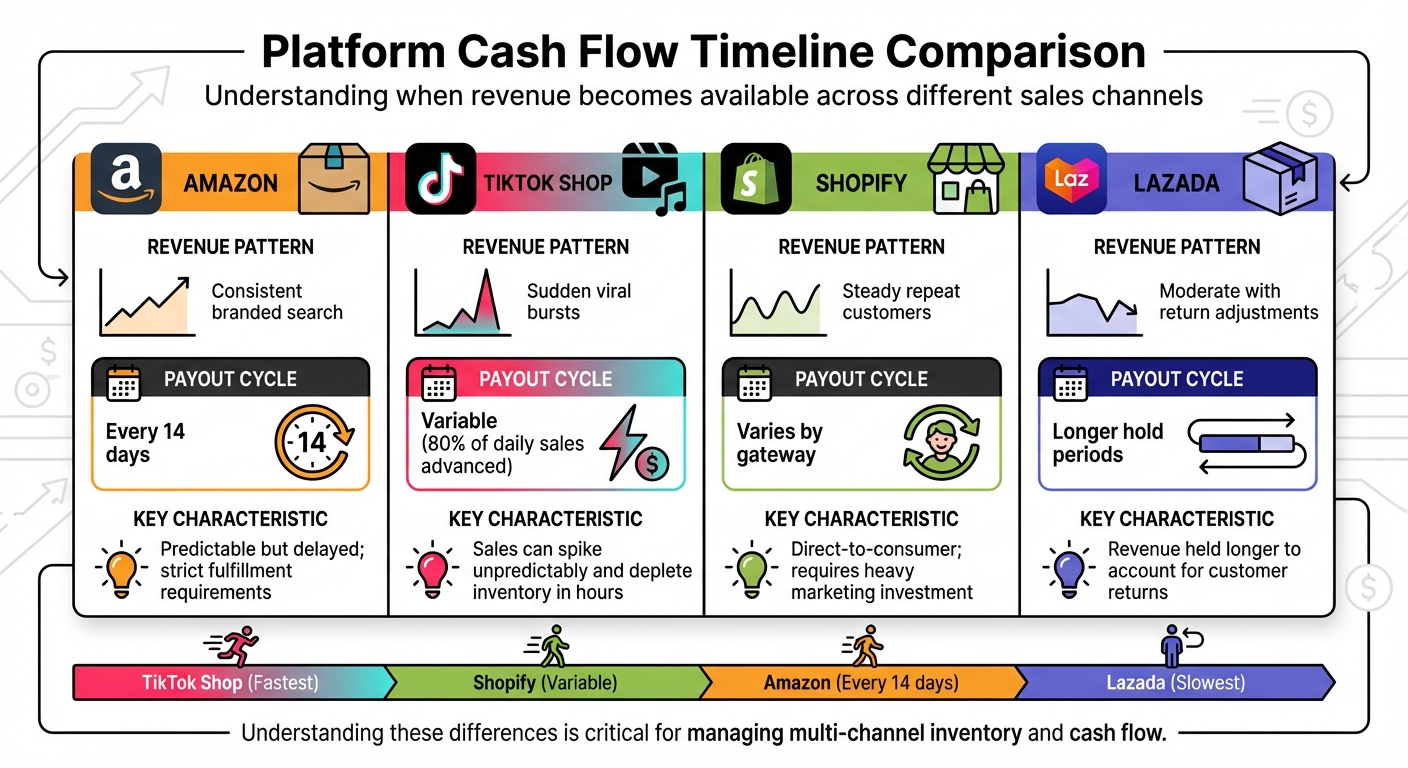
Platform Cash Flow Timeline Comparison
Understanding the payout schedules of various platforms can help you plan when cash will actually be available in your account, as opposed to when sales occur. Here’s a breakdown of key platforms to illustrate these differences:
Conclusion
Expanding your business across platforms like Shopify, Amazon, and TikTok Shop offers incredible growth potential - but success hinges on how well you manage your capital. Each platform operates on a different payout schedule, and failing to align your funding with these schedules can lead to inventory shortages during viral surges or missed chances to invest in high-growth ads when funds are tied up.
To navigate these challenges, it’s essential to understand how cash flow varies across platforms and plan accordingly. Secure funding ahead of product launches or major campaigns to ensure you’re prepared for spikes in demand. Flexible repayment options that match your sales patterns - rather than rigid monthly loan payments - can make a huge difference. For example, when a TikTok Shop partnership clears out your inventory in hours, you need funding that keeps pace with your rapid sales cycle.
Onramp Funds addresses these needs by offering fast, equity-free financing that adapts to your revenue. Eligible sellers can access funds within 24 hours, with repayment terms that scale with sales - higher during busy periods and lower when sales slow. Their direct integrations with sales platforms ensure your operating capital remains steady across all channels, avoiding the inflexibility of traditional loans.
Aligning your funding strategy with your sales ecosystem is critical. This approach not only helps you seize opportunities as they arise but also supports consistent, scalable growth across every platform you sell on. Multi-channel growth isn’t just about being present everywhere - it’s about having the financial agility to thrive in each space.
FAQs
How do I spot a cash-flow gap before it happens?
To keep a close eye on your cash flow, start by digging into your historical sales data, payment schedules, and expenses across all the platforms you use. Platforms like Shopify, Amazon, and TikTok Shop can sometimes delay payouts, so it’s important to stay alert for any timing issues.
Using tools like predictive analytics or cash flow forecasting software can help you spot potential shortfalls early. This gives you time to adjust by aligning your expenses with payout schedules. Additionally, managing your inventory proactively can help you navigate any gaps before they disrupt your business operations.
When should I fund inventory vs. marketing across channels?
When managing your business finances, funding inventory should be your top priority to ensure you have enough stock to meet customer demand - especially during busy seasons or when expanding into new sales channels. Running out of inventory can lead to lost sales and unhappy customers, which can hurt your reputation and bottom line.
At the same time, it's important to allocate funds for marketing to drive traffic and boost conversions, particularly in new or highly competitive channels. However, your spending should align closely with your cash flow and inventory levels. Overextending resources can create unnecessary risks. Focus on stabilizing your supply first, then use marketing to scale sales effectively.
How do sales-based repayments work with multiple platforms?
Sales-based repayments work by linking your payment amounts to a set percentage of your revenue, no matter which platform you’re selling on. Whether your sales soar or slow down, the repayment adjusts to match, giving you better control over your cash flow during seasonal shifts or unpredictable sales cycles. This approach aligns repayments with how your business is performing, making it easier to expand across platforms like Shopify, Amazon, or TikTok Shop.
Related Blog Posts
Onramp Funds
Funding built around your sales
Connect your store and see what you qualify for. Repay as a percentage of sales, with no personal credit check.
Funding in as little as 24 hours.
