

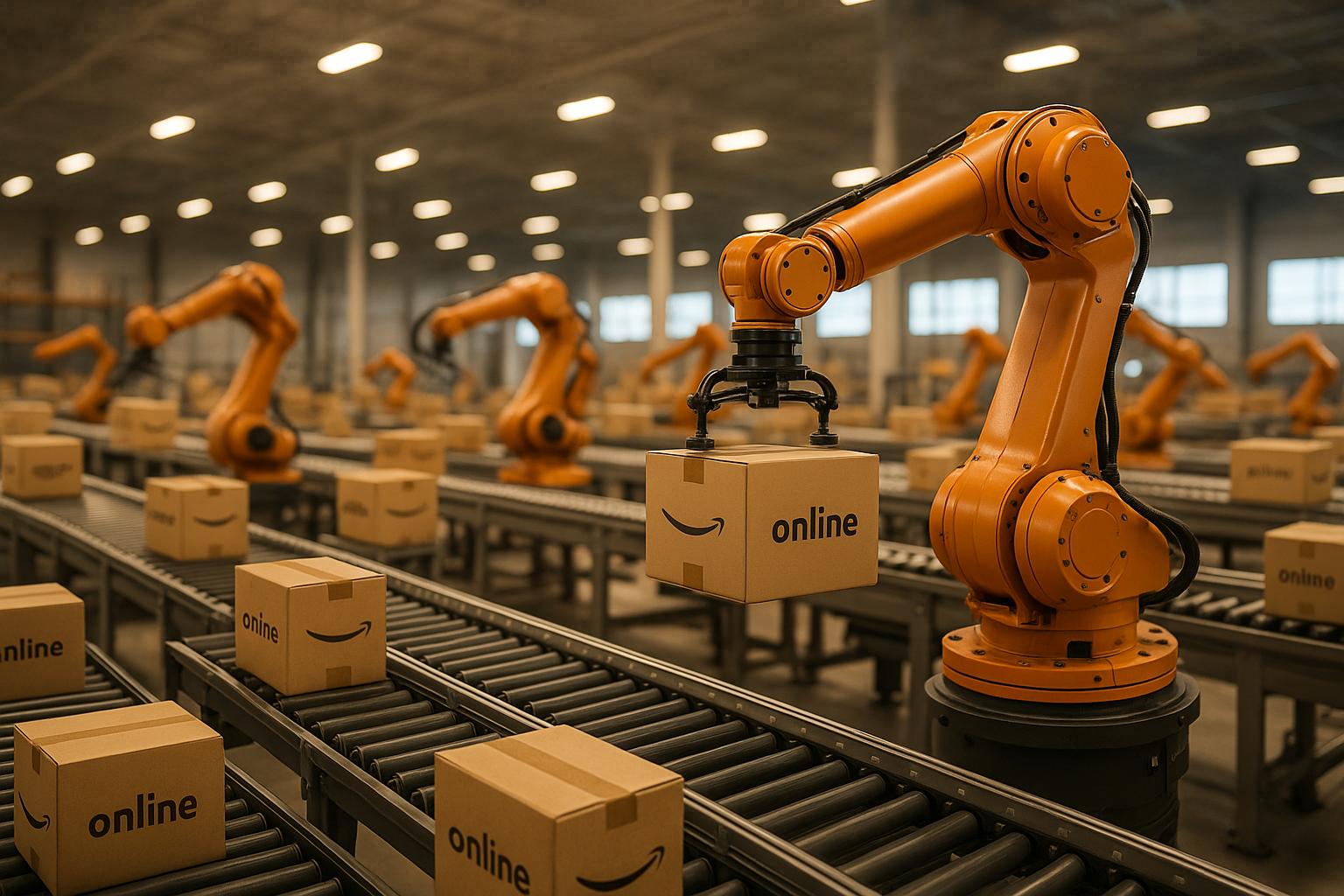
Automation has reshaped e-commerce fulfillment, making it faster, more accurate, and cost-efficient. Here's what you need to know:
- Market Growth: The e-commerce fulfillment market was valued at $124.8 billion in 2024 and is projected to exceed $272 billion by 2030.
- Adoption: 54% of companies now use automation in warehouses. Tools like autonomous mobile robots (AMRs) boost productivity by 2–3x.
- Customer Expectations: 79% of consumers expect same-day shipping. Automation helps meet these demands by reducing processing times and errors.
- Financial Impact: Companies like Kookaburra cut labor dependency by 65% and reduced costs per order by 470%.
- Key Technologies: Goods-to-person systems, robotic sorters, automated packing, and robotic process automation (RPA) are driving efficiency.
Automation isn’t just for large corporations. Businesses of all sizes can benefit from faster processes, fewer errors, and reduced costs. With careful planning, the right tools, and funding options like revenue-based financing, automation can transform your fulfillment operations.
What is Fulfillment Automation
Defining Fulfillment Automation
Fulfillment automation refers to systems that combine software and hardware to manage key tasks in e-commerce warehouses - like picking, sorting, packing, and inventory management - without constant human oversight. These systems streamline operations, cut down on manual labor, and help reduce errors in processing customer orders[4]. The result? Faster workflows and improved accuracy.
"Automated order fulfillment is akin to having a well-oiled machine power your ecommerce business - each cog, from inventory to shipping, works in harmony." - Shopify[4]
Modern automation tools offer real-time inventory updates, automate order processing across multiple platforms, and simplify returns management[4]. By linking e-commerce platforms directly to warehouse management software and physical tools like robotic sorters or automated storage systems, businesses can keep up with the growing demands of online shoppers. It’s not just about moving faster; it’s about meeting customer expectations with precision.
Why E-Commerce Businesses Need Automation
The rise in customer expectations has made automation a necessity for e-commerce businesses. For instance, 79% of consumers now expect same-day shipping options[1]. Falling short of these expectations can have serious consequences, with poor delivery experiences leading to an 87% drop in customer loyalty[6].
Automation helps businesses handle higher order volumes without a proportional increase in labor costs or mistakes. Take Amazon, for example: in 2020, 54% of its total sales came through its automated Fulfillment by Amazon (FBA) service[7]. Not only does FBA streamline operations, but it also cuts shipping costs by 70% per unit compared to other premium carriers in the U.S.[5].
"Automation has become a transformative force across various industries, and the e-commerce sector is no exception." - David Wilson[7]
Automated systems also provide real-time data on inventory, orders, and shipping, enabling smarter decisions and preventing stockouts[3]. By eliminating repetitive manual tasks, businesses can redirect their workforce toward more strategic roles, like enhancing customer service or refining long-term strategies. However, achieving these benefits requires careful preparation and planning.
Requirements for Implementing Fulfillment Automation
To unlock the full potential of fulfillment automation, businesses need a well-thought-out implementation strategy. A successful rollout starts with software that integrates seamlessly with existing e-commerce platforms like Shopify, Amazon, BigCommerce, or WooCommerce[4].
Before introducing automation equipment, warehouses need to optimize their layouts. Adequate space is essential for robotic systems, automated storage units, and supporting infrastructure. This often means reconfiguring existing setups to accommodate new workflows.
The fulfillment software itself should include features like real-time inventory tracking, automatic order synchronization, and algorithm-driven shipping solutions that select the most efficient carrier for each order[4]. Seamless communication between this software and your warehouse management system (WMS) is critical to ensure smooth, real-time coordination.
Financial planning is another key consideration. Initial investments can be significant, starting at around $500,000 depending on the scale and technology chosen[10]. For example, a single robotic arm may cost between $50,000 and $80,000, with additional components potentially pushing the total cost above $150,000[10].
Businesses should also prioritize scalability and flexibility when selecting automation tools. The system you choose needs to grow with your business and adapt to changing demands[9]. Look for solutions that can expand capacity without requiring major infrastructure overhauls.
Finally, preparing your team is essential. Employees need training to operate new systems effectively. A phased implementation approach often works best: start small with a pilot system to test its effectiveness, then gradually scale up[8]. This method reduces risks and disruptions while providing valuable insights for future expansions.
To ensure long-term success, data tracking should be built into your automation strategy from day one. Systems that monitor performance, identify bottlenecks, and offer actionable insights are crucial for optimizing operations and proving the return on your investment.
AutoStore | Inside Best Buy’s Fulfillment Machine: 50M Shoppers. 1-Day Delivery. 0 Time Wasted.
Core Technologies That Power Fulfillment Automation
The warehouse automation market is on track to hit nearly $60 billion by 2027, driven by the integration of advanced technologies that enable fast, efficient fulfillment operations[11].
Goods-to-Person Systems
Goods-to-person (GTP) systems revolutionize how items are picked in warehouses by using robotic shuttles and automated storage units to deliver products directly to picking stations.
Traditional picking methods split time inefficiently - about 60% walking and 40% actual picking. In contrast, GTP systems allow workers to focus entirely on picking, boosting productivity by 150% and enabling over 400 lines per hour compared to the manual rate of 50–100 lines per hour[14]. These systems also make smart use of space with dense vertical storage, improving utilization by 60–85%[12]. On top of that, the robots used in these systems are incredibly efficient, reaching speeds of up to 12 mph while maintaining an impressive order accuracy rate of over 99.9%[12].
For example, an e-commerce warehouse preparing for a 50% surge in holiday orders can easily scale up by adding more robots to its Exotec Skypod® system. These robots prioritize urgent orders, adjust workflows in real time, and seamlessly scale back once the rush is over - all without disrupting overall operations[13]. Meanwhile, automation in sorting and packing continues to enhance fulfillment efficiency.
Robotic Sorters and Automated Packing
Robotic sortation systems tackle the challenging task of organizing products with multiple SKUs and routing them to their correct destinations. Using tools like conveyor belts, cross-belt sorters, and tilt-tray sorters, these systems efficiently move products through fulfillment centers[11].
These systems scan barcodes and rely on algorithms to determine the best path for each item, processing thousands of items per hour with high accuracy. This is especially useful for businesses managing a wide array of products, as it allows for simultaneous sorting of items of different sizes, weights, and destinations.
Automated packing systems complement sorting by speeding up order preparation and reducing errors. They can select the right box size, add protective materials, and even print shipping labels automatically[15]. Together, robotic sorting and automated packing significantly cut down the time from order placement to shipment. These systems also integrate with warehouse management software, inventory tracking tools, and shipping carriers, creating a unified workflow. Real-time data from these tools helps optimize inventory placement and predict peak processing times.
Robotic Process Automation in Order Management
Robotic Process Automation (RPA) focuses on streamlining the digital aspects of fulfillment by automating repetitive tasks like data entry, order updates, and inventory synchronization across various systems[17].
RPA uses software "bots" that mimic human actions within existing applications. These bots can log into systems, extract and update data, and trigger actions based on preset rules. For example, they can automate order processing across platforms like Amazon, Shopify, and WooCommerce, while ensuring real-time inventory updates.
The combination of RPA with AI and Machine Learning is accelerating growth in this area. Experts predict a compound annual growth rate of over 26.8% for AI in global warehousing between 2024 and 2032[11]. One fashion designer successfully implemented RPA to improve accuracy in tasks like forecasting, reporting, and order processing. This reduced manual errors and sped up routine operations, freeing employees to focus on customer service and strategic initiatives[16].
Implementing RPA typically involves identifying repetitive tasks, mapping workflows, creating automation scripts, and integrating them with existing systems. The Industrial Internet of Things (IIoT) further enhances RPA by connecting physical devices with automation systems. Sensors collect real-time data on inventory, equipment performance, and workflow bottlenecks, enabling immediate corrective actions[11].
These technologies, when combined, create a powerful automation framework that is transforming modern e-commerce fulfillment.
How to Add Automation to Your Fulfillment Process
Automation technologies have revolutionized many industries, and fulfillment is no exception. To integrate automation effectively, you need a step-by-step plan that minimizes disruptions and maximizes the benefits. A gradual, well-thought-out approach ensures your team and systems are ready for each stage of the transition.
Evaluate Your Current Fulfillment Operations
Before diving into automation, take a close look at your current fulfillment process. Map out every step - from receiving an order to shipping it - to identify inefficiencies and establish baseline metrics like order accuracy and time-to-ship [4]. Track how long each stage takes, where delays occur, and the sources of errors. This detailed analysis will help you pinpoint which areas to automate first. Instead of vague goals like "improving efficiency", focus on measurable objectives, such as cutting shipping times or increasing order accuracy.
Choose and Test Automation Solutions
Finding the right automation tools means aligning them with your specific business needs. Whether you handle global shipping, offer custom packaging, or manage complex returns, your chosen solution should integrate seamlessly with your existing systems, provide real-time data, and scale with your business [18]. Look for features like real-time order tracking, a reliable Warehouse Management System (WMS), and automation tools for tasks like packing and returns processing.
Testing is a crucial step. Start with small-scale pilot programs on platforms like Shopify, WooCommerce, BigCommerce, or Amazon. These tests will help you confirm that the new system integrates smoothly and can handle your typical order volumes - even during peak times. Once you're confident in the system's performance, decide whether to keep fulfillment in-house or partner with a third-party logistics provider (3PL). Many 3PLs offer advanced automated solutions, which can simplify operations and enhance efficiency without requiring you to manage an automated warehouse [18].
Prepare Staff and Refine Workflows
Automation isn't just about technology - it’s also about people. Once you've chosen your tools, involve your team in refining workflows to ensure the system fits your operations. Your staff’s insights are invaluable for avoiding the automation of inefficient processes [19]. Provide thorough training so employees understand how to use the new tools and when to step in if something goes wrong. Clearly outline which tasks are automated and which require human attention to prevent confusion.
It's important to emphasize that automation is not about replacing jobs. Instead, it’s about freeing up your team to focus on more complex tasks and exceptions. Encourage employees to suggest additional tasks that could be automated, fostering a collaborative environment.
Pilot testing the updated workflows is essential to ensure everything runs smoothly. Keep a close eye on processes during the initial rollout - monitor order flows, notifications, and inventory updates. Set up alerts to catch any failures or unusual patterns early. As Keith Gorney, head of supply chain at Pivotree, explains:
"If we are able to monitor order statuses through the workflow, we can identify anomalies based on the amount of time an order sits in a status and react to any delays - both systemic and process driven." [19]
As your business grows and changes, revisit and tweak your automation rules to keep everything running efficiently. This approach not only ensures your investment pays off but also helps you maintain the high level of service your customers expect.
sbb-itb-d7b5115
Real Examples of Fulfillment Automation Success
Automation is changing the game for e-commerce businesses, solving issues like slow processing, frequent errors, and rising labor costs. These real-world examples show how companies have successfully implemented automation to tackle these challenges, offering a clear picture of its transformative effects.
Clothing Company Achieves Same-Day Shipping
NPFulfilment faced a massive jump in orders during Black Friday, surging from 12,000 to 40,000. Despite the spike, they upheld their same-day shipping promise by adopting Sure Sort's iBOT system. This goods-to-person technology handled the increased demand efficiently - without requiring a major workforce expansion [2].
Another success story comes from Kookaburra, a clothing retailer that also embraced Sure Sort technology. Their results were striking: a 65% reduction in labor dependency and a 470% decrease in total cost per order [2].
Online Retailer Boosts Order Accuracy with RPA
For a multinational medical supply company, manual processes were causing errors and driving up labor costs. By introducing Matthews' Warehouse Execution System (WES), which automates tasks like inventory tracking, order processing, and quality control, the company achieved remarkable results: order accuracy soared to 99.9%, and labor costs dropped by 75% [20].
Multi-Product Store Manages Inventory with Robotic Sorters
Electronics retailer Newegg needed to speed up its fulfillment operations while maintaining accuracy. They turned to OPEX's Perfect Pick system, which slashed their cycle time to just 20 minutes [2].
Similarly, a leading e-grocery company saw a fivefold increase in throughput after implementing Matthews Automation's warehouse execution system [20].
"Automated fulfillment systems revolutionize how businesses manage orders by integrating advanced technologies across inventory, order processing, and shipping with minimal human input." [2]
These examples demonstrate how targeted automation investments can transform fulfillment operations, offering a blueprint for e-commerce businesses looking to optimize their processes.
Solving Funding Challenges for Automation Projects
While automation offers clear advantages, many e-commerce businesses struggle to secure the funding needed to kickstart these transformative projects.
Common Funding Barriers in Automation
The high upfront costs of automation can be daunting. Technologies like robotic sorters, goods-to-person systems, and warehouse execution solutions often demand hefty initial investments, which can strain even the most well-planned budgets.
Adding to the challenge are seasonal revenue fluctuations and concerns about risk. Business owners worry about potential disruptions, technical failures, and the steep learning curve that often accompanies new systems. These fears become even more pressing when significant financial investments are on the line.
Traditional funding options, such as bank loans or venture capital, often fall short for automation projects. Bank loans typically require collateral and personal guarantees, while venture capital can mean giving up equity and enduring drawn-out approval processes. This leaves many e-commerce businesses stuck between the need to innovate and the financial limitations they face.
To move forward, businesses need funding solutions that address these unique challenges.
How Onramp Funds Supports Automation Efforts
New financing options are helping e-commerce businesses overcome these hurdles. Onramp Funds provides fast, equity-free, revenue-based financing tailored specifically for automation projects. This model is designed to meet the unique needs of online retailers.
With Onramp Funds, businesses can access capital within 24 hours, enabling them to act quickly on automation opportunities. Unlike traditional bank loans, which can take months to process, this rapid funding ensures businesses can implement solutions when market conditions are favorable.
The platform's integration with major e-commerce platforms - including Amazon, Shopify, BigCommerce, WooCommerce, Squarespace, Walmart Marketplace, and TikTok Shop - simplifies the application process. By assessing real-time sales data, Onramp Funds bases funding decisions on actual performance rather than traditional credit metrics.
Repayment is flexible and adjusts according to sales performance. During slower sales periods, repayment amounts decrease, easing financial strain. Conversely, during peak seasons, repayments increase in line with revenue, ensuring the repayment plan remains manageable and aligned with business cycles.
Why Revenue-Based Financing Fits E-Commerce
Revenue-based financing is particularly well-suited for e-commerce automation because it adapts to the seasonal nature of online businesses. When revenues dip, repayment amounts decrease, offering financial breathing room. During high-revenue periods, repayments scale up, making it easier to meet obligations without stress.
Another major advantage is that this type of financing is non-dilutive. Unlike venture capital, which often requires giving up equity and decision-making control, revenue-based financing allows business owners to maintain full ownership while securing the funds needed for automation.
The process is also relatively quick. Deals typically close within 4–8 weeks, allowing businesses to implement automation solutions promptly and gain a competitive edge.
As Mike McCracken, Chairman and Co-Founder of McCracken, puts it:
"Revenue-based financing is quietly becoming the go-to capital strategy for founders and CFOs who want to scale without sacrificing ownership or taking on rigid debt." [21]
For e-commerce businesses generating at least $10,000 in monthly sales, this approach offers a practical way to fund automation. With transparent fees - usually ranging from 2–8% - and repayment terms tied to revenue cycles, this financing model provides a predictable and scalable solution for automation investments.
Conclusion: Building Your Automated Fulfillment Future
Automation is transforming e-commerce fulfillment at an incredible pace. With the market projected to grow from $124.8 billion in 2024 to over $272 billion by 2030 [1], businesses that embrace these changes early are positioning themselves for long-term success.
To thrive, start with a structured approach. Keep a close eye on metrics like shipping speed and order accuracy to identify areas for improvement. Opt for scalable automation tools that integrate seamlessly into your operations - think software with real-time inventory tracking, automatic order syncing, and smart shipping algorithms.
Zvika Alon, COO of Edikted, shared in January 2023:
"We are Shopify-based, so the technical integration with Ryder was seamless and straightforward. The onboarding process was very professional, and we saw how much of management's attention went into it." [22]
Invest in advanced warehouse management systems and train your team to get the most out of automation. Autonomous mobile robots, for instance, can double or even triple picking productivity while reducing physical strain on workers [1].
Once you've identified the right technology, secure the funding to bring your plans to life. Revenue-based financing options like Onramp Funds can provide quick, equity-free capital - often within 24 hours - tailored to your sales. Businesses generating $10,000 or more in monthly revenue can access this funding without the usual hurdles.
As you implement automation, continuously track key performance indicators and refine your systems based on data. This agility is crucial in a market where 79% of consumers expect same-day shipping, and nearly 87% of decision-makers are planning warehouse expansions [1].
Automation is reshaping fulfillment, and the time to act is now. Start by auditing your current processes, exploring funding options, and integrating the right solutions to stay ahead in this rapidly evolving landscape.
FAQs
What are the first steps to automate e-commerce fulfillment successfully?
To kick off automating your e-commerce fulfillment, start by evaluating your current workflow to pinpoint any bottlenecks or areas that slow things down. This step helps you understand where improvements are needed most. After that, set clear goals - whether you're aiming to speed up order processing, lower costs, or boost accuracy.
With your objectives in place, establish a budget and focus on automating tasks that will make the biggest difference. Key areas to consider include inventory management, order processing, picking, packing, and shipping. Taking a gradual approach to implementation lets you test and fine-tune each step without disrupting your entire operation.
How is revenue-based financing better suited for funding e-commerce automation projects compared to traditional loans?
Revenue-based financing (RBF) provides a repayment model that shifts with your monthly revenue, unlike traditional loans that demand fixed payments no matter how your sales are performing. This setup is particularly helpful for e-commerce businesses investing in automation, as it ties payment obligations to cash flow, easing the pressure during slower sales periods.
By choosing RBF, you can concentrate on expanding your business - like upgrading your fulfillment processes with automation - without being burdened by inflexible repayment terms. It allows you to focus on growth while keeping your cash flow under control.
What challenges do small to medium-sized e-commerce businesses face when adopting automation, and how can they overcome them?
Small and medium-sized e-commerce businesses often face hurdles when trying to adopt automation. These can include high initial costs, a lack of technical know-how, and fears about losing the personal connection with customers. On top of that, managing and syncing data across multiple systems can get pretty complicated.
One way to tackle these issues is to take small steps. Start with easy-to-use automation tools that don’t require deep technical skills. Rolling out automation gradually gives teams time to adjust, and training employees ensures they’re comfortable with the new systems. It’s also important to use automation to improve customer interactions rather than replace them, striking a balance between streamlined processes and maintaining that personal touch.
Related Blog Posts
Onramp Funds
Funding built around your sales
Connect your store and see what you qualify for. Repay as a percentage of sales, with no personal credit check.
Funding in as little as 24 hours.
